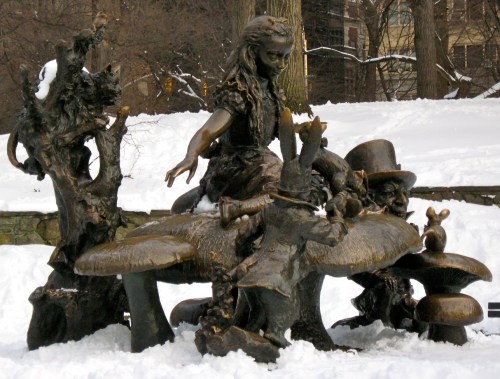
There are two kinds of people: those who follow and those who don’t. Of followers, there are two kinds: those who stay put, and those who go somewhere. Of followers who go somewhere, there are two kinds: those who are led and those who are pushed, the latter including those who fall in holes whether pushed or not (go ask Alice). Of followers who stay put, there are two kinds: those who stay in a place, and those who stay in a particular frame of mind.
Of those who do not follow, there are three kinds: poets, prophets, and migrants. Of poets, it is said that they show us who we are. Of prophets, it is said that they show us who we should be. Of migrants, it is said they show us where to go next.
Poets, prophets, and migrants are called. They do not choose who they are, and mistakes can be made when callings are crossed, whether by the one who is called or by those doing the calling. When poets are mistaken for prophets, everyone is deceived. Cults are formed and lives are wasted.
There’s a whole lot of people in trouble tonight from the disease of conceit
Whole lot of people seeing double tonight from the disease of conceit
Give you delusions of grandeur and an evil eye
Give you the idea that you’re too good to die
Then they bury you from your head to your feet
From the disease of conceit.
Bob Dylan, “Disease of Conceit”
Prophets are rarely mistaken for poets, but when they are, they are generally neither and the poetry is awful. Though it is nearly impossible for a poet to be a prophet, either might be a migrant, whether on land, in dreams, or of the mind.
Leadership is an attribute given by those who follow to someone else, who may or not be the kind of person who follows. The truth is—leadership has nothing to do with being a follower or not. In the end, perhaps there really are only two kinds of people: those who do well when type-cast, and those who only begin to thrive when cast against type.
Notes and Credits
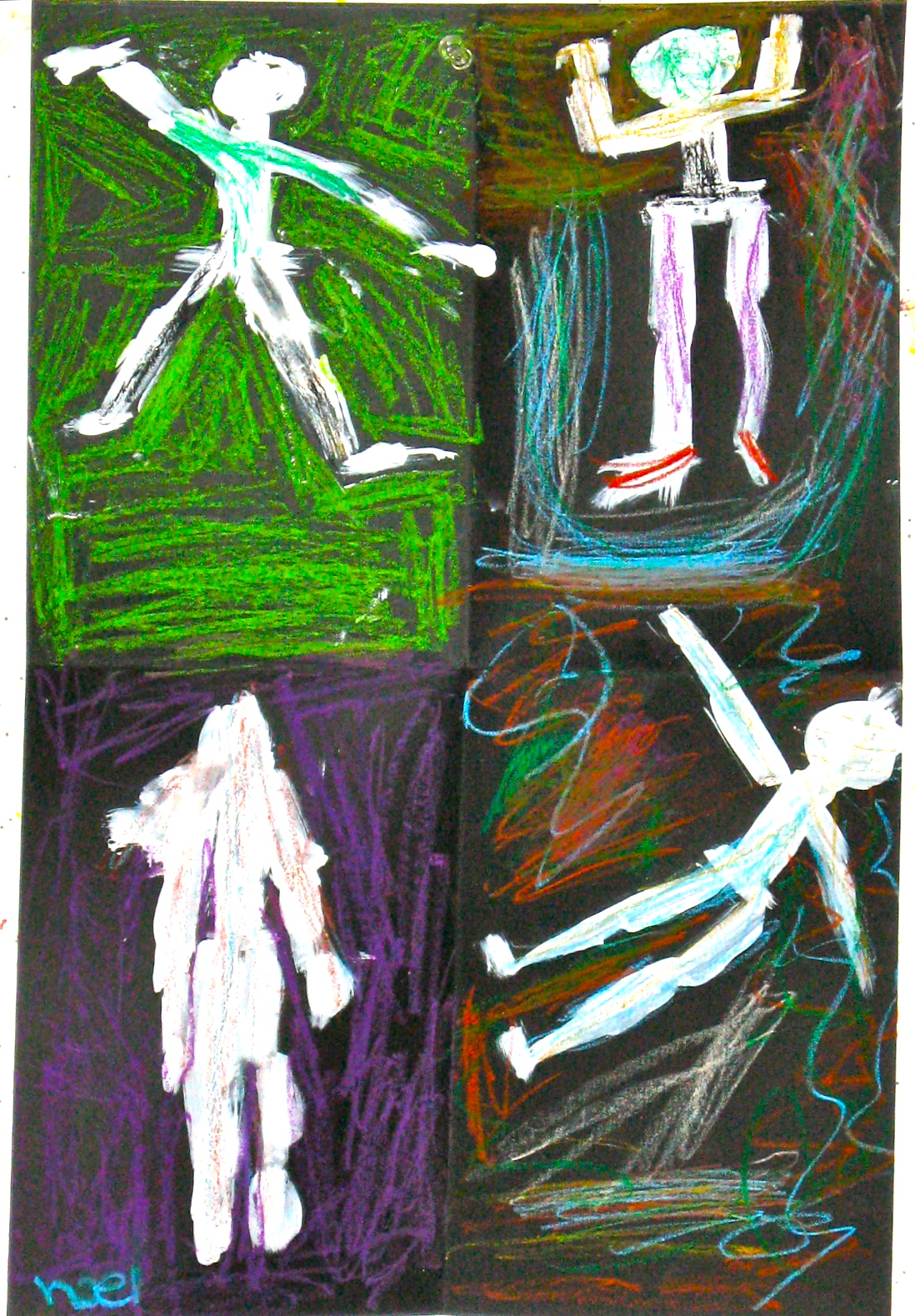
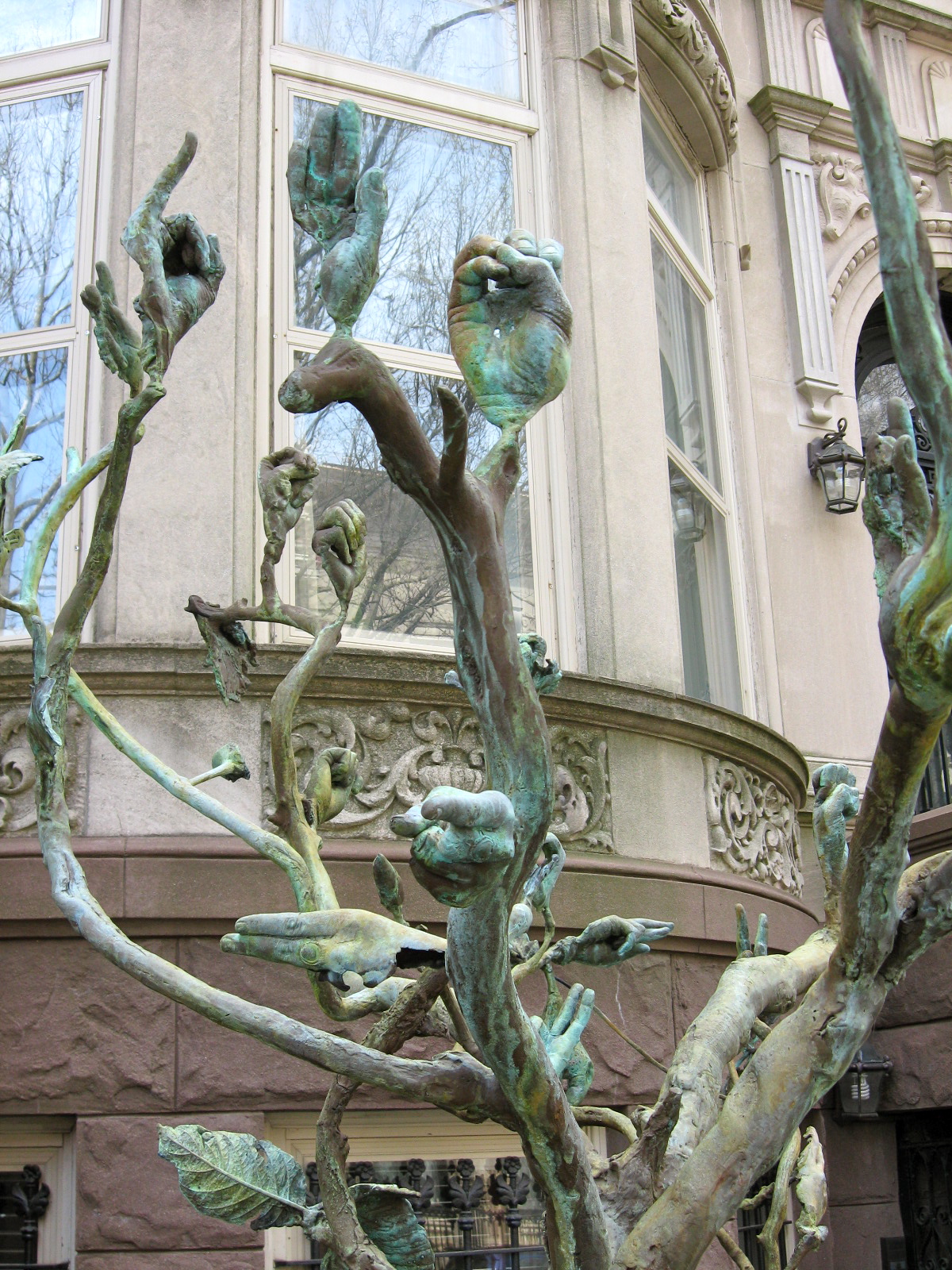
The photos were all taken by the author in the neighborhood of Park Slope, Brooklyn, in 2008, 2009, and 2010. The first is a photo of an art project my son did in the first grade (2009), drawing the human form. The second is the tunnel at the northwestern entrance of Prospect Park. The third is a garden scultpure in front of a house on 2nd Street, near the corner with Prospect Park West.
Bob Dylan was called to be a poet, but the people who loved him wanted him to be a prophet. It cost him, and some of those loved him, twenty years. After years of reflection, Dylan wrote that by the mid-1980s “[e]verything was smashed. My own songs had become strangers to me. I didn’t have the skill to touch their raw nerves, couldn’t penetrate the surfaces. It wasn’t my moment of history any more. I couldn’t wait to retire and fold the tent”—Chronicles, Vol. One (Simon and Schuster, 2004), p. 148.
Dylan wrote “Disease of Conceit,” in 1987 as he began to explore a new musical identity more aligned with his own sense of self and his mission as an artist. The song would be the eighth track on Oh Mercy, the album that set him on the path to redeeming his career with a whole new audience by the mid-1990s. In the fall of 1989, I saw him perform at Hill Auditorium on the University of Michigan Campus in Ann Arbor. It was the third show of his I had seen at that point in my life and by far the best. Toward the end of the show – as either the closing song or the last encore – he brought down the house with “Disease of Conceit.” The poetry was breathtaking.
As for those who fall down holes …
Alice on the toad-stool, Central Park, New York, December 20, 2009
“… let no mournful yesterdays
disturb thy peaceful heart.”
Ellen M. Huntington Gates, “Sleep Sweet”
“Of the making of many books there is no end,
and in much study there is weariness for the flesh.”
Ecclesiastes 12:12
When the glass is empty the writer searches, at times desperately, for some truth or experience to put on the page. The writer writes to make life real. It is an alchemy that turns nothing into something. Without writing, the writer is hollow, small, almost nothing.
When the glass is full the writer becomes like a god, though not so much a god of creation as one who reorders worlds that already exist. The writer recreates what he or she has known in order to say something about it. At the end of the day, it is a gratifying act.
Reverie
In 1967, Gloria Steinem interviewed Truman Capote for an article that was published in McCall’s. It was a candid interview. She asked him how he would like to be described as a writer and as a person—adding “without false modesty,” just in case. Capote replied with grace and clarity.
“As a writer, that I’m a good artist, a serious craftsman; that my writing gives pleasure in itself, regardless of what I’m writing about. I spend a great deal of time with that object in mind. Because to me, the greatest pleasure of writing is not what it’s about, but the inner music that words make.”
Early in his career, Capote was praised for the beauty of his sentences. His prose was impeccable and his writing almost alone brought him into social circumstances the likes of which he never could have dreamed as the model for Dill in Harper Lee’s To Kill a Mockingbird, a lonely child of divorce in a small Alabama town.
But Capote flew too close to sun. In a terrific irony—the exception that proves the rule, it seems—Capote’s downfall came when he tried to write what he (thought he) knew. The serialized chapters of his long-awaited novel, Answered Prayers, hewed too closely to the real lives of his New York socialite crowd. Scandalized, Capote’s supposed friends abandoned him and he learned how far, indeed, Monroeville, Alabama, was from New York’s Upper East Side.
Capote had abandoned the “inner music” of his words for a cloying attempt that was less writing what he knew than writing what he both coveted and hated. Such is vanity.
Vanity
To write is to be like a god, one of those fundamental acts of hubris that always results in a fall, whether in the Garden of Eden or Greek mythology. The “inner music” of Capotean reverie was to Franz Kafka a siren call to vanity and self-worship through the admiration of others. To his close friend and ally, Max Brod, Kafka wrote in 1922—
“Writing is a sweet and wonderful reward, but a reward for what? Last night it was as clear to me as the catechism learned in childhood that it is a reward for devil worship. This descent to the powers of darkness, the dubious embraces, and all the other things that doubtless occur down below and which we know nothing about up here when we write our stories in the sunshine. Perhaps there are other kinds of writing, this is only one I know…”
The writer was oblivious to this affliction, mindlessly scribbling away beneath a penumbra of vanity that surrounded the sun itself. Like sex, writing was at once a sensual and gratifying pact with the devil that was utterly essential to living experience—and at the same time, an act that obscured and defamed the very essence of love itself.
“It is the vanity and the hedonism, which flutter around and around either one’s own or another’s form in a ceaseless search for pleasure until in the end, by this constant repetition, a whole planetary system of vanity is created.”
Kafka’s life was filled with deep and vital relationships, with both women and men. His Madonna-whore complex notwithstanding, he knew how to connect with others, recoiling only from those women he thought of marrying. Writing was Kafka’s only salvation, the only thing that made him seem real to himself.
As a writer, however, Kafka was a failure in his own estimation. His work remains for us mainly because his close friend and literary executor, Max Brod, famously chose to ignore to Kafka’s request to destroy all the remaining manuscripts, which included his novels The Trial, The Castle, and Amerika.
Prayer, a writerly cup
The photo of the cup of tea at the beginning of this post was given to me by a friend, Maghan Lusk. She is from South Carolina. In 2008-09, she wrote a blog called “[a creative writer’s] life, uncensored.” On the blog, she wrote about writing, managing seamlessly to intersperse her own experiences with topical matter. Her writing and point of view suggested a very thoughtful person who took the time to understand why people were doing what they did, rather than judging them and tossing off opinions.
In 2009, she shut down her blog to work on her first novel, which she has now completed. Of her desk and cup she wrote—
“When I sit down to write, I make a pot of Ceylon orange pekoe (2 tbsp of loose tea, 1 tbsp of lemon curd, 1 tbsp of honey). And I warm the pot before I add the boiling water – it’s a highly methodical process. I like the color, so I always drink from a glass tea cup. The pot in the back belonged to my mom before she married my dad (27 years ago).”
Before Maghan turned the pot to the support of her writer’s craft, her mother used it to warm the water she soaked her feet with. Behind the pot, on the edge of the chest-of-drawers, is a framed poem, “Sleep Sweet,” by Ellen M. Huntington Gates.
The desk itself is piled high with the artifacts of Maghan’s life and work. In the stack of books are admired pieces, atop which sits Marilynne Robinson’s Gilead, the much-celebrated novel set in Iowa, in which the Rev. John Ames writes out a family history for his young son. The Reverend’s wife calculated that all the sermons he had written across his life of preaching would come to 67,500 pages of prose, or 225 books by the Rev.’s own calculation, “which puts me up there with Augustine and Calvin for quantity.” In Robinson’s prose, Rev. Ames takes us to a place in writing so much finer and wonderful than Kafka’s, less self-involved than Capote’s, more human and more in touch with the real reasons we write—to reach out to someone else.
“For me writing has always felt like praying, even when I wasn’t writing prayers, as I was often enough. You feel that you are with someone. I feel that I am with you now, whatever that can mean …”
Feeding the Wolves
There is a famous Cherokee fable that goes like this.
An elder Cherokee was teaching his grandchildren about life. He said to them, “A fight is going on inside me. It is a terrible fight and it is between two wolves. One wolf represents fear, anger, envy, sorrow, regret, greed, arrogance, self-pity, guilt, resentment, inferiority, lies, false pride, superiority, and ego. The other stands for joy, peace, love, hope, sharing, serenity, humility, kindness, benevolence, friendship, empathy, generosity, truth, compassion, and faith. This same fight is going on inside you, and inside every other person, too.”
The children thought about it for a minute and then one child asked his grandfather, “Which wolf will win?”
The old Cherokee simply replied, “The one you feed.”
Capote fed both wolves, with his life and with his words. He was as destroyed by writing as he was acclaimed for it. The same thing happened to Hemingway. Kafka—and possibly Faulkner—fed the wolves with words alone, leaving their lives to become shambles of unrequited desire.
Sylvia Plath fed both wolves. She fed them with her words and her flesh. She married a man, Ted Hughes, who believed that a writer had the duty to live beyond all morality, to use his or her own life to build the experiences that would come to life in words.
To be an artist is a dangerous thing. It is a special role, a special calling that cannot be resisted. From the beginning of time—Lascaux to the Bible to Pynchon and Picasso and Joe Strummer—artists have helped us know who we are and how we live. Some of them handle the role better than others.
Notes and Credits
I owe thanks to Maghan Lusk for sharing her photos and story for this posting, as well as for insightful correspondence over issues of writing, spirituality, and living in the Deep South over the last year or so.
Capote’s interview was by Gloria Steinem, “‘Go Right Ahead and Ask Me Anything.’ (And So She Did) An Interview with Truman Capote.” McCall’s 95 (November 1967), 76-77, 148-52, 154.
Kafka from: Letter to Max Brod, July 5, 1922, in Franz Kafka, I Am a Memory Come Alive: Autobiographical Writings, ed. N Glatzer (New York: Schocken, 1974), p. 223. An interesting source for Kafka information (though not the only one I used, of course) and condominiums in Miami can be found here.
Gilead quotation: p. 19 of the Picador, 2004, edition.
The Cherokee fable of the two wolves is widely known. The version posted here was taken from a website called “First People, The Legends.” The story is the much the same in its various posting around the Web.
The photographs of books were taken by the author, on his own desk. Disclosure: I have not read Gilead, but I will do so shortly. I have not read In Cold Blood, but I saw the movie with Robert Blake a long time ago on late-night tv. I have not seen the movies of Capote’s life, neither Toby Jones’s nor Philip Seymour Hoffman’s. The copy of In Cold Blood in the photograph was found on the sidewalk in Park Slope one day. I have read much of Kafka’s writing—novels, stories, and letters, and I saw the movie.
The truth is that money is often a divisive influence in our lives. We keep our bank balances secret because we worry that being candid about our finances will expose us to judgment or ridicule—or worse, to accusations of greed or immorality. And this worry is not unfounded.
Jenny Offill and Elissa Schappell, Money Changes Everything (New York: Doubleday, 2007), p. xi
Brooklyn Reading Works:
The Truth and Money
On April 15, 2010, the Brooklyn Reading Works will present its monthly writers’ program on “tax day.” This happy accident, observed last summer in a casual conversation over coffee with Louise Crawford, resulted in the idea for a panel called “The Truth and Money,” a reading and Q & A with three authors whose work has taken on money in some significant way.
Our three panelists are:
Elissa Schappell, a Park Slope writer, the editor of “Hot Type” (the books column) forVanity Fair, and Editor-at-large of the literary magazine Tin House.With Jenny Offill, Schappell edited Money Changes Everything, in which twenty-two writers reflect on the troublesome and joyful things that go along with acquiring, having, spending, and lacking money.
Jennifer Michael Hecht, a best-selling writer and poet whose work crosses fields of history, philosophy, and religious studies. In The Happiness Myth, she looks at what’s not making us happy today, why we thought it would, and what these things really do for us instead. Money—like so many things, it turns out—solves one problem only to beget others, to the extent that we spend a great deal of money today trying to replace the things that, in Hecht’s formulation, “money stole from us.”
Jason Kersten, a Park Slope writer who lives 200 feet from our venue and whose award-winning journalism has appeared in Rolling Stone, Men’s Journal, and Maxim. In The Art of Making Money, Kersten traces the riveting, rollicking, roller coaster journey of a young man from Chicago who escaped poverty, for a while at least, after being apprenticed into counterfeiting by an Old World Master.
Please join us for the event at 8:00 p.m. on Thursday, April 15, 2010, at the Old Stone House in Washington Park, which is located on 5th Avenue in Park Slope, between 3rd and 4th Streets, behind the playground.
Many thanks from all of us at Truth and Rocket Science to Louise Crawford, of Only the Blog Knows Brooklyn, for making this possible.
Money, It’s a Gas
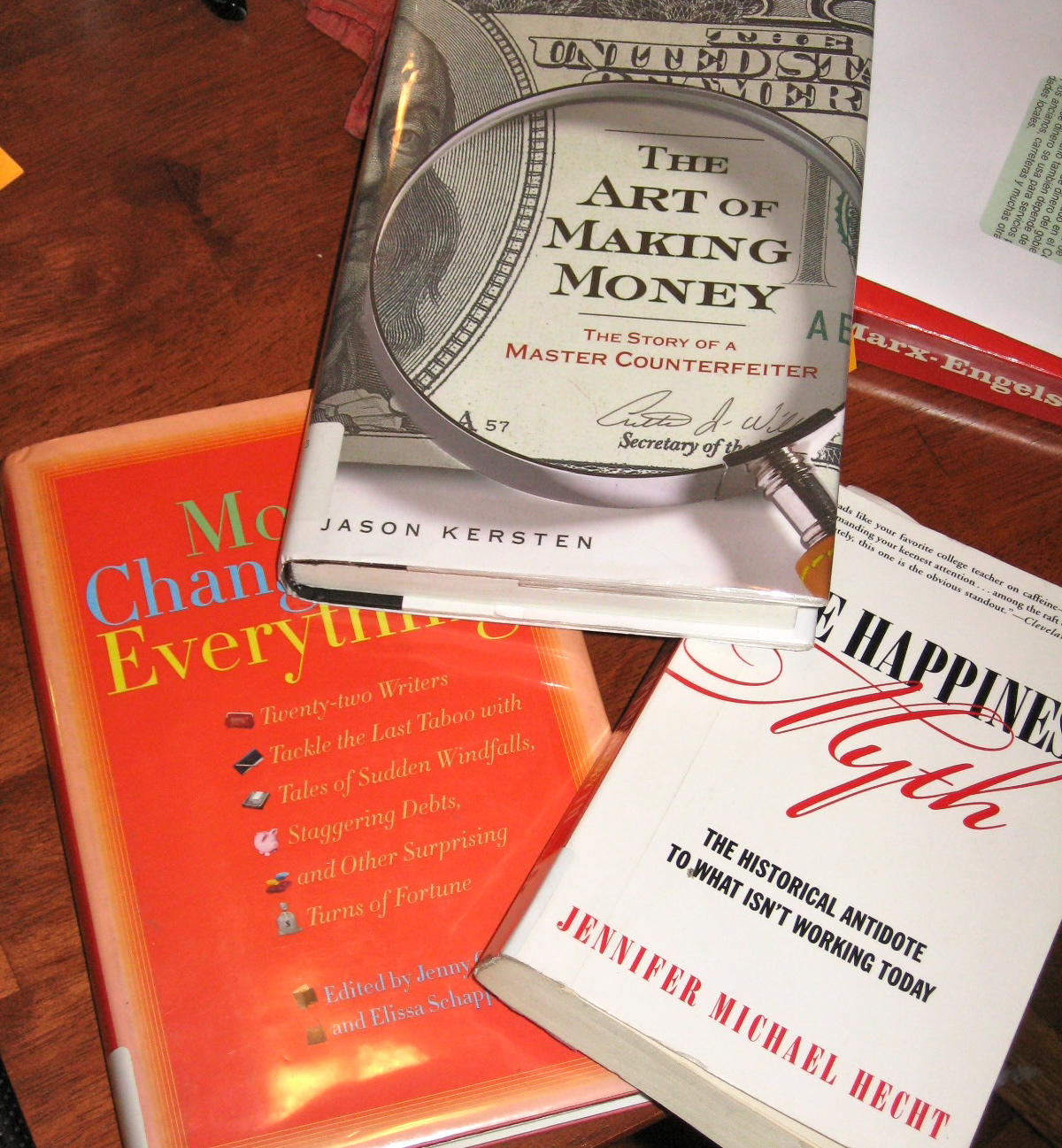
The subtitle on the cover of Elissa Schappell’s book says everything you need to know about the stories within: Twenty-two writers tackle the last taboo with tales of sudden windfalls, staggering debts, and other surprising turns of fortune. “The last taboo” is how Schappell and her co-editor, Jenny Offill, characterize our behavior when it comes to money, because nobody really wants to talk about it.
People are secretive and embarrassed—for having too little, or too much, or something to hide about the reasons either way. In a country where everyone seems to have a story of how they, or their parents or grandparents, used to be poor, any personal narrative but “hard work” is out of the question. Even hardened criminals revel in detailing the blood, sweat, and tears that go into their “work.” No one, it seems, can sit back and say with no embellishment or apology, “I got lucky, that’s all.” Money is the measure of what we deserve, and in our society what we deserve is in some sense who we are.
In The Happiness Myth, Jennifer Michael Hecht seeks to disentangle why things that are supposed to make us happy frequently don’t. To the notion that “money doesn’t buy happiness,” she shows that it does, to an extent. For most of human history (and pre-history), people have lived in conditions of terrible, frightening, life-threatening scarcity that money in no small part has eradicated for all but a very small fraction of Americans. (In line with Schappell’s notion of money-taboo, I now feel the urge to apologize and state something statistical about hardship and inequality in America, but I won’t. We deserve ourselves and all of our money issues.) Hecht writes,
“We need to remember that most people through history have been racked by work that was bloody-knuckled drudgery, the periodic desperate hunger of their children, and for all but the wealthiest, the additional threat of violent animals. Nowadays a lot of what we use money for is a symbolic acting-out of these triumphs.”
Once out of poverty, in other words, what we do with money—or more precisely the things we feel when using money—have a lot to do with ancient urges and inner conflicts that endure in our minds, bodies, and culture across time and without, so it seems, our self-conscious awareness of them. Money does buy happiness, up to the point we’re out of poverty, and then the real problems begin.
Like the craving for fat and things that are sweet, the urges we satisfy with money are deeply embedded in our being, fundamental to the way we evolved in the most far-away places and times. It’s all fine and easy to understand or forgive, but we all know what happens when you eat too many doughnuts.
Doughnuts to Dollars
Yet money is not like a doughnut. This we all know—money isn’t some thing, it’s just some non-thing you use to get doughnuts or whatever else you think you need. The economists’ word for this quality is fungible. Adam Smith introduced money in his great book on wealth by reviewing the things that societies have used for exchange measures over time, including cattle, sheep, salt, shells, leather hides, dried codfish, tobacco, sugar, and even “nails” in a village in Scotland that Smith knew of. All this was terribly inconvenient, and Smith noted that the use of precious metal as a stand-in for things of value constituted a considerable advance—
“If, on the contrary, instead of sheep or oxen, he had metals to give in exchange for it, he could easily proportion the quantity of the metal to the precise quantity of the commodity which he had immediate occasion for.”
Money in this sense becomes nothing but a means of measurement, and it would be perfect indeed if money’s effects on the world ended there, but we all know that they don’t.
Money—as Elissa Schappell and Jenny Offill, Cyndi Lauper and conventional wisdom tell us—changes everything. Money’s magical qualities go well beyond simple notions like greed. Money’s powers are existential, transformative, and really weird. Money makes us into things we are not. Karl Marx was pretty blunt about this—
“Money’s properties are my properties and essential powers … what I am and am capable of is by no means determined by my individuality. I am ugly, but I can buy for myself the most beautiful of women. Therefore I am not ugly, for the effect of ugliness—its deterrent power—is nullified by money. I, in my character as an individual, am lame, but money furnishes me with twenty-four feet. Therefore I am not lame. I am bad, dishonest, unscrupulous, stupid; but money is honored, and therefore so is its possessor. Money is the supreme good, therefore its possessor is good. Money, besides, saves me the trouble of being dishonest: I am therefore presumed honest. I am stupid, but money is the real mind of all things and how then should its possessor be stupid?”
Marx may have fallen short as an economist, but then again so do most official economists. In terms of money’s most basic ontological properties, however, it’s worth noting that he got money right.
The Glow
In the story of master counterfeiter Art Williams, Jason Kersten tells one such story of how money changes people, their values, and the truths that bind them together. Art’s counterfeit was of an extraordinarily high quality, and its effect on people was fascinating to behold. Art called it The Glow—“They would get this look on their face … a look of wonder, almost like they were on drugs. It was like they were imagining the possibilities of what it could do for them, and they wanted more.”
Like the anonymous subjects of history in Hecht’s writing (note: that’s us), Art wanted something that money, or the lack of it, had apparently stolen from his life. Art’s “pursuit had very little to do with money, and the roots of his downfall lay in something impossible to replicate or put a value on. As he would say himself, ‘I never got caught because of money. I got caught because of love.’”
So where does money get us? It’s easy to tell stories of money and doom, but we all know that without enough of it we’d be unable to do anything we need to do, let alone the supposedly unnecessary things that seem to make up for the drudgery of a life built upon doing the things we need to do. Is the grubbiness of money as it comes off in the Pink Floyd song all there is to it? Or is there more?
Join us on April 15, after affirming the give-away of twenty-eight percent (for most of us) of your annual harvest.
Many thanks to Louise Crawford for inviting me to curate the Tax Day BRW panel, through the Truth and Rocket Science blog. A sincere debt of gratitude, not to mention late fees, is owed to the Brooklyn Public Library, for enabling my research and inquiry into this topic. The BPL’s copies are indeed those photographed on my dining room table to lead the blog post.
Jenny Offill and Elissa Schappell, Money Changes Everything (New York: Doubleday, 2007).
Jennifer Michael Hecht, The Happiness Myth (New York: Harper One, 2007), p. 129.
Adam Smith, The Wealth of Nations, in Robert L. Heilbroner, ed., The Essential Adam Smith (New York: W. W. Norton, 1986), p. 173.
Karl Marx, Economic and Philosophic Manuscripts of 1844, in Robert C. Tucker, editor, The Marx-Engels Reader, 2nd ed. (New York: W. W. Norton, 1978), p. 103.
Jason Kersten, The Art of Making Money (New York: Gotham Books, 2009), p. 152 (first quotation) and p. 4 (second quotation).
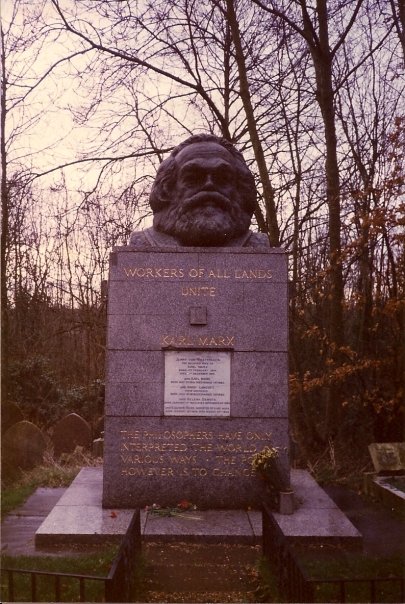
Photo Karl Marx’s grave, Highgate Cemetary, London, taken by the author in January, 1994, while on layover on the way to South Africa and its historical elections later that year.
The still photograph is not so still. The photograph asks questions. It suggests a story. It presents an idea in a language without words. It is even as it signifies. Video killed nothing, and the still photograph survives (even as the radio star carries on). Unlike video, you can take the still photograph in. You have a role in your experience of the photograph. It speaks to you at a speed that you can handle, that doesn’t overwhelm, that invites your participation and imagination. You can look into its nooks and crannies and seek out all it has to offer. All this at your own pace, and for your own reasons.
Snow on Sterling Place, Brooklyn 2005
The still photograph is a water that runs deep. If it seems to sit there, that’s its charm. The still makes you active, because it’s impossible to just look. Indeed, that’s the point, and all the while the still is not nearly inert. It just moves differently, at a different pace, like a tree.
Detail of a rock on the beach, Long Island Sound, 2009
You fill the stillness with motion, the silence with voices. You hear these people, feel the breeze come across the flowers, sympathize with a long face or smile with happy eyes. Or you imagine the immediate suspension of all motion and noise and concentrate on only the image and the miracle of capturing time itself.
Intensity . . .Prospect Park, Brooklyn, 2009
Video? Its harsh, grating noise, the motion too fast to keep up with – video steals your ability to think about what you’re seeing and replaces your mind with its own images. The difference between the still photograph and video is the difference between democracy and dictatorship.
Fixing the sidewalk, Prospect Park Parade Grounds, Brooklyn 2009
Notes and Credits
On December 15, 2009, I had the opportunity to hear two award-winning photographers, Lynsey Addario and Damon Winter, discuss their work at the Museum of the City of New York. After the panel discussion, one member of audience asked them if they were experimenting with video, given the prominence of video on the Web and current developments in social media and journalism. Of course they were interested, but they were still committed to the still photograph. That’s what got them aroused in the first place, and the still continues to drive them today. Moderater Kathy Ryan, photo editor for the NYT Magazine, chimed in that photos are still much more popular than videos on the Magazine’s website, perhaps because the photos allow the viewer to control what they are seeing. So that got me thinking . . .
Sidewalk fixed, December 2009
All the photos featured in this post were taken by the author. Go back and double-click them to see a larger view. Enjoy. If you want to see some interesting and incredible photos by others more talented and adept with shutters than I, check out the work of some friends at T’INGS, Chloe, and the No Words Daily Pix on Only the Blog Knows Brooklyn.
E. Things that we never would have done had we known better, but that we must live with to the end of our days.
F. Wonderful things and great discoveries that never would have happened had we known better.
Note: E/F will be a recurring feature of truth and rocket science. If you have a half-glass photo to share, or want to create one, send it to me at jguidry.7 AT gmail DOT com and I’ll use it in a future posting, with full credit to you. Make sure that you tell me the story behind the photo, including the contents of the glass, in the following manner . . .
Credit: This standard Williams Sonoma pint glass is half-filled with Hoegaarden whitbier. Its taste is semi-tart and well-accented with a slice of lemon. It sits on a small faux-marble coffee table, in front of a love seat futon that was found on the sidewalk in Park Slope, Brooklyn, Sixth Avenue b/t Garfield and Carroll, on a spring day in 2008. As the mattress was clean and the frame in almost perfect shape, we took it home because we needed a sofa. Ah, providence.
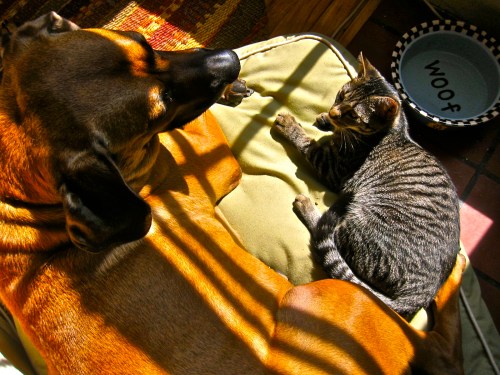
a comfortable living room, for people and cats
The paintings were acquired in Bahia, Brazil in the summer of 1998. The artist signs himself “Alberto,” and they are of mixed media, acrylic paint with splatters of sand and swatches of cloth added for texture. I don’t recall the name of the shop, but I could certainly find it in a minute upon return to the city.
The coffee table was given to me by a friend to hold for her while she moved back to Rockford, Illinois to live in the barn on the family farm while writing her first three books. One day she may want the table back, but until then, it’s here.
Pixie, ace mouser
Pixie, the cat, is about five and a half years old. She came into the family in February of 2005, for the specific purpose of eradicating the mice that had beset us in the fall of 2004. As I told Duke, Pixie was “a technician,” and she proved a very effective one: in her first 14 days, she took out 13 mice, and we never saw another one.
Brazil is a country of inspired appropriation. Its peoples, cultures, sounds, and visions grind against each other. They rise up and smash together like tectonic plates. In the collision of Brazil and Brasília, the city of candangos gave the country Renato Russo.
No “torso of steel,” no “[w]inged elbows and eyeholes,” but like Zweig and Plath a literary mind and poet, Russo’s voice became his generation’s. In his epic song, “Faroeste Caboclo,” Russo tells the story of a poor kid’s migration to Brasília across 159 lines of free verse, punk sensibilities, and an affecting melody that calls to mind the traditional country music of Brazil’s Northeast. Faroeste is what they call a “Western movie” in Brazil, and caboclo refers to the Brazilian mestiço everyman, a mixture of races and cultures, poor, seeking his or her fortune in some faraway place. Faroeste Caboclo is Walt Whitman, rogue-Gary Cooper and Joe Strummer together in Niemeyer’s white palace.
The hero is João de Santo Cristo, from Brazil’s Northeastern “backlands.” Brazilians call this region the Sertão, a rural, agrarian, drought-afflicted area that is the poorest place in the country and carries the deepest currents of Brazil’s premodern past. João robs the poor box from the church. He goes after the girls in the town. People don’t trust him. He feels the effect his skin color has on others who are lighter, more well-to-do. He’s arrested and goes to reform school, where he is raped and degraded. He is filled with hatred.
When a man on his way to Brasília decides not to go and gives his bus ticket to João, he becomes an accidental candango, leaving his past for the “beautiful city” where everything will be different. He works as a carpenter’s apprentice, but he can’t make ends meet and becomes a drug trafficker.
After some time in the criminal world, he tries to go straight when he falls in love Maria Lúcia, but eventually the drug trade pulls him back in. João’s enemy, Jeremias, steals Maria Lúcia and they have a child together. João challenges Jeremias to a duel, which is covered in the press and shocks the city’s elite but makes João a hero to the people. In the duel, Jeremias shoots João in the back and wounds him fatally. Maria Lúcia rushes to her first love and gives João a gun. He challeges Jeremias to die like a man and shoots him. In the end, Maria Lúcia and João die together in each other’s arms.
The people declared that João de Santo Cristo
Was a saint because he knew how to die
And the bourgeoisie of the city didn’t believe the story
That they saw on TV
And João didn’t accomplish what he desired like the devil
When he came to Brasília
What he wanted was to speak to the president
To help all the people that
Suffer
Russo and his bandmates in Legião Urbana (Urban Legion) grew up in Brasília in the late 1970s. Their songs of protest, love, and everyday struggles became the nation’s soundtrack to the last years of the military dictatorship and the re-emergence democracy in the 1980s.
“Será,” a love song with an anthemic refrain, could be heard blaring from sound trucks at the massive marches and rallies of the caras-pintadas (“painted faces”) in 1992, as they challenged the nation to bring down Fernando Collor, Brazil’s first democratically elected president since 1960.
So called because they painted their faces in the Brazilian national colors, green and yellow, the caras-pintadas had grown up under the military regime and saw their hopes threatened by Collor’s massively corrupt regime. They led the way for the whole country, which stopped each day at 7:00 for the allegorical soap opera, Deus Nos Acuda (God Help Us), a comedy in which the angel Celestina tries to save Brasil from the excesses of its social and political elite. In the show’s opening, the rich are smothered in mud and flushed down a whirlpool shaped like the country itself.
Collor was impeached and left office by the end of 1992.
Russo died on October 11, 1996, of AIDS-related illnesses. Russo’s wishes were to have his ashes spread over the gardens of Brazilian landscape artist Roberto Burle Marx, returning him to Brasília and its modernist vision.
In 2006, Fernando Collor was elected Senator for his home state, Alagoas, for an 8 year term (2007-2015). Brazil has absorbed Brasília.
Notes and Credits
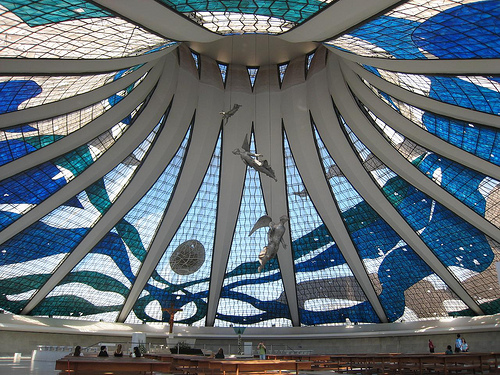
Photo: interior of the Brasília Metropolitan Cathedral. As with the previous post, the photo is taken from the Flickr site of Shelley Bernstein, aur2899. She works at the Brooklyn Museum (according to the Flickr “about”) and has a lot of pictures from Brasília and elsewhere. Her Brooklyn Museum blog posts are here.
Renato Russo was born Renato Manfredi, Jr., in Rio de Janeiro. He moved to Brasília in 1973 at the age of 13 and became a songwriter and musician. He renamed himself after the philosophers Rousseau and Bertrand Russell, and the painter Henri Rousseau.
Faroeste Caboclo plays on the iconic stories of migration from the Brazilian backlands, the sertão, to cities in search of a better life – one of the central storylines of Brazilian history. It’s a story of spiritual depth and apocalyptic reach, most famously told in Euclides da Cunha’s Os Sertões. Da Cunha’s book, published in 1903, tells of the Brazilian military’s destruction of the city of Canudos in the 1890s.
Canudos was a city that grew up around the milennial teachings of a folk preacher, Antonio Conselheiro, bringing tens of thousands of poor Brazilians together in a sertanejo enclave to await the last days. The Brazilian government saw the city as a grave threat to its own project of bringing Brazil into the community of modern republics while still maintaining the class and racial divisions of its colonial and plantation (slavery) past. Canudos was utterly destroyed by the military, and its inhabitants were massacred.
The destruction of Canudos removed one “sore” from the Brazilian body politic, but in the predictable irony of history and unintended consequences, Canudos gave birth to the next social threat. Soldiers from the campaign, unable to find work on retrn to civilian life, migrated south from the Northeast to Rio de Janeiro and built their own squatter colony on a hill. Thus was born the first favela, later to become the 21st century dystopian Canudos that continues to challenges the Brazilian modernizing project.
During 1992 and 1993, I lived in Belém and accompanied the protest marches through the city. I was officially a researcher, but I was also 28 years old, not much older than the caras-pintadas who I spoke to. Just a few years earlier, as a college student in New Orleans in the mid-1980s, I used to grab the New York Times every day to read up on the military’s exit from power in 1985. In 1992-93, like everyone else in Brazil, I was glued to the television every day for Deus Nos Acuda.
Another song that rang out from the sound trucks and radios everywhere was the first Legião Urbana hit, “Tempo Perdido,” with the echoing call of the refrain, selvagem, meaning wild, untamed. It was a song about love and not losing the time at hand, but it was also about the passion for breaking free of repression that made this song the “anthem of an entire generation” (O hino de toda uma geração), according to Alexandre Inagaki. In the video the band pays homage to all their forebears in rock and roll.
“Tempo Perdido” follows in the footsteps, or looking down from the shoulders of Raul Seixas and “Maluco Beleza.” Raul Seixas was Brazil’s Elvis (his idol), Jim Morrison, and John Lennon rolled into one. He “was not just a musician, but a philosopher of life …” (Raul não era apenas música, Raul era uma filosofia de vida), “Always Ahead of his Time.” See Jesse’s portrait of Raul on her blog, Mundo de Jesse. “Maluco Beleza” (“Crazy Beauty”) is for many the epic statement of individuality and creativity from the central icon of Brazilian rock.
Senhor Hype reports that the Brazilian RockWalk is in development, creating a walk of fame that will include both national artists as well as some international artists like the Scorpions.
For an English translation of “Faroeste Caboclo” along with the music, go here. The translation of the ending of the song above is taken from this video, and credit goes to Alexandre Mello and Andrea Hilland.
From 1956 to 1960, Brazilian architects, engineers and peasant laborers called candangos built a new capital, Brasília. This was the realization of a dream first voiced in 1827, just 5 years after the country became independent, when an advisor to Emporer Pedro I suggested that he move the capital from the colonial city of Rio de Janeiro, on the coast, to a new city in the interior.
Brasília, as it eventually came to be called, was a Brazilian version of Luso-Manifest Destiny. The new city was built on the legacy of the Bandeirantes, slave hunters and prospectors whose journeys into the South American interior in the 16th and 17th centuries extended Portuguese holdings – Brasil – at the expense of the Spanish crown.
President Juscelino Kubitschek asked Oscar Niemeyer to head up the team that would create the new capital. A native of Rio de Janeiro, Niemeyer was already an internationally renowned architect, his design for the United Nations Head Quarters in New York an immediate icon of post-war modernism. His designs for Brasília’s government buildings, plazas, monuments, and National Cathedral created something of a modernist theme park in Brasília, and in 1987 the city was designated a World Heritage Site by UNESCO.
For Brasília, Niemeyer collaborated with another celebrated Brazilian designer, Lucio Costa, whose plans for the city took the national dream into the air itself – from above, Brasília’s layout looks like a giant bow, loaded and aimed at the heart of the continent. Costa’s Brasília conformed to the modernist Athens Charter of 1933 almost to the letter, creating a city of functionalism and (for many) modern alienation. Landscaping was done by Roberto Burle Marx, another of the generation of Brazilian modernists whose work defined an era in South American history.
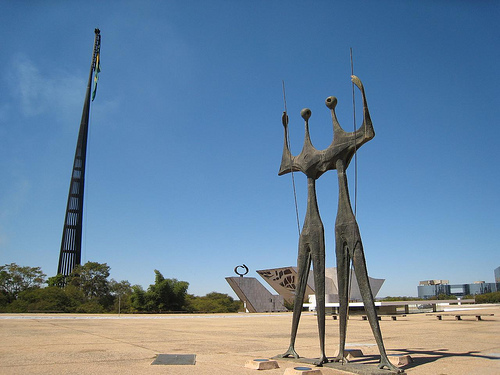
In the Plaza of the Three Powers, Bruno Giorgi’s sculpture, Os Candangos, memorialized the northeastern Brazilians who built the capital. In the national discourse of the time, these impoverished peasants were living symbols of Brazil’s colonial and agrarian past. By coming to Brasília and building the city, they were transformed into new pioneers who would settle the vast empty spaces of the country’s interior, from the dry plains of Brasília through the vast green desert of the Amazon. Unlike the North American slaves who built the White House and the U.S. Captiol buildings, the candangos were memorialized as part and parcel of Brasília’s futurist vision.
The architect must think that the world has to be a better place, that we can end poverty . . . . it is important that the architect think not only of architecture but of how architecture can solve the problems of the world . . . The architect has to always be political.
—Oscar Niemeyer, 2009
Hard Winter
Meanwhile, in London, Sylvia Plath was pregnant again. Her husband, Ted Hughes, was having an affair with another woman, and they were destined to separate soon after the birth of their son, Nicholas. In the 13 months after Nick’s birth, Plath wrote most of the poems in her second collection, Ariel, and published her autobiographical novel, The Bell Jar. Then on February 11, 1963, Plath left her children sleeping in their room, sealed the door with wet towels, and committed suicide with oven gas in the kitchen.
Among the poems she wrote in this period was Brasilia, which was not published in Ariel. Like Zweig, Plath was thinking about the past and the future and the trouble with seeing it through.
Will they occur,
These people with torso of steel
Winged elbows and eyeholes
Awaiting masses
Of cloud to give them expression,
These super-people! –
And my baby a nail
Driven, driven in.
He shrieks in his grease
Bones nosing for distance.
And I, nearly extinct,
His three teeth cutting
Themselves on my thumb –
And the star,
The old story.
In the lane I meet sheep and wagons,
Red earth, motherly blood.
O You who eat
People like light rays, leave
This one
Mirror safe, unredeemed
By the dove’s annihilation,
The glory
The power, the glory.
It was one of the coldest winters on record in England, and Sylvia Plath’s life was falling apart even as she was bringing new life on. How long she had intended to take leave of this life is not something we can know. She had attempted suicide before, and she was troubled by deep emotional struggles that went back to childhood. Her relationship with Hughes held some high points in her life, but now he had left her for another woman. What is clear, however, is that once she made her decision, she executed it with consummate intentionality. She meticulously protected her children as she took her own life.
Like Zweig, she left two works for posthumous publication, one pointing backwards, one pointing forward. The Bell Jar was on its way to publication; in this, her semi-autobiographical novel, she exposed a world she knew in the past, a world she tried to leave once before. As she died, the manuscript for Ariel and Other Poems, her masterwork, lay on the desk, each poem typed and left in the precise order she wanted for the book. The first word of the first poem, “Morning Song,” was “love.” The last word of the last poem, “Wintering,” was “spring.”
Like Zweig, Plath thought she left a book pointing to a better future, but that wasn’t to be. The Ariel that was published under Ted Hughes’s editorial guidance was not the same book. The poems were reordered, others added, and a few, like Brasilia, removed. This Ariel was darker, seeming to foreshadow Plath’s end, but whatever the critics of Hughes’s intentions, this Ariel made Plath who she is today.
Cold War
On March 31, 1964, the Brazilian military overthrew the democratically elected government. As the military took control, they created the model for the “bureaucratic authoritarian state” in the developing world. Niemeyer and Costa’s modernist visions were perverted into symbols of Latin America’s dark period, the capital’s bland functionality and order representing the kind of control that the military celebrated in its culture, the kind of functionality they wished to instill in the rest of the country.
Behind the gleaming white façades of Brasília’s futuristic vision, the Brazilian military contributed to the “dirty wars” against the left in Brazil, Argentina, Chile, and Uruguay. These regimes took the lives of tens of thousands of people who dreamed of a different kind of democracy than the region had known. Beyond those killed, many more were tortured, and hundreds of thousands were forced into exile. Niemeyer, a Communist and therefore enemy of the state, went into exile in Europe.
When the opposition movements eventually took power in the late 1980s and 1990s, the world was a very different place. Brasília was a bigger city, showing some age, surrounded by “satellite cities” and large favelas – the squatter settlements that the military tried to eradicate in Rio de Janeiro with less than efficient results. Costa’s rationally designed city had its flaws, its ups and downs, and its critics. For some, it seemed as if Brazil, and Brasília, had turned Zweig’s book into a joke: Brazil is the country of the future, and it always will be.
The future that Brasília promised, that Plath saw in her mind and in her children, didn’t work out according to the original plans. Yet life goes on. I will continue these themes in the next posting on theThe truth and Brasília, 3: Faroeste Caboclo.
Notes and Credits
The critics of Brasília’s ambitious design and lofty principles are many. I am not one of them. I am writing to explore what Brasília means, not its shortcomings, and my approach should indicate that I believe the city’s meaning far outshines any of its shortcomings.
Lauro Cavalcanti provides a beautiful guide to Brazil’s modernist architecture that places Brasília in perspective. In Brasília, the government sought to “turn the state into a spectacle,” and Brasília is indeed the enactment of a dream. If you can’t go to Brasília but can find your way to New York, go to Lincoln Center, and you can witness Neimeyer and Brasília’s influence on one of the great cultural centers of the world.
Photo of the Praça dos Três Poderes, with the statue of Os Candangos, is from the Flickr site of Shelley Bernstein, aur2899. She works at the Brooklyn Museum (according to the Flickr “about”) and has a lot of pictures from Brasília and elsewhere. Her Brooklyn Museum blog posts are here.
The candangos are publicly memorialized in Brazil, in marked contrast to the North American squelching of the slave labor employed to build our own White House. Without suggesting that Brazil is any less racist than the U.S., or that either country has a better social model for dealing with its racial legacy, I point this out as a matter of historical interest. The reader may regard these facts as he or she wishes.
Niemeyer and Costa’s designs were political statements. They expressed political beliefs in modernity, order, and democracy in the layout of the city. Niemeyer himself was a Communist, whose architeture reflected his beliefs in a world of collective and individual democracy, the triumph of working people over the old regime and the capitalist governing class.
Oscar Niemeyer is 101 years old, and he is still working. The quotation in this posting is taken from an interview he did with Santiago Fernandez-Stelley for Vice magazine online, at some point in 2009. The interview can be seen on video at VBS.TV. The video of the interview is simply inspirational.
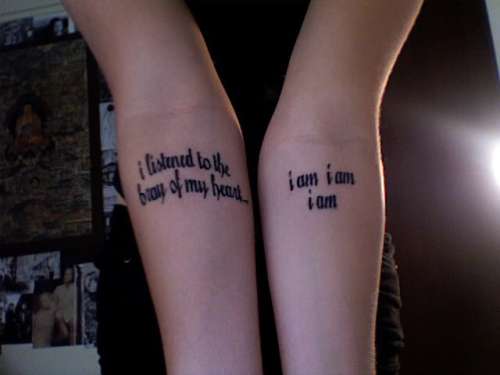
The photo of the Sylvia Plath tattoo is from a photobucket listing from PaperCuttt. I found it first on this site for literary tattoos. You can also find material from the same person at another livejournal channel. She notes that she altered the original slightly (“As I listened to the old bray of my heart….I am. I am. I am.”) but that it contains the same spirit.
I have long been greatly motivated by the poetry and writing of Sylvia Plath. As I mentioned in the introduction to this series of posts, her Collected Poems was one of two English language books I brought to Brazil in 1992 for my year of doctoral reserach in Belém. Over my life I have read many books on her and her life. These resources include: the poems themselves. Anne Stevenson, Bitter Fame; Jacqueline Rose, The Haunting of Sylvia Plath; Linda Wagner, Critical Essays on Sylvia Plath; and Erica Wagner, Ariel’s Gift. I’ve tried to read as much as possible, and to work through the thicket of political controversy around her work and life. I also read Ted Hughes’ Birthday Letters and have some to a deeper appreciation of how Sylvia Plath affected all those around her. The tragedy of her son’s suicide last year brought me a several days of stark reflection on emotions, depression, and the struggle of human consiousness and life against itself.
The third post in this series, The truth and change, is split in two, 3a and 3b. They provide different outcomes for the multi-part essay on change and the future that I began a month ago. It wasn’t how I planned the posts, nor are these the only two ways things can work out. They are, instead, the unintended surprises at the end of a long chain of lateral thinking that has also suggested a set of follow-up postings down the line. It’s always nice to pile up things to do.
From Life on Mars to Linden
Avatars are nothing new to the human species, from the caves of Lascaux to the virtual worlds of Second Life and other large web-based games. These (brave?) new worlds carry out the same primeval urge that led people to create paintings of their daily lives 35,000 years ago. What began in the caves has become a massive wall written on by millions of people, together, sharing a world that they have imagined out of the very world in which they live.
The House of Tomorrow, 35,000 BCE
One of the interesting things about the virtual world is that it does create a “place” that didn’t exist before, uncovering new spaces in life that are hidden beneath the physical dimensions we take for granted. In the world of Massive Multiplayer Online Role Playing Games (MMORPGs, or MMOs) such as Second Life, people leave their organic beings and create virtual selves, societies, and places in cyberspace. These worlds are a social version of the extra-dimensional physics of string theory, “brane worlds,” and high energy model building that physicist Lisa Randall has written and spoken about. In MMOs, we are building new worlds in very small spaces inside the world of everyday experience.
The key thing about these virtual dimensions is their connectivity to real life, which engenders much greater imaginative potential than the escape to the “silver screen” that left the sad girl in David Bowie’s song wondering if there was “Life on Mars.” Ours is now a world of both cultural production and absolute reflexivity, in which the virtual world is like a magnifying mirror we hold to our organic lives.
In a fascinating example of this reflexivity, organic journalist Marcia Stepanek reports on Second Life journalistDraxtor Despres, who himself reports on the goings-on of the organic world for the people of Second Life. Their dialogue is like an 8-track tape, or a Möbius Strip in which one side is organic, the other side virtual, both surfaces effortlessly sliding into each other when they are attached in just the right way.
Already, the virtual economy is derived from, reflects, and ultimately contributes to the organic economy. In July of 2009, Second Life creator Philip Linden spoke to BOSL (Best of Second Life) Blog about how Linden Labs is creating various supports for crossover services involving both businesses and educators, who will use the SL platform to provide services in real life. Within SL, “Linden Dollars” are the basis of a vast economy of virtual goods that can be converted, ultimately, into organic dollars.
The virtual world embraces an entire crossover economy. Hermione Watanabe is a “virtual wealth coach” whose blog provides advice and information on the SL economy and how to grow income there and in the organic world. Perhaps the most compelling confirmation of the virtual world’s “real” existence is that the Federal Government is thinking about how to tax virtual economic activity.
The crossover continues in the amateur machinima that is becoming an art form of its own, sprawling across YouTube, Vimeo, and other video networking sites. Aenea Nori’s SL video for Kafka Dinzeo’s remix of Lily Allen’s “Littlest Things” brilliantly takes us through the wormholes that connect virtual dimensions to the organic and back again.
LauraMW12345 created an organic-virtual mix in which “Second Life Meets Real Life,” in which the green screen existed in SL and the “real world” had to be inserted as fictional background for the avatars. The video is set over the DNA remix of “Tom’s Diner,” which was one of the early, pioneering events in remix history, on the borders of different dimensions of musical creation and imagination.
This sliding between organic and virtual lives has inevitably encompassed the most ubiquitous and equalizing of human emotions: sex (and its correlate emotions). Love is in the virtual air, as people in Second Life and other MMOs mix, mingle, fall for each other, become married (virtually, but quite really), pledge love, cheat, cry, break up, and try again. For a while, people started to create real-world-like porn magazines on-line (in Second Life, Slustler was a phenomenon in 2005-07), but these have been displaced by other virtual services and games that better fit the medium, such as Red Light Center (which creates a very real organic economy for itself as well) and SL meeting places and adult parties.
Eventually, however, we come back to the connection between the virtual and organic worlds. They cannot function without each other. “If This is Second Life Why Is My Heart Breaking In Real Life?” is a machinima video created by Kirk Lancaster and Sandra Holyoke that explores the crossover of desire and heartache. The relationships we create in other dimensions reverberate in the organic world and behind them all lie one, beating, very organic heart.
The future, it seems, is not out there in the world, some place distant in either time or space. It’s in our minds, already, right now, and available for our scrutiny. This isn’t the future I imagined as a youth, or even when I began writing these postings. In this future, much of the world is simply brought to life from our own minds with the help of technologies that enable millions of minds to communicate in tandem, synced together to build a world that is every bit as real as the organic world even as it vanishes before us to live in our minds.
This brings me back to the Shetland Islands of the late 1940s, where Erving Goffman gathered observations and data for his book, The Presentation of Self in Everyday Life. It was published in 1959 and became a classic of American sociology; it’s still widely read and has never been thought out-of-date.
Immersing himself in the world of the Shetland Islanders, Goffmann looked at their everyday interactions through the lens of drama – people were actors in their own plays, as well as each other’s audiences. “All the world’s a stage,” Shakespeare famously said, and Goffmann set out to prove it. People work hard to create settings and situations in which they can enact a specific, intentional script. They have certain behaviors for their audience, as well as an array of backstage behaviors.
Goffman’s point of view was revolutionary at the time and cemented the foundation of a whole school of social thought. We construct our own worlds in the same way that we construct plays and dramas. The representational activity that started in places like Lascaux and ends up in MMOs is pretty much the same. The attractiveness of gaming and MMOs is clear: it’s what we already do in regular life, only in the MMO we get a greater degree of control over what we hide backstage.
This begs a question. Is the change we experience with this technology really anything more than a change in the venue (now virtual, created) for the same old desires we’ve always had? A vanity of vanities in which there’s nothing new under the sun except for the bottles that are filled with old wine? Does the virtual world of love and sex and desire change any of the fundamental emotions or relationships that constitute what it means to be human? When and where does the virtual world go beyond reflections and extrapolations of the organic?
When is the virtual world for-itself?
Notes and Credits
The opening photo is from the Flikr site of rikomatic. The photo shows a house for sale in Second Life, where participants engage in an extensive economy that has several dimensions – purely virtual, combined virtual and organic, and mainly oriented toward organic profit. In Second Life, people create their own houses by using virtual money (Linden dollars) to purchase land and materials in the virtual world.
Much thanks to Marcia Stepanek for introducing me to the world of machinima in her writing on Cause Global and Pop!Tech.
Aenea Nori’s machinima for the “Littlest Things (remix)” carries us through many layers of time and space. I would have embedded the video in the blog for people to see, except that WordPress (the free version, anyway) isn’t communicating with Vimeo. You should go to her site, however, and check out her video work. There is no recent activity on the Vimeo site or on her blog (the last activity is September 2008), but perhaps she’ll be back.
Lily Allen uses a lot of mixing, overdubbing, and sampling to build her songs, which are themselves an aural hypertext calling forth a multitude of associations and images. “Littlest Things” recalls Cat Stevens’ “Wild World,” morphing time across 35 years of cultural production. Listening to Allen’s work is stimulating – and now Aenea Nori and Kafka Dinzeo transport the music and associated images into another world altogether, sliding along a “brane” between the virtual and organic worlds.
Regina Lynn has written in Wired about the growth of the virtual sex world found in MMOs all over the web, some of which are lucrative businesses. WebMD posted a balanced article on the advantages of cybersex and “teledildonics,” which include a safe place to try out new ideas (both in terms of disease and in terms of emotional control), as well as the problems – it can become addictive and affect real-life relationships. The article quotes Regina Lynn, who brings the issue down to earth: “Does your partner know, and does your partner consent? Lying is cheating.” Over at True/Slant, Todd Essig writes about the cutting edge developments in the world of cyber sex – now, cyber-touch with lasers across world’s distances.
Taunt is a blog devoted to SL economics and SL sex life. SL and other MMOs feature escort services and erotic parties to cater to every taste, including many that are all but impossible to enact in organic life. “Second life guys can have it all, as long as they’re willing to pay,” according to Elle Kirshner, a Second Life designer and voiceover artist for Kirk Lancaster’s SL video, “Second Life Man.”
Overall, sex is actually the cutting edge of machinima and virtual reality. Why? Because it’s what we want so much in real life that our urges push the limits of technology so that we can pursue desire in every possible corner of existence, from dreams to waking life to virtual reality.
things that get destroyed in war, Ann Arbor, January-February 1991
“Every quantitative measurement we have shows we’re winning this war …”Robert S. McNamara, 1962
Few people with the power to make change have placed so much faith in science as a force for public good. Few have wreaked so much havoc and destroyed so many lives with their belief in science. Many fewer still are those who have tried to grapple publicly with the damage they did.
These were thoughts that occurred to me as I read the obituaries of Robert S. McNamara yesterday morning. It brought me back to Errol Morris’s The Fog of War, which I recently spent three days watching, over and over, for a different project.
In Morris’s film, McNamara narrates his life around 11 “principles” that he learned from his involvement with war, both the Second World War and Vietnam. The first is “empathize with your enemy,” and this is the vantage from which I prefer to think about McNamara himself. Rhetorically speaking, this makes him my enemy, which I know he is not, but like any enemy he is the object of my perplexed and sometimes angry thoughts, a person I likely would have “opposed” had I been of an age to do so.
To the extent that McNamara is an object of anyone’s judgment, however, empathy is the perhaps the best way one might understand how a person as remarkable as McNamara could also be, as David Halberstam put it, “a fool.” Yet to remember McNamara only in anger or glib, anti-intellectual sniping at the fact that brilliance is no guarantee against foolishness gains nothing for the world. Most brilliant fools will never, in the manner of Mr. McNamara, admit and more importantly explore their mistakes for the good of the public.
McNamara’s reckoning with his own illusions of scientific truth led him to conclude, among other things, that “rationality will not save us,” that “belief and seeing are often both wrong,” and that one should “be prepared to reexamine your reasoning.” These are his lessons from war, but they would serve us well in ordinary life, too.
From the mid-1990s forward, McNamara became immersed in debating the issues around nuclear war, as well as Vietnam, and the documentary he made with Errol Morris was released right about the time the Bush administration began the invasion of Iraq in 2003. McNamara’s ultimate conclusion from a life of war and science was this:
“What ‘the fog of war’ means is: war is so complex it’s beyond the ability of the human mind to comprehend all the variables. Our judgment, our understanding, are not adequate. And we kill people unnecessarily.”
In his dreams and goals and desires, in his patriotism and sense of duty, McNamara was no different than most people. His own peculiar acumen, however, put him in an extraordinary position to affect the lives of others. The hubris of his belief in science was perhaps no more or less than Richard Dawkins’s own arrogance, but circumstance and ambition have placed Dawkins in a relatively benign position that mainly involves preaching to his own choir of fellow travelers.
We might serve Mr. McNamara, and ourselves, best – whether from the view that he was an inhuman monster or the more reflective position that he seemed to wish we would have – by listening to the things he had to say during the last 15 years of his life, from the time of his autobiography, In Retrospect (1995), forward.
Late or not – 27 years elapsed between the end of McNamara’s tenure as Secretary of Defense and his autobiography – McNamara at least tried to help the world understand what he did, without making excuses for himself or (for the most part) fudging the facts in a self-serving way.
One could only wish that other powerful true believers would do the same, but the likelihood is that Alan Greenspan, George W. Bush, Dick Cheney, and Donald Rumsfeld won’t go where Mr. McNamara finally chose to go.
Personal disclosure
I was not yet born when Robert McNamara assumed the post of Secretary of Defense. My first memories of television, however, are of war reporting. I recall a picture of an empty field, with the rat-a-tatt-tatt of machine guns firing in the distance and the gravelly voice of a war correspondent trying to explain what we weren’t seeing.
The first time I went to Washington DC was in 1990 or 1991, quite possibly for the Washington Mall protest against the Persian Gulf War, part 1 (Desert Storm), though I don’t recall. There was a wedding I went to around that time, which might have been the first trip to DC.
What I do remember is this: As we drove from Michigan to Washington, we listened to the 10,000 Maniacs album Blind Man’s Zoo. “The Long Parade,” a song about watching people pass along the Vietnam Memorial, stuck in my head. By the time I reached the end of my own walk along the wall, I was in tears, as much for the tragedy spelled out in the 50,000+ names on the wall as for the one name I knew was not there.
My own father served in the US Army from 1962 to 1967. He wasn’t sent to Vietnam, though he trained soldiers who went there from the place of my birth, Fort Hood, Texas. Later, he was sent to West Germany where, for a couple of years, he stood with the first line of defense in the event of Soviet invasion.
Notes and Credits
These are the obituaries I read in preparation for this posting: Thomas Lippman in the Washington Post, Tim Weiner in the New York Times, and Fred Kaplan in Slate.com.
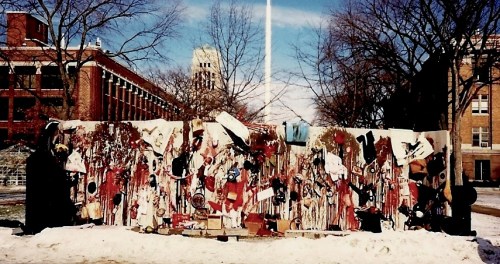
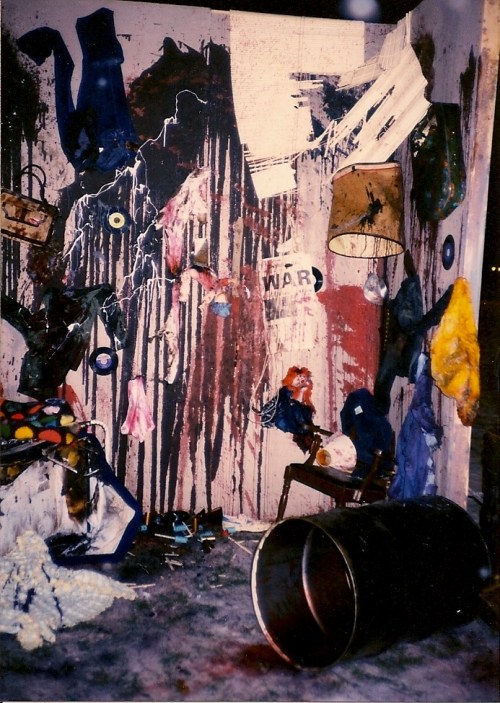
The photograph at the head of this post is of a wall that I helped to build in Ann Arbor at the beginning of Operation Desert Storm, the First Persian Gulf War, in 1991. The idea for this piece of public art was Jeffrey Levy-Hinte’s. At the time, Jeff and I were both graduate students in political science at the University of Michigan, Ann Arbor. A group of us built the wall and attached to it all of the things that get destroyed in war. It was located on the central lawn of the Ann Arbor campus, the “Diag” as we called it, for the the diagonal pathways that cross the lawn to connect the buildings.
things that get destoyed in war, close up
The wall stayed up for only a few days, being torn down by ROTC members on the one night that people didn’t camp out there to protect it – at the time, it was terrifically cold, in the single digits every night.
The university, however, didn’t clean it up, and it remained for another few weeks. As a pile of rubble it actually accomplished its goal even more effectively. During this time, no one crossed the Diag without stopping to talk about the war.
Richard Dawkins is among the best and brightest evolutionary scientists of his generation. I’ve read some of his books and have enjoyed them – The Selfish Gene, The Ancestor’s Tale – but I have found his unoriginal assessments of religion and the stupidity of people who choose to believe in God (even if they also believe in evolution) to be, at the most generous, tiresome. For an example of hollow, rude intellectual badgering, see his video on Google. It’s like a supernerd bully picking on crippled jock bullies and, frankly, I found the original much more entertaining.
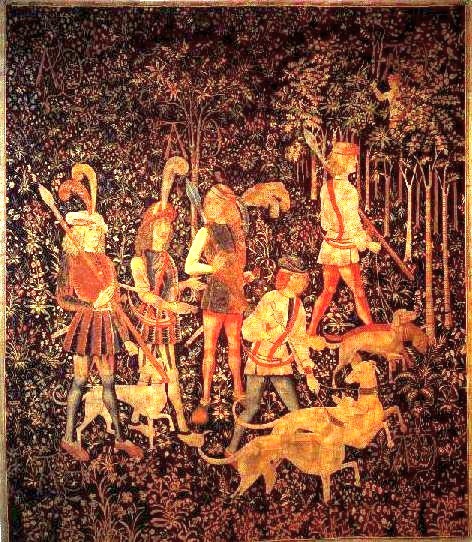
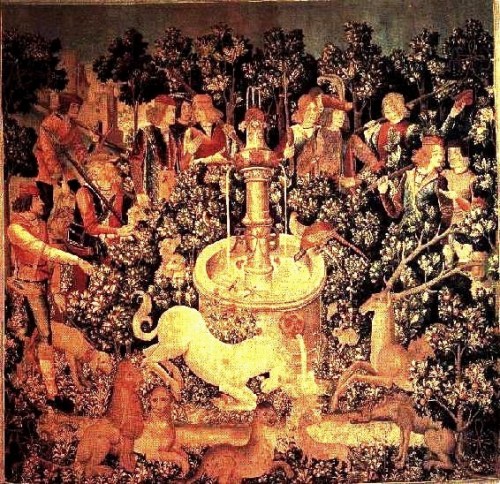
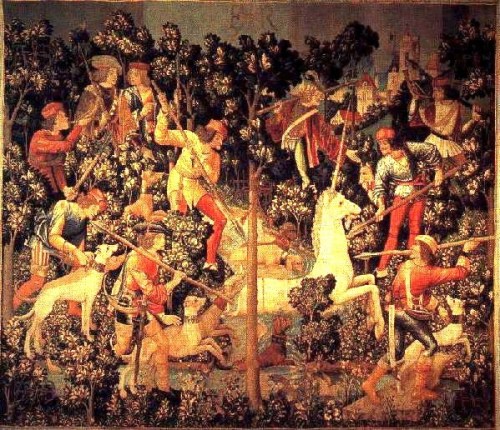
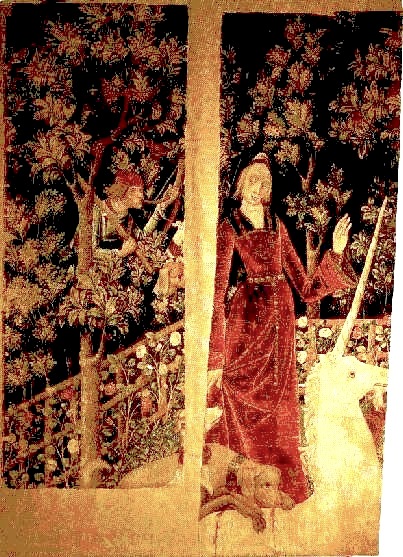
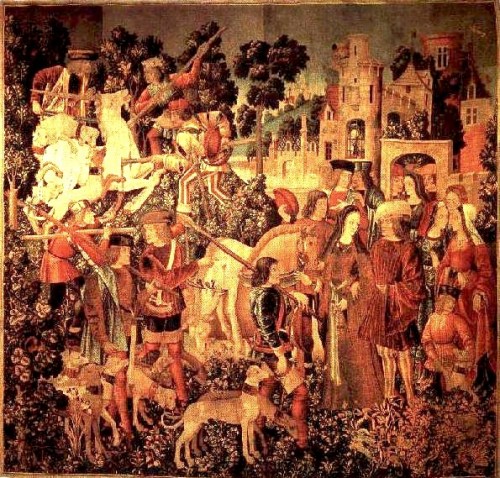
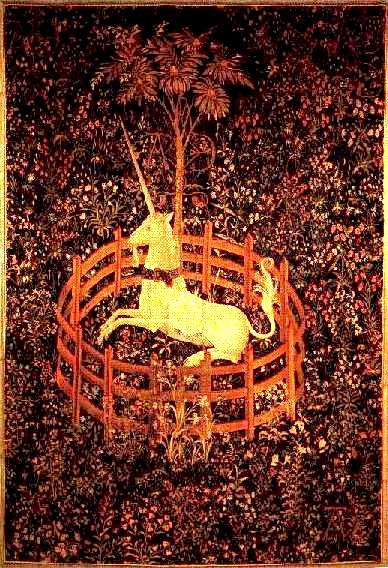
The Cloisters is the Medieval branch of the Metropolitan Museum of Art in New York City. If you’re not in New York, drag your mouse here. When you get there, you will find a large room, like the banquet hall of a castle, complete with a large, carved stone fireplace. There is no table in the middle, and you will see hanging from the walls seven tapestries that date from the turn of sixteenth century (1495-1505).
They were woven in Brussels of wool, silk, silver, and gilt wefts by deft hands. Hanging twelve feet from ceiling-to-floor, the tapestries tell the story of a unicorn hunt, a standard Medieval myth, set against mille-fleurs backgrounds that show over one hundred species of plants. A group of well-armed nobles and knights search the countryside for a unicorn, but they can capture it only with the help of a Maiden, a virgin. They stab and gore the unicorn and set their dogs on it. Custom would have the capture killed on the spot – but the unicorn lives again in the final tapestry, The Unicorn in Captivity, which shows it tied to a pomegranate tree, surrounded by a low fence. It is an allegory of the passion of Christ, or the cruelty of mankind, the rape of nature, the fierceness of men, the innocence of virgins, sexuality itself.
If you have the chance to visit the exhibit, read aloud Rainer Maria Rilke’s sonnet to the unicorn. The echo in the room takes you out of time and space and into the sensual experience of near-fantasy.
O this is the beast who does not exist.
They didn’t know that, and in any case
– with its stance, its arched neck and easy grace,
the light of its limpid gaze – they could not resist
but loved it though, indeed, it was not. Yet since
they always gave it room, the pure beast persisted.
And in that loving space, clear and unfenced,
reared its head freely and hardly needed
to exist. They fed it not with grain nor chaff
but fortified and nourished it solely with
the notion that it might yet come to pass,
so that, at length, it grew a single shaft
upon its brow and to a virgin came
and dwelled in her and in her silvered glass.
Or see the following video (best when set to full screen, though the quality of photos suffers a little):
Rilke follows the Medieval European unicorn myth as it lived in the space between paganism and Gothic Christianity. The unicorn was brought into being by human desire, yet represented innocence. For this reason, it could be captured only by a Maiden, and not by men, as the tapestries illustrate so beautifully. Eros and Thanatos are deeply entwined in this story.
The contradictory portrayal of sexual desire and the crushing forces of denial are all on display: Does the unicorn’s story celebrate the feminine or banish it to a world of fantasy and lost innocence that only serve the interests of men? How far do we have to go from the Maiden and the unicorn to witches and witch-hunts? Is this story a well-dressed window of oppression, the Maidens who become women chained to the pomegranate tree and fenced in like the unicorn of the seventh tapestry? Is the unicorn Jesus, loved by women and destroyed by the cruelty and hubris of men? Does it show the men for the hypocrites they are, able for all their weaponry and warmongering to capture the unicorn only with the aid of the Maiden?
It makes me think of my trip to the Louvre to see the Mona Lisa. To get to the room with Da Vinci’s masterpiece, you must walk through long hallways of religious paintings that depict, over and over, the Christian martyrs, the Crusades, and scenes of religious violence reminiscent more of Sam Peckinpah than St. Francis. There were at least 2 Sebastians, pierced by dozens of arrows, bleeding on the stake. There were 3 heads of John the Baptist brought to Salome. Countless crucifixions. Nothing but destruction, over and over. Visitors weren’t lingering. They were on their way to the Mona Lisa. The ropes begin well down the hallway from her painting, to order the crowd into a manageable queue.
I had expected to be underwhelmed, but that’s not what happened. Mona Lisa’s room was packed. We were all struck, in awe of how she followed us wth her eyes, the way her smile seemed to change as we moved. It was a magical moment, unicorn-worthy and lovely.
Steve Earle, one of my great songwriting heroes, wrote a song called “The Kind,” which is on his CD Jerusalem, dedicated to themes inspired by 9/11, the War on Terror, and the build-up to the Iraq War. In this song he sings of a soldier who “wins the prize and gets the girl,” of a “cowboy with an achin’ heart,” and finally, of a “girl with a secret smile.”
Paint me a picture of a girl with a secret smile
Lookin’ back at ya ‘cross the years through ancient eyes
You’re standin’ there like an open door
‘Cause she’s seen it all before
That’s the kind of picture I like –
The kind that makes you sigh
In spite of all the art devoted to destruction and terror, we were all there just to see the painting of this girl who smiles. In that moment, as in the story of the unicorn, truth.
Note
“The truth and unicorns, part 3” is in preparation and will round out the unicorn series for now. After the credits I include all 7 unicorn tapestries, in order.
Credits
Unicorn Sonnet: Rainer Maria Rilke, Sonnets To Orpheus, Pt. 2, No. 4, trans Robert Hunter. Hulogosi Communications Inc., November 1993.
“The Kind,” by Steve Earle. Included on the CD Jerusalem, 2002.
Photos of The Hunt: http://www.geocities.com/area51/corridor/5177/hunt.html. I cannot figure out who is responsible for the site, but it lists an email address, amulet@geocities.com. These photos are a bit darker than the tapestries; the photos on the Met’s Unicorn Tapestries site are much clearer and show the the color much better (but they cannot be dowloaded and are protected by copyright). Here are the photos, in order.























 truth and rocket science