Category Archives: life

The truth and moonshadows, 1: Another Saturday Morning

Note:  This is the first of three posts in an extended essay exploring my relationship with my father and my son through the songs of Cat Stevens/Yusuf Islam.

Another Saturday Morning

When I was a child, Saturday mornings were tranquil and unoccupied, a time when no one had work to do or church to attend.  It was the one day of the week that mom got to sleep in, and it was the one morning of the week when my father had some time to himself. And so it was that Saturday mornings began with a ritual of discovery, waking up to seek out my father in the family room to see what he was doing.  This was important, because whatever it was that he was doing, it looked important.

Sometimes he would be reading; sometimes he would be writing.  But he was always writing in all the books he read, and when he listened to music on the stereo, he scribbled all over the record sleeves and lyric sheets. And then sometimes he was just writing in one of his empty books that were simply labeled “Record.” He had a whole bunch of these already filled on the bookshelves.

Teaser and the Firecat

One Saturday morning, I came into the room and heard a new record, as I often did.  This one was “Teaser and the Firecat,” by an oddly-named singer called Cat Stevens.  From that day on, the song “Peace Train” became an anthem in our household, for it was in those days, or thereabouts, that my parents and their friends were peace-loving young people, the “social left” of their local Catholic Church, complete with their own bearded-hippie-Jesus priest who rode a motorcycle, preached against war and hosted wonderful weekends at his family’s fishing camp down on Lake Verret. In our household, guns were forbidden, not even toys, and we didn’t go hunting or shooting, all of which set us quite apart in Louisiana.  Guns, my father said, had only one purpose, which was to kill people, and that was not something to celebrate.

At the same time, from the walls of our living room—the same living room where Cat Stevens, Bob Dylan and Joan Baez sang every Saturday morning—there hung a striking sunset-silhouette photograph of my father’s tank out on the ground around Fort Hood, Texas, where my brother and I were both born.  On the same or a nearby wall (it changed every once in a while) my father’s bayonet was mounted on a felt-covered board with some other mementos, and on another wall hung award my mom got for service to Army wives.  Before Cat Stevens, Captain Ronald James Guidry was a tank commander and expert marksman.
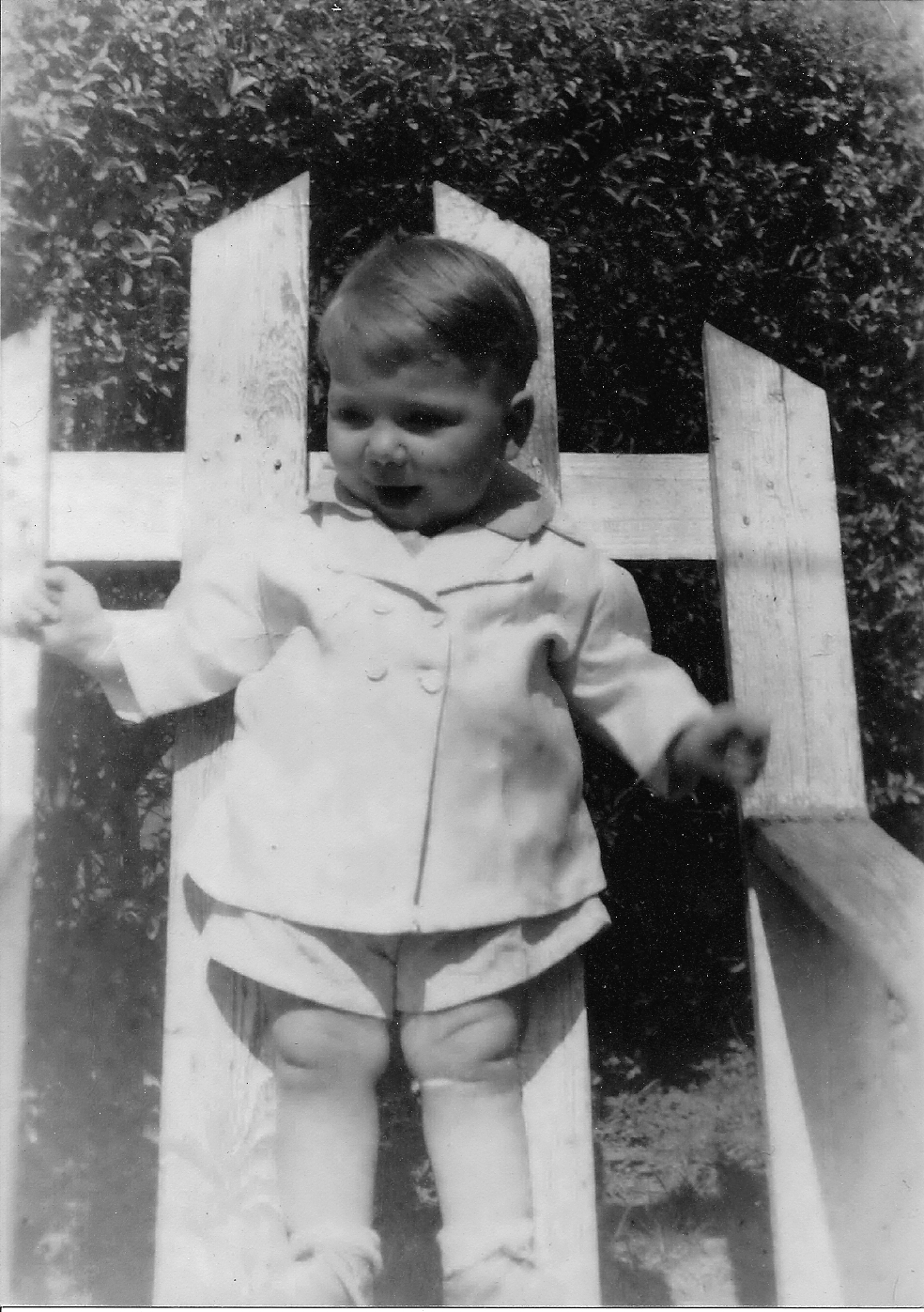
Captain Ronald James Guidry, age 1 or thereabouts

Over time, Cat Stevens’ music continued to be played in our house. My father brought home each new album, all the way through Numbers, though I recall thinking that “Bannapple Gas” didn’t do the same thing for me that the other songs did.  Within a few years of that, however, around the same time that Cat Stevens seemed to disappear—and I would have no idea why that happened until many years later—my brother and I were both playing the guitar and learning the ubiquitous Cat Stevens’ Greatest Hits songbook cover-to-cover.

It was around that time, too, that the songs started to mean something different to me. They were no longer songs that were important to my father for reasons that he told us. They were songs that helped me think about important things, too. They were songs that captured the way I had begun to feel about my father as I was starting to think about what I wanted from this world and realized, with no small degree of concern, that the things I wanted weren’t what he wanted for me.

This was a challenging idea, because I thought of my aspirations and values and dreams as direct extensions of my father’s.  I didn’t understand the difficulty he had with some of my ideas, but I began to think I should worry less about his feelings than just figuring out how to move along.  Like every boy my age with a guitar, I sang the words to “Father and Son” as if I had written them myself.

How can I try to explain, when I do he turns away again.
It’s always been the same, same old story.
From the moment I could talk, I was ordered to listen.
Now there’s a way, and I know that I have to go away.
I know I have to go.

Cat Stevens, “Father and Son,” 1970

For his part, I recalled how my father listened to “Oh, Very Young,” seeing in his eyes the familiar look of loss that increasingly haunted his moods the older he got.  I couldn’t tell if he was mourning his own lost youth or mine, or perhaps the notion of lost innocence, though whether personally or in general I couldn’t quite tell.

Oh very young what will you leave us this time?
You’re only dancing on this earth for a short while
And though your dreams may toss and turn you now
They will vanish away like your daddy’s best jeans
Denim Blue fading up to the sky.
And though you want him to last forever
You know he never will.

Cat Stevens, “Oh, Very Young,” 1974

What I can say is that to this day, almost 40 years after first hearing that lyric, I cannot see my father in blue jeans without hearing the song in my head.  The images are burned in my mind and branded on my heart, stirring me still as I grow older and watch my own son as he emerges from the fog of childhood into a person of his own substance and mettle.

Notes and Credits

On some Saturday mornings, my father took my brother and me to Audubon Park.  These were especially magical.  He would sit in the grass and paint watercolors while we played.  Then he took us around the park, across the bridges and next to the lagoon.  He pointed out the places where he and my mother fell in love.  Whatever he did on those Saturday mornings, my brother and I followed.

When challenged that guns could be used to kill animals for food, my father simply pointed out that guns were not used to kill the animals we ate. He’d spent a goodly part of his childhood on his grandparents’ farm in Lutcher, Louisiana, fifty or sixty miles up-river from New Orleans. It was part of the sugar plantation there, but now it’s a Kaiser Aluminum Plant. And as a teenager, he was a butcher in his neighborhood meat shop. He knew how animals became food, and the few shot with guns today had mostly been killed in other ways for most all of human history.  When pressed on the point, he explained military history and why we have guns. He was adamant about this.


6 Comments

Filed under ageing, fathers, life, sons, struggle, truth, youth

The truth and oral history: The Double Life of the Interview

BROOKLYN READING WORKS

org. Louise Crawford
guest curator John A. Guidry

THURSDAY, JANUARY 20, 2011
8:00 – 10:00 PM
Where: OLD STONE HOUSE at J. J. BYRNE PLAYGROUND
5th Avenue in Park Slope between 3rd and 4th Streets
(718) 768-3195

The idea

Stories do not tell themselves. Even once they are told and recorded, stories need some help to be heard and to live in the world. This month’s Brooklyn Reading Works will look at the processes by which people collect stories and use them to tell stories. We will have panelists who use oral history practices to document our world and the lives we lead, and the conversation will explore the work it takes to make stories interesting and give them legs to stand on, as it were. Panelists will represent and explore several different genres and styles of the oral historian’s craft, from traditional first-person historical storytelling to the mediations of photography, academic writing, marketing, multimedia, and social advocacy—as well as stories of how collecting stories ultimately affects oral historians as authors and curators of the human experience.

The panel

Brian Toynes and Luna Ortiz, with Gay Men’s Health Crisis, who have developed innovative community-level interventions that use personal stories about change and resiliency. Luna is one of the few people documenting the “House and Ball” scene that came to general public prominence in the film, Paris is Burning, and in Madonna’s “Vogue – but which has also had a much more complex and international history over the last 100 years.

Michael Garofalo, a producer with StoryCorps, who will talk about the work of StoryCorps and the importance of collecting and listening to the stories we can tell each other about our lives.

Mary Marshall Clark, Director of the Columbia Oral History Office. Mary Marshall will concentrate on the stories of 9-11 that her team collected here in New York and the process of working with these kinds of interviews in order to create a tangible and personal history of these events.

Jason Kerstenauthor of “The Art of Making Money,” a true-crime story of a young counterfeiter and his life. Jason’s interviews with Art and his family reveal a host of issues that a writer must confront when getting so close to the subject while trying to tell a true story that is compelling, informative, honest, and in the end protective of the subject’s own history and privacy.

John A. Guidry, who has used oral history and long-interviewing techniques in academic writing (community organizing and children’s rights in Brazil), community development research (all over the US), and public health promotion (HIV health and social marketing).

4 Comments

Filed under ideas, journalism, knowledge, life, literature, media, Park Slope, writing

The truth and stones

With relation to stones, we observe two kinds of people:  those who cast them and those who collect them.  Of those who cast stones, some do so from fear, while others do so strategically.

The fearful cast their stones either from glass houses or at glass houses.  The former are the hypocrites, while the latter are self-righteous, and both are equally insufferable.  The fearful cast their stones in reaction to something and not because of a belief in something, less from the solidity of their own convictions than from a nagging sense of their fragility.  The fear that causes these stones to be cast comes from inside the throwers and, like the stones they throw, is projected outward into a hostile and alien world.

The strategically inclined cast their stones either from a position of strength or at a position of strength.  Both tend to claim truth as their ally, and the truth tends to flee equally from either, for the truth is seldom on the side of casting stones.  Truth, being what truth is, can win its battles without stones, or in spite of them, because all positions of strength are time-bound and predicated on illusion.  The emperors will never wear clothes.  Their castles will all be made of sand—and glass, as we know, is nothing but sand.

The collectors of stones are mainly of two kinds.  They are either martyrs or future throwers of stones.

Of martyrs, there are two types, the situational and the pure.  The former are those who, upon being showered with stones, simply die because they are overcome.  They die because nothing else is possible, regardless of the degree or intensity or their fervor.  No one can prove whether situational martyrs were committed to a cause, or if they just happened to be in the way of an angry mob.  Situational martyrs die in the right time at the right place before they can get bored or do something that would cast aspersions on their martyrability.  A great many narcissists have achieved sainthood this way.

Pure martyrs collect stones in order to cleanse the world and remove hatred so that the rest of us can live in peace.  While their service to humanity is well-recognized, in life most of them are indistinguishable from narcissists.  The pure martyr is only revealed in death, for in death their purity is preserved.  Die young, stay pretty. Pure or situational, martyrs are the scissors-carriers of the world.  Yet as our mothers told us, running with scissors will be no escape, for those with scissors will always be crushed by those throwing stones.

The future throwers of stones are the paper carriers.  They cover stones and rocks to avoid martyrdom.  For more than a few, not coincidentally, throwing stones is a second career taken up after re-assessing the limitations of an earlier vocation to martyrdom.  They cover the stones that have been cast at them, but then they tear away their paper covers and cast those stones back again.  Thus we observe the cycle of stone-throwing and fear in which victims recycle what has happened to them, joining the ranks of oppressors and casting off the stones they once hid beneath paper.  Write what you know, as the saying goes.

It is thus that we arrive at the central problem facing humankind:  In a world of human conflict, no one will win.  Neither the throwers nor collectors of stones can vanquish the other.  Neither righteousness nor evil will win the day, which may be some comfort for those who wish to avoid evil but not so much for those who wish to achieve righteous glory.  This is because victory by either side—stone throwers or stone collectors—would require settling differences among adversaries in ways that are not possible to achieve.

The stone throwers face each other in glass houses, which before long will lay about their feet in shards and pieces.  Of those who collect stones, the paper carriers who are the future throwers of stones will allow the stone throwers to crush those with scissors, who in martyrdom provide the narratives and scripts that give the rest of us hope.  Yet once all the martyrs are gone the future throwers of stones will become simply the throwers of stone and new martyrs will emerge with sharper scissors to cut the old paper into bits.

The fortunate thing is that we are defined not only by our relation to stones, conflicts, or disagreements.  We are bigger than this.  Our world is increasingly one made of glass in which the things we wear and say and claim dissipate around our bodies like lost auras or the blinding penumbrae of lives best viewed through smoke-colored glasses.  Seeking truth in this haze is both a worthy and a necessary endeavor, though a thankless and quite possibly never-ending one as well, whose value lay more in the seeking than in the finding.

Notes and credits

The photographs of rocks and stones and scissors were taken by the author.  The photograph of Philip Johnson’s  Glass House is from the Wikimedia Commons and is available for common usage.  The Sandcastles are also courtesy of Wiki Commons.

Rock/paper/scissors—RPL as it is commonly known —is a game of strategy, cunning, and skill. Or so the World RPS Society would have us believe.  Apparently, RPS has been used to resolve disputes for hundreds of years, supplanting dueling and other more barbarian forms of conflict resolution.  If only Alexander Hamilton had known.

The math whizzes at PlayRPS.com have devised a simple playable RPS game that allows anyone to use the method to resolve their disputes.  To the naive, this could be very useful, for example, in the current Israeli-Palestinian negotiations, greatly facilitating Hillary Clinton’s job.  The only problem is that while on average RPS tends toward random distribution of the results (i.e. on average rock, paper, and scissors even out over time), in any one instance the odds are overwhelmingly that one outcome will have more wins than the others.  For example, the odds that the results after 99 efforts will be 33-33-33 are slimmer than the odds that it will be unbalanced and favor someone.  Level results happen only if the total number is divisible by 3, which further narrows the odds.  Any odd number of games (and any idiot who agrees to play with an even number of games deserves to lose) that isn’t divisible by three guarantees that someone will have more wins than the others.

RPS actually exemplifies the perfect mathematical expression of the futility of human design and intentionality:  It is a conflict resolution device almost perfectly designed to engender more conflict.  RPS is more elegant than “Murphy’s Law,” which operates by way of categorical affirmations and a priori givens, without any justification or proof whatsoever.  While offering the masses a palliative notion of conflict resolution, RPS actually encodes the perfect mathematical explanation of why conflict resolution is almost completely impossible. It’s like politics in America rendered in a way that both children and adults can believe in.  Randall Munroe demonstrates this in his XKCD comic strip, “Improvised,” in which RPS doesn’t do Han Solo much good in figuring out how to reply to Princess Leia in a famously tight moment, though in Han’s defense this is not the kind of proposition that is easy to deal with even under the most relaxed of circumstances.

At least one financial analyst has chosen to analyze our current economic crisis as a relationship between currency and gold as one of rock (gold), paper (currency), and scissors (economic turmoil).  And the television show Big Bang Theory just made it all seem silly, as it does with most things.

The Rock-Paper-Scissors playing glove is a technological innovation that serves at least two purposes.  It should help indecisive people make decisions in crucial moments.  It is also something that Senatorial candidate Christine O’Donnell of Delaware might find use in helping people to avoid masturbating by giving them something useful to do with their hands.  (Scissors and masturbation?  Oops.)  If the mathematical logical I outlined above holds, the glove will keep them playing forever, thus ensuring the inavailability of the hands for other, more profane purposes.

2 Comments

Filed under conflict, freedom, ideas, life, normal distribution, politics, risk, statistics, struggle, truth, war

The truth and narrative, 3: my life with Roberto Bolaño

1987

I met Gondim in Rio de Janeiro in 1987.  He brought me to Morro dos Prazeres, a favela whose name translates into English as “Hill of Pleasures.”  We took the streetcar from downtown up to the neighborhood of Santa Teresa, climbing a couple thousand feet along the way.  It was (and still is) Rio’s last streetcar line, and the trip is a step back in time.  At the end of the line, you arrive in Santa Teresa’s walled streets and tight alleys, a Bohemian retreat high above the Rio’s noise and splatter.  It’s a nice place, and the mountain air is cool.

One turn and a hundred feet down another street, Santa Teresa gives way to small houses climbing up the hillside in seemingly ramshackle fashion, stacked one atop the other to the sky.  Children play on rooftops, their kites hanging in the ocean breeze.  The two neighborhoods cling to each other on the steep hillsides of Rio de Janeiro in an uneasy relationship marked by occasional hostility, outbreaks of violence, and cheap domestic help.  The views are breathtaking across the Guanabara Bay.  Back in 1987, Gondim introduced me to Walter, the “professor,” a fan of Fidel Castro’s and leader of the neighborhood association in Morro dos Prazeres.  I spent time there talking to people, hanging out, following Walter around.

At that time, Gondim lived in Santa Teresa, among artists and musicians and dancers.  It was love and revolution all night long over cachaça, weed, and samba.  At night, and sometimes during the day, I played music anywhere I could, with Rogerio or for the girls on Avenida Atlântica between tricks, the ocean crashing across the road beneath the moon and the Southern Cross.

1992

Five years passed and I wasn’t a very good correspondent.  Neither was Gondim or Rogerio or anyone in Rio.  In 1992, I found Rogerio in Flamengo, the neighborhood down on the beach below Santa Teresa.  He asked me what I was doing, and I told him I was on my way to Belém.  Belém!, he screamed—there are only crooks and thieves and whores there! Madness to go there! he told me.  My people, I thought, and then he gave me his sister’s phone number and said I should look up her up when I get there.  Next I went to Gondim’s offices at the magazine, but the editor told me he had moved.  Where to? I asked.  Belém, she said, and she gave me a phone number.

In Belém, it was sweaty nights on the street in Cidade Velha with Gondim and his friends, among them Petit, a Catalan who had married a Belemense girl and become a professor at the university.  We drank beer, ate chicken and rice, and sang songs about everything.  With Marga (see the Tamba-Tajá stories) I took in the arrival of Iemanjá on the beach at Mosqueiro in 1992.  Márcia took me to her neighborhood, Bom Futuro, which like Morro dos Prazeres had a meaning that seemed at odds with its circumstance, “Good Future” in Portuguese.  We had great parties at her house and a photograph of all the women in her family, four generations, hangs in my office next to my desk, not far from a photograph of my own mother.

Bom Futuro was an invasão—they didn’t call them favelas in Belém—in a swampy area amid the mega-invasão of Área Cabanagem (pop 200,000) named after Oscar Neimeyer’s nearby monument to the slave and Afro-Native rebellion that occurred in Belém in the 1830s.  Chiquinho took me to his invasão in Aurá, a suburb about an hour or 90 minutes from central Belém by bus.  I spent years with him and his comrades as they struggled to pave the streets and keep the lights on.  I cherished these friends dearly, as I also loved M-J, who became my accomplice in dreams for a few years.

Then things changed.

The details are unimportant.  What matters is that things changed because I made decisions that I don’t understand today.  The right thing to do now seems so obvious, though it was so obviously the wrong thing to do at the time.  My mistake was not so much in doing right or wrong, but in doing either only half way.  I forgot my passion at some point, and my calling went to rest beneath a rock of responsibility or reason that did not suit me very well.  Maluco Beleza was the song I loved, and it became the life I lived a little by accident and not nearly enough by design.

2008

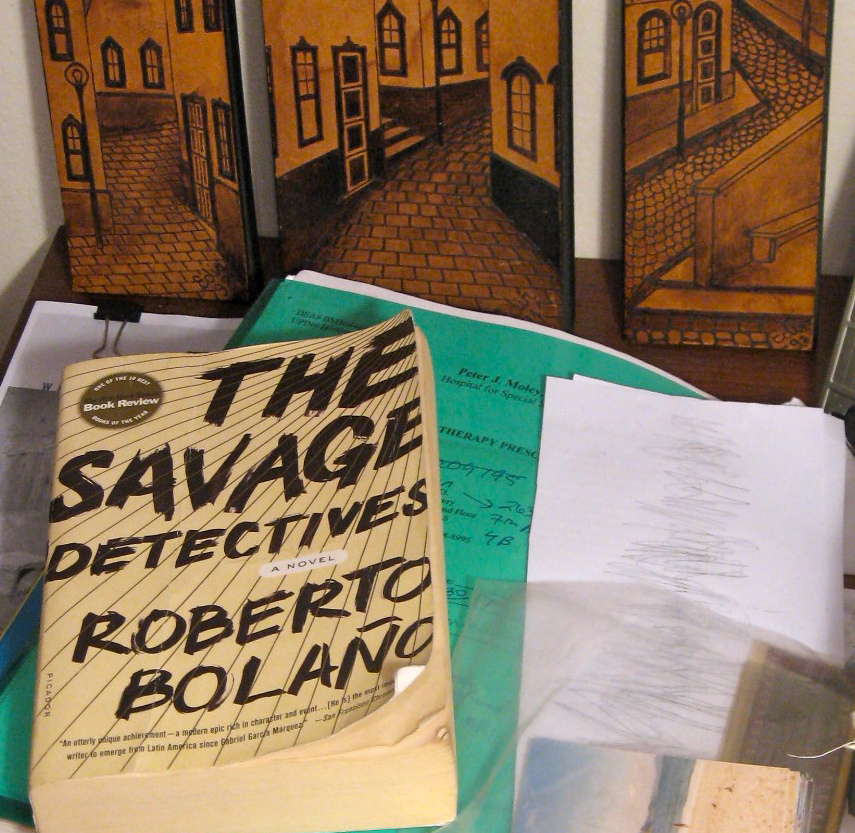
Years later, when I picked up The Savage Detectives in Brooklyn’s Community Bookstore, I felt like I found something I had lost.

My lives with Greene and Cortázar were there on Bolaño’s pages, in the stories of Arturo Belano, Ulises Lima and their band of poets—the visceral realists—by way of hundreds of small depositions from everyone who had crossed paths with them over four continents and twenty years, chronicling their lovers and affairs, their triumphs and tragedies and madness.  About half way through, the literary and historical sweep of the novel becomes staggering, Cortázar resurrected in the granularity of Bolaño’s storytelling and an entire generation of Latin American literature (including at least two Nobel prizes) left in the dust.  This was my world.

I laughed out loud on the subway to read Amadeo Salvatierra reminiscing on his hero during the years just after the Mexican Revolution (p. 396),

… I emerged from the swamp of mi general Diego Carvajal’s death or the boiling soup of his memory, an indelible, mysterious soup that’s poised above our fates, it seems to me, like Damocles’ sword or an advertisement for tequila …

And also at the exchange between Belano and Lima and Salvatierra over the one published poem by Cesárea Tinajero, the original visceral realist in the 1920s (p. 421),

Belano or Lima: So why do you say it’s a poem?

Salvatierra:  Well, because Cesárea said so … That’s the only reason why, because I had Cesárea’s word for it.  If that woman had told me that a piece of her shit wrapped in a shopping bag was a poem I would have believed it …

Belano:  How modern.

I felt my heart tug when Joaquín Font spoke about his release from the mental hospital where he’d spent the last several years (p. 400) …

Freedom is like a prime number.

… and when Edith Oster, a heart-broken, ill, displaced Mexican in Barcelona, told of how she went to find a payphone to call her parents in Mexico City (p. 436),

In those days, Arturo and his friends didn’t pay for the international calls they made … They would find some telephone and hook up a few wires and that was it, they had a connection … The rigged telephones were easy to tell by the lines that formed around them, especially at night.  The best and worst of Latin America came together in those lines, the old revolutionaries and the rapists, the former political prisoners and the hawkers of junk jewelry.

She had broken Belano’s heart, too, but the image brought me back to Vargas Llosa’s revolutionaries in Historia de Mayta, who sat around debating the finer points of Marxist theory in their garage, perched atop stacks of their party’s newspaper that had no readers and never saw the light of day, much less of a dim bulb or candle for covert reading in a dormitory, prison, or monastery.

Bolaño himself was at one time or another an old revolutionary, a former political prisoner, and a hawker of junk jewelry. Adding rapists to the mix only put down the rose-colored glasses of our generation’s passions and all those fights between Garcia Marquéz and Vargas Llosa as if to say “enough, already.”  Yet being Bolaño, it would have been more like a visceral scream from the front row during a book reading at a polite salon or book store.

The Savage Detectives is a fractured narrative told in the shards of pottery and broken mirrors laying about the floors of the places where Bolaño slept.  I read Bolaño and I saw what had become my life.

Notes and Credits

The photo of Bolaño’s The Savage Detectives was taken by the author on his nightstand.  This is the normal appearance of my end table.  I picked up the leather Brazilian street scenes in Salvador, Bahia, in 1993.

Bolaño’s biography is well-noted and I won’t go over it here, except to say that the last 10 years of his tragic life (cut short by terminal illness) was one of those artistic outpourings that will live in legend.  In a brief period of time, Bolaño the cast-off cast-away reshaped Latin America an became its voice (for now, at least).

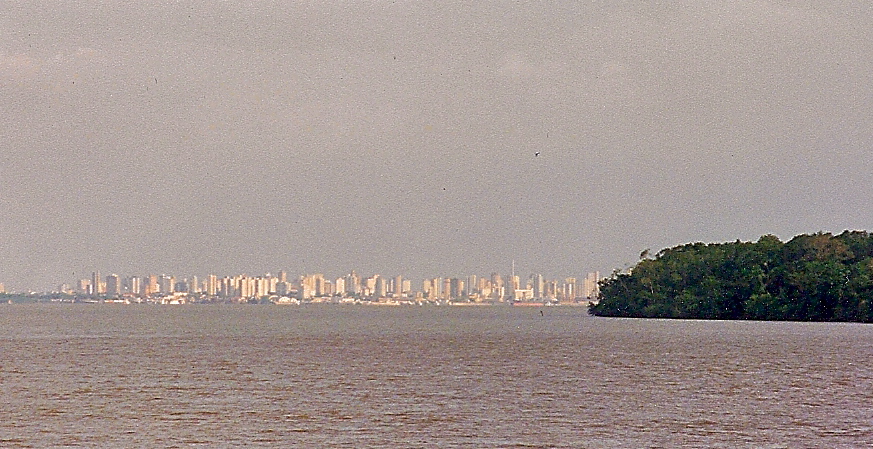
The photo of Santa Teresa and Morro dos Prazeres comes from the Wikimedia Commons and a photographer named “chensiyuan.”  The photo of Belém from the Amazon River was taken by the author in 2000, arriving in Belém on a boat trip that began in Manaus about 10 days earlier.  The photograph of Bom Futuro was taken in 1995 on a visit to Márcia’s house. I’ve chosen for now to leave out my photos of Márcia, her family, and the parties we had.

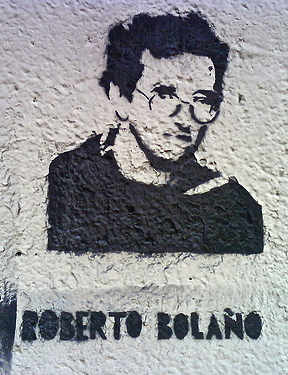
The picture of the Bolaño graffiti was taken from gsz’s photostream on Flickr.  The photo of the author and Gondim was taken on the beach at Mosqueiro in 1995.  Mosqueiro is the old resort area of Belém, still within the city limits but on a remote island, where the elite used to have weekend vilas and houses.

Earlier this year, torrential rains caused flooding in Rio that resulted in a huge landslide in Morro dos Prazeres and other areas.  As a result, the mayor of the city developed a plan to remove the neighborhoods, on the pretext that the danger of flooding is no longer tolerable.  The problem with this logic, however, is that Rio’s favelas have always had this problem in the annual rainy season.  To many, it seems the floods are just an excuse to to solve some of Rio’s other problems with crime and drugs (really a police problem) by blaming the poor and tearing down their neighborhoods.

This is the same issue that drew Janice Perlman to the favelas in the 1960s and me there, later, in the 1980s.  Unfortunately, the problem of drugs and organized crime is all too real.  In 1987, when I was there, the police routinely went into Morro dos Prazeres and rounded up young men for summary executions – this as a warning to others and a means of controlling the population.  Twenty years later, the film Trope de Elite (Elite Squad) chronicled the same story, Morro dos Prazeres still there at the center.

The Memorial da Cabanagem is a landmark in Belém.  It was built by Governor Jader Barbalho after he became one of 9 resistance candidates to win election to governorships against the military regime in 1984.  The pretext is that Barbalho’s victory signaled a rebellion of Cabanagem-like proportions, the people rising up against the elite.  After humble beginnings, Barbalho himself has been governor twice and held seats in both the national congress and the senate, where he was that body’s leader for a short while until he was impeached while rumors and allegations of corruption mounted.  Barbalho is one of the richest men in Pará.  As with Fernando Collor, time conquers all, and Barbalho is back in the national congress representing Pará.  Jeferson Assis’s Flickr photostream has many images of the Cabanagem monument, as does Jeso Carneiro.

Bolaño’s rigged payphones reminds me of stories my friends told about the payphones in Washington Heights in the 1980s.  The Latin American drug traffickers (or so my friends said) would rig them to make free international calls, and everyone in the neighborhood used them.

When all is said and done, I wish peace to my friend Gondim and pray that I will see him again.

5 Comments

Filed under brasil, Brazil, existentialism, fiction, freedom, ideas, life, literature, love, philosophy, truth, writing

The truth and narrative, 2: my life with Julio Cortázar

In the midst of my Greenean visions, fueled from the outset by Pulling’s trip from Buenos Aires to Asunción, I picked up a novel called The Winners at my local bookstore.  I was still in college, and I hadn’t met R in Mexico City yet.

I was possibly still reading One Hundred Years of Solitude or soon to do so. This would have been immediately after exams, either in December or May, when I went to the book store to find novels to fill my holidays away from studies and those other books that gave me purpose without vision.

The Winners had a thick grey paperback cover with a waxy finish.  The design appealed to me, and I can say honestly that book design is an art I admire and cherish and that does indeed achieve its purpose of inviting me to open the book.  It was published by Pantheon, an imprint I always looked for because their titles were leftist and internationalist, like an American Verso.  The novelist was Julio Cortázar, an Argentine writer who was new to me at the time.

It was a narrative of people thrown together by chance.  They’d all won a cruise trip in a local lottery, but once out to sea it became clear that something was wrong.  They were prohibited from going certain places on the boat. There seemed to be a disease somewhere, but there was little information on what was happening and how it might end.  They created alliances and enemies and friends, like Lord of the Flies but not really.  Perhaps more like an inverted episode of Doctor Who, the British inter-galactic time and space traveler who would alight in different worlds and plunge head-first into local controversies and disputes—only in the case of The Winners, it was like a Doctor Who-less Doctor Who with Lord of the Flies-like consequences.

The Winners reflected the real world I knew at the time, in which people become intimately concerned with each other when circumstances gave them common stakes in something.  The something could be anything and was often potentially dreadful, but I was an existentialist.  Cortázar wasn’t my first attempt at anti-narrative or pre-postmodernity.  I’d just come off reading Ulysses and Gravity’s Rainbow in the same term. The difference between Pynchon and Cortázar was that I chose Cortázar, and next I read Hopscotch (Rayuela).  The die was cast.

My copy of Hopscotch was from the same grey-covered series on Pantheon.  I was captivated by the photograph of the thin strawberry-blonde woman on the cover, blouse off her right shoulder, looking down or away, smoke from her cigarette trailing upwards, obscuring her face.  The book came with “instructions” for reading—in linear form, in the order of my choosing, or Cortázar’s indications at the end of each chapter pointing the reader through the book in a semi-random way.  I chose the last alternative, which however random-seeming hung together around a life-time of doing what R and I did in Mexico City for the summer of 1984.

A few years later, in 1987, Sérgio talked about Cortázar as we drank chopp in the sidewalk cafes on Avenida Atlântica in Rio de Janeiro.  Sérgio was the 40-something son of Dona Nazaré, a nice woman in her 60s who rented her rooms as something of a cottage bed-and-breakfast business on Rua Duviver in Copacabana, one block from one of the most famous beaches in the world.  Sérgio was writer; he stood at a podium every day typing while standing, in an odd bedroom or in Nazaré’s kitchen, adding more words and pages to his self-described Kafkaesque stories about life in mid-twentieth century Brazil.  He would publish them on his own, but he had no grand ideas about how many copies they would sell.  For money, he had a state pension (disability after being sacked from a state job and tortured by the military regime), his mother, and the sales of his uncle’s paintings, which he hawked on weekends Copacabana and Leblón.  In whatever combination, it was enough.

Sérgio himself had walked off the pages of Hopscotch.  I liked him, in spite of his off-putting arrogance, and I added many like him to my cast of friends and supporters around Rio.  As we sat there under the umbrellas on Avenida Atlântica, Sérgio named the working girls, many of whom were friends of his and more than few of which, he made of point of mentioning, were not girls in the genetic sense of the word in spite of all (quite convincing I should add) evidence to the contrary.  Avenida Atlântica was his world, and for a while it became mine.  With Sérgio, I read Cortázar and heard a calling.

Notes and Credits

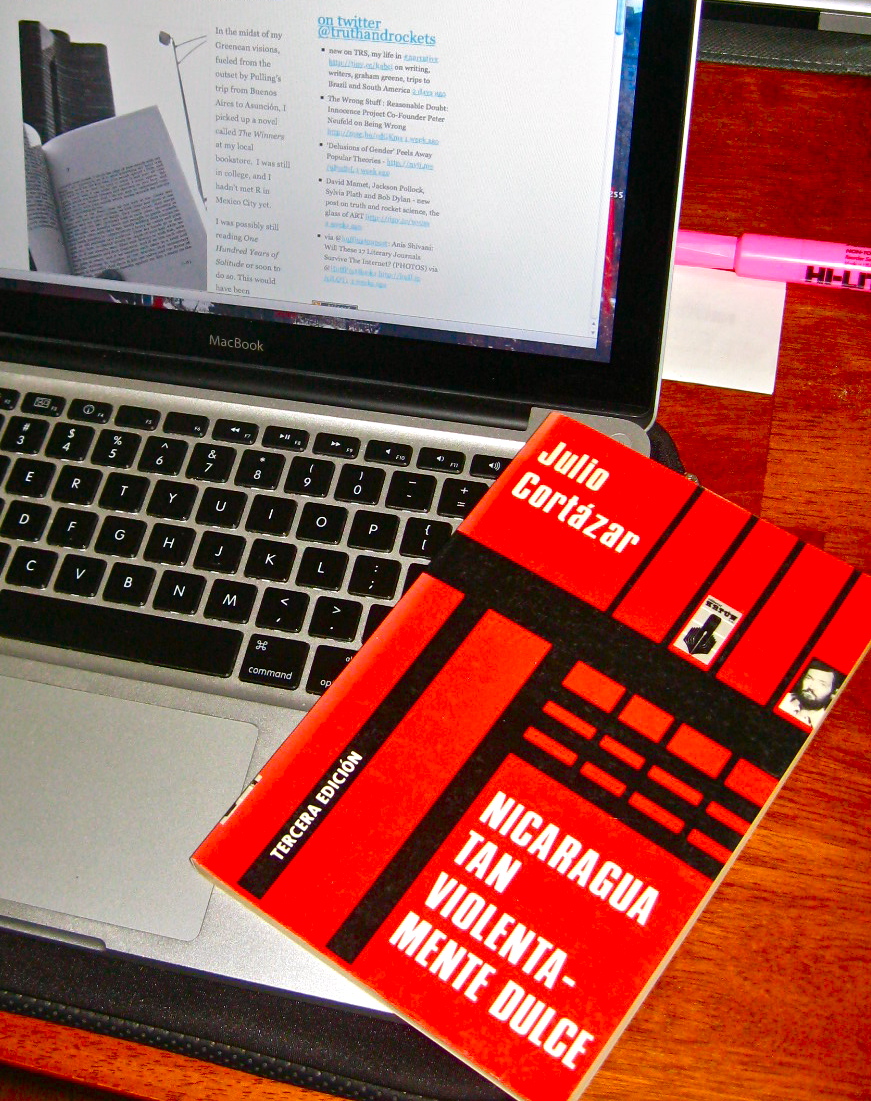
The opening photo is of a volume that R gave me when I visited her in Mexico City in the summer of 1986, Nicaragua tan Violentamente Dulce.  In the background, Gary Fuss’s photo of Chapter 7 of Hopscotch sits at the opening of an earlier version of this post.  Gary was kind of enough to allow me to use his photo, which can be found on his Flickr page here, along with many other interesting photos of Chicago and elsewhere.

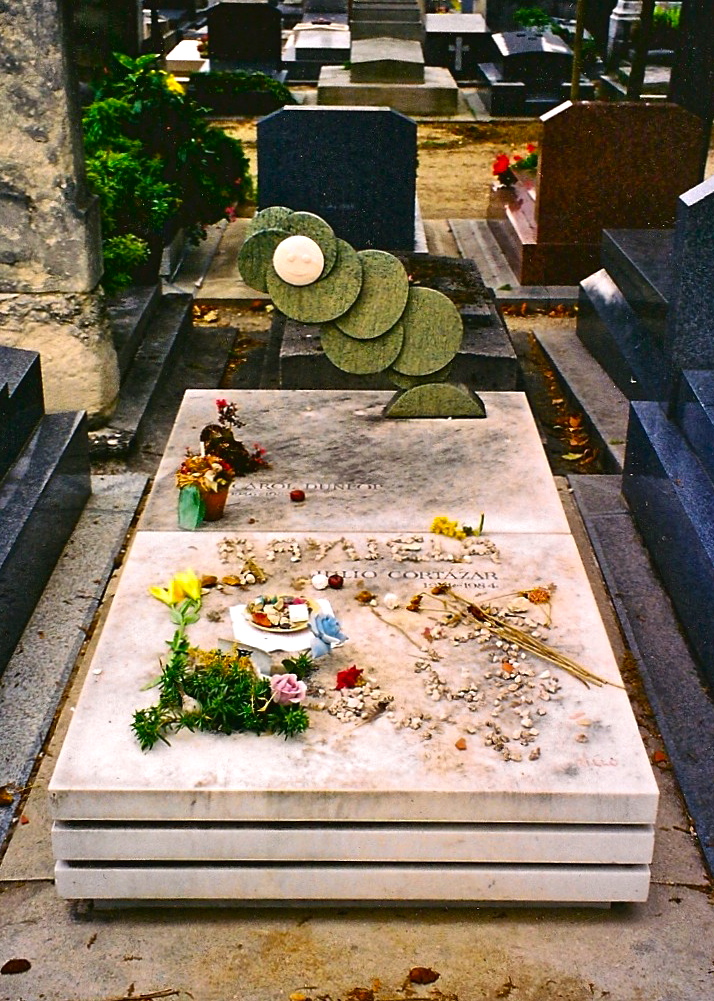
The photos of Copacabana Beach and Cortázar’s grave site were both taken by the author, in 1987 and 2002, respectively.  This was the view of Copacabana from across Avenida Atlântica, where Sérgio and I would sit, talking and drinking chopp in the sidewalk restaurants.

My volumes of The Winners and Hopscotch have been lost, sold to the Dawn Treader bookstore along with 40 shelf-feet of books that I liquidated when I left Ann Arbor in the early 1990s.  This sale involved nearly every single book I had ever owned in my 28 years up to that point.  It was a literary purging.  I saved some (like my Pynchon) and would have thought Cortázar’s among them, but no.  To this day I can no longer find The Winners or Hopscotch (Rayuela) among my holdings.  Along they went with the lot, over $400 of books at about 50 cents per book.  At that point in my life, it was half a month’s salary.

It was a lot of books for anyone, 28 or 82, but books were where I lived to that point, in my head and in the imaginations of my writers.  For a while, I entered Dawn Treader lore, and a photograph taken from one of my books went on the store’s bulletin board with other artifacts retrieved likewise over the years.  I know that the photo stayed there for some time, a few years it seems.  I remember the woman reviewing my books for purchase was struck by the notes my father wrote on the cover page of every single he’d ever given me.  Perhaps there are still books of mine on the shelves.

In Brazil in 1987, I was fortunate to have brought Kafka’s The Castle.  It kept me company after Sergio’s lectures.  At home in the mid-1980s, I had Doctor Who—the Tom Baker version who with the lovely Romana took me all the other places literature and social science couldn’t.

2 Comments

Filed under art, brasil, Brazil, existentialism, freedom, ideas, life, literature, truth, writing

The truth and narrative, 1: my life with Graham Greene

This is the first of three posts on writers whose work has influenced the course of my own life.  The writers are Graham Greene, Julio Cortázar and Roberto Bolaño.  In these writers I have seen myself in futures, presents, and pasts.

Travels with My Aunt

It started when I saw glimpses of the film, Travels with My Aunt, late at night on television.  I was doing homework or something.  What I noted then, and what I remember now, is the face of a very young Cindy Williams on a train with Alec McGowen as Henry Pulling.

I was in college already, but still living at home with my parents.  I had these vague ideas of wanting to explore the world, do something exciting, see places no one in my family ever had seen.  Later, I noticed the book on a shelf in the house and read it.  What I remember best from the book is Pulling’s trip by boat up the Rio Paraguay, from Buenos Aires to Asunción.  I knew then what I wanted to do with my life.

My mother, it turned out, was quite fond of Graham Greene.  She was fluent in Spanish for reasons she never told me, though I cannot recall whether she declined to say or I simply failed to ask.  As a college student in Pennsylvania, she had gone to Mexico City one summer to study abroad, a trip that led her to New Orleans and Loyola University, where she met my father in 1960.  At Loyola, she paid her bills in college by teaching Spanish at Mercy Academy, a Catholic girls’ prep school next to the campus.  She told me Travels with My Aunt was a frivolous book and that the really good Green was in The Power and the Glory, his novel of a “whiskey priest” trying to escape persecution during the Mexican Revolution and its aftermath.  I read the book and though I agreed with my mother, I never stopped thinking about Asunción.

Mexico City

In the summer of 1984 it was my turn, and I went off to Mexico City in the very same program my mother had gone on 25 years earlier.  My Dutch friend was on the Mexico trip the year before, and he gave me the names of two girls, R and E, and told me to look them up.  He’d had a crush on E, who worked in the big bus station and lived in a poor neighborhood on the outskirts of Mexico City, where 2-room cinder block houses crept up the hillsides surrounding the city.  E was indeed the prettier of the two, but I fell in love with R.

She was older than I was by about seven years, which at the time seemed like a lot.  She took me to Coyoacan, where we sat on park benches until three in the morning kissing and talking under the stars, which we could not see but knew were there above the constant soup of Mexico City smog.  We talked about Frida Kahlo and listened to jazz.  We drank tequila over art and philosophy and revolution with her friends.  During the days, in between classes in US-Mexican Diplomatic History and Spanish, I took Graham Greene novels from the library and devoured them.  The End of the Affair, The Comedians, The Human Factor, and others.  I marveled at the stories he told, so strong and bold and confident.  I read Greene and knew what I wanted to do with my life.

Rio de Janeiro and Asunción

I imagined I was reading biographies of the lives I wanted to lead, perhaps without the Russian Roulette but nonetheless in that Greenean world of strained romance and moral decay.  By the time I was 23 I was on my way to Asunción, albeit over land by bus from Rio de Janeiro, where I had just spent 6 weeks interviewing people in favelas during the day.  Favelas were the infamous slums that clung to the mountainsides of Rio and lined the bottoms of its swamps.  In the favelas, marginal people lived on the extremes of the most spectacular scenery on earth.  By night I played music with my friend Rogerio do Maranhão, who had standing gigs at Maria Maria in Bota Fogo and a pasta house in Copacabana.  We sang for food, beer and women.

... portrait of the author as a young musician

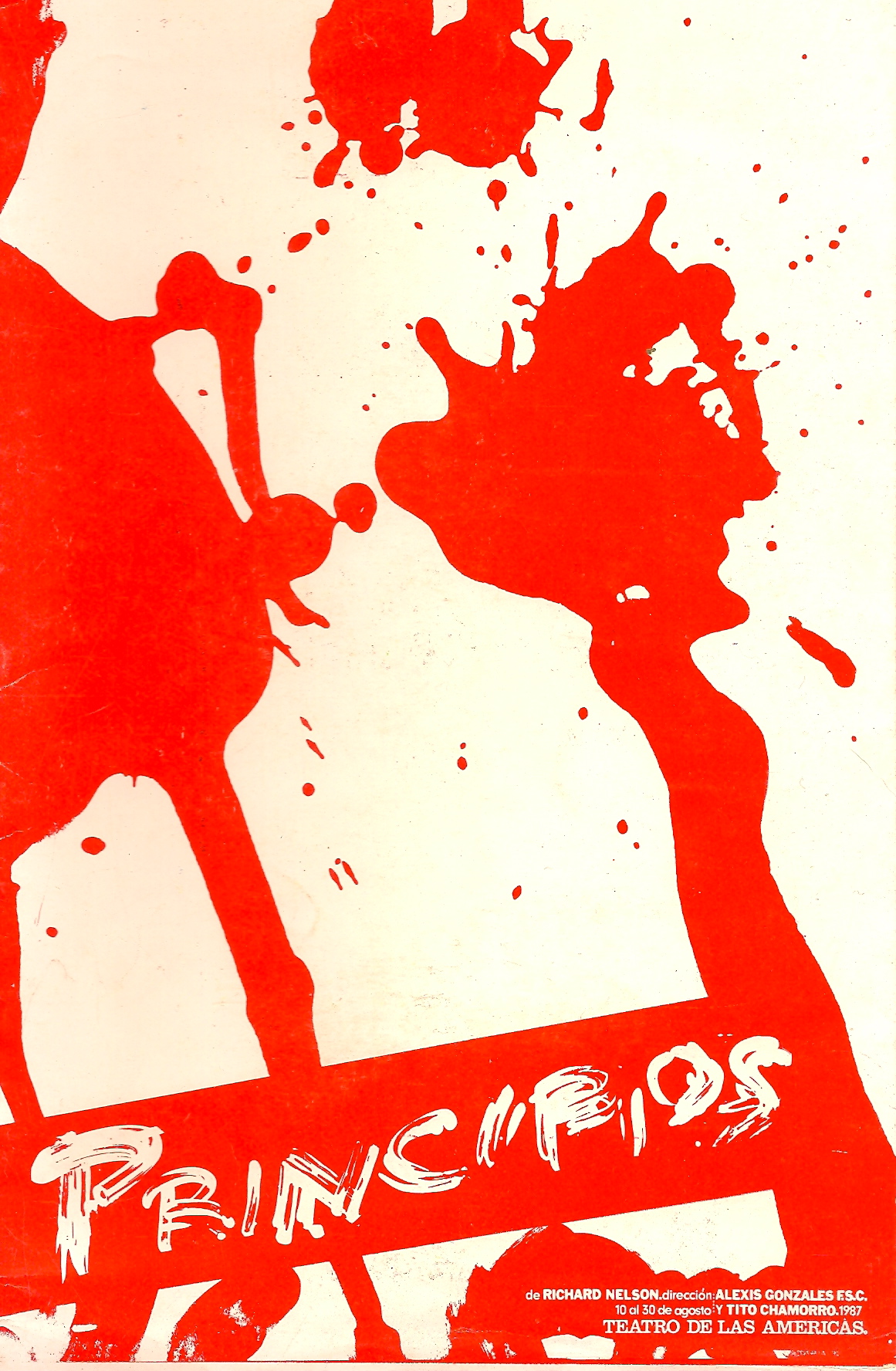
In Asunción, I stayed with the family Weiss, who were hosting Brother Alexis Gonzales, a theatre director from Loyola, mom’s and my old alma mater.  One night, after hanging out with the actors past curfew—these were Stroessner’s last days—I came home to find everyone on the street in their night clothes.  Minutes earlier, some Colorados drove by and shot up the house. They didn’t like Alexis’s production of Princípios, a play about censorship in Latin America. We pulled bullets from the walls and kept them as souvenirs.

Along the way, Greene stayed with me.  He wrote at a disciplined clip of five hundred words per day and produced almost a novel a year for forty years. His stories played on the compromised decisions of flawed men in decadent contexts.  With le Carré, Greene was the ultimate Cold War novelist, the two of them forming bookends around the era’s great struggles and grand themes, le Carré in Europe and its near environs, Greene everywhere else, across Latin America, Africa, and Asia.  They were our literary secret agents, searching for (and finding) the same themes every where they looked, morphing effortlessly into the same man with a different name everywhere they went.

Greene wrote about people and places that were not his native contexts, though when he did touch his own world, as in The End of the Affair, the results were breathtaking.  I was drawn most to his wanderlust and his ability to create compelling stories in so many different places.  Still I wondered—why did Greene make such sense to me?  Was it because I, too, was an outsider, a privileged white thrill-seeker in worlds brown and black and poor and altogether far away from the places I knew?

Yet critical post-colonial narrative was not something I could sustain for very long.  I was too good-humored and guileless.  This was a chicken and egg story that after a while could be anything and nothing at all.  Like all narratives it was mostly about justification and never really got to the heart of the matter.  Disciplined writing in an inevitably tainted world of compromised good and stilted vengeance was, on the other hand, a narrative I could understand.

Notes and Credits

I was inspired to go up the hills by my advisor at Tulane and by a book called The Myth of Marginality by Janice Perlman.  Perlman went to the favelas and lived there and worked with the residents even as the military government at the time was razing their neighborhoods and resettling the residents in modern slums further from the center of town.  I called Perlman from S’s dorm room at Louisiana State University one Sunday morning as the fog of a hangover left me, to ask Perlman about doing this kind of work.  “Go, do it,” she said, without specifying anything more specific about how to do it or whom to ask for help.  I didn’t speak to her again until 2006, almost 20 years later, and in 2007 I was able to contract her to evaluate the program I ran at the New York Academy of Medicine.  In 2010, she published a sequel to Myth of Marginality called Favela, in which she revisits the favelas and favelados she wrote about n the early 1970s.  She was able to find the children and grandchildren of her original subjects and the new book is a compelling story of coming full circle, as all narratives eventually do.

Cover photograph of Travels with My Aunt from the Wikipedia article about the novel, found here and used under fair use principles.   The photograph of Greene’s gravesite is also from Wikimedia and is used under the Creative Commons license.

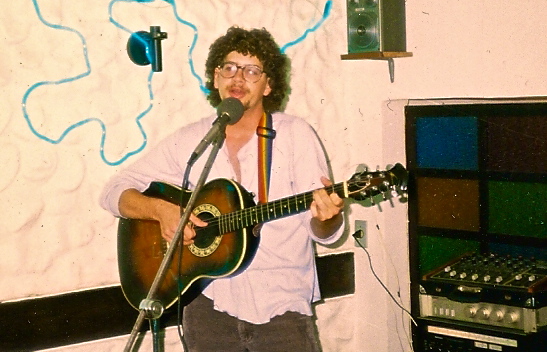
Photograph of the author from his personal collection, no doubt to be sold one day for millions (in Monopoly money?) on E-Bay.  I cannot recall the name of the restaurant in Copacabana where we used to play, but here’s another of my friend Rogerio, from the same time.

Rogerio do Maranhão

2 Comments

Filed under art, Brazil, freedom, individuality, life, philosophy, postcolonialism, truth, writing, youth

The truth and the recursive (in search of search terms)

There was a time when searching any string of words with “Lascaux” in it would bring up my post, “The truth and change, 3a:  From Life on Mars to Linden,” as one of the top three hits in the images section—because of the photograph I used of the caves in Lascaux, France.  I got the photo from Wikimedia Commons.

Then there was “bee tree,” or “bee bee tree,” which for a long time brought up my photograph of a tree in Prospect Park, Brooklyn (11215), where I observed a bee swarm with my son in 2008.  I took the photograph, along with the photograph of the bee warm itself.  This photo was in the post, “The truth and Twitter, part 3:  The Swarm.”

And then these images completely disappeared from the Google Images searches.

Which made me begin to wonder:  How do search terms work?  A friend told me to embed vivid descriptions in my photographs, because Google really likes this.  And then I thought about all those search terms that I see every day on my data.  Some are downright weird—“life goes on symbology” or “rocket party dei black eyed beans”—and some sound really cool—“gilgamesh Foucault” and “shot of major truth and rocket science.”

I’m no whiz in SEO (search engine optimization), but I thought it would be fun to post all the  search terms I have seen, down to a certain level (all these are multiple viewings) that people have used to find truth and rocket science, whether they intended to or not.  What happens when people search these terms?  Do they come to this posting, or some other? Does this (not entirely) random assortment of words bring about some kind of Internet query magic?  Would be fun to see …

Update, 15 minutes after I posted this originally

Within 15 minutes of posting this, these search strings came up.  I just had to add them.  It’s obvious why.

medieval witch killings paintings

envy the epic of gilgamesh

eclectic

bee tree

wolverine michigan desk

maghan lusk

sleeping dogs

pond @wordpress

blacklight poster

zebras

brigadier pudding

hubris fingerprint

faroeste gary cooper

mirrors “lady from shanghai ”

blacklight poster

bee bee tree (almost every day for a while)

lady from shanghai mirror scene

“not many people make me laugh”

tett creativity complex

john locke public domain pictures humane

iran twitter

rocket party dei black eyed beans

bacon francis house

Walgreen

lotte zweig

“kareem fahim”

zebras

twitter iran

reichstagsbrand

sleeping dog

bee tree

sleeping dogs

Walgreens

zak smith

tattoo and tattoos

“life goes on” tattoo

tattoo design principles

Credit:  The photograph is of tattoo work by Grisha Maslov, copyright 2010, obtained from Wikimedia Commons.

Gilgamesh

heroism in Gilgamesh

gilgamesh Foucault

Foucault Gilgamesh

Note: I am not sure where this came from, since Foucault is not mentioned in the post with Gilgamesh.

amoebas and dysentery

gas exchange in amoebas

amoeba pictures

poem on dysentery

amoebic dysentery brazil

live amoeba vs. fixed amoeba

Amoeba

Brazil

brazil land of the future by Zweig trans

lolalita brasil1

brasilia architecture falling apart

brasilia

faroeste caboclo

brazil colony

forest manaus

social science

standard deviation diagram

one standard deviation bell curve

stats bell curve normal curve

standard deviation bell curve

bell curve

iq bell curve

bell curve standard deviation

iq bell curve diagram

standard deviation diagram

bell curve diagram

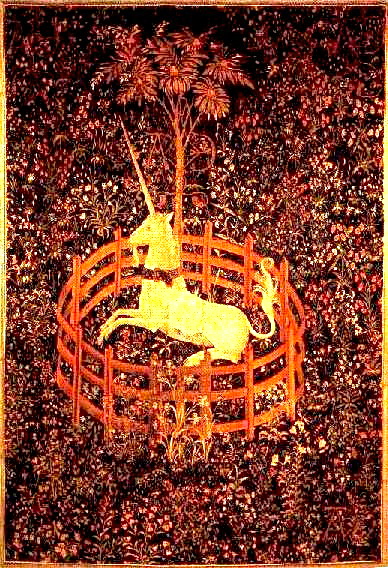
unicorns and medieval stuff

medieval maiden painting

unicorn pictures

unicorn truths

unicorn Bristol

unicorns

unicorn

unicorn medieval

unicorn museum castles in new york

the unicorn leaps out of the stream

the start of the hunt

unicorn in captivity

the unicorn is found

the start of the hunt

the truth about unicorns

the hunt of the unicorn

Sylvia Plath and Leonard Shelby

Memento, the film, a timeline

plath writing

leonard shelby

Credit: The chart of the timeline of Memento (Christopher Nolan) is by Dr Steve Aprahamian, and can be found on Wikimedia Commons.

truth and rocket science

truth and rocket science (lotsa times)

rocketscience.com

rocket science in our lives

shot of major truth and rocket science

truth and rocket science

the truth about diamonds

the truth and sleeping dogs

Lascaux

The House of Tomorrow, 35,000 BCE

Lascaux

lascaux cave pictures

lascaux paintings

lascaux cave paintings

lascaux cave

lascaux painting

lascaux images

cave art Lascaux

lascaux caves france

cave paintings Lascaux

lascaux pictures

cave of Lascaux

lascaux caves

caves of Lascaux


9 Comments

Filed under hubris, ideas, life, New York, philosophy, truth, vanity

Without truth you are the looser

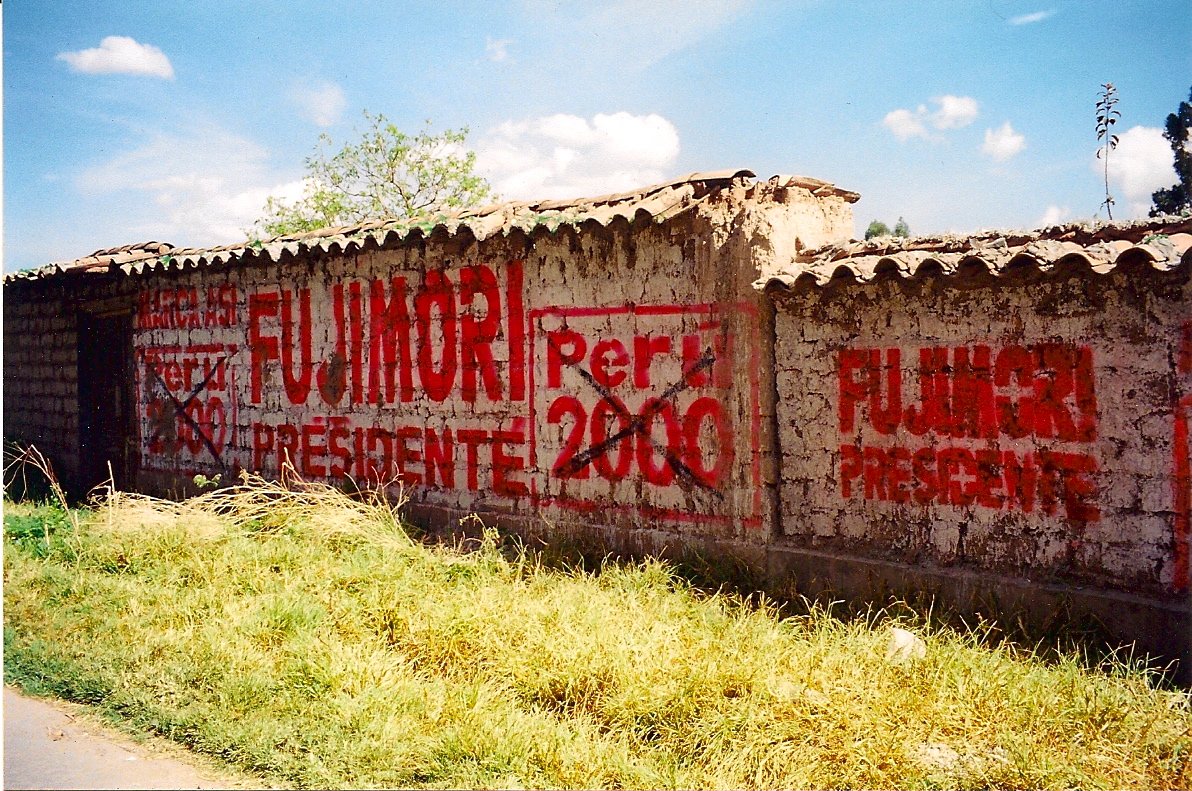
If a picture is worth a thousand words, how many words is a picture of words worth?

Spelling mistake or assertion about the relationship of truth to intestinal fortitude?  Martin Luther would surely disagree, for in his case getting to the truth was intimately dependent upon getting loose, and the entire fate of the Medieval Church hung in the balance.  Luther’s was one divine and hellacious struggle.

By the time Alberto Fujimori got loose and began to deal with his struggles, he was a wanted man.  President of Peru from 1992 to 2000, he defeated the Shining Path revolutionaries by resorting to atrocities that rivaled those of this enemies.  The dirty war in Peru took over 70,000 lives on both sides, and mass graves of military executions are still being found.  Peru’s Equipo Peruano de Antropología Forense (Peruvian Forensic Anthropology Team) has made a striking documentary of the largest grave site, If I Don’t Come Back, Look for Me in Putis.  After losing the 2000 presidential race, Fujimori fled to Japan after corruption schemes involving over a billion dollars came to light.  He returned to South America in 2005 to run for president again the following year, but instead he was arrested, tried, convicted, and thrown in jail.  With or without the truth, Fujimori was finally  the loser.
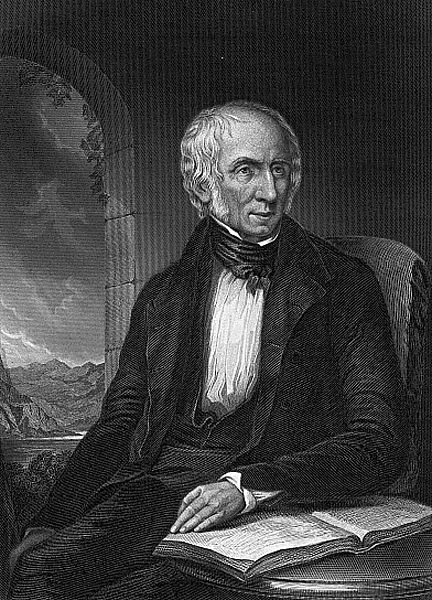
How many words is a Wordsworth worth?

Notes and Credits

All photographs were taken by the author, except as otherwise noted.

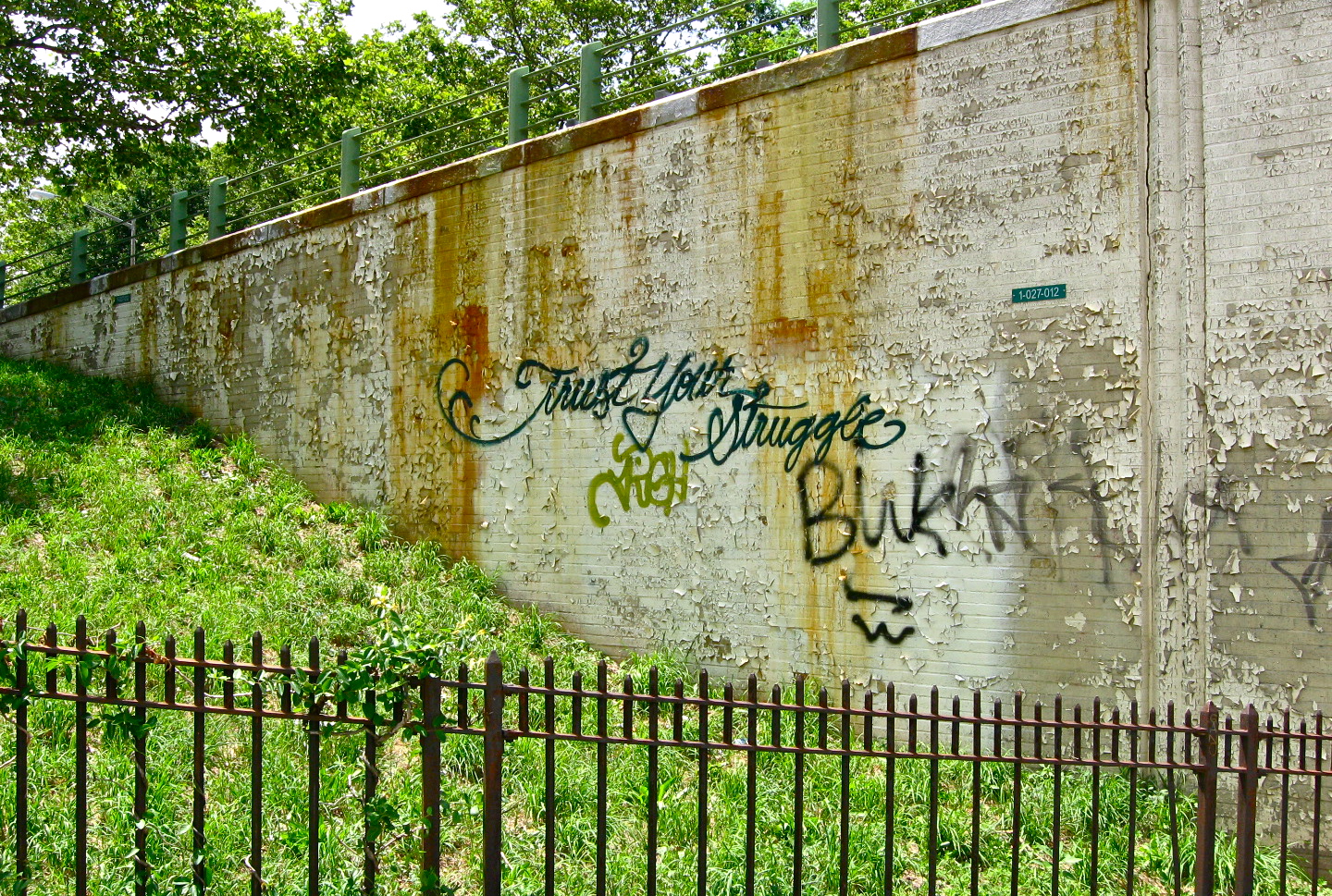
“Trust your struggle” appears on the approach ramp to the Ft. Hamilton Parkway Subway Station in Kensington, Brooklyn (zip code = 11218).

“Without truth you are the looser” was taken in Lisbon, Portugal in 2000.  The ironies of this photograph go well beyond its mispelling.  But that’s all I’m saying here.

“Fujimori Presidente” was also taken in 2000, on a trip I took to Peru with students from the college where I taught at the time.  This political graffiti was seen on a fairly desolate road in the altiplano, the high plains of the Andes Mountains.  We were on a bus on our way over the continental divide, which we crossed at around 16,000 feet, and then down, down, down to the Manu River Forest Preserve.  The Manu River is a tributary of the Amazon River which at this point has just come rushing down from the Andes and is settling into the massive river it will become with each new tributary on its 2,000+ mile journey to the Atlantic Ocean at Belém.

William Wordsworthis an image from the Wikimedia Commons of what is apparently an 1873 reproduction of an 1839 watercolor of the poet by Margaret Gillies (1803-1887).

The Importance of Place: Fort Hamilton Subway Station

The Ft. Hamilton station is beneath an expressway interchange, where the Prospect Expressway empties out on to (or begins at, depending on your vantage) Ocean Parkway, beneath the Ft. Hamilton Parkway overpass.  Ocean Parkway is a major thoroughfare running south to Coney Island from Prospect Park.  It’s a folkloric parkway lined with trees and sidewalks where people are walking every day of the week, at all hours it seems.  Kareem Fahim posted this wonderful story on Ocean Parkway in the Times on October 10, 2008.

Here’s a video, working hard to be experimental, on the Parkway …

And this one, with a bowling theme, which is big here.  In summer camp they take the kids at least once a week, from age 5 on up.

The Prospect Expressway links Ocean Parkway to the Brooklyn-Queens Expressway, the BQE as we call it.  This interchange is a concrete manifestation (literally) of Robert Moses’s dreams for New York.  Moses served in various posts involved in urban planning and development, and from the 1930s to the 1970s he managed to thoroughly remake the city and Long Island’s highway system, housing agencies, and parks, which we have taken up before in Truth and Rocket Science, in The truth and change, 2: Technoredemption Goes Pro and The truth and set theory: more on Mr. McNamara.  The Fort Hamilton interchange is one small of Robert Moses’s living legacy.

The photograph above is found on the Wikimedia Commons.  To the right is the beginning of Ocean Parkway, where the Prospect Expressway empties out.  The person walking away in the photo has just passed “Trust your Struggle,” to the left, on the side of another retaining wall, as is obvious from the way that he (or she?) is contemplating the solipsism of passengerless cars rushing by on the expressway.  I do not know who put this particular graffiti there, but I smile a little every morning as I walk by it.

11 Comments

Filed under art, ideas, life, media, philosophy, struggle

E/F – The glass (or cup, as it were) of coffee

Thomas Pynchon once imagined a conversation between Mason and Dixon (of the “line” fame, not the knitters, or the pollsters) that is as true in the twenty-first century as it must have been in the eighteenth.  Mason asked Dixon,

How is it … that of each Pot of Coffee, only the first Cup is ever worth drinking,— and that, by the time I get to it, someone else has already drunk it?”  To which Dixon answered that it’s because of “Coffee’s Sacramental nature, the Sacrament being Penance … whereby the remainder of the Pot, often dozens of cups deep, represents the Price for enjoying that first perfect Cup.”

Coffee is the original smart drug, but like all things good, it comes with a price. The key is to be mindful of how much you drink, for the beneficial effects advance only to a certain level, after which having more coffee produces something like a living nightmare of half-truths, unfinished thoughts, and incomplete sentences.

For these and other reasons, people have blamed coffee for the Enlightenment and related revolutions in rocket science and politics.  They all got started in coffee houses, perfect sites for the blending of conversation and caffeine, the ultimate result of which being a heightened desire for self-expression without, however, a commensurate acuity thereof.  Or as Pynchon put it when describing the scene as Mason and Dixon slipped into a coffee house in Philadelphia in the late 1700’s—

With its own fuliginous Weather, at once public and private, created of smoke billowing from Pipes, Hearthes, and Stoves, the Room would provide an extraordinary sight, were any able to see, in this Combination, peculiar and precise, of unceasing Talk and low Visibility, that makes Riot’s indoor Sister, Conspiracy, not only possible, but resultful as well.  One may be inches from a neighbor, yet both blurr’d past recognizing,— thus may Advice grow reckless and Prophecy extreme, given the astonishing volume of words moving about in here, not only aloud but upon Paper as well …

Coffee sounds a lot like alcohol.  Coffee houses and barrooms once upon a time shared the combination of low lights and incessant smoking that leads two or more people to make very bad decisions based on what little they can see or understand of each other, half-remembered bliss and release lifting like a fog with the clarity of morning.  The poor judgment brought on by low-lit coffee conversations that once resulted in revolutionary dreams, however, now leads mainly to snark and graduate theses.  Compared to alcohol, it’s more difficult to appreciate the terrible results of coffee, because they are so often taken for success.

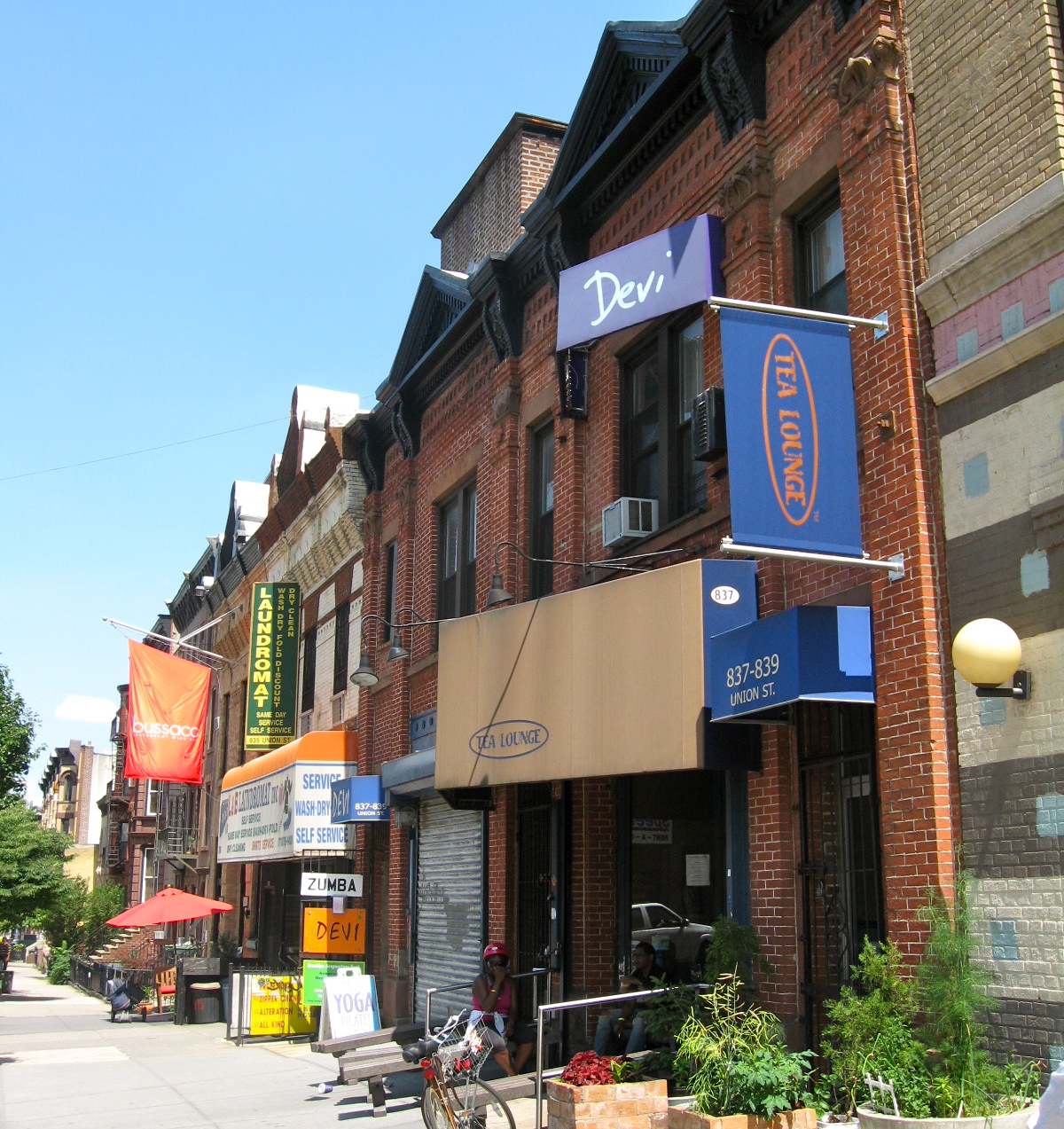
The Tea Lounge, Park Slope, Brooklyn: a revolution is being plotted right here, right now.

People often combine alcohol and coffee, as if the effects of one can cancel out the other.  This is a mistake.  When you drink coffee while already drunk, you don’t become sober.  Instead, you achieve a much more keen awareness of how incoherent you are.  It’s called coffee-boarding and is outlawed by several international accords signed by everyone but the United States.

The relationship of coffee and alcohol to the truth is easily demonstrated by the degree to which various world religions have grappled with either or both.  Islam banned alcohol, and Muslims became coffee addicts, as did fundamentalist Christians though their coffee is not nearly as good.  AA meetings would be intolerable without coffee.  The Mormons banned both coffee and alcohol, which is why they wound up in Utah, though somehow Coca-Cola escaped the ban despite its (post-cocaine) base in coffee’s essential force, caffeine.  The Buddhists call for people to avoid intoxication by alcohol or stimulants, but they don’t make it inflexible.  This sounds like a pretty good idea, except that it’s impossible, which is the point.

The Tea Lounge, Park Slope

repurposing an old garage, the Park Slope way

The photos for this post were taken in the Tea Lounge, a venerable institution in Brooklyn’s Park Slope, the neighborhood that everyone (else) in New York loves to hate, according to the local newspaper.

The original shop was located in the South Slope on 7th Avenue but had to close a while back due to increasing rents, leaving the larger Union Street shop (pictured here) as the flagship in the heart of the neighborhood.  (Another Tea Lounge has opened in Cobble Hill, a couple nabes over on the other side of the Gowanus Canal.)

Every morning, it begins to fill up with freelancers of every type imaginable – writers, designers, editors, bloggers, people looking for jobs – who stay there all day sipping coffee and making the American economy what it is (hey, they’re telecommuting).  One morning a week (which one has rotated over time) the place fills up with mommies and nannies and toddlers when Lloyd comes to sing for the kids.  Those of us who’re working (including the staff) double down, shut our ears, and keep on working.  The place features in Amy Sohn’s satirical send-up of (and not-entirely-ironic homage to) Park Slope mommyhood, Prospect Park West, as the “Teat Lounge,” so-called for the ubiquitous nursing of infants that goes on there to the soundtracks of Neil Young, Rolling Stones, Joni Mitchell, and the occasional contemporary indie-groove (think Jem).

A review by Elizabeth of the Anti Tourist describes the Tea Lounge like this:

Studious laptop users sat beside romancing couples and chatty friends and I have to say, between licking the whipped frosting off of my OREO cupcake and sipping a glass of Riesling, I was immediately at ease–especially when my friend bought me a second glass. So yes. Conclusively, I like Tea Lounge. Is it a perfect place to work? Eh. Maybe not. Is it a good place for a date or a drink with a friend? Definitely.

Notes and Credits

All photographs by the author.

Thomas Pynchon on coffee in Mason and Dixon (New York:  Henry Holt, 1997) page 467 for the first quotation and 305 for the second. It’s an historical novel that follows the eighteenth century British astronomers Charles Mason and Jeremiah Dixon throughout their lives, from their early collaborations in England and South Africa through their pioneering work to survey the border between the Pennsylvania and Maryland colonies from 1763 to 1768.  As novels go, it’s a wonderfully comic buddy film with a touching ending that reaches deep into the emotions surrounding friendship and fatherhood.

Stephen Johnson in The Invention of Air:  A Story of Science, Faith, Revolution, and the Birth of America (New York:  Riverhead Books, 2008) provides rollicking imagery of the confluence of coffee, truth, alcohol, rocket science, tobacco, and the Enlightenment.  The thesis is simple:  replacing beer with coffee as a way to avoid bad water propelled the Enlightenment foward with clear thinking at long last.  Of the London Coffee House, the meeting place of Benjamin Franklin, Joseph Priestly, and other men of science and revolution, Johnson wrote (p. 17)—

The London Coffee House lay in St. Paul’s churchyard, a crowded urban space steps from the cathedral, bustling with divinity students, booksellers, and instrument makers.  The proximity to the divine hadn’t stopped the coffeehouse from becoming a gathering place for some of London’s most celebrated heretics, who may well have been drawn to the location for the sheer thrill exploring the limits of religious orthodoxy within shouting distance of England’s most formidable shrine.  On alternating Thursdays, a gang of freethinkers – eventually dubbed “The Club of Honest Whigs” by one of its founding members, Benjamin Franklin – met at the coffeehouse, embarking each fortnight on a long, rambling session that has no exact equivalent in modern scientific culture.

It no doubt would be interesting for Mr. Johnson to survey the clientele at the Tea Lounge and find out what revolutions are brewing for the near future here.

7 Comments

Filed under fiction, freedom, ideas, individuality, life, Park Slope, philosophy, politics, revolution, struggle, truth

The truth and fearlessness

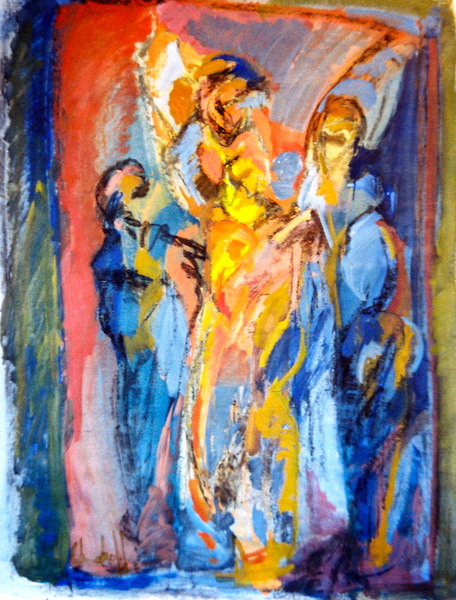
Macha Chmakoff, Daniel et l'ange dans la fosse

My God has sent his angel and closed the lions’ mouths so that they have not hurt me.

Daniel 6:23

Of those who are fearless, there two kinds:  the reckless and the serene.

The reckless attract more followers, for they are dashing and dramatic.  Yet that which is dramatic is also sloppy and careless.  The reckless laugh in the face of danger, but only because doing anything else would seem lifeless and limp.  The reckless cannot appreciate the little things, nor can they understand the subtle, warm moments in between danger, fear, excitement and ecstasy.  They see and feel only in extremes and abandon all judgment in between.  They search out life at the margins where few dare to go or dwell and in this they seem like heroes, but they are not.  Heroes can understand triumph in sadness, and they always know where they are.  The reckless, by comparison, are lost.

I—I can remember
Standing, by the wall
And the guns, shot above our heads
And we kissed, as though nothing could fall
And the shame, was on the other side
Oh we can beat them, for ever and ever
Then we could be heroes, just for one day

David Bowie, “Heroes” (1977)

Fearless Heroes

The serene can be heroes.  They know where they are and what they want.  They are motivated by the desire to do the right thing, and they do so regardless of the odds of success or failure.  They are not reckless because they endanger no one but themselves.  They accept the risk even as they try to minimize it because they are as simply human as the rest of us and they do fear death and pain and suffering.

Giotto, St. Francis Preaching to the Birds

Heroes who are fearless and serene become vessels for a love larger than they are.  They seek nothing from their actions but to be made even more whole in the act of giving to another.  St. Francis of Assisi—once a street brawler, solider, and libertine—found his calling in service to the poor and in love for the animals.  He became the friend of all those in harm’s way, the trampled upon, oppressed, and marginal.   The prayer of St. Francis puts all of this in simple verse.  We used to sing it in church when I was a child.

Lord, make me an instrument of your peace
where there is hatred, let me sow love
where there is injury, pardon
where there is doubt, faith
where there is despair, hope

where there is darkness, light
where there is sadness, joy.

O Master, grant that I may never seek
so much to be consoled as to console
to be understood, as to understand
to be loved, as to love
for it is in giving that we receive
it is in pardoning that we are pardoned
and it is in dying that we are born to Eternal Life.

Amen.

Modern Heroes

Padre Bruno Secchi and Pastora Rosa Marga Rothe—he a Catholic priest and she a Lutheran Minister—are both human rights workers in Brazil. I met them in 1992, as I was beginning fieldwork for research on social movements and politics.

Padre Bruno came to Brazil in 1964 and in 1970 founded the República of Emaús, a ministry with street children.  Emaús has just celebrated its 40th anniversary and is still going strong.  Padre Bruno’s work is dedicated to creating the space and opportunity for street children to grow into productive, happy people.  It is humble work, dedicated not to changing these children but to allowing them to find their potential and calling in life.  Emaús in Belem was a part of the worldwide movement that eventually resulted in the UN’s Convention on the Rights of the Child, which was ratified in 1989.  The CRC is a milestone on the path to a better world, appointing the rights of the child in the world we would like to have, not the world we know right now.

Rosa Marga I have written about already, in the Tamba-Tajá stories.  She teaches and practices liberation theology, the interpretation of Jesus’s life and works as a message of liberation for the oppressed and marginalized of the world.  She has been a leader in the women’s movement in Brazil and Belém.  From 1997 to 2005, she was the Ombudswoman for the State Police in Pará, responsible for representing and investigating claims against corruption, brutality, or human rights violations by the police.  In this position, she received international recognition.  She and her family took me in as a friend.  There is always much joy in her house.

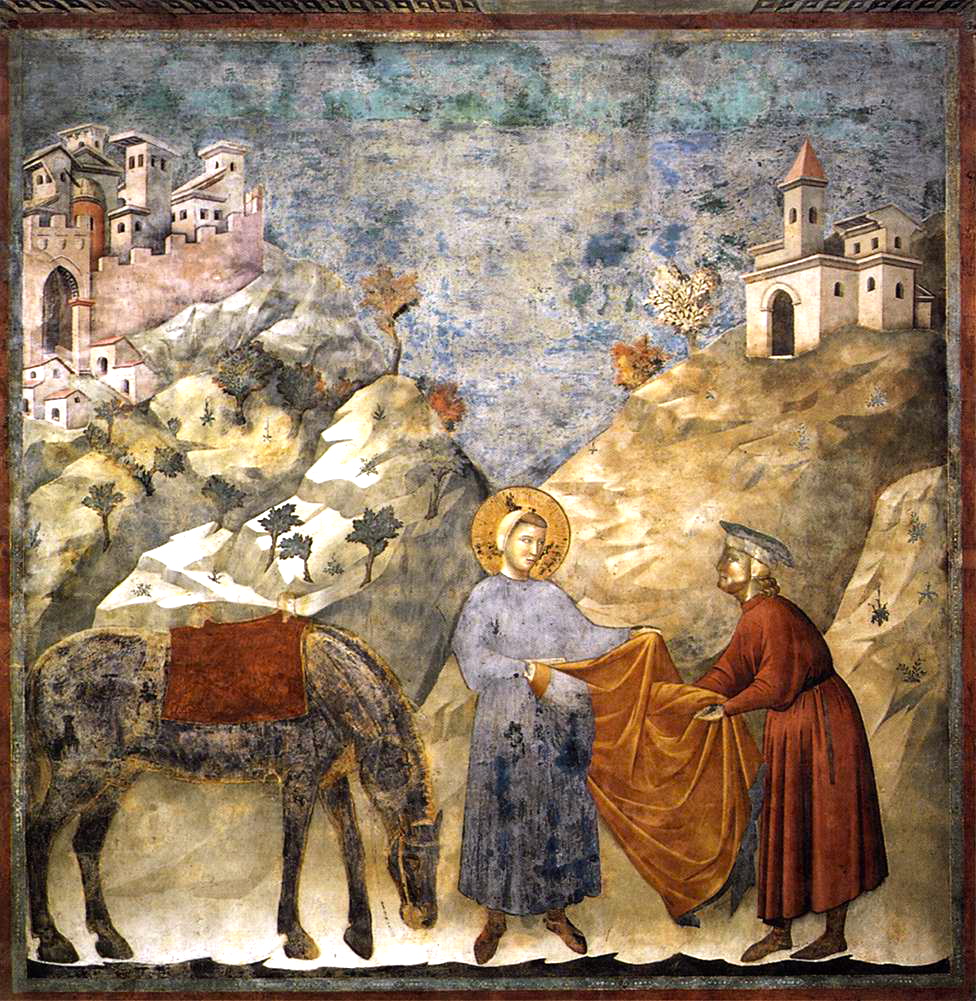
Giotto, "St Francis Giving his Mantle to a Poor Man"

In 2004, along with my colleague Sasha Abramsky, I once again interviewed Padre Bruno and Rosa Marga for my work as a researcher.  Afterwards, I reflected on what I had learned from them over all these years.  I was struck by their constancy in the face of overwhelming odds.  They work for the small victories and see joy in every one, rather than the long road left.  Serenity, I thought, is what makes them so effective and compelling.  Without serenity, they would not be able to endure the suffering that their struggles have brought them personally.  Without serenity they would not be able to bring young people into adulthood with hope, promise, and love.

The theologian Reinhold Niebuhr wrote the “Serenity Prayer” at some point in the 1930s.  It has been widely adopted by many who struggle with changing themselves in a world that resists change.

God, give us grace to accept with serenity
the things that cannot be changed,
Courage to change the things
which should be changed,
and the Wisdom to distinguish
the one from the other.

What is remarkable about people like St. Francis, Padre Bruno, and Rev. Rosa Marga, is that the “wisdom to distinguish the one from the other” leads them to take on the most enduring and difficult challenges of all.  That is real heroism.

Notes and Credits

The opening image is “Daniel et l’ange dans la fosse” (“Daniel and the Angel in the Pit”) by Macha Chmakoff (www.chmakoff.com), a contemporary painter who has an extensive set of works in Biblical themes and images.  The original painting is oil on canvas, 52″ x 39″ (130 x 97 cm).  Ms. Chmakoff is a psychoanalyst and painter who has been exhibited across France and has gained international noteriety for her paintings.  The image was provided by Ms. Chmakoff and is used here with her permission.  She recently had a reproduction of one her paintings, “Jésus, souviens-toi de moi,” exhibited between the columns of the Église de la Madeleine, the magnificent Greek classical church in Paris.

David Bowie’s song “Heroes” was recorded in Berlin with Brian Eno, near the Berlin Wall. When guitarist Tony Visconti and backup singer Antonia Maass snuck away for a kiss near the wall, Bowie wrote them into the song and they became heroes.  The song is a masterpiece of experimentation that sounds so much less than experimental today.  Radical as it was in its day, it’s purely beautiful today, and its sentiment is timeless.

The images of “St. Francis Preaching to the Birds” and “St Francis Giving his Mantle to a Poor Man” are from the series of frescoes known as “The Legend of St. Francis,” which can be found in the Upper Church of the Basilica de San Francesco in Assisi, Italy.  The frescoes date from 1297-1300 and are usually attributed to Giotto de Bondone, though they may have been done by several painters.  These images are taken from The Atheneum, an organization devoted to making tools for art, scholarship and community-building available over the Web.  They encourage people to post photographic images of art from around the world and then make it possible for others to repost and use that art in ways that will bring it to others.

St. Francis’s ministry to animals and to the poor are radical and enduring parts of his ministry.  St. Francis is a constant reminder of the simple fearlessness in Jesus’s ministry.

A Note on Heroes, Villians, and Justice

Not all who are serene and fearless can be called heroes.  I have chosen to dedicate this post to the heroes, but I have to recognize that villains, too, can be fearless and serene.  In this way, they are like heroes, even though they are not.  Let me clarify.

Only those who work for the cause of justice are heroes.  There are others who are equally fearless and serene but who are concerned only for themselves, their narrow interests, and personal pleasures.  They are sociopaths.  Those sociopaths who intentionally harm others are the criminals of sensational accounts in films, television, books, and magazine.  They are rapists and serial killers and destroyers.  Some find a legitimate outlet for their urges in mercenary exploits, military conquest, dogma, and institutional authority.  These sociopaths are dangerous and horrible, but they are not numerous.

Far more pernicious are sociopaths whose violence is exerted at a distance under the cover of ideology and reason.  They kill without ever coming close to the trigger.  They command armies and industries.  They tell us we need them in order to live our own lives and that without them we would not have jobs or homes or food to put on the table.  They are serene.  They are fearless.  They are all around us and hidden in our midst.  “Sometimes Satan,” Bob Dylan sang, “comes as a man of peace.”

As for justice, there are many definitions, but I prefer to keep it simple.  That which reduces needless suffering and cruelty is just.  The definition of needless suffering and cruelty usually is apparent by sight alone, without words.  Once people start to bring words into play, the cause of justice is damaged.  This is a cruel irony for those of us who are writers and seek to paint beauty in words.

The Convention on the Rights of the Child is one of the UN’s landmark accomplishments.  It is a form of aspirational justice, more a signpost on the way to the world we would like to live in than a description of the world we have.  All member-nations of the UN have signed on to the CRC, except for two:  Somalia and the United States of America.  Serenity now.

2 Comments

Filed under art, beauty, Brazil, danger, death, existentialism, ideas, life, truth