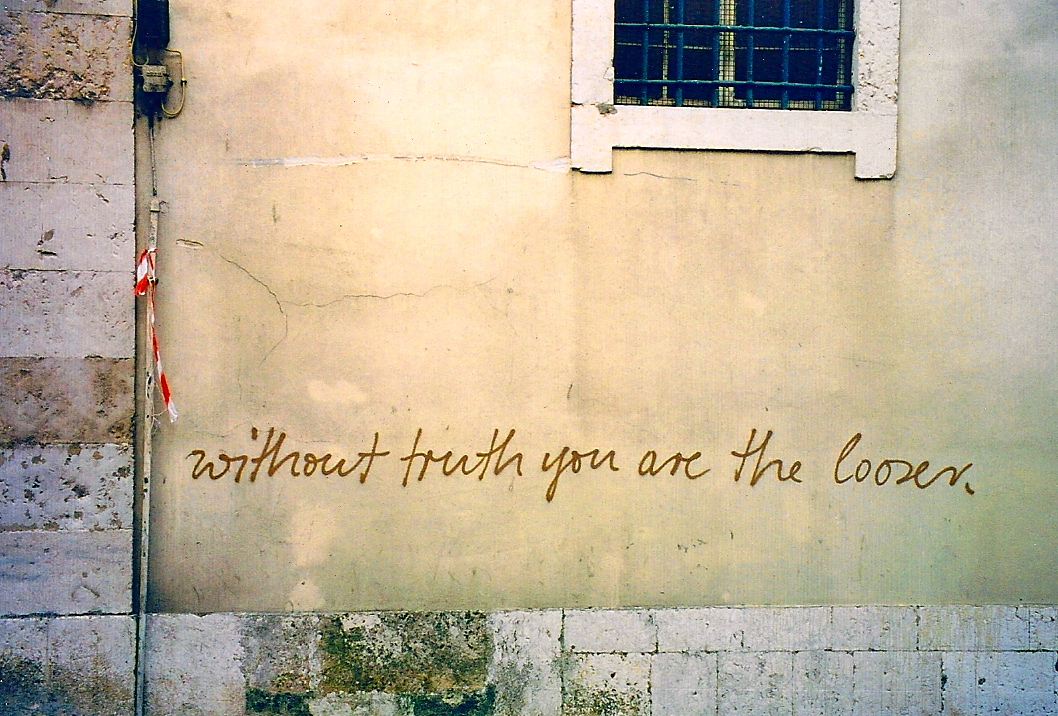
If a picture is worth a thousand words, how many words is a picture of words worth?
Spelling mistake or assertion about the relationship of truth to intestinal fortitude? Martin Luther would surely disagree, for in his case getting to the truth was intimately dependent upon getting loose, and the entire fate of the Medieval Church hung in the balance. Luther’s was one divine and hellacious struggle.
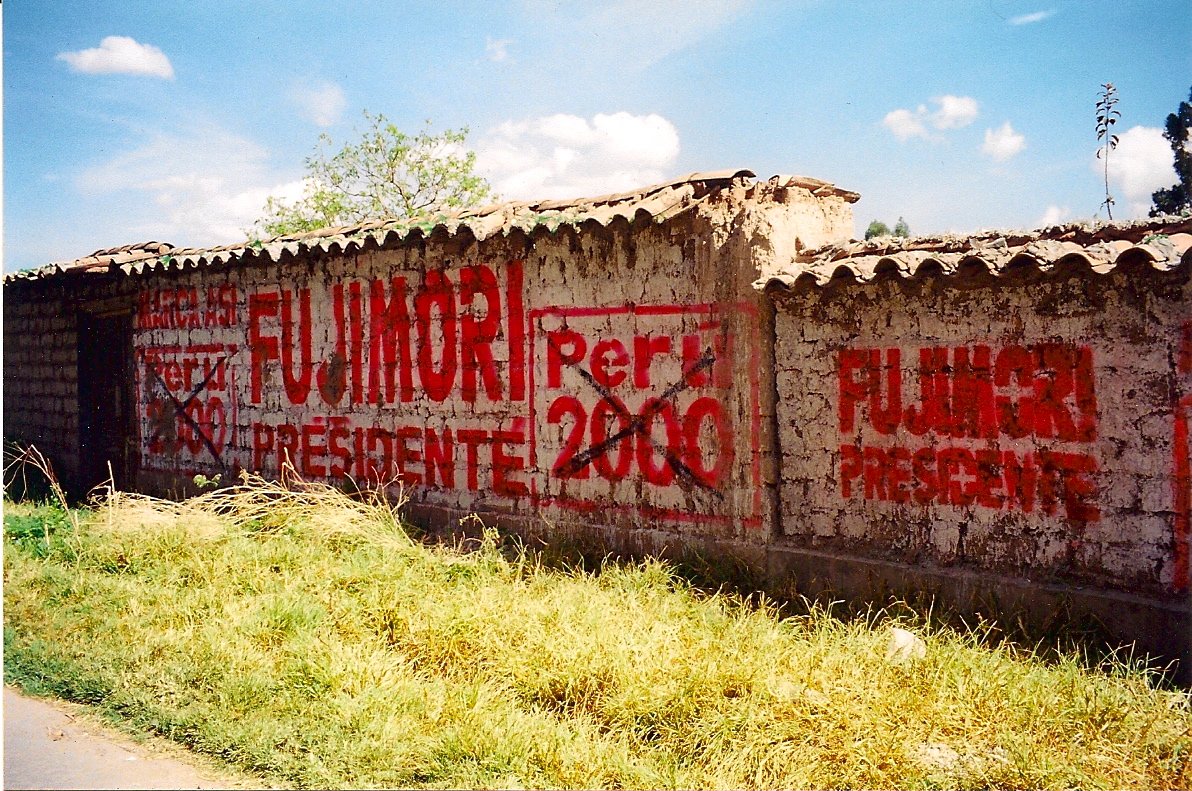
By the time Alberto Fujimori got loose and began to deal with his struggles, he was a wanted man. President of Peru from 1992 to 2000, he defeated the Shining Path revolutionaries by resorting to atrocities that rivaled those of this enemies. The dirty war in Peru took over 70,000 lives on both sides, and mass graves of military executions are still being found. Peru’s Equipo Peruano de Antropología Forense (Peruvian Forensic Anthropology Team) has made a striking documentary of the largest grave site, If I Don’t Come Back, Look for Me in Putis. After losing the 2000 presidential race, Fujimori fled to Japan after corruption schemes involving over a billion dollars came to light. He returned to South America in 2005 to run for president again the following year, but instead he was arrested, tried, convicted, and thrown in jail. With or without the truth, Fujimori was finally the loser.
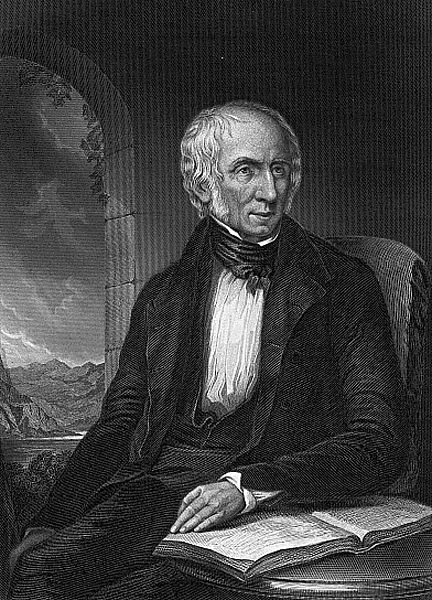
How many words is a Wordsworth worth?
Notes and Credits
All photographs were taken by the author, except as otherwise noted.
“Without truth you are the looser” was taken in Lisbon, Portugal in 2000. The ironies of this photograph go well beyond its mispelling. But that’s all I’m saying here.
“Fujimori Presidente” was also taken in 2000, on a trip I took to Peru with students from the college where I taught at the time. This political graffiti was seen on a fairly desolate road in the altiplano, the high plains of the Andes Mountains. We were on a bus on our way over the continental divide, which we crossed at around 16,000 feet, and then down, down, down to the Manu River Forest Preserve. The Manu River is a tributary of the Amazon River which at this point has just come rushing down from the Andes and is settling into the massive river it will become with each new tributary on its 2,000+ mile journey to the Atlantic Ocean at Belém.
“William Wordsworth” is an image from the Wikimedia Commons of what is apparently an 1873 reproduction of an 1839 watercolor of the poet by Margaret Gillies (1803-1887).
The Importance of Place: Fort Hamilton Subway Station
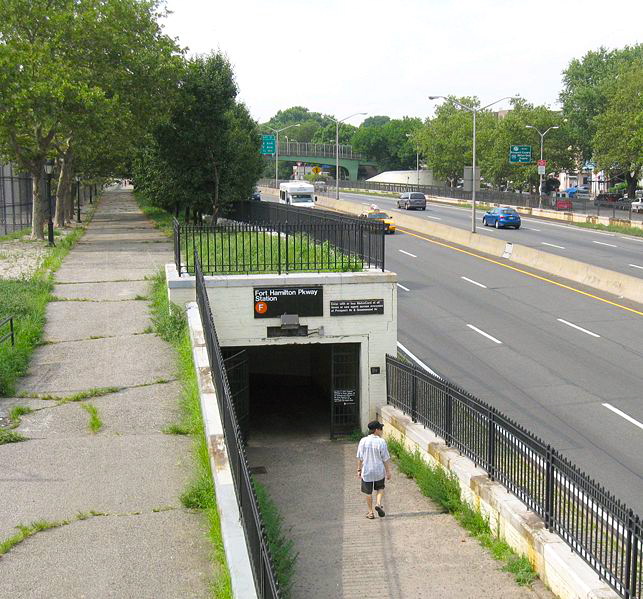
The Ft. Hamilton station is beneath an expressway interchange, where the Prospect Expressway empties out on to (or begins at, depending on your vantage) Ocean Parkway, beneath the Ft. Hamilton Parkway overpass. Ocean Parkway is a major thoroughfare running south to Coney Island from Prospect Park. It’s a folkloric parkway lined with trees and sidewalks where people are walking every day of the week, at all hours it seems. Kareem Fahim posted this wonderful story on Ocean Parkway in the Times on October 10, 2008.
Here’s a video, working hard to be experimental, on the Parkway …
And this one, with a bowling theme, which is big here. In summer camp they take the kids at least once a week, from age 5 on up.
The Prospect Expressway links Ocean Parkway to the Brooklyn-Queens Expressway, the BQE as we call it. This interchange is a concrete manifestation (literally) of Robert Moses’s dreams for New York. Moses served in various posts involved in urban planning and development, and from the 1930s to the 1970s he managed to thoroughly remake the city and Long Island’s highway system, housing agencies, and parks, which we have taken up before in Truth and Rocket Science, in The truth and change, 2: Technoredemption Goes Pro and The truth and set theory: more on Mr. McNamara. The Fort Hamilton interchange is one small of Robert Moses’s living legacy.
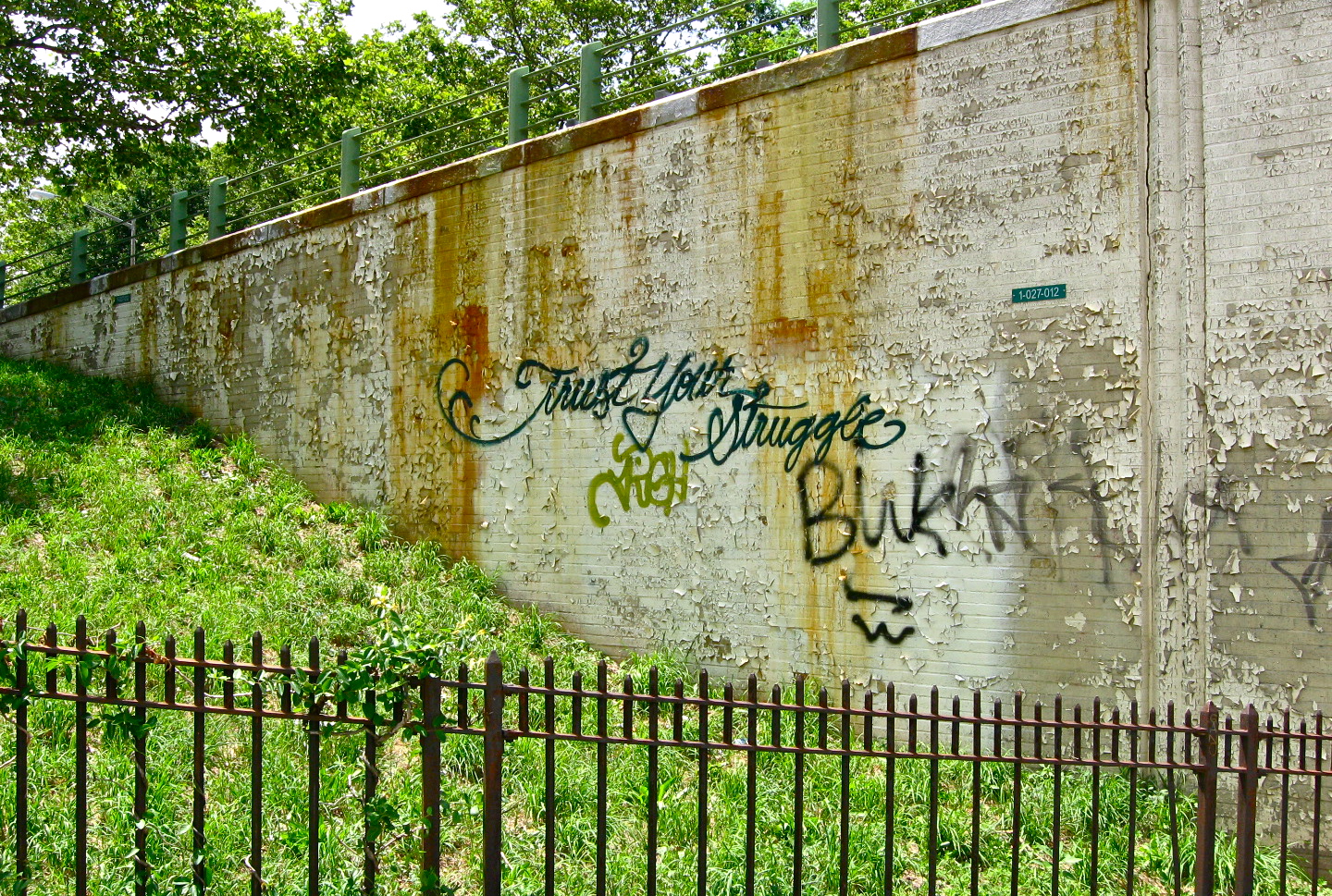
The photograph above is found on the Wikimedia Commons. To the right is the beginning of Ocean Parkway, where the Prospect Expressway empties out. The person walking away in the photo has just passed “Trust your Struggle,” to the left, on the side of another retaining wall, as is obvious from the way that he (or she?) is contemplating the solipsism of passengerless cars rushing by on the expressway. I do not know who put this particular graffiti there, but I smile a little every morning as I walk by it.
Both can shine brilliantly, sparkling in the light to dazzle your eyes, making young couples blush with happiness and pride. Like the truth, diamonds aren’t nearly as rare as their market value would indicate. Both can be found with ease when you know where to look. Every once in a while, someone stumbles on a massive diamond in the plain light of day, just one more rock in the landscape until a chance encounter sets it apart. No small amount of truth is discovered in the same way. What sets these discoverers apart from the rest of us is as often as not luck.
The truth and diamonds leave two trails, one of bliss and hope, the other of blood and cruelty. More banal than ironic, this is the way of the universe. The same truth that turns a God of peace into a God of war also turns simple assumptions about fairness into human rights.
What happens when beauty and ugliness form a bond so tight that they become inseparable? The trouble with the truth and diamonds is that they can lead you anywhere. What really matters is where you want to go.
Notes and Credits
The opening photograph of the Hope Diamond is by Chip Clark, who passed away on June 12, 2010, away after 35 years as a photographer for the Smithsonian National Museum of Natural History in Washington. Mr. Clark’s beautiful photographs of gems, animals, birds, and other things can be found all over the web.
The Hope Diamond is surrounded by legend. It seems that most who have possessed it have come to tragic ends. It is currently owned by the United States of America and is on display at the Smithsonian.
The playing cards were photographed by the author, from a miniature travel deck for Patience (Solitaire) given to me in 1992 by Professor Raymond Grew, a mentor of mine in graduate school at the University of Michigan.
It should be noted that the truth also grows more precious with time, the simple truths of youth seeming to appear ever more complex and enduring as time goes along, much like the songs of Neil Diamond and just about everything touched by Johnny Cash.
We built our world on petroleum, especially in the state I come from, Louisiana. We power our cars and computers and houses with petrol and its funky little brother, natural gas. Over the course of the long twentieth century, the automobile fueled explosive growth in the American economy and allowed people to spread out in endless suburbs that offered relief and tranquility compared with the noise and chaos of urban life.
Along the Gulf Coast and elsewhere, countless thousands of jobs are devoted to the exploration, drilling, refining, distributing, selling, purchasing, and using of petrol in its many forms. We create our food with petrochemical fertilizers that rely on the abundant natural gas deposits found deep in the Gulf of Mexico along with oil. The plastic bags we carry our food in are made of petroleum. Cosmetics and personal lubricants are made of petrol.
Oil and other fossil fuels have made everything we know possible, from the things we use to the lifestyle of abundance that for some seems an American birthright. We Americans are the people of the tar.
We eat the oil, and the oil eats us
Back in the 1970s, when gas prices shot through the roof because of the Arab Oil Embargo, the rest of the country went into a tailspin while Louisiana thrived on oil. The construction of the New Orleans Superdome, opened in 1975, started a downtown building boom in New Orleans that reshaped the city before my eyes as I grew up. Then in the early 1980s, when oil prices fell as the country’s economy recovered, New Orleans and Louisiana went into a tailspin. The oil companies moved their offices to Houston and drilling shut down as oil fell below $15 a barrel, the price at which it was no longer economical to produce oil in Louisiana. As the oil money left, people lost jobs all over the state and everyone suffered.
Now, as the Deepwater Horizon blowout has become the world’s worst man-made environmental disaster, Americans face an impasse. Do we follow Louisiana’s own politicians and call for more drilling? These are the same politicians who along with other (mainly Republican) politicians around the country created an environment of contempt for business regulation that fueled a lawless world in the boardroom, on the factory floor, and in the marshes and mountains and wildlife prerserves. Corporate lobbyists wrote environmental and workplace protection laws. Our social world—our values and the values reflected by our government—made it the casual business of the day to celebrate the sub-prime mortgage market, overlook safety in coal mines, and build drilling rigs without proper blowout protection. It was the time of our life and there wasn’t an American alive—left, right, or independent—who didn’t just love their IRAs, home equity, air conditioning, and cheap gas.
Un-natural disasters
Deepwater Horizon comes almost 5 years after the “natural” disaster of Hurricane Katrina, which continues to show us what can happen when the government abandons its people. The Katrina disaster was neither inevitable nor natural. It was a man-made disaster of the first degree, founded upon the same neglect and abdication of social responsibility that are at the core of America’s post-Reagan social contract.
Our world will change as the oil runs out, which it will do one day, sooner rather than later by current predictions. How many disasters do we need to learn that all of us are made better by a government that provides social protections and guarantees against exploitation—of people, environments, and resources? The BP oil disaster is our opportunity now for the national courage to get off oil. Such a matter of fundamental change could be achieved only by a massive state-led effort akin to the New Deal.
For comparison’s sake, here’s The Deal We Got: oil will kill us, either way. It’s already started. If it doesn’t kill us now, it will kill our children or grandchildren. There’s no going back now on the damage oil has done and will do to Louisiana and the Gulf Coast at large. Add one hurricane to it this year and it’s over.
Imagine
Can we just think about ending oil? It doesn’t matter how realistic it seems. It will hurt. It hurts to stop any self-destructive addiction. Yet while it’s going to hurt one way or another, it doesn’t hurt to dream a little. Ask any hurting person. Or these pelicans. Why not …
… deploy the government’s resources to bail out the regular people of Louisiana who will lose their jobs in this tragedy? If it’s good enough for Goldman Sachs it’s good enough for the Bayou State.
… put the Army Corps of Engineers to work creating a levee system that channels the immense force of the Mississippi River to the restoration of the coast? The same government agency that corralled the river in the first place ought to be able to set it free. Indeed, by cutting off the annual flood, the levees have helped erode the Louisiana wetlands at the rate of one acre per hour.Restoring the annual flood just might be the best way to combat the effects of the oil spill.
… cut our addiction to automobiles and airplanes by building railways—high speed and local—that can rely on wind, hydro, and other safer energy sources? Start with rails in Louisiana so that people there don’t have to buy gas and can still get to work. Put these guys to work at home and let them become a corps of railroad builders who can teach the rest of the nation how it’s done.
Imagine a permanent, federally funded project of restoring and then maintaining one of the world’s most vital and richest wetlands. Call it real conservation and tip your hat to Teddy Roosevelt (the ex-Republican Bull Moose). The point is that this is not just an oil spill. It’s the big one, the wake-up call. If the fear of losing jobs is what keeps people in Louisiana under the thumb of big oil, then let’s find them other jobs. Are we slaves?
This isn’t rocket science. It’s a matter of will. We are the richest country on Earth, and we can do this if we want to. While we’re at it, we can finally clean up the mess and set things to right from Katrina. What America does shows the world—and more importantly, ourselves—what we really want and what we really care about. What shall we do this time?
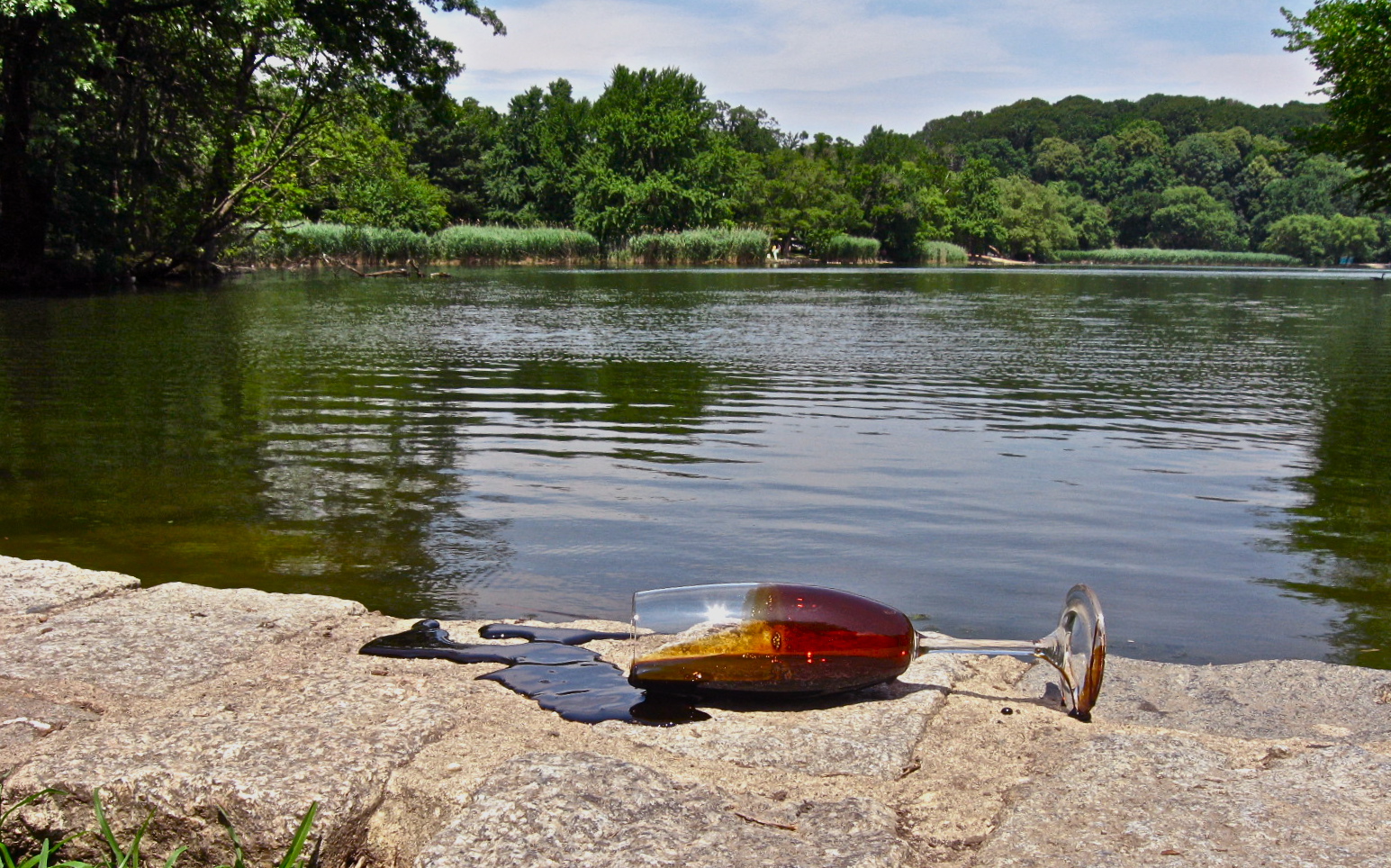
The glass
The glass is a champagne flute from Williams Sonoma. I photographed it on the southern edge of the pond in Prospect Park, Brooklyn. The pond is home to a lot of turtles. Fish are stocked and then fished out by the people who live in the neighborhood. Macy’s sponsors an annual fishing tournament in the park. Swans, geese, ducks and other birds make the pond home, for at least part of the year. Of late, there has been a series of mysterious animal deaths in the park, prompting outrage and concern by folks all over the city. Comprehensive coverage of what started with an injury to John Boy the Swan, which later resulted in his death, can be found in Gothamist and in the Brooklyn Paper. Video of John Boy can be found here.
Notes and Credits
All photographs are by the author, unless otherwise noted.
On the petrochemical sources of our food, no one has written more eloquently than Michael Pollan. In his book, Omnivore’s Dilemma, he provides an accounting of the carbon footprint beneath the food we buy so cheaply in the supermarket, as well as the government policies that prop up the union of agribusiness and petroleum.
The sub-title, “We eat the oil and the oil eats us,” paraphrases the title of June Nash’s classic book about Bolivian tin miners, We Eat the Mines and the Mines Eat Us. The book’s title comes from the way the miners talked about their relationship to the mines, mining, the mountains, and the tin companies that exploited them so ruthlessly. Louisiana is like that, a place being eaten up by big companies who could care less about the local people apart from their willingness to work for low wages without union representation. When I was a kid, we sometimes called New Orleans “The Tegucigalpa of the North.” It was sort of joke, just sort of.
On levees and their importance—I grew up about a half mile from the levee. I used to play behind the levee every day in the batture, the swampy land between the levee and the river itself. We played army and pirates behind the levee when we were little. Then we smoked pot and made out. When I was in college at Loyola University in New Orleans, I used to ride my bike from home (commuter student) to the college on the levee. I wrote one of my best songs, “Down By the River,” about falling in love with a brown-eyed girl who gave me my first kiss on the levee. It’s a bluegrass tune.
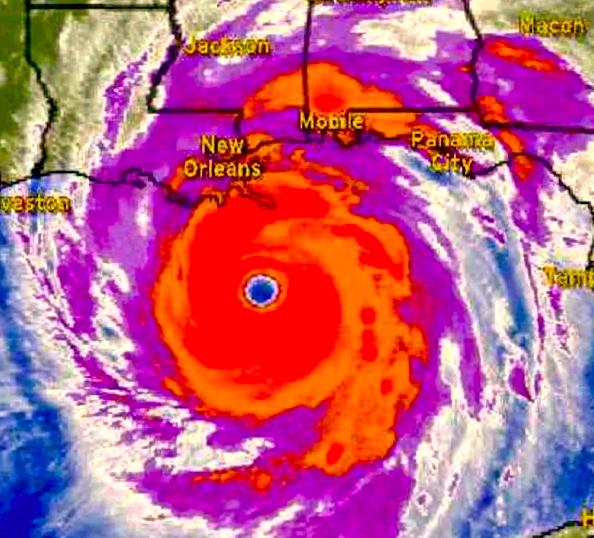
I took the satellite image of Hurricane Katrina from weather.com a few days before it made landfall. I was holed up in Dallas, Texas, at my mother-in-law’s. I happened to be there visiting, for reasons that had nothing at all to do with the storm. My parents went to my brother’s place in Nacogdoches, Texas—now they were storm refugees and only went home at the end of October, after 2 months in Texas. I kept that image of Katrina. In my anger over the storm and the abandonment of New Orleans, I made it the wallpaper of my computer desktop, not changing it for a couple of years.
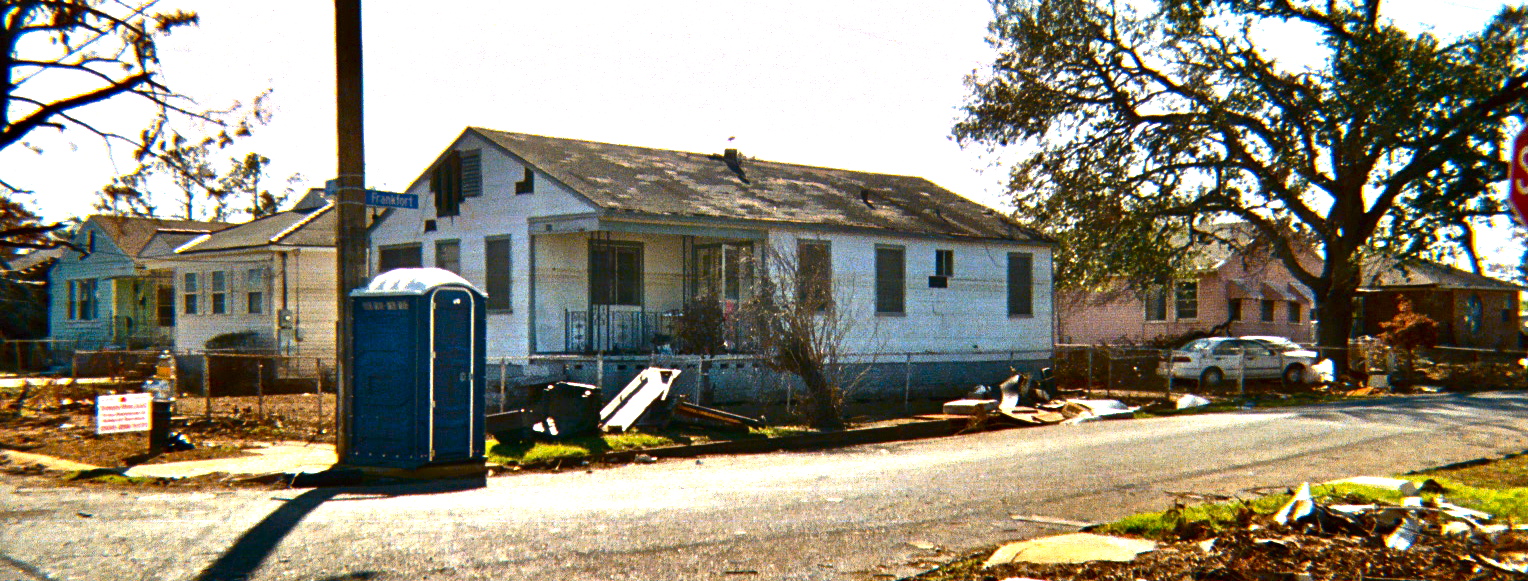
The battered house is where my father grew up in the 1940s and 50s. It was on the corner of Lafaye and Frankfort Streets, which was in a new subdivision being made up near the shore of Lake Ponchatrain, where the Air Force had major installations during World War II. My grandparents moved there after the war, once my grandfather— “Grumpy” as we called him—got home from the Pacific and took a job with the Postal Service, where he would work until his retirement. I remember that house in the 1960s and early 70s. I was all of 5 and everything was happy there. Grumpy made ice cream in the back yard and told us funny stories. He let us grandkids take a turn or two each on the hand-crank. It was good ice cream. The house is no longer there.
Environmental Impact Statement
None of the fish, turtles, geese, ducks, or swans that call Prospect Park home were endangered in any way by this photo shoot. In place of oil, I used all-natural, unsulphered molasses, which has the look of oil but is quite sticky and tastes much better.
Molasses is a rather suitable substitute for oil in other ways as well, since it’s a Louisiana product that probably does much less damage than oil. My grandparents grew up on sugar plantations up the river from New Orleans. Grumpy used to tell us how they refined sugar from cane, every single step, including molasses. He knew sugar. Granny used molasses to sweeten the pecan pies she made every year with the nuts she gathered from the tree in her own backyard. Molasses has been around for a long time without causing the epidemic of obesity that can be traced to high fructose corn syrup, which in turn can be traced be to the agricultural policies of the Nixon administration (will we ever run out Republicans in this story?), which in turn can be traced to petrochemical fertlizers and in the end: oil, oil, oil.
The use of the first-person, plural possessive—we—in this essay is intentional. We all own the oil spill. The politicians who created the culture of disregard for public safety and environmental sustainability in business and corporate life are there because they received enough votes to win office. The people who voted them in office did so for various reasons that Thomas Frank documents pretty well in What’s the Matter with Kansas and which for Louisiana are intricately related to the famed “Southern Strategy” that the Republican party adopted with Richard Nixon’s successful presidential campaign in 1968. The race politics that underlay all of this are a tangled (yet quite simple) web that deserve another essay in their own right. This is how America is, for whatever it’s worth. Those of us who didn’t vote for these politicians, we’re also complicit. We use the energy that comes from petrol. We might want to laugh at Sarah Palin’s convoluted explanation of how environmentalists are really responsible for the Deepwater Horizon tragedy, but it’s our culture and we’ll keep driving to work every day, even if on a bus powered by gasoline or its funky little brother, “natural” gas.
God looked at everything he had made, and he found it very good (Genesis 1:31).
Life is full of contradiction, and so are attempts to understand where life came from, why we are here, and what will become of us.
An old English proverb proclaims: There but for the grace of God go I. The proverb sums up the randomness of the universe—the order-out-of-chaos, the utter, unexplained, and unaccounted for contingency of life itself—as a matter of Divine will.
Some have interpreted this idea darkly, as for example the Reverend Jonathan Edwards, whose God is angry and holds sinners over the pit of hell “much as one holds a spider, or some loathsome insect over the fire.” For Edwards, only God’s “pleasure” or “arbitrary will” stood in the way of eternal suffering, and the sinner “hang[s] by a slender thread, with the flames of divine wrath flashing about it …” Lions and tigers and bears seem meek by comparison—oh my.
For those who dwell on the goodness of the Earth, however, life as a gift of grace is a liberating thought, providing the freedom to leave other-worldly issues alone. Instead, one’s gaze turns to the things that matter in this world, and in this moment a new kind of human freedom is born. The world beyond this one is indeed arbitrary and unknowable, but in this world what we do matters. Here we, not God, are responsible.
This notion of contingency, of the arbitrary nature of causality in the universe, isn’t a terribly God-bound thought. The grace of God in the proverb can be understood in quite godless terms as the general force of randomness as it functions in the entropy of the universe. Either way, life is contingent on a lot of things that are completely out of our control, and in that contingency, ironically, good and evil are placed in human hands and human hands alone.
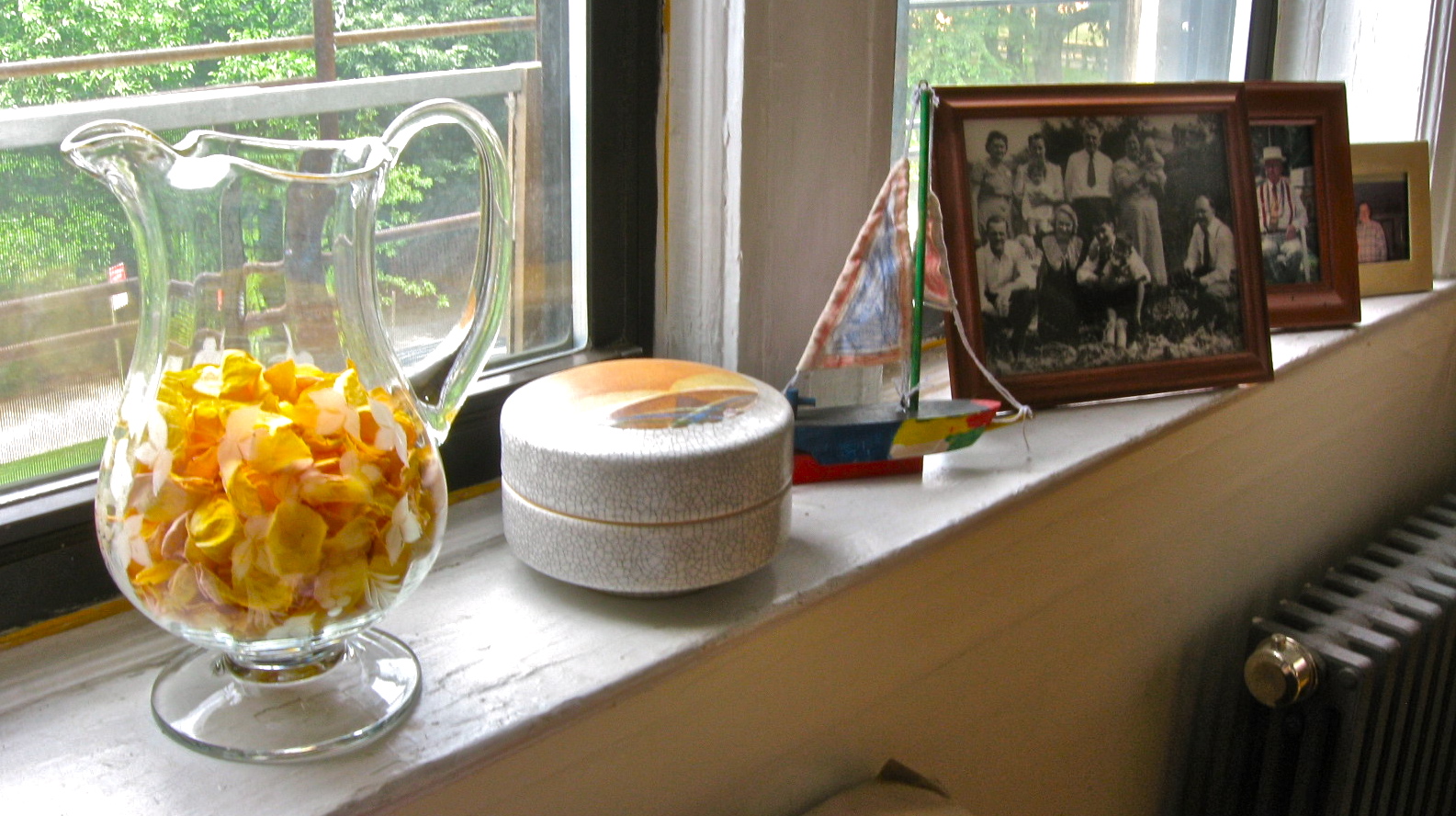
The pitcher and its window sill
A couple months ago, I had a party. I’d moved into a new apartment and wanted to share the space with some friends. We prepared for the party all day, cleaning house and eventually going out to buy some good cheese, wine, bread, the makings of spinach salad, and such. Along the way, my girlfriend bought a dozen yellow roses.
After the party, once the roses had dried, I took the petals from the stems and placed them in a bowl. I had hoped they would smell like roses and I would crush them to place them in a bowl as potpourri. Alas, they never smelled so good, but the yellow petals were very pretty and I put them in the pitcher, which sits on the window sill and now adds a dash of yellow to the room.
On this window sill in my living room, I keep a number of things. There is a ceramic covered bowl that I bought in 1989 the first time I ever went to the Ann Arbor Art Fair. It was made by Rob Wiedmaier, who worked out of St. Joseph, Missouri. Next to that is a little wooden toy sailboat that my son made from a kit he received in the gift bag at another boy’s birthday party. And then there are three photographs of my family.
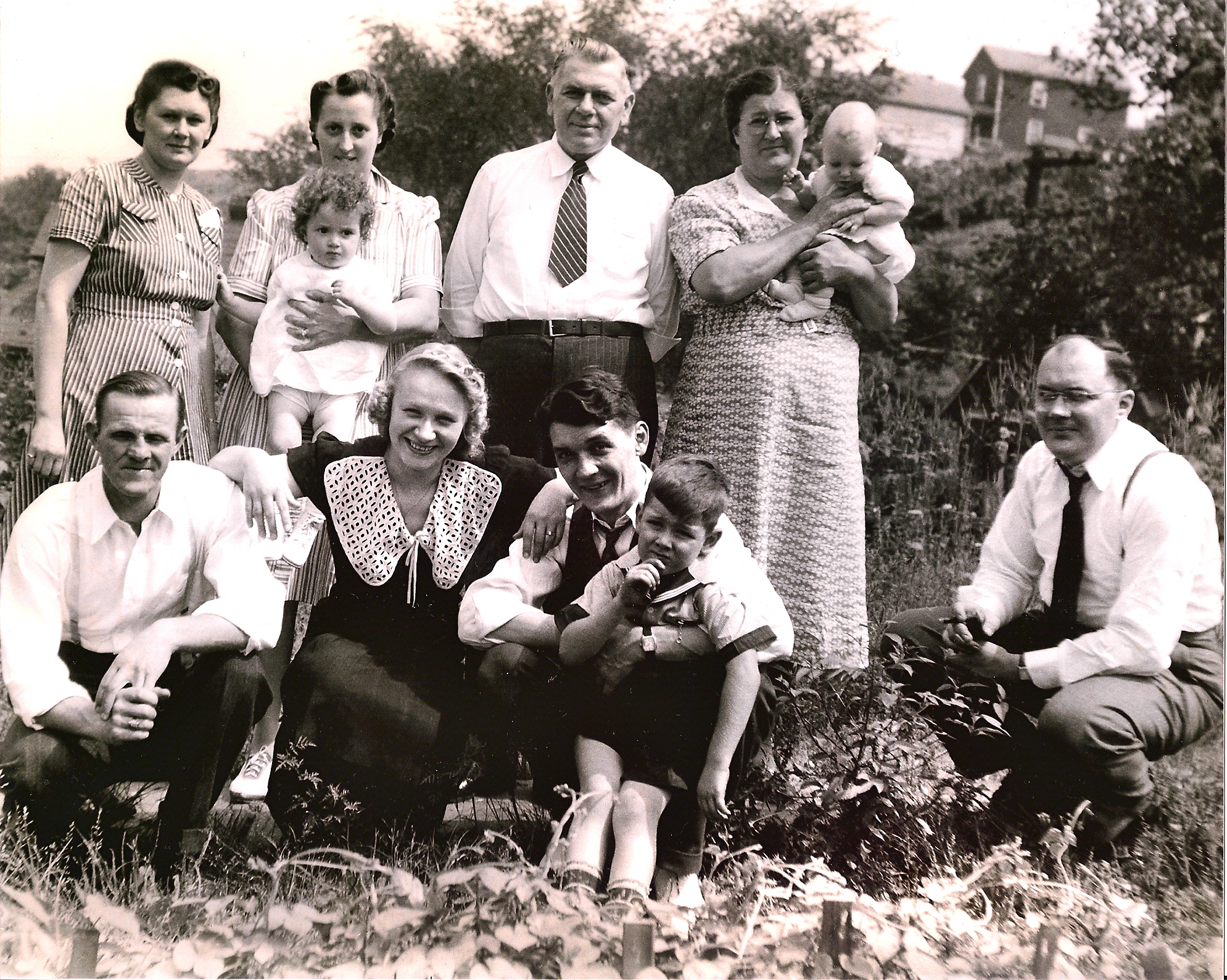
Buddy-Buddy, Grandpa #1
In the first photograph, we have the Krupas, from about 1941 or so. The patriach, great-grandpa Krupa, stands in the center. His three children are there—Joe, Johnny, and Annie. Joe was my grandfather, who my brother and I called “Buddy-Buddy,” because he that’s what he was, our buddy. Next to great-grandpa Krupa is my grandmother, Joe’s wife, Mary Niznik. She’s is holding my mother, Mary, who is about one year old in this photo, looking bright with her Shirley Temple curls. These were good Slovak people from the hills of the Monongahela Valley in western Pennsylvania.
Buddy-Buddy was a steelworker. After he died in 1969, my grandmother came to live with us, and for the next seven years, she was the most wonderful storyteller, babysitter, friend, and ally my brother and I ever had. She made stuffed cabbage roles, she ground her own meat, and she made the Easter Bread every year, just like in the old country, which she called “Austria-Hungary.” I took Joseph as my confirmation name in the memory of my Buddy-Buddy. My brother named his son Joseph.
Grumpy, Grandpa #2
The next photo over is of my other grandfather, Ernest John Guidry, III. In the photo he is old, in his mid-70s, sitting in his back yard decked out for Mardi Gras. My brother and I never called him “grandpa.” We always called him “Grumpy,” a nickname that my mother gave him because he was always so jolly and full of life. He had 17 grandchildren, and he called each and every one of us “Peanut.” When this photo was taken, he had recently been diagnosed with Parkinson’s Disease. He died within a year or two of the diagnosis, thankfully, we all felt.
The good fight
In the final photo, half hidden behind the rest on the window sill, are my mother and father. They were photographed in the den/living room of their house in River Ridge, Louisiana, the house where I grew up. I remember the first time I saw the place. It was in 1973, late summer. Mom took my brother and I there—we were all of 8 and 9—and there wasn’t much of a house. Just a slab of concrete on a sand lot with lots of trees all around. There were only four houses on the street. A couple months later, there was a house on our slab, and we moved. Such it was in the 70s. My father still lives there.
The photo is from the better days, before the multiple sclerosis put mom in a wheelchair and changed her body and all of our lives in ways that are all but impossible to describe. She passed away on June 27, 2007, and for her funeral mass, she had the following read from Paul’s second letter to Timothy, which I forever think of when I think of her—
I for my part am already being poured out like a libation. The time of my dissolution is near. I have fought the good fight, I have finished the race, I have kept the faith. —2 Timothy 4:6-7
Consider the lilies
Such is life, with no reason to be and no reason to end, but every reason for the living to live. Do not ask, but live. Run the race you are given. Be simple and don’t strive. Be like the flowers of the field.
Consider the lilies how they grow: they toil not, they spin not; and yet I say unto you, that Solomon in all his glory was not arrayed like one of these. —Luke 12:27
Notes and Credits (Grandpa #3)
The photographs of the pitcher, the window sill, and the lily were taken by author. The window sill was photographed as it appears in my living room. Behind it, through the window, is the Bowling Green of the Prospect Park Parade Grounds in Brooklyn, which has been the photographic subject of a few postings so far.
The lily grows in my apartment building’s garden next to the sidewalk. The garden isn’t kept or tended very well. It mainly just grows there, though I do see Bart’s mother, the landlord, sweeping and cleaning and watering from time to time. I saw the flower when returning home from a run in the park with my son.
Of all the people in the photographs, only one is still alive, my father. He is 70 years-old now, in quite robust health, and determined to reach 100. His odds are better than average. His father, who was pictured as described, died at 77, quite young for our family. My father’s mother died at 91. His grandmother, EJ’s mother, died at 101 or 102. The rest of our aunts and uncles are in their 80s and 90s. My odds, on the other hand, are something of a split decision, for my mother’s side of the family—the Krupas and Nizniks—mainly seem to die in their 50s and 60s. Mom was 67 when she died, like her mother, who made the cabbage rolls and the Easter Bread. Buddy-Buddy was about 58 when he passed on. There but for the grace of God go any one of us, on any given day, at any given age.
For the record, my son and his cousins call my father “Grandpa,” because that’s what he is.
E. “. . . the eyes of both of them were opened, and they realized that they were naked . . .” Genesis 3:6
F. “A little learning is a dang’rous thing;
Drink deep, or taste not the Pierian spring:
There shallow draughts intoxicate the brain,
And drinking largely sobers us again.”
Alexander Pope, “Essay on Criticism,” ll. 215-18
For some, knowledge leads down the path to hubris, a “revenge of the intellect” as Susan Sontag warned (ironically, some might say) in “Against Interpretation” (1966). For others, knowledge is the source of enlightenment. Know thyself: as inscribed on the Temple of Apollo at Delphi and lived by Socrates, for whom the knowledge of anything was only as good as its limits.
However we look upon knowledge or follow where it leads, it’s almost certain we’ll wind up somewhere never intended, with consequences for good or ill that we may barely understand. Such is the way of truth.
The glass and St. Rita’s Church
The tumbler is half-filled with Apple and Eve apple juice, all natural, no added sugar, of unknown yet possible relation to the juice of the apples of the tree of the knowledge of good and evil. At least that’s what I take away from the company’s name.
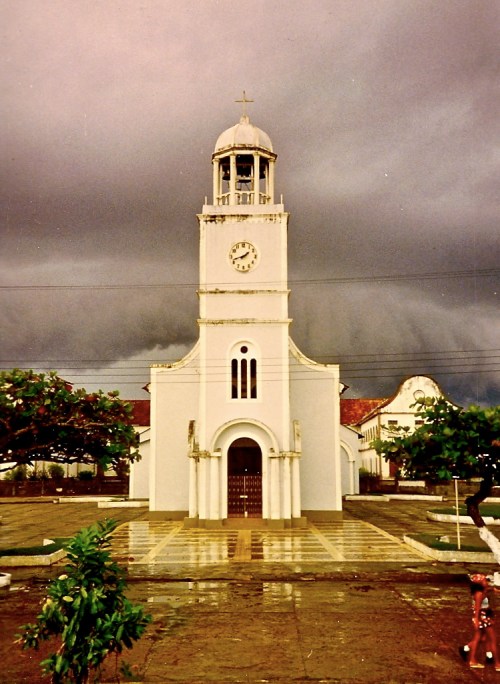
The etching on the glass is of St. Rita’s Church, Harahan, which was founded in 1950 by Monsignor Roy Champagne, who was a young priest at the time. The tumbler was part of a larger set created in 2000 for the parish’s 50th anniversary.
I went to St. Rita’s school from the fourth through seventh grades, and Fr. Champagne (he wasn’t a Monsignor yet) was still walking the grounds with the children and saying mass on Sundays. I attended church there until I left my parents’ home in 1986. For many years, I performed with, and then led, the youth choir. My son was baptized at St. Rita’s. I now attend St. John’s Episcopal Church in Park Slope, Brooklyn, but St. Rita’s is a cherished part of my life. It is a place I return to from time to time, to walk in the past and present, and to reflect on the lessons of knowledge and ignorance in my own life.
The desk and a dual journey from Michigan to Illinois
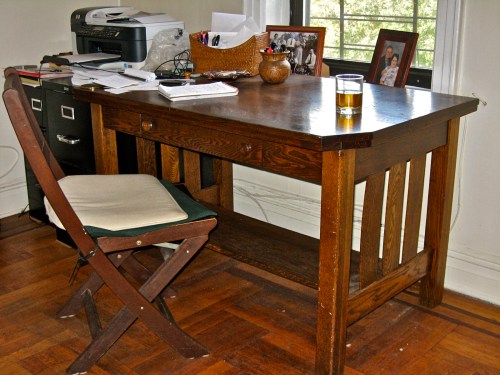
The tumbler was photographed on my desk, a sturdy workshop piece in the Mission Style, dating from the 1920s or 1930s (I am guessing here). I bought it in Rock Island, Illinois, in 1997 for $100.00 in rough but usable shape.
a sturdy writing companion
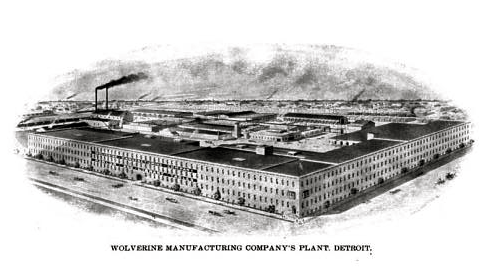
The desk was made in Michigan, by the Wolverine Manufacturing Company of Detroit. The company was organized in 1887, according to the tag, and at least this one desk is still going strong. Wolverine Manufacturing was one of the historical suppliers of parlor and other furniture in the Arts and Crafts style. I wonder sometimes at the happenstance (some might say magic) by which I took a similar route from Michigan, where I obtained my doctorate in 1996 from the university in Ann Arbor, to Rock Island, where I began my first teaching appointment the same year.
Almost everything that has been posted in truth and rocket science was written at this desk.
Notes and credits
The photos of the tumbler and the desk were taken by the author.
This image of the Wolverine Manufacturing Plant was taken from the State of Michigan’s Twentieth Annual Report of the Bureau of Labor and Industrial Statistics (Lansing, 1903), as found on Google Books.
Geotag: St. Rita’s is at 7100 Jefferson Highway, Harahan, Louisiana, 70123. St. John’s Episcopal is at 139 St. John’s Place, Brooklyn, New York, 11217.
Your body isn’t your own,
exposed for all it really is:
permeable, full of holes,
part of the world.
A floating thing tossed and spit
on tumbling water not always clear,
you become home to others,
little animals here
at play in the world.
You could be a tree, or grass, under
tiny feet that make no sound of their own,
their steps heard in quickened heartbeats
and restless groans
that shake the world.
You’re full of holes that leave
you open, a window lost of glass,
panes rattling, short of breath,
waiting, waiting, hoping to pass
this sense of a world
stumbling moments from death,
moments from life.
____________
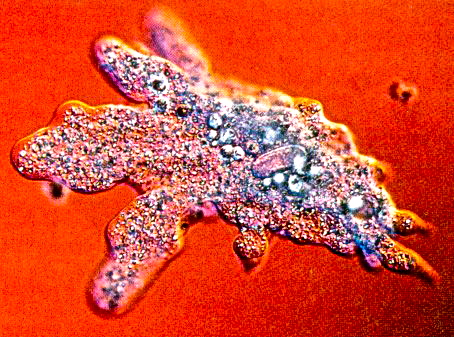
The name of the poem is Sickness. I wrote it in Belém in February of 1993, as I was coping with the onset of amoebic dysentery. It was rather a rough time, and this, the worst and latest in a cascade of different ailments since my arrival in Brazil the previous November. I was adjusting to my new home, I told myself, but I began to re-conceive my relationship to the world. Except for a bout of the flu at age 9 and a one-day bug at age 13, I’d never been seriously ill in my life. When I met the amoebas, my body-as-fortress gave way to a new understanding of myself as a being in the world, no different really than a bug, participating in the world along with all the other creatures of existence, open to all those creatures, part of the landscape. In the world – the amoebas helped me understand Heidegger and Sartre.
We’re all part of the landscape here, guests of each other, parts of each other. Somewhere in the human genome, shot through my body and yours, there is DNA that we inherited from a common of ancestor with amoebas. According to Richard Dawkins in his lovely The Ancestor’s Tale, our most recent common ancestor (MRCA in biospeak) would have existed between about 1.3 and 2 billion years ago. This being, some kind of single-celled thing, would have eventually given rise to amoeba and other protozoans, in one evolutionary path, and the things that became plants and animals on another path.
Most recent common ancestor, collapsed tree
All creation is locked in struggle for the limited energy of this world. This struggle produces rainforests when so many beings stretch to outdo others in an effort to trap the sun. The struggle produces abundance as well as scarcity, cooperation as often as annhiliation, and a long-standing collaboration between us humans and the hoards of friendly bacteria (and even some amoeba) that live inside our bodies and help us be “human,” as it were.
Notes and Credits
A really interesting article about amoebas can be found here, by Wim van Egmond, and it includes really great photos of amoebas in action. The photo of an amoeba at the beginning of this posting is taken from the site, Helpful Health Tips, which discusses the causes and treatments for amoebic dysentery. More detail on the different kinds of amoebas can be found in this piece on Innvista. Getting past dysentery meant mountains of Flagyl and a lot of examinations and tests, not only in Brazil but also after I got back to the US in 1993 and in 1994. I never was the same again, but then again, were we ever?
When I was looking around the web for amoeba-related sites, photos, and such, I came across this company, Rogue Amoeba Software, LLC, and it’s blog. It has nothing to do with this post specifically, except that it’s a very cool name for a company, and especially suggestive for a software firm. Our computers and their software are, like our bodies, permeable, full of holes,
part of the world. We’ve made information systems in our image, both on purpose and by accident, just as it was presumed by some we ourselves were made.
The still photograph is not so still. The photograph asks questions. It suggests a story. It presents an idea in a language without words. It is even as it signifies. Video killed nothing, and the still photograph survives (even as the radio star carries on). Unlike video, you can take the still photograph in. You have a role in your experience of the photograph. It speaks to you at a speed that you can handle, that doesn’t overwhelm, that invites your participation and imagination. You can look into its nooks and crannies and seek out all it has to offer. All this at your own pace, and for your own reasons.
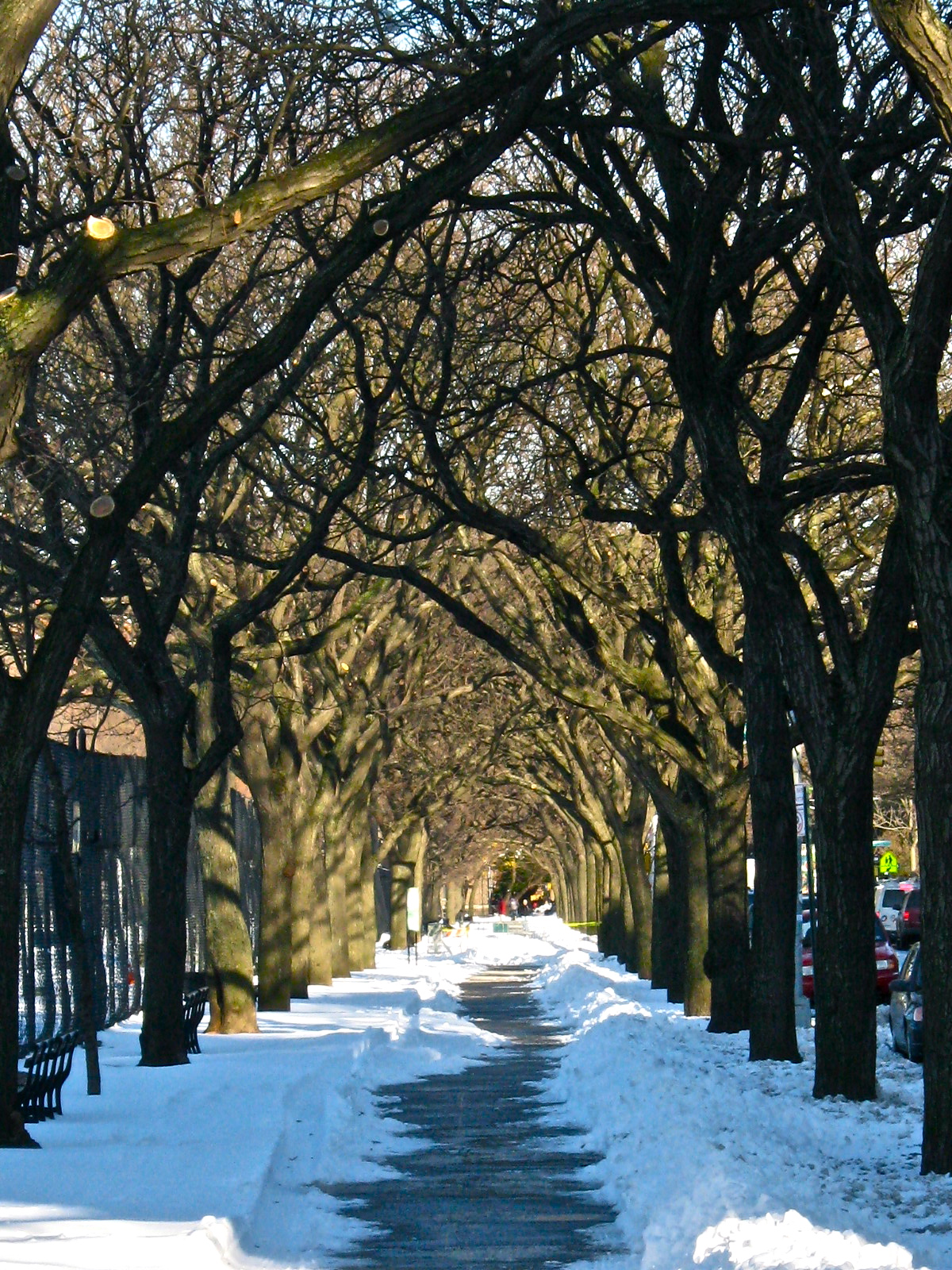
Snow on Sterling Place, Brooklyn 2005
The still photograph is a water that runs deep. If it seems to sit there, that’s its charm. The still makes you active, because it’s impossible to just look. Indeed, that’s the point, and all the while the still is not nearly inert. It just moves differently, at a different pace, like a tree.
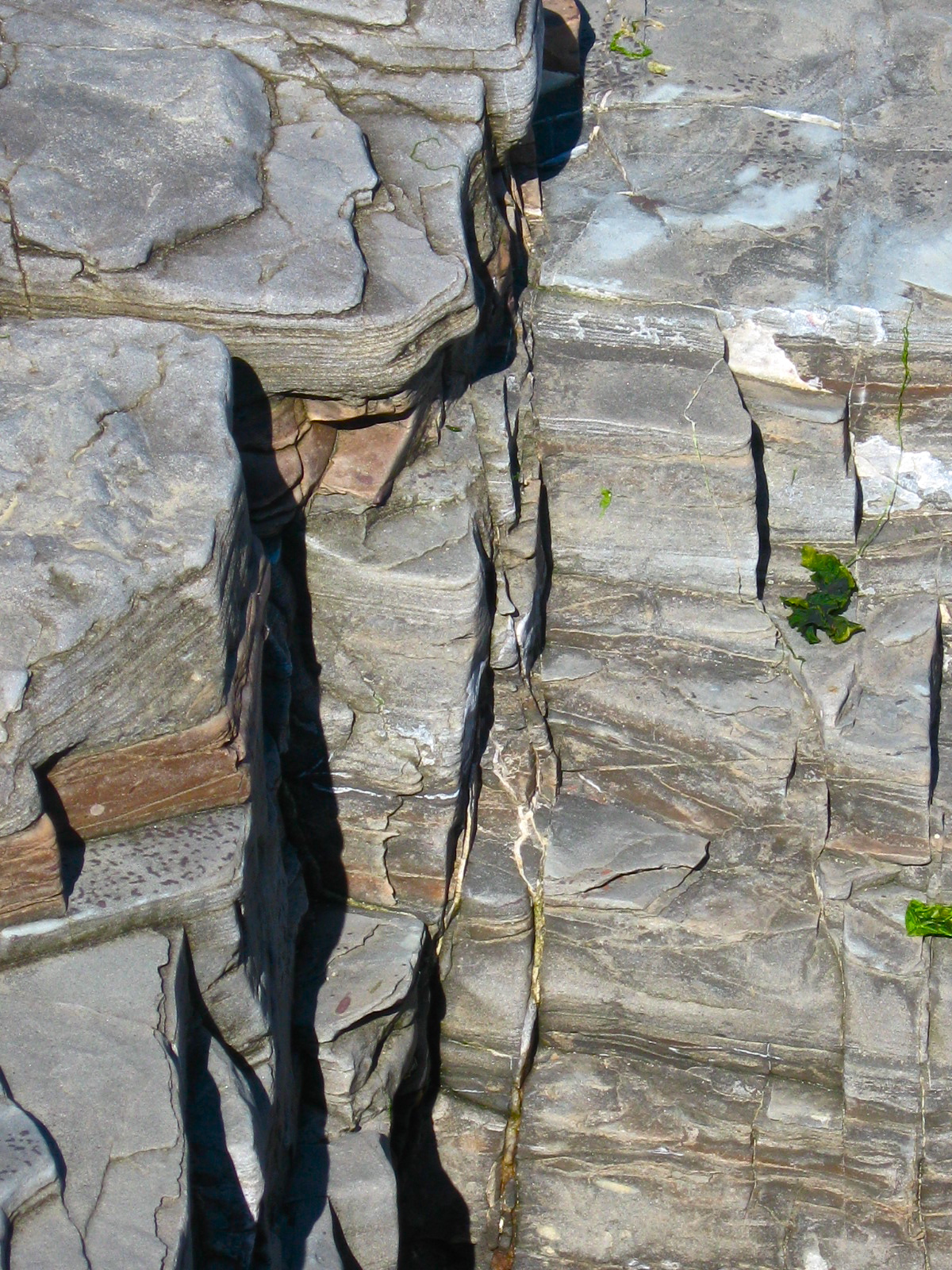
Detail of a rock on the beach, Long Island Sound, 2009
You fill the stillness with motion, the silence with voices. You hear these people, feel the breeze come across the flowers, sympathize with a long face or smile with happy eyes. Or you imagine the immediate suspension of all motion and noise and concentrate on only the image and the miracle of capturing time itself.
Intensity . . .Prospect Park, Brooklyn, 2009
Video? Its harsh, grating noise, the motion too fast to keep up with – video steals your ability to think about what you’re seeing and replaces your mind with its own images. The difference between the still photograph and video is the difference between democracy and dictatorship.
Fixing the sidewalk, Prospect Park Parade Grounds, Brooklyn 2009
Notes and Credits
On December 15, 2009, I had the opportunity to hear two award-winning photographers, Lynsey Addario and Damon Winter, discuss their work at the Museum of the City of New York. After the panel discussion, one member of audience asked them if they were experimenting with video, given the prominence of video on the Web and current developments in social media and journalism. Of course they were interested, but they were still committed to the still photograph. That’s what got them aroused in the first place, and the still continues to drive them today. Moderater Kathy Ryan, photo editor for the NYT Magazine, chimed in that photos are still much more popular than videos on the Magazine’s website, perhaps because the photos allow the viewer to control what they are seeing. So that got me thinking . . .
Sidewalk fixed, December 2009
All the photos featured in this post were taken by the author. Go back and double-click them to see a larger view. Enjoy. If you want to see some interesting and incredible photos by others more talented and adept with shutters than I, check out the work of some friends at T’INGS, Chloe, and the No Words Daily Pix on Only the Blog Knows Brooklyn.
“We do not draw the moral lessons we might from history … In history a great volume is unrolled for our instruction, drawing the materials of future wisdom from the past errors and infirmities of mankind … History consists for the greater part of the miseries brought upon the world by pride, ambition, avarice, revenge, lust, sedition, hypocrisy, ungoverned zeal, and all the train of disorderly appetites which shake the public with the same.”
This passage from Edmund Burke’s Reflections on the Revolution in France, written as the French Revolution began in 1789, is shot through with contradiction, like Burke himself. It takes a little more time to digest than a shot of Santayana – Those who cannot remember the past are condemned to repeat it – or the oft-cited quip, We learn from history that we learn nothing from history, which is often attributed (erroneously, it seems) to George Bernard Shaw. But it’s worth it, because Burke got it right.
Notes and Credits: Burke and history and quotations
This quotation from Burke is taken from the Google books archive, which features the 2nd Edition of the Reflections on the Revolution in France, printed in London for J. Dodsley, M.DCC.XC (1790), pp. 207-08.
Burke’s writing fleshed out the impassioned complexity of his own life and commitments. As a member of parliament in the 1770s, he was a staunch supporter of the American Revolution, something of a libertarian. With the fall of the Bastille, however, he became enraged at the treatment of the French royal family and the disregard for history and tradition by the revolutionaries and their Enlightenment muses.
In the Reflections, he seems to predict the horror that would follow in the “Reign of Terror,” as well as the problems of revolution in general, and this work became the foundation of modern conservatism. Interestingly, the degree to which a conservative relies on Burke in his or her own thinking is the line between the intellectual side of the movement (George Will, David Brooks, Thomas Sowell) and the populist mobs (Glen Beck, Rush Limbaugh) that one such as Burke would so rightly disown. (Note: George Will’s use of Burke to attack blue jeans is just silly, but Will has earned it.)
A searchable, copyable, full text of Burke’s Reflections is available here. As a life long leftist, I don’t share the commitments that George Will and David Brooks have, but I do admire complex thinking and impassioned writing. As Sina Odugbemi points out, Burke’s supposed “conservatism” was really about finding the appropriate – and constant – means for reform of the state: “You reform in order to conserve; without reform you cannot really conserve a political system.” If only the opponents of health care reform had the tact and intellect of Burke.
In response to a call-out on Facebook to find out where the G. B. Shaw statement mentioned above came from, my friend Katie replied with:
I tried to use the power of the internets, and what the internets are telling me is that I should infer that it is a popular misattribution. It’s not on his Wikiquote page, but it was on the Anonymous Wikiquote page for a while–if you look at the talk page someone mentioned a similar quote attributed to Otto von Bismarck. Here is an actual political scientists saying it’s popularly attributed to Hegel: http://bit.ly/1Xp8RD .
Notes and Credits: The teacup
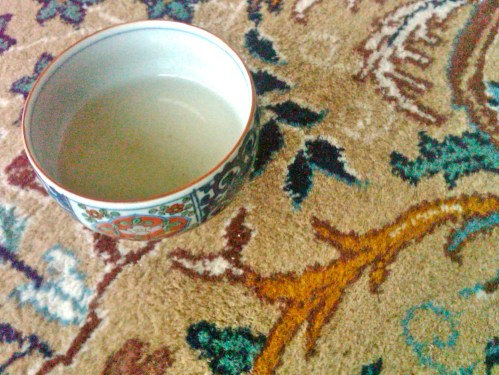
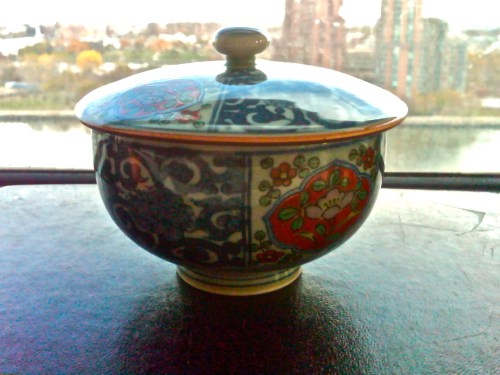
The Chinese teacup in the photograph is half-filled with lukewarm jade tea. It belongs to Kaoru Wang, a friend who responded to my call-out for photos of half-filled glasses in the first E/F posting. The teacup has been in her family for “years and years and years.” She photographed it on a pretty carpet of unknown origin. She sent another photograph showing the cup with its cap, which lets you keep the tea warm while taking your time to drink it over pleasant conversation or in reflective solitude.
Teacup, with cap
The tea itself was given to Kaoru by a friend who left his family’s tobacco business in order to build a tea company in Vancouver, bringing his knowledge and experience with leaves into a concern that could contribute positively to the health and well-being of his customers. Among his clients are some of the most prestigious hotels around the world.
In her note to me about the teacup and its surroundings, Kaoru wrote that it is “comforting to reflect how much history and warmth there is in the most basic of items,” a sentiment that drives my own writing here and elsewhere. Kaoru’s observations about life, her experiences, and her work can be found here. She is currently making a film about education and change called “The Killer App,” which she writes about in several places, including the film’s blog under its previous title, “Something Far Finer.”
... with persimmons and more of Roosevelt Island
Through the window, behind the teacup, we have a blurred view of Roosevelt Island, a 2 mile long sliver of land in the East River between Manhattan and Queens. A self-contained family farm from the late 1600s to 1828, it was known as Blackwell’s Island (after its owners) for most of its modern history, being named for FDR only in 1973. After the Blackwells sold the island to the city in 1828, it was given over to “a long succession of institutions and hospitals,” which included a lunatic asylum (“The Octagon,” so called for its signature building); a hospital; a Smallpox laboratory (The Strecker Laboratory); and a prison that at one time or another housed Boss Tweed, Emma Goldman, Mae West, and Billie Holiday.
In 1969, the city leased the island to the State of New York Urban Development Corporation, which has created a unique urban community on the island. Home to about 12,000 people today, the island is closed to car traffic and accessible by bus and tram. The Roosevelt Island tram is a notable piece of New York architecture, frequently featured in films and television (CSI: New York, City Slickers, The Professional, Spider-Man, Cold Souls, and others). The residential buildings have innovative designs – such as duplex (multi-story) apartments that make is possible for the elevators to stop only every 3 floors. In the spirit of contemporary wealth-and-consumption-driven governance and planning, The Octagon has been restored and is now a high-end apartment community with a mall and a lot of solar panels.
E. Things that we never would have done had we known better, but that we must live with to the end of our days.
F. Wonderful things and great discoveries that never would have happened had we known better.
Note: E/F will be a recurring feature of truth and rocket science. If you have a half-glass photo to share, or want to create one, send it to me at jguidry.7 AT gmail DOT com and I’ll use it in a future posting, with full credit to you. Make sure that you tell me the story behind the photo, including the contents of the glass, in the following manner . . .
Credit: This standard Williams Sonoma pint glass is half-filled with Hoegaarden whitbier. Its taste is semi-tart and well-accented with a slice of lemon. It sits on a small faux-marble coffee table, in front of a love seat futon that was found on the sidewalk in Park Slope, Brooklyn, Sixth Avenue b/t Garfield and Carroll, on a spring day in 2008. As the mattress was clean and the frame in almost perfect shape, we took it home because we needed a sofa. Ah, providence.
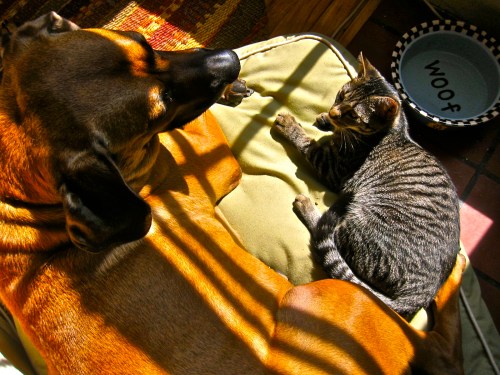
a comfortable living room, for people and cats
The paintings were acquired in Bahia, Brazil in the summer of 1998. The artist signs himself “Alberto,” and they are of mixed media, acrylic paint with splatters of sand and swatches of cloth added for texture. I don’t recall the name of the shop, but I could certainly find it in a minute upon return to the city.
The coffee table was given to me by a friend to hold for her while she moved back to Rockford, Illinois to live in the barn on the family farm while writing her first three books. One day she may want the table back, but until then, it’s here.
Pixie, ace mouser
Pixie, the cat, is about five and a half years old. She came into the family in February of 2005, for the specific purpose of eradicating the mice that had beset us in the fall of 2004. As I told Duke, Pixie was “a technician,” and she proved a very effective one: in her first 14 days, she took out 13 mice, and we never saw another one.
Brazil is a country of inspired appropriation. Its peoples, cultures, sounds, and visions grind against each other. They rise up and smash together like tectonic plates. In the collision of Brazil and Brasília, the city of candangos gave the country Renato Russo.
No “torso of steel,” no “[w]inged elbows and eyeholes,” but like Zweig and Plath a literary mind and poet, Russo’s voice became his generation’s. In his epic song, “Faroeste Caboclo,” Russo tells the story of a poor kid’s migration to Brasília across 159 lines of free verse, punk sensibilities, and an affecting melody that calls to mind the traditional country music of Brazil’s Northeast. Faroeste is what they call a “Western movie” in Brazil, and caboclo refers to the Brazilian mestiço everyman, a mixture of races and cultures, poor, seeking his or her fortune in some faraway place. Faroeste Caboclo is Walt Whitman, rogue-Gary Cooper and Joe Strummer together in Niemeyer’s white palace.
The hero is João de Santo Cristo, from Brazil’s Northeastern “backlands.” Brazilians call this region the Sertão, a rural, agrarian, drought-afflicted area that is the poorest place in the country and carries the deepest currents of Brazil’s premodern past. João robs the poor box from the church. He goes after the girls in the town. People don’t trust him. He feels the effect his skin color has on others who are lighter, more well-to-do. He’s arrested and goes to reform school, where he is raped and degraded. He is filled with hatred.
When a man on his way to Brasília decides not to go and gives his bus ticket to João, he becomes an accidental candango, leaving his past for the “beautiful city” where everything will be different. He works as a carpenter’s apprentice, but he can’t make ends meet and becomes a drug trafficker.
After some time in the criminal world, he tries to go straight when he falls in love Maria Lúcia, but eventually the drug trade pulls him back in. João’s enemy, Jeremias, steals Maria Lúcia and they have a child together. João challenges Jeremias to a duel, which is covered in the press and shocks the city’s elite but makes João a hero to the people. In the duel, Jeremias shoots João in the back and wounds him fatally. Maria Lúcia rushes to her first love and gives João a gun. He challeges Jeremias to die like a man and shoots him. In the end, Maria Lúcia and João die together in each other’s arms.
The people declared that João de Santo Cristo
Was a saint because he knew how to die
And the bourgeoisie of the city didn’t believe the story
That they saw on TV
And João didn’t accomplish what he desired like the devil
When he came to Brasília
What he wanted was to speak to the president
To help all the people that
Suffer
Russo and his bandmates in Legião Urbana (Urban Legion) grew up in Brasília in the late 1970s. Their songs of protest, love, and everyday struggles became the nation’s soundtrack to the last years of the military dictatorship and the re-emergence democracy in the 1980s.
“Será,” a love song with an anthemic refrain, could be heard blaring from sound trucks at the massive marches and rallies of the caras-pintadas (“painted faces”) in 1992, as they challenged the nation to bring down Fernando Collor, Brazil’s first democratically elected president since 1960.
So called because they painted their faces in the Brazilian national colors, green and yellow, the caras-pintadas had grown up under the military regime and saw their hopes threatened by Collor’s massively corrupt regime. They led the way for the whole country, which stopped each day at 7:00 for the allegorical soap opera, Deus Nos Acuda (God Help Us), a comedy in which the angel Celestina tries to save Brasil from the excesses of its social and political elite. In the show’s opening, the rich are smothered in mud and flushed down a whirlpool shaped like the country itself.
Collor was impeached and left office by the end of 1992.
Russo died on October 11, 1996, of AIDS-related illnesses. Russo’s wishes were to have his ashes spread over the gardens of Brazilian landscape artist Roberto Burle Marx, returning him to Brasília and its modernist vision.
In 2006, Fernando Collor was elected Senator for his home state, Alagoas, for an 8 year term (2007-2015). Brazil has absorbed Brasília.
Notes and Credits
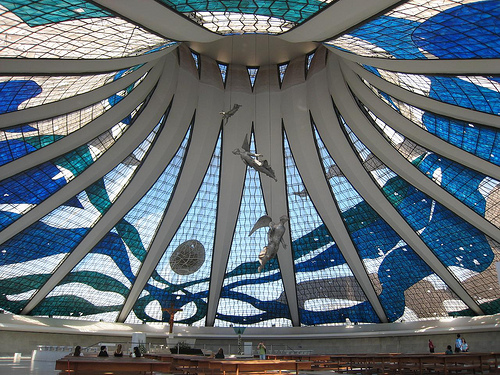
Photo: interior of the Brasília Metropolitan Cathedral. As with the previous post, the photo is taken from the Flickr site of Shelley Bernstein, aur2899. She works at the Brooklyn Museum (according to the Flickr “about”) and has a lot of pictures from Brasília and elsewhere. Her Brooklyn Museum blog posts are here.
Renato Russo was born Renato Manfredi, Jr., in Rio de Janeiro. He moved to Brasília in 1973 at the age of 13 and became a songwriter and musician. He renamed himself after the philosophers Rousseau and Bertrand Russell, and the painter Henri Rousseau.
Faroeste Caboclo plays on the iconic stories of migration from the Brazilian backlands, the sertão, to cities in search of a better life – one of the central storylines of Brazilian history. It’s a story of spiritual depth and apocalyptic reach, most famously told in Euclides da Cunha’s Os Sertões. Da Cunha’s book, published in 1903, tells of the Brazilian military’s destruction of the city of Canudos in the 1890s.
Canudos was a city that grew up around the milennial teachings of a folk preacher, Antonio Conselheiro, bringing tens of thousands of poor Brazilians together in a sertanejo enclave to await the last days. The Brazilian government saw the city as a grave threat to its own project of bringing Brazil into the community of modern republics while still maintaining the class and racial divisions of its colonial and plantation (slavery) past. Canudos was utterly destroyed by the military, and its inhabitants were massacred.
The destruction of Canudos removed one “sore” from the Brazilian body politic, but in the predictable irony of history and unintended consequences, Canudos gave birth to the next social threat. Soldiers from the campaign, unable to find work on retrn to civilian life, migrated south from the Northeast to Rio de Janeiro and built their own squatter colony on a hill. Thus was born the first favela, later to become the 21st century dystopian Canudos that continues to challenges the Brazilian modernizing project.
During 1992 and 1993, I lived in Belém and accompanied the protest marches through the city. I was officially a researcher, but I was also 28 years old, not much older than the caras-pintadas who I spoke to. Just a few years earlier, as a college student in New Orleans in the mid-1980s, I used to grab the New York Times every day to read up on the military’s exit from power in 1985. In 1992-93, like everyone else in Brazil, I was glued to the television every day for Deus Nos Acuda.
Another song that rang out from the sound trucks and radios everywhere was the first Legião Urbana hit, “Tempo Perdido,” with the echoing call of the refrain, selvagem, meaning wild, untamed. It was a song about love and not losing the time at hand, but it was also about the passion for breaking free of repression that made this song the “anthem of an entire generation” (O hino de toda uma geração), according to Alexandre Inagaki. In the video the band pays homage to all their forebears in rock and roll.
“Tempo Perdido” follows in the footsteps, or looking down from the shoulders of Raul Seixas and “Maluco Beleza.” Raul Seixas was Brazil’s Elvis (his idol), Jim Morrison, and John Lennon rolled into one. He “was not just a musician, but a philosopher of life …” (Raul não era apenas música, Raul era uma filosofia de vida), “Always Ahead of his Time.” See Jesse’s portrait of Raul on her blog, Mundo de Jesse. “Maluco Beleza” (“Crazy Beauty”) is for many the epic statement of individuality and creativity from the central icon of Brazilian rock.
Senhor Hype reports that the Brazilian RockWalk is in development, creating a walk of fame that will include both national artists as well as some international artists like the Scorpions.
For an English translation of “Faroeste Caboclo” along with the music, go here. The translation of the ending of the song above is taken from this video, and credit goes to Alexandre Mello and Andrea Hilland.





















 truth and rocket science