E/F – The glass of history

halfglass-kaoru-1

“We do not draw the moral lessons we might from history … In history a great volume is unrolled for our instruction, drawing the materials of future wisdom from the past errors and infirmities of mankind …  History consists for the greater part of the miseries brought upon the world by pride, ambition, avarice, revenge, lust, sedition, hypocrisy, ungoverned zeal, and all the train of disorderly appetites which shake the public with the same.”

This passage from Edmund Burke’s Reflections on the Revolution in France, written as the French Revolution began in 1789, is shot through with contradiction, like Burke himself.  It takes a little more time to digest than a shot of Santayana – Those who cannot remember the past are condemned to repeat it – or the oft-cited quip, We learn from history that we learn nothing from history, which is often attributed (erroneously, it seems) to George Bernard Shaw.  But it’s worth it, because Burke got it right.

Notes and Credits:  Burke and history and quotations

This quotation from Burke is taken from the Google books archive, which features the 2nd Edition of the Reflections on the Revolution in France, printed in London for J. Dodsley, M.DCC.XC (1790), pp. 207-08.

Burke’s writing fleshed out the impassioned complexity of his own life and commitments.  As a member of parliament in the 1770s, he was a staunch supporter of the American Revolution, something of a libertarian.  With the fall of the Bastille, however, he became enraged at the treatment of the French royal family and the disregard for history and tradition by the revolutionaries and their Enlightenment muses.

In the Reflections, he seems to predict the horror that would follow in the “Reign of Terror,” as well as the problems of revolution in general, and this work became the foundation of modern conservatism.  Interestingly, the degree to which a conservative relies on Burke in his or her own thinking is the line between the intellectual side of the movement (George Will, David Brooks, Thomas Sowell) and the populist mobs (Glen Beck, Rush Limbaugh) that one such as Burke would so rightly disown.  (Note:  George Will’s use of Burke to attack blue jeans is just silly, but Will has earned it.)

A searchable, copyable, full text of Burke’s Reflections is available here.  As a life long leftist, I don’t share the commitments that George Will and David Brooks have, but I do admire complex thinking and impassioned writing.  As Sina Odugbemi points out, Burke’s supposed “conservatism” was really about finding the appropriate – and constant – means for reform of the state:  “You reform in order to conserve; without reform you cannot really conserve a political system.”  If only the opponents of health care reform had the tact and intellect of Burke.

In response to a call-out on Facebook to find out where the G. B. Shaw statement mentioned above came from, my friend Katie replied with:

I tried to use the power of the internets, and what the internets are telling me is that I should infer that it is a popular misattribution. It’s not on his Wikiquote page, but it was on the Anonymous Wikiquote page for a while–if you look at the talk page someone mentioned a similar quote attributed to Otto von Bismarck. Here is an actual political scientists saying it’s popularly attributed to Hegel: http://bit.ly/1Xp8RD .

Notes and Credits:  The teacup

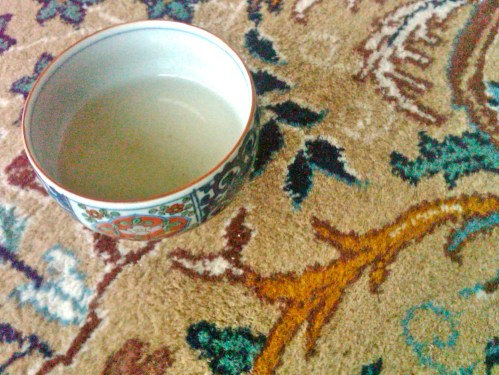
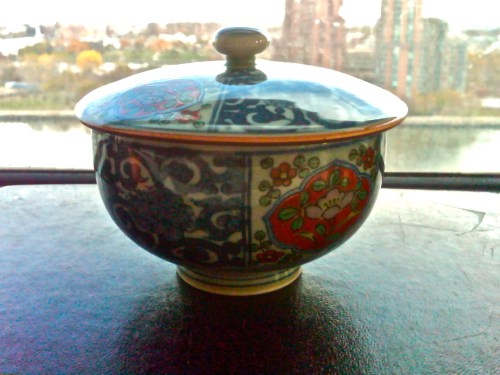
The Chinese teacup in the photograph is half-filled with lukewarm jade tea.  It belongs to Kaoru Wang, a friend who responded to my call-out for photos of half-filled glasses in the first E/F posting.  The teacup has been in her family for “years and years and years.”  She photographed it on a pretty carpet of unknown origin.  She sent another photograph showing the cup with its cap, which lets you keep the tea warm while taking your time to drink it over pleasant conversation or in reflective solitude.
halfglass-kaoru-4

Teacup, with cap

The tea itself was given to Kaoru by a friend who left his family’s tobacco business in order to build a tea company in Vancouver, bringing his knowledge and experience with leaves into a concern that could contribute positively to the health and well-being of his customers.  Among his clients are some of the most prestigious hotels around the world.

In her note to me about the teacup and its surroundings, Kaoru wrote that it is “comforting to reflect how much history and warmth there is in the most basic of items,” a sentiment that drives my own writing here and elsewhere.  Kaoru’s observations about life, her experiences, and her work can be found here.  She is currently making a film about education and change called “The Killer App,” which she writes about in several places, including the film’s blog under its previous title, “Something Far Finer.”

halfglass-kaoru-3

... with persimmons and more of Roosevelt Island

Through the window, behind the teacup, we have a blurred view of Roosevelt Island, a 2 mile long sliver of land in the East River between Manhattan and Queens.  A self-contained family farm from the late 1600s to 1828, it was known as Blackwell’s Island (after its owners) for most of its modern history, being named for FDR only in 1973.  After the Blackwells sold the island to the city in 1828, it was given over to “a long succession of institutions and hospitals,” which included a lunatic asylum (“The Octagon,” so called for its signature building); a hospital; a Smallpox laboratory (The Strecker Laboratory); and a prison that at one time or another housed Boss Tweed, Emma Goldman, Mae West, and Billie Holiday.

In 1969, the city leased the island to the State of New York Urban Development Corporation, which has created a unique urban community on the island.  Home to about 12,000 people today, the island is closed to car traffic and accessible by bus and tram.  The Roosevelt Island tram is a notable piece of New York architecture, frequently featured in films and television (CSI: New York, City Slickers, The Professional, Spider-Man, Cold Souls, and others).  The residential buildings have innovative designs – such as duplex (multi-story) apartments that make is possible for the elevators to stop only every 3 floors.  In the spirit of contemporary wealth-and-consumption-driven governance and planning, The Octagon has been restored and is now a high-end apartment community with a mall and a lot of solar panels.

1 Comment

Filed under beauty, freedom, ideas, order, politics, revolution, truth, war

E/F – the glass of youth

halfglass-beer

E.  Things that we never would have done had we known better, but that we must live with to the end of our days.

F.  Wonderful things and great discoveries that never would have happened had we known better.

Note:  E/F will be a recurring feature of truth and rocket science. If you have a half-glass photo to share, or want to create one, send it to me at jguidry.7 AT gmail DOT com and I’ll use it in a future posting, with full credit to you.  Make sure that you tell me the story behind the photo, including the contents of the glass, in the following manner . . .

Credit:  This standard Williams Sonoma pint glass is half-filled with Hoegaarden whitbier.  Its taste is semi-tart and well-accented with a slice of lemon.  It sits on a small faux-marble coffee table, in front of a love seat futon that was found on the sidewalk in Park Slope, Brooklyn, Sixth Avenue b/t Garfield and Carroll, on a spring day in 2008.  As the mattress was clean and the frame in almost perfect shape, we took it home because we needed a sofa.  Ah, providence.

IMG_3264

a comfortable living room, for people and cats

The paintings were acquired in Bahia, Brazil in the summer of 1998.  The artist signs himself “Alberto,” and they are of mixed media, acrylic paint with splatters of sand and swatches of cloth added for texture.  I don’t recall the name of the shop, but I could certainly find it in a minute upon return to the city.

The coffee table was given to me by a friend to hold for her while she moved back to Rockford, Illinois to live in the barn on the family farm while writing her first three books.  One day she may want the table back, but until then, it’s here.

IMG_3260

Pixie, ace mouser

Pixie, the cat, is about five and a half years old.  She came into the family in February of 2005, for the specific purpose of eradicating the mice that had beset us in the fall of 2004.  As I told Duke, Pixie was “a technician,” and she proved a very effective one:  in her first 14 days, she took out 13 mice, and we never saw another one.

112-1222_IMG

Duke loves Pixie

6 Comments

Filed under art, Brazil, Duke, freedom, life, Pixie, truth, youth

The truth and Brasília, 3: Faroeste Caboclo

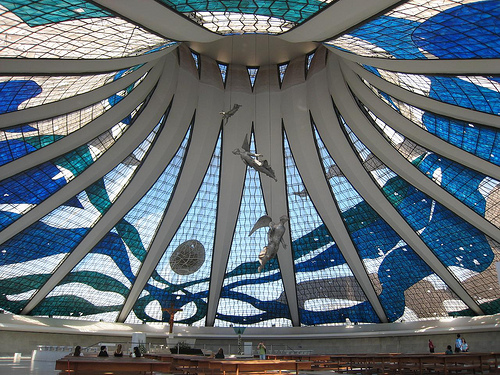
Brasília, Metropolitan Cathedral

Brasília, Catedral Metropolitana Nossa Senhora Aparecida

Brazil is a country of inspired appropriation.  Its peoples, cultures, sounds, and visions grind against each other.  They rise up and smash together like tectonic plates.  In the collision of Brazil and Brasília, the city of candangos gave the country Renato Russo.

No “torso of steel,” no “[w]inged elbows and eyeholes,” but like Zweig and Plath a literary mind and poet, Russo’s voice became his generation’s.  In his epic song, “Faroeste Caboclo,” Russo tells the story of a poor kid’s migration to Brasília across 159 lines of free verse, punk sensibilities, and an affecting melody that calls to mind the traditional country music of Brazil’s Northeast.  Faroeste is what they call a “Western movie” in Brazil, and caboclo refers to the Brazilian mestiço everyman, a mixture of races and cultures, poor, seeking his or her fortune in some faraway place.  Faroeste Caboclo is Walt Whitman, rogue-Gary Cooper and Joe Strummer together in Niemeyer’s white palace.

The hero is João de Santo Cristo, from Brazil’s Northeastern “backlands.”  Brazilians call this region the Sertão, a rural, agrarian, drought-afflicted area that is the poorest place in the country and carries the deepest currents of Brazil’s premodern past.  João robs the poor box from the church.  He goes after the girls in the town.  People don’t trust him.  He feels the effect his skin color has on others who are lighter, more well-to-do.  He’s arrested and goes to reform school, where he is raped and degraded.  He is filled with hatred.

When a man on his way to Brasília decides not to go and gives his bus ticket to João, he becomes an accidental candango, leaving his past for the “beautiful city” where everything will be different.  He works as a carpenter’s apprentice, but he can’t make ends meet and becomes a drug trafficker.

After some time in the criminal world, he tries to go straight when he falls in love Maria Lúcia, but eventually the drug trade pulls him back in.  João’s enemy, Jeremias, steals Maria Lúcia and they have a child together.  João challenges Jeremias to a duel, which is covered in the press and shocks the city’s elite but makes João a hero to the people.  In the duel, Jeremias shoots João in the back and wounds him fatally.  Maria Lúcia rushes to her first love and gives João a gun.  He challeges Jeremias to die like a man and shoots him.  In the end, Maria Lúcia and João die together in each other’s arms.

The people declared that João de Santo Cristo
Was a saint because he knew how to die
And the bourgeoisie of the city didn’t believe the story
That they saw on TV

And João didn’t accomplish what he desired like the devil
When he came to Brasília
What he wanted was to speak to the president
To help all the people that

Suffer

Russo and his bandmates in Legião Urbana (Urban Legion) grew up in Brasília in the late 1970s.  Their songs of protest, love, and everyday struggles became the nation’s soundtrack to the last years of the military dictatorship and the re-emergence democracy in the 1980s.

“Será,” a love song with an anthemic refrain, could be heard blaring from sound trucks at the massive marches and rallies of the caras-pintadas (“painted faces”) in 1992, as they challenged the nation to bring down Fernando Collor, Brazil’s first democratically elected president since 1960.

So called because they painted their faces in the Brazilian national colors, green and yellow, the caras-pintadas had grown up under the military regime and saw their hopes threatened by Collor’s massively corrupt regime.  They led the way for the whole country, which stopped each day at 7:00 for the allegorical soap opera, Deus Nos Acuda (God Help Us), a comedy in which the angel Celestina tries to save Brasil from the excesses of its social and political elite.  In the show’s opening, the rich are smothered in mud and flushed down a whirlpool shaped like the country itself.

Collor was impeached and left office by the end of 1992.

Russo died on October 11, 1996, of AIDS-related illnesses.  Russo’s wishes were to have his ashes spread over the gardens of Brazilian landscape artist Roberto Burle Marx, returning him to Brasília and its modernist vision.

In 2006, Fernando Collor was elected Senator for his home state, Alagoas, for an 8 year term (2007-2015).  Brazil has absorbed Brasília.

Notes and Credits

Photo:  interior of the Brasília Metropolitan Cathedral.  As with the previous post, the photo is taken from the Flickr site of Shelley Bernstein, aur2899.  She works at the Brooklyn Museum (according to the Flickr “about”) and has a lot of pictures from Brasília and elsewhere.  Her Brooklyn Museum blog posts are here.

Renato Russo was born Renato Manfredi, Jr., in Rio de Janeiro.  He moved to Brasília in 1973 at the age of 13 and became a songwriter and musician.  He renamed himself after the philosophers Rousseau and Bertrand Russell, and the painter Henri Rousseau.

Faroeste Caboclo plays on the iconic stories of migration from the Brazilian backlands, the sertão, to cities in search of a better life – one of the central storylines of Brazilian history.  It’s a story of spiritual depth and apocalyptic reach, most famously told in Euclides da Cunha’s Os Sertões.  Da Cunha’s book, published in 1903, tells of the Brazilian military’s destruction of the city of Canudos in the 1890s.

Canudos was a city that grew up around the milennial teachings of a folk preacher, Antonio Conselheiro, bringing tens of thousands of poor Brazilians together in a sertanejo enclave to await the last days.  The Brazilian government saw the city as a grave threat to its own project of bringing Brazil into the community of modern republics while still maintaining the class and racial divisions of its colonial and plantation (slavery) past.  Canudos was utterly destroyed by the military, and its inhabitants were massacred.

The destruction of Canudos removed one “sore” from the Brazilian body politic, but in the predictable irony of history and unintended consequences, Canudos gave birth to the next social threat.  Soldiers from the campaign, unable to find work on retrn to civilian life, migrated south from the Northeast to Rio de Janeiro and built their own squatter colony on a hill.  Thus was born the first favela, later to become the 21st century dystopian Canudos that continues to challenges the Brazilian modernizing project.

During 1992 and 1993, I lived in Belém and accompanied the protest marches through the city.  I was officially a researcher, but I was also 28 years old, not much older than the caras-pintadas who I spoke to.  Just a few years earlier, as a college student in New Orleans in the mid-1980s, I used to grab the New York Times every day to read up on the military’s exit from power in 1985.  In 1992-93, like everyone else in Brazil, I was glued to the television every day for Deus Nos Acuda.

Another song that rang out from the sound trucks and radios everywhere was the first Legião Urbana hit, “Tempo Perdido,” with the echoing call of the refrain, selvagem, meaning wild, untamed. It was a song about love and not losing the time at hand, but it was also about the passion for breaking free of repression that made this song the “anthem of an entire generation” (O hino de toda uma geração), according to Alexandre Inagaki.  In the video the band pays homage to all their forebears in rock and roll.

“Tempo Perdido” follows in the footsteps, or looking down from the shoulders of Raul Seixas and “Maluco Beleza.”  Raul Seixas was Brazil’s Elvis (his idol), Jim Morrison, and John Lennon rolled into one.  He “was not just a musician, but a philosopher of life …” (Raul não era apenas música, Raul era uma filosofia de vida), “Always Ahead of his Time.”  See Jesse’s portrait of Raul on her blog, Mundo de Jesse.   “Maluco Beleza” (“Crazy Beauty”) is for many the epic statement of individuality and creativity from the central icon of Brazilian rock.

Senhor Hype reports that the Brazilian RockWalk is in development, creating a walk of fame that will include both national artists as well as some international artists like the Scorpions.

For an English translation of “Faroeste Caboclo” along with the music, go here.  The translation of the ending of the song above is taken from this video, and credit goes to Alexandre Mello and Andrea Hilland.

3 Comments

Filed under art, Brasília, brasil, Brazil, danger, death, freedom, individuality, legiao urbana, life, love, myth, politics

The truth and Brasília, 2: Torsos of Steel

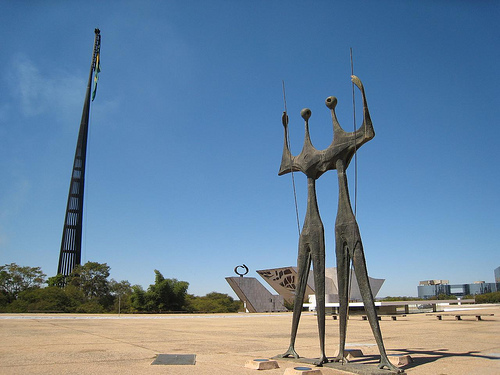
brasilia-trespoderes

The Dream

From 1956 to 1960, Brazilian architects, engineers and peasant laborers called candangos built a new capital, Brasília.  This was the realization of a dream first voiced in 1827, just 5 years after the country became independent, when an advisor to Emporer Pedro I suggested that he move the capital from the colonial city of Rio de Janeiro, on the coast, to a new city in the interior.

Brasília, as it eventually came to be called, was a Brazilian version of Luso-Manifest Destiny.  The new city was built on the legacy of the Bandeirantes, slave hunters and prospectors whose journeys into the South American interior in the 16th and 17th centuries extended Portuguese holdings – Brasil – at the expense of the Spanish crown.

President Juscelino Kubitschek asked Oscar Niemeyer to head up the team that would create the new capital.   A native of Rio de Janeiro, Niemeyer was already an internationally renowned architect, his design for the United Nations Head Quarters in New York an immediate icon of post-war modernism.  His designs for Brasília’s government buildings, plazas, monuments, and National Cathedral created something of a modernist theme park in Brasília, and in 1987 the city was designated a World Heritage Site by UNESCO.

For Brasília, Niemeyer collaborated with another celebrated Brazilian designer, Lucio Costa, whose plans for the city took the national dream into the air itself – from above, Brasília’s layout looks like a giant bow, loaded and aimed at the heart of the continent.  Costa’s Brasília conformed to the modernist Athens Charter of 1933 almost to the letter, creating a city of functionalism and (for many) modern alienation.  Landscaping was done by Roberto Burle Marx, another of the generation of Brazilian modernists whose work defined an era in South American history.

In the Plaza of the Three Powers, Bruno Giorgi’s sculpture, Os Candangos, memorialized the northeastern Brazilians who built the capital.  In the national discourse of the time, these impoverished peasants were living symbols of Brazil’s colonial and agrarian past.  By coming to Brasília and building the city, they were transformed into new pioneers who would settle the vast empty spaces of the country’s interior, from the dry plains of Brasília through the vast green desert of the Amazon.  Unlike the North American slaves who built the White House and the U.S. Captiol buildings, the candangos were memorialized as part and parcel of Brasília’s futurist vision.

The architect must think that the world has to be a better place, that we can end poverty . . . . it is important that the architect think not only of architecture but of how architecture can solve the problems of the world . . . The architect has to always be political.

—Oscar Niemeyer, 2009

Hard Winter

Meanwhile, in London, Sylvia Plath was pregnant again.  Her husband, Ted Hughes, was having an affair with another woman, and they were destined to separate soon after the birth of their son, Nicholas.  In the 13 months after Nick’s birth, Plath wrote most of the poems in her second collection, Ariel, and published her autobiographical novel, The Bell Jar.  Then on February 11, 1963, Plath left her children sleeping in their room, sealed the door with wet towels, and committed suicide with oven gas in the kitchen.

Among the poems she wrote in this period was Brasilia, which was not published in Ariel.  Like Zweig, Plath was thinking about the past and the future and the trouble with seeing it through.

Will they occur,
These people with torso of steel
Winged elbows and eyeholes

Awaiting masses
Of cloud to give them expression,
These super-people! –
And my baby a nail
Driven, driven in.
He shrieks in his grease

Bones nosing for distance.
And I, nearly extinct,
His three teeth cutting

Themselves on my thumb –
And the star,
The old story.

In the lane I meet sheep and wagons,
Red earth, motherly blood.
O You who eat

People like light rays, leave
This one
Mirror safe, unredeemed

By the dove’s annihilation,
The glory
The power, the glory.

It was one of the coldest winters on record in England, and Sylvia Plath’s life was falling apart even as she was bringing new life on.  How long she had intended to take leave of this life is not something we can know.  She had attempted suicide before, and she was troubled by deep emotional struggles that went back to childhood.  Her relationship with Hughes held some high points in her life, but now he had left her for another woman.  What is clear, however, is that once she made her decision, she executed it with consummate intentionality.  She meticulously protected her children as she took her own life.

Like Zweig, she left two works for posthumous publication, one pointing backwards, one pointing forward.  The Bell Jar was on its way to publication; in this, her semi-autobiographical novel, she exposed a world she knew in the past, a world she tried to leave once before.  As she died, the manuscript for Ariel and Other Poems, her masterwork, lay on the desk, each poem typed and left in the precise order she wanted for the book.  The first word of the first poem, “Morning Song,” was “love.”  The last word of the last poem, “Wintering,” was “spring.”

Like Zweig, Plath thought she left a book pointing to a better future, but that wasn’t to be.  The Ariel that was published under Ted Hughes’s editorial guidance was not the same book.  The poems were reordered, others added, and a few, like Brasilia, removed.  This Ariel was darker, seeming to foreshadow Plath’s end, but whatever the critics of Hughes’s intentions, this Ariel made Plath who she is today.

Cold War

On March 31, 1964, the Brazilian military overthrew the democratically elected government.  As the military took control, they created the model for the “bureaucratic authoritarian state” in the developing world.  Niemeyer and Costa’s modernist visions were perverted into symbols of Latin America’s dark period, the capital’s bland functionality and order representing the kind of control that the military celebrated in its culture, the kind of functionality they wished to instill in the rest of the country.

Behind the gleaming white façades of Brasília’s futuristic vision, the Brazilian military contributed to the “dirty wars” against the left in Brazil, Argentina, Chile, and Uruguay.  These regimes took the lives of tens of thousands of people who dreamed of a different kind of democracy than the region had known.  Beyond those killed, many more were tortured, and hundreds of thousands were forced into exile.  Niemeyer, a Communist and therefore enemy of the state, went into exile in Europe.

When the opposition movements eventually took power in the late 1980s and 1990s, the world was a very different place.  Brasília was a bigger city, showing some age, surrounded by “satellite cities” and large favelas – the squatter settlements that the military tried to eradicate in Rio de Janeiro with less than efficient results.  Costa’s rationally designed city had its flaws, its ups and downs, and its critics.  For some, it seemed as if Brazil, and Brasília, had turned Zweig’s book into a joke:  Brazil is the country of the future, and it always will be.

The future that Brasília promised, that Plath saw in her mind and in her children, didn’t work out according to the original plans.  Yet life goes on.  I will continue these themes in the next posting on the The truth and Brasília, 3:  Faroeste Caboclo.

plath-tat

Notes and Credits

The critics of Brasília’s ambitious design and lofty principles are many.  I am not one of them.  I am writing to explore what Brasília means, not its shortcomings, and my approach should indicate that I believe the city’s meaning far outshines any of its shortcomings.

Lauro Cavalcanti provides a beautiful guide to Brazil’s modernist architecture that places Brasília in perspective.  In Brasília, the government sought to “turn the state into a spectacle,” and Brasília is indeed the enactment of a dream.  If you can’t go to Brasília but can find your way to New York, go to Lincoln Center, and you can witness Neimeyer and Brasília’s influence on one of the great cultural centers of the world.

Photo of the Praça dos Três Poderes, with the statue of Os Candangos, is from the Flickr site of Shelley Bernstein, aur2899.  She works at the Brooklyn Museum (according to the Flickr “about”) and has a lot of pictures from Brasília and elsewhere.  Her Brooklyn Museum blog posts are here.

The candangos are publicly memorialized in Brazil, in marked contrast to the North American squelching of the slave labor employed to build our own White House.  Without suggesting that Brazil is any less racist than the U.S., or that either country has a better social model for dealing with its racial legacy, I point this out as a matter of historical interest.  The reader may regard these facts as he or she wishes.

Niemeyer and Costa’s designs were political statements.  They expressed political beliefs in modernity, order, and democracy in the layout of the city.  Niemeyer himself was a Communist, whose architeture reflected his beliefs in a world of collective and individual democracy, the triumph of working people over the old regime and the capitalist governing class.

Oscar Niemeyer is 101 years old, and he is still working.  The quotation in this posting is taken from an interview he did with Santiago Fernandez-Stelley for Vice magazine online, at some point in 2009.  The interview can be seen on video at VBS.TV.  The video of the interview is simply inspirational.

The photo of the Sylvia Plath tattoo is from a photobucket listing from PaperCuttt.  I found it first on this site for literary tattoos.  You can also find material from the same person at another livejournal channel.  She notes that she altered the original slightly (“As I listened to the old bray of my heart….I am. I am. I am.”) but that it contains the same spirit.

I have long been greatly motivated by the poetry and writing of Sylvia Plath.  As I mentioned in the introduction to this series of posts, her Collected Poems was one of two English language books I brought to Brazil in 1992 for my year of doctoral reserach in Belém.  Over my life I have read many books on her and her life.  These resources include:  the poems themselves. Anne Stevenson, Bitter Fame; Jacqueline Rose, The Haunting of Sylvia Plath; Linda Wagner, Critical Essays on Sylvia Plath; and Erica Wagner, Ariel’s Gift.  I’ve tried to read as much as possible, and to work through the thicket of political controversy around her work and life.  I also read Ted Hughes’ Birthday Letters and have some to a deeper appreciation of how Sylvia Plath affected all those around her.  The tragedy of her son’s suicide last year brought me a several days of stark reflection on emotions, depression, and the struggle of human consiousness and life against itself.

12 Comments

Filed under art, beauty, existentialism, failure, ideas, order

Old

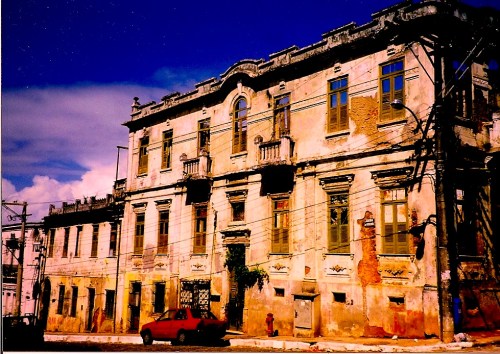
bldg-salvador-alt1

Rust red water seeps from the walls.

It comes out between
dirty white tiles that
cling to the surface by only the
faintest memory of
glue or caulking.

At this point,
cleaning could do great
damage, for the whole thing is
held together by
piles of time itself.
This is no dilemma.

It’s what happens when things get old.

bldgs-belem-alt-2

Notes and Credits

Photos:  I took these photos in Brazil.  The first is from 1998, a delapidated building in the old quarter of Salvador, Bahia, the capital of the Brazilian colony from its founding in 1549 to 1763 (when the capital was moved to Rio de Janeiro).  The second is from 1993, in downtown Belém along the waterfront on the the Bahia de Guarajá at the mouth of the Amazon River.  The façade stood like this for at least five more years, for I know it was that way in 1998.  I can’t recall if this façade was ever torn down or refurbished as the front to a new building.  Memory fails me now (see the poem).

The poem:  I just moved to a new apartment, new to me, in an old building.  We’re dealing with a few old building issues as I try to get settled amid the boxes upon boxes.  My friend Amy calls this a “liminal period,” and she is right.  Everything is up for grabs.  I could throw things away.  I could re-evaluate the value of things and keep them.  I could completely rearrange my material surroundings and invent something different.

I moved myself with four of my friends, all dads to friends of my son.  We moved me on Sunday.  We felt a little older on Monday.  At the same time, I am reading Ted Hughes’s Birthday Letters and Erica Wagner’s Ariel’s Gift as I prepare to finish off the next post on Brasília.  In my quiet moments, I can’t help but think in short lines of verse and hear them, over and over, in the silent spaces between my thoughts and actions.

The liminal experience of moving is not fun.  It unearths too much.  Our dust is comfortable, even if we pretend to vacuum it away every week.  Unsettling everything creates a dilemma:  deal with it or shut it away as quickly as possible.  The good thing about creating this posting is that it made me dig through old photographs (I knew exactly the ones I needed, and I knew exactly where the dusty boxes and albums containing them were).  Some old photos aren’t easy to look at.  “Too many lovers,” to quote the title of a song written by my old bandmate and best friend P.H. Fred.  Others are good to find, bringing on moments of reverie that soften the blows of age and loss, reminding one of a life lived well, and pointing forward in hope, for we will continue to live well.

Dedication:  To old people everywhere.  May their wisdom remain with us.

5 Comments

Filed under ageing, body

The truth and Brasília, 1: Land of the Future

zweig

This series of posts springs from three sources.  First, my research for “The truth and change,” recalled the poem Brasília, by Sylvia Plath.  Second, I have lived in Brazil for long periods of time and consider Belém, the “cidade das mangueiras” at the mouth of the Amazon River, as my second home town.  Third, The Collected Poems of Sylvia Plath was one of two English-language books I brought with me to Belém in 1992, as I began a year-long stay for my doctoral research.

These are stories of exile, suicide and hope in a world caught just between a despair-ridden past and an open-ended, possibly bright future.  They are stories of writers and writing.  They are stories close to my heart and deeply tied to my own passions.  The first is that of Stefan Zweig’s tragic love affair with Brazil.  The exiled Austrian Jew will give his story to Sylvia Plath, the expatriate American poet of Autsrian extraction writing of a metphor sprung from a city she never visited.  Like Zweig, she died by her own hand in a foreign land.  Finally, Renato Russo brings us back to his Brasília, in an epic poem that marries the cinematic Western to the story of his own country.

These are stories of gifted storytellers whose lives were dealt a blow by the hubris of others.  Their achievements in the face of all this are a thing of drastic beauty and desperate truth.  Life is hard, a friend of mine once said, and it is.  But worth every ounce of the struggle, no matter how it ends.

The truth and Brasília, 1:  Land of the future

In 1942, Stefan Zweig and his wife, Lotte, commited double suicide in Petrópolis, Brazil.  Ever the writer – one of the world’s best known, at the time – Zweig left a note to explain why.

Zweig stated that his decision was “of my free will and in my right mind,” and he told the world why he chose to leave this life.  In the dozen years up to this point, Zweig went from being the world’s most-translated author to literary refugee, fleeing his native Vienna for Britain in 1934, then the United States, and finally Brazil in 1941.  By this time he was morally and spiritually homeless, “my own language having disappeared from me and my spiritual home, Europe, having destroyed itself.”

No mention is made of Lotte in the letter, so her role, contribution, or support in the decision is only as clear as the fact that she was there on the bed with Zweig at the end of it all, free of struggle, her body like his finally free of the life within it.

Had Zweig the wherewithal to hold out a few years, so the critics say, he might have been able to reinvigorate his spirits – but such conjecture is pointless.  Europe in the late 1940s was no picnic, either, and the onset of the Cold War was for many simply a continuation of Europe’s long demise.

For Zweig, the tragedy of Europe was deeply important.  He was a stalwart of the pacifist movement, going back to the early years of the century, and he was a famous champion of European integration.  A secular Jew from Vienna, he was of the great class of pan-European intellectuals whose history and inclinations drove them to think of a larger cultural world of ideas and human progress.  To see that dream dashed so spectacularly by fascism was indeed, I imagine, a tragic, numbing blow to the soul.

Brazil-16-map

Zweig wrote two books in the final years of life that spell his struggle in simple letters.  In 1941, he published Brazil:  Land of the Future, a love letter to his newly adopted country.  On the day before he committed suicide in 1942, Zweig mailed another manuscript to his publisher:  The World of Yesterday, an autobiography.  Zweig’s European world was on the brink of genocidal horror, and it was killing him.  In Brazil, he was trying, heroically perhaps, to follow the European tradition of celebrating all that was American as a new world, a blank slate, a place of abundance unsullied by the tragic history of European struggle, war, and religious strife.  He tried, but as he says in the suicide note, he was simply too old to keep on.

. . . after one’s sixtieth year unusual powers are needed in order to make another wholly new beginning. Those that I possess have been exhausted by long years of homeless wandering. So I think it better to conclude in good time and in erect bearing a life in which intellectual labor meant the purest joy and personal freedom the highest good on earth.

Even as Zweig lived and wrote and died, young Brazilian idealists like Lúcio Costa and Oscar Niemeyer were establishing themselves as world class designers and architects.  After World War II, Niemeyer’s design for the United Nations in New York placed his ideas on the world’s stage – a House of Tomorrow for the hopes and dreams that Zweig himself had given up on.

Costa and Niemeyer would go on to design Brazil’s city of the future, Brasília, its capital of the future, a gleaming, white, rational city reflecting their beliefs in a truly democratic world that would work for everyone, regardless of class or any other distinction that made life difficult in the old world they inherited.  Like Zweig, they looked to a land of the future that was their own Brazil.

Notes and Credits

Cidade das mangueiras = city of mango trees.  It’s the local nickname for Belém, where the avenues are lined with mango trees.  Every November, when the fruit falls, children scurry into the streets, dodging busses and cars (and sometimes horses) to pick up a free snack.

There are a number of wonderful blog sites, radio interviews, and other web resources available to learn about Stefan Zweig.  My source for Zweig’s suicide note is Artopia:  John Perreault’s Art Diary.  WNYC’s Leonard Lopate did a radio show on August 13, 2007, for which he interviewed George Prochnik, who was working on a book about Stefan and Lotte Zweig.  Monica Carter of Salonica writes of Zweig’s Amok and Other Stories,

Three out of the four stories in this collection put us in the hearts of those suffering from unrequited love. Zweig’s style is so elegant and descriptive, the purity of this love scares and engages us. The last story draws us in to man who cannot find his way home, due to the war. This is the story I found most tragic because of its autobiographical slant. Zweig and his wife committed suicide because the home that they knew, was one they could never get to again. These stories are so worthwhile and if there is any credence to the adage ‘write what you know’ then Zweig was a man who wrote about loss and love with equal knowledge.

Zweig’s reputation in Brazil is uneven.  As journalist Carlos Haag reported in 2006, Brazilians have discounted the authenticity and sincerity of Zweig’s book, from the 1940s onwards.  The book was rumoured to be a quid pro quo with the Brazilian dictator at the time, Getúlio Vargas, who allegedly granted the famous exiles, Zweig and Lotte, permanent residency in exchange for the writer’s services.  Brazil was to be the land of Zweig’s future, and perhaps nothing more than that.

The photograph of the colonial map of Brazil can be found in the Wikimedia Commons at http://en.wikipedia.org/wiki/File:Brazil-16-map.jpg.  The photograph is in the public domain.

I first heard of Zweig’s book while living in Brazil.  The book has been appropriated for an insider joke about eternal contrast between Brazil’s riches and potential for greatness with its ever-present reality of income disparity, poverty, and crime.  The joke plays on Zweig’s book title and figures in the second of these postings:  Brazil is the country of future, and it always will be.

The statement, “In Brazil, [Zweig] followed the grand European tradition of celebrating all that was American as a new world, a blank slate, and a place of abundance unsullied by the tragic history of European struggle,” is a standard of European history.  The notion of a “new world” was the result of Columbus’s discovery of a place that no one in Europe or Asia ever knew existed. John Locke backs up his understanding of the “blank slate” of human history and his state of nature theory with unrelenting references to the Native American societies who demonstrate his point.

lery

Jean De Lery, a French doctor and Huguenot minister who travelled to the original French Colony of Rio de Janeiro (that’s right, it was a French town at he beginning), wrote a brilliant polemic, History of a Voyage to the Land of Brazil, aimed at demonstrating that the Tupi natives were more fully civilized than French Catholics, even if the Tupi had integrated cannibalistic rituals into their warfare.  As Lery wrote, the French Catholic monarchy was persecuting the Huguenots and massacring them en masse.

Finally, the Founding Fathers of the United States were themselves European intellectuals in the Enlightenment tradition, who sought to enshrine their country’s ahistorical legacy into the very structure of governance.  Article I, Section 9 of the U.S. Constitution abolished nobility and privileged relationships with nobles (who could only be from Europe); and the First Amendment’s protection of freedoms to religion, speech, press, assembly, and petition is itself a rejection of the entire course of European political struggle since the Reformation began in 1517.

1 Comment

Filed under death, failure, freedom, ideas, life, philosophy, politics, truth, war

The truth and change, 3b: From Gilgamesh to Pharma

The House of Tomorrow, 2009

The House of Tomorrow, 2009

This is the concluding post in the series, The truth and change. As part 3b, it offers a final alternative future.  In 3a, I looked at how technology is bringing out the futures within our minds and imaginations.  The virtual world is deeply connected to the organic world, and the “crossover” realm may well be the real space in which we do live.

The present posting, 3b, picks up where 3a left off – wondering about the potential for change in the essential emotional experience of being human.  This leads to a Huxleyesque future of chemical alterations and experiential morphing.

From Gilgamesh to Pharma

Gilgamesh, the God-King of Uruk, is the oldest surviving literary protagonist in human history.  He was a real man, who built the walls of his famous town, after which the modern nation of Iraq is named.  His story was told in the Epic of Gilgamesh, which has inspired writers, readers and listeners alike for over 4,700 years.

Preserved on cuniform tablets, the Epic tells how Gilgamesh grieved the loss of his friend Enkidu.  In his sorrow and listlessness Gilgamesh became consumed with death and set out on a quest for immortality.  Gilgamesh’s inner turmoil at this point is no different than any of us will have over the death of a loved one.

Some years later, but still long ago – 2,300 years ago to be more precise – the Hebrew prophet Qoheleth wrote that there would be nothing new under the sun, and about 2,267  years later The Beatles got a number 1 hit with the same message.

There’s nothing you can do that can’t be done.
Nothing you can sing that can’t be sung.
Nothing you can say but you can learn how to play the game …

If there’s nothing we can do that can’t be done, then what is there?  Do the changes that have occurred in the world really matter when it comes to the fundamental experience of what it means to be human?  The issue is not about change in the world, or change in the nature of social organization, or the changes we can effect on the world.  It’s about who we are inside:

What about being human has ever changed in some undeniably essential way?

This question doesn’t deny the reality of change.  Societies are different.  Mores and belief systems change over time.  That some technological changes have made life better for some people is absolutely true.  Some illnesses and conditions no longer make life miserable for people.  Basic everyday machines like vacuum cleaners and refrigerators have liberated countless numbers of people from demeaning and exhausting chores, even while they take up new chores for new reasons.

The undeniably essential experiences I am thinking of, however, belong to other moments in our lives.  They are moments of being.  They are fundamental.  They are emotional.  They are constitutional.  They are moments critical of passage:  birth, love, marriage, death, loss, success, envy, anger.  In these kinds of moments, has what it means to be human really changed all that much?

The answer is yes, maybe, sort of.  These are emotional moments, and emotions are not purely given, because we can tinker with them.  A change in scenery is sometimes enough to change one’s emotional state.  Want to feel better?  Find the sun.  Get some air.  Climb a hill.  Have a drink.  It is in the last instance that we people began to find real power over our emotions.

The House of Tomorrow, 2009, Park Slope Version

The House of Tomorrow, 2009, Park Slope Version

We’ve been tinkering with chemical alterations to emotions for millions of years, well before Gilgamesh.  This may not even be unique to the human species; chimps use chemicals, too. People, however, have a way of taking things to extremes, as any history of the species will demonstrate.  There’s a cost to chemical happiness in terms of addictions.  Some chemicals even change who we are and give rise to social ills, such that most societies ban certain forms of chemicals.

What gets banned and what doesn’t – or as Jennifer Michael Hecht poses the issue, what makes a good drug bad – is really an outcome of cultural power politics (though other issues are also involved).  From the late 1800s, upper middle class, liberal, Americans of Northern European descent acted out their concern for the disruptive behaviors of less-welcome immigrants (Irish, Italians, Slavs, Jews) and African Americans by banding together to ban alcohol, which they did successfully from 1920 to 1933.  For the last 40 years, “drugs”gained a connotation of “mind altering experience” that became associated in our society with illegality, rebellion, and tragedy, but that’s nothing new either.

What is different today is the industrialization and institutionalization of mass drug consumption designed to create an emotional social fabric that breeds order, productivity, and “happiness” (not “high,” but “happy” and “productive”).  These are the legal drugs that big, powerful companies want us to take under the guise of “freedom,” the kinds of drugs that appeal to people who believe there’s something fundamentally different between the urge to eat Xanax as opposed to psilocybin mushrooms.

In this scenario, prescription drugs are the real gadgets making the future happen, and “health care reform” is the Trojan Horse that Big Pharma will ride into the future (and into our minds and bodies), a “PhRMA payoff” in the words of journalist Matt Taibbi.  The great gorging that the drug companies will continue to enjoy will fuel research and development into drugs that can normalize every possible quirk, peak, and valley of human experience.

This has been at least a century in the making:  from snake oil, to heroin (created by Bayer in 1898 as a cough remedy), to Hadacol, to the array of drugs advertised directly to you on television but which you need to make a doctor’s appointment to demand.  Whether there’s a government option for insurance in the reform won’t change this:  belief in pill-popping is one thing that everyone agrees on.

The pills we have for depression, anxiety, weak erections, high cholesterol, urine flow, restless leg, bacterial infections, low sex drive, menstruation, motherhood, and every other imaginable “malady” (a word chosen advisedly here) are what the future is about – and it’s not about change.

The future according to Pharma is about muting our experiences so that change doesn’t matter.

The original, brilliant video for “Ashes to Ashes” can be seen here (it can’t be embedded).

Epilogue

I wrote this to explore an alternative future, not to predict it.  The creative spaces opened up by the Internet and virtual lives (The truth and change, 3a) are far more interesting and preferable to me.

When it comes to the issues in this posting, there are a lot of grassroots ways to challenge the way that health reform is going on.  Changes in diet and lifestyle practices can prevent a great many problems that are currently medicated out of us.  Organizations like the Economic Policy Institute provide informative coverage of the issues with data that make sense.

A stern willingness to explore the nature of illness and suffering is another way to challenge the future:  we all get sick and must live with it.  We’ll all die.  Why not die with dignity and leave on one’s own terms?  There will be sadness as surely as there will be joy, and the latter is only made deeper and richer by contrast to our experience of the former.

Notes and Credits

The songs of David Bowie have guided my thinking along the way through these four posts on “The truth and change.”  At every turn I found another one to make me think even more deeply about these topics, forcing my mind to link further and further afield into the other areas I was reading about now or had some knowledge of in a past life.

The photo of Walgreen’s at the head of the post was taken by Monique S. Guidry.  It’s at 3004 North St, Nacogdoches, TX 75965-2858.  The photo of the Prospect Gardens Pharmacy, at 89 7th Ave., Brooklyn, NY 11217, was taken by the author.  That pharmacy is a nice little store in the gentrifying Park Slope neighborhood, subject of recent contretemps among the Park Slope literary and blogging community. The New York Times ran an interesting story about Amy Sohn’s novel, Prospect Park West and yet another possible TV series to shoot here (what happened to Darren Starr’s?). Local blogger Louise Crawford ran two versions of a review, one on her blog, “Only the Blog Knows Brooklyn,” and the other in the Brooklyn Paper, where she also writes the “Smartmom” column.  Fucked in Park Slope absolutely loved the book.

In The Happiness Myth (New York:  Harper Collins, 2007), Jennifer Michael Hecht looks at the relationship between drugs and happiness, beginning with a chapter entitled “What Makes a Good Drug Bad.”  Along the way (pp. 78-79), she tells the story of Bayer’s invention and marketing of Heroin against the backdrop of an inquiry into what we really want out of drugs in our society.  The book is an unrelenting look at things that are supposed to make us “happy” and how misplaced our ideas about “happiness” today might be.  She explores her subject across time and cultures to make a pretty good case that happiness isn’t all it’s been cracked up to be.

1 Comment

Filed under body, death, freedom, order, politics, truth

The view from 4-A, 9.11.09

911-IMG_2971

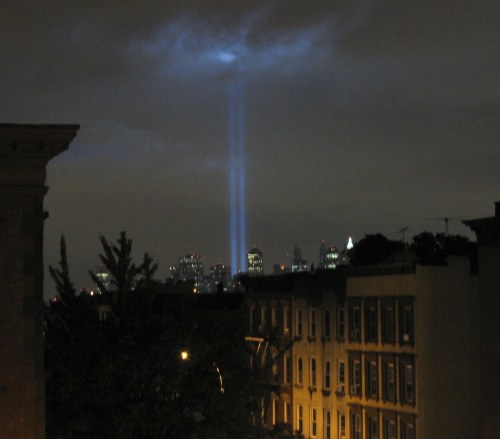
When I wrote the post on the view from our building this afternoon, I wasn’t sure if the clouds would obscure the view of the memorial lights tonight.  For a few minutes, however, the clouds parted just enough for me open the window and take this last photograph from the windows of apartment 4-A.

For all who perished, and for all who remain.

IMG_3036-alt2

4 Comments

Filed under Uncategorized

Another year, and we remember

IMG_1220

This is the view from the window next to my desk.  From that window, I took the photo that was the first masthead for this blog (it’s in the page on “the blog” if you want to take a look).

This was the view last night, from the ground, at the corner of 6th Avenue and Union Street in Brooklyn.

911-sarah-alt

My downstairs neighbor, Sarah, took that photo, and I saw it on her Flickr.

For the last three years, I have engaged a small ritual on or about September 11, when I can see the beams of light from Ground Zero over downtown from this window.

I turn out the lights.  I sit for a few minutes, 10 minutes or so.  My son is asleep in the next room, or maybe he’s at his mom’s apartment, just a few blocks away in the neighborhood.  Either way, he’s safe, while I gaze at the lights.  Irony is not the word for this.

I know my fate.  One day my name will be associated with a memory of something tremendous—a crisis without equal on earth, the most profound collision of conscience, conjured up against everything that had been believed, demanded, hallowed so far … Where you see ideals, I see what is human, alas, all too human.

Nietzsche’s words stream through my mind as I look at the beams and write my friends—

The clouds have cleared now and I have turned off the lights.  I just want to look out at the beams of light streaming up to the heavens.  So strange to think of the world before that day, and the world we have now.  And it made me feel like reaching out to a few people who matter to me.  I hope you’re all well.

As it happens, I never have taken a photo of the 9.11 beams from this window.  Tonight I will try, but I fear it’s going to be cloudy.  That’s unfortunate, because over the last couple of years, the view was so spectacular, iconic – and this year, 2009, will be my last at this window.  I will be moving at the end of September, to a new apartment in “Prospect Park South” which is the trendy name for what has often been called “Kensington” or simply “Flatbush” in the local dialect.

As all things happen, however, Providence gives us what we need, and Sarah’s photo from last night is such a gift.  So:  Thank you much to Sarah for this photo.  To all those who have touched my life, or whom I have touched in any way however small, I say this,

Be well and cherish those whose love you share.  We have no way to change what was, and our attempts to shape what will be never have their intended effect.  Where we are absolute, however, is the moment at hand.  Let us live that moment well, with love, and with all the peace that the world so deeply needs.  Only then do we stand a chance against the forces of darkness.  Strange as it may seem, those are pretty good odds.

Notes and Credits

Sarah’s photo: http://www.flickr.com/photos/37558372@N03/3908398726/

The precise address of our building is 211 Sixth Avenue.  Or the Union Market, at 754 Union Street, Brooklyn.  11215.

The quote from Nietzsche was taken from the opening of the BBC documentary of him, which can be seen here.  See also this and this.

My own quoted email was what I sent in 2007, the first year I sat at this window.  I cannot find last year’s email, which was a little more focused.  My three years of having this view have been important to me, because this window was a starting-over in many ways.  I will miss the view – but mostly I will hold dear the fact that I have the chance to have this view for a little while.  I only hope that the folks who come next to this little apartment are able to appreciate it as well.

Personal Note

I moved to New York in May of 2004.  In 2001, I was in Rock Island, Illinois, teaching at Augustana College.  On that particular day, I was in my office early.  Jane, who was the secretary for the departments of History and Political Science, came running down the long hallway to my office – we might have been the only two people on the floor.  She told me that I needed to come to the television and see what happened.  Her husband had called and said that a plane crashed into the World Trade Center.  Jane and I watched the rest of it happen, in a conference room on the campus of Augustana College which from its own window had a wonderful view of the Mississippi River and America’s own “heartland” on the border of Illinois and Iowa.  We saw the second plane crash into the other tower, and we saw the buildings fall to the ground, all live.  In my office, I heard about the plane crashing into the Pentagon, live.  I was very afraid.  My wife was out of town, and she was very possibly pregnant with our child (we had this confirmed just weeks after 9.11).  My country was under attack.

I don’t know if folks in New York know what it was like to experience 9.11 outside of this city.  It was pretty dreadful.   Nothing like here, of course, but awful nonetheless.  For a little while, we had no idea where this would lead, and everyone feared bombs and flames and explosions.

A few weeks later, November 10-12, 2001, we were in New York.  My wife had some meetings and I was along for the ride and the visit.  We knew then that our child would be expected some time in May or June.  I had some good runs in the city, in Central Park, along the avenues, but not on the West Side Highway.  It was blocked, for security reasons.  As we prepared to leave on the 12th, we heard odd news suddenly:  all the bridges and tunnels were closed, and so were the airports.  A plane had crashed in Queens.

Downstairs, we spoke to the hotel personnel.  The looks on their faces and the emotions in the air are emblazoned on my mind, in a way that makes me think of my parents’ generation when they talk about what they were doing when Kennedy was assassinated.  I won’t forget that.

6 Comments

Filed under danger, death, existentialism, ideas, philosophy, politics, truth, Uncategorized, war

The truth and change, 3a: From Life on Mars to Linden

The House of Tomorrow, 200x

The House of Tomorrow, now

The third post in this series, The truth and change, is split in two, 3a and 3b.  They provide different outcomes for the multi-part essay on change and the future that I began a month ago.  It wasn’t how I planned the posts, nor are these the only two ways things can work out.  They are, instead, the unintended surprises at the end of a long chain of lateral thinking that has also suggested a set of follow-up postings down the line.  It’s always nice to pile up things to do.

From Life on Mars to Linden

Avatars are nothing new to the human species, from the caves of Lascaux to the virtual worlds of Second Life and other large web-based games.  These (brave?) new worlds carry out the same primeval urge that led people to create paintings of their daily lives 35,000 years ago.  What began in the caves has become a massive wall written on by millions of people, together, sharing a world that they have imagined out of the very world in which they live.

The House of Tomorrow, 35,000 BCE

The House of Tomorrow, 35,000 BCE

One of the interesting things about the virtual world is that it does create a “place” that didn’t exist before, uncovering new spaces in life that are hidden beneath the physical dimensions we take for granted.  In the world of Massive Multiplayer Online Role Playing Games (MMORPGs, or MMOs) such as Second Life, people leave their organic beings and create virtual selves, societies, and places in cyberspace.  These worlds are a social version of the extra-dimensional physics of string theory, “brane worlds,” and high energy model building that physicist Lisa Randall has written and spoken about.  In MMOs, we are building new worlds in very small spaces inside the world of everyday experience.

The key thing about these virtual dimensions is their connectivity to real life, which engenders much greater imaginative potential than the escape to the “silver screen” that left the sad girl in David Bowie’s song wondering if there was “Life on Mars.”  Ours is now a world of both cultural production and absolute reflexivity, in which the virtual world is like a magnifying mirror we hold to our organic lives.

In a fascinating example of this reflexivity, organic journalist Marcia Stepanek reports on Second Life journalist Draxtor Despres, who himself reports on the goings-on of the organic world for the people of Second Life.  Their dialogue is like an 8-track tape, or a Möbius Strip in which one side is organic, the other side virtual, both surfaces effortlessly sliding into each other when they are attached in just the right way.

Stepanek has also profiled the work of Douglas Gayeton, a multimedia artist who “creates immersive story experiences for virtual worlds and social networks.”  Gayeton’s documentary, “Molotov Alva and His Search for the Creator: A Second Life Odyssey,” was the first documentary produced entirely in Second Life.  For a while it was the highest rated video on YouTube.  It’s been picked up by HBO and begins to make clear how “real” the virtual world really is.

Already, the virtual economy is derived from, reflects, and ultimately contributes to the organic economy.  In July of 2009, Second Life creator Philip Linden spoke to BOSL (Best of Second Life) Blog about how Linden Labs is creating various supports for crossover services involving both businesses and educators, who will use the SL platform to provide services in real life.  Within SL, “Linden Dollars” are the basis of a vast economy of virtual goods that can be converted, ultimately, into organic dollars.

The virtual world embraces an entire crossover economy.  Hermione Watanabe is a “virtual wealth coach” whose blog provides advice and information on the SL economy and how to grow income there and in the organic world.  Perhaps the most compelling confirmation of the virtual world’s “real” existence is that the Federal Government is thinking about how to tax virtual economic activity.

The crossover continues in the amateur machinima that is becoming an art form of its own, sprawling across YouTube, Vimeo, and other video networking sites.  Aenea Nori’s SL video for Kafka Dinzeo’s remix of Lily Allen’s “Littlest Things” brilliantly takes us through the wormholes that connect virtual dimensions to the organic and back again.

LauraMW12345 created an organic-virtual mix in which “Second Life Meets Real Life,” in which the green screen existed in SL and the “real world” had to be inserted as fictional background for the avatars. The video is set over the DNA remix of “Tom’s Diner,” which was one of the early, pioneering events in remix history, on the borders of different dimensions of musical creation and imagination.

This sliding between organic and virtual lives has inevitably encompassed the most ubiquitous and equalizing of human emotions:  sex (and its correlate emotions).  Love is in the virtual air, as people in Second Life and other MMOs mix, mingle, fall for each other, become married (virtually, but quite really), pledge love, cheat, cry, break up, and try again.  For a while, people started to create real-world-like porn magazines on-line (in Second Life, Slustler was a phenomenon in 2005-07), but these have been displaced by other virtual services and games that better fit the medium, such as Red Light Center (which creates a very real organic economy for itself as well) and SL meeting places and adult parties.

Eventually, however, we come back to the connection between the virtual and organic worlds.  They cannot function without each other.  “If This is Second Life Why Is My Heart Breaking In Real Life?” is a machinima video created by Kirk Lancaster and Sandra Holyoke that explores the crossover of desire and heartache.  The relationships we create in other dimensions reverberate in the organic world and behind them all lie one, beating, very organic heart.

The future, it seems, is not out there in the world, some place distant in either time or space.  It’s in our minds, already, right now, and available for our scrutiny.  This isn’t the future I imagined as a youth, or even when I began writing these postings.  In this future, much of the world is simply brought to life from our own minds with the help of technologies that enable millions of minds to communicate in tandem, synced together to build a world that is every bit as real as the organic world even as it vanishes before us to live in our minds.

This brings me back to the Shetland Islands of the late 1940s, where Erving Goffman gathered observations and data for his book, The Presentation of Self in Everyday Life.  It was published in 1959 and became a classic of American sociology; it’s still widely read and has never been thought out-of-date.

Immersing himself in the world of the Shetland Islanders, Goffmann looked at their everyday interactions through the lens of drama – people were actors in their own plays, as well as each other’s audiences.  “All the world’s a stage,” Shakespeare famously said, and Goffmann set out to prove it.  People work hard to create settings and situations in which they can enact a specific, intentional script.  They have certain behaviors for their audience, as well as an array of backstage behaviors.

Goffman’s point of view was revolutionary at the time and cemented the foundation of a whole school of social thought.  We construct our own worlds in the same way that we construct plays and dramas.  The representational activity that started in places like Lascaux and ends up in MMOs is pretty much the same.  The attractiveness of gaming and MMOs is clear:  it’s what we already do in regular life, only in the MMO we get a greater degree of control over what we hide backstage.

This begs a question.  Is the change we experience with this technology really anything more than a change in the venue (now virtual, created) for the same old desires we’ve always had?  A vanity of vanities in which there’s nothing new under the sun except for the bottles that are filled with old wine?  Does the virtual world of love and sex and desire change any of the fundamental emotions or relationships that constitute what it means to be human?  When and where does the virtual world go beyond reflections and extrapolations of the organic?

When is the virtual world for-itself?

Notes and Credits

The opening photo is from the Flikr site of rikomatic.  The photo shows a house for sale in Second Life, where participants engage in an extensive economy that has several dimensions – purely virtual, combined virtual and organic, and mainly oriented toward organic profit.  In Second Life, people create their own houses by using virtual money (Linden dollars) to purchase land and materials in the virtual world.

Much thanks to Marcia Stepanek for introducing me to the world of machinima in her writing on Cause Global and Pop!Tech.

The photo of the Lascaux cave paintings is from Prof. Saxx and can be seen at the Wikimedia commons.

Aenea Nori’s machinima for the “Littlest Things (remix)” carries us through many layers of time and space.  I would have embedded the video in the blog for people to see, except that WordPress (the free version, anyway) isn’t communicating with Vimeo.  You should go to her site, however, and check out her video work. There is no recent activity on the Vimeo site or on her blog (the last activity is September 2008), but perhaps she’ll be back.

Lily Allen uses a lot of mixing, overdubbing, and sampling to build her songs, which are themselves an aural hypertext calling forth a multitude of associations and images.  “Littlest Things” recalls Cat Stevens’ “Wild World,” morphing time across 35 years of cultural production. Listening to Allen’s work is stimulating – and now Aenea Nori and Kafka Dinzeo transport the music and associated images into another world altogether, sliding along a “brane” between the virtual and organic worlds.

Regina Lynn has written in Wired about the growth of the virtual sex world found in MMOs all over the web, some of which are lucrative businesses. WebMD posted a balanced article on the advantages of cybersex and “teledildonics,” which include a safe place to try out new ideas (both in terms of disease and in terms of emotional control), as well as the problems – it can become addictive and affect real-life relationships.  The article quotes Regina Lynn, who brings the issue down to earth:  “Does your partner know, and does your partner consent? Lying is cheating.”  Over at True/Slant, Todd Essig writes about the cutting edge developments in the world of cyber sex – now, cyber-touch with lasers across world’s distances.

Taunt is a blog devoted to SL economics and SL sex life.  SL and other MMOs feature escort services and erotic parties to cater to every taste, including many that are all but impossible to enact in organic life.  “Second life guys can have it all, as long as they’re willing to pay,” according to Elle Kirshner, a Second Life designer and voiceover artist for Kirk Lancaster’s SL video, “Second Life Man.”

Overall, sex is actually the cutting edge of machinima and virtual reality.  Why?  Because it’s what we want so much in real life that our urges push the limits of technology so that we can pursue desire in every possible corner of existence, from dreams to waking life to virtual reality.

4 Comments

Filed under art, body, fiction, ideas, journalism, life, love, media, truth, vanity