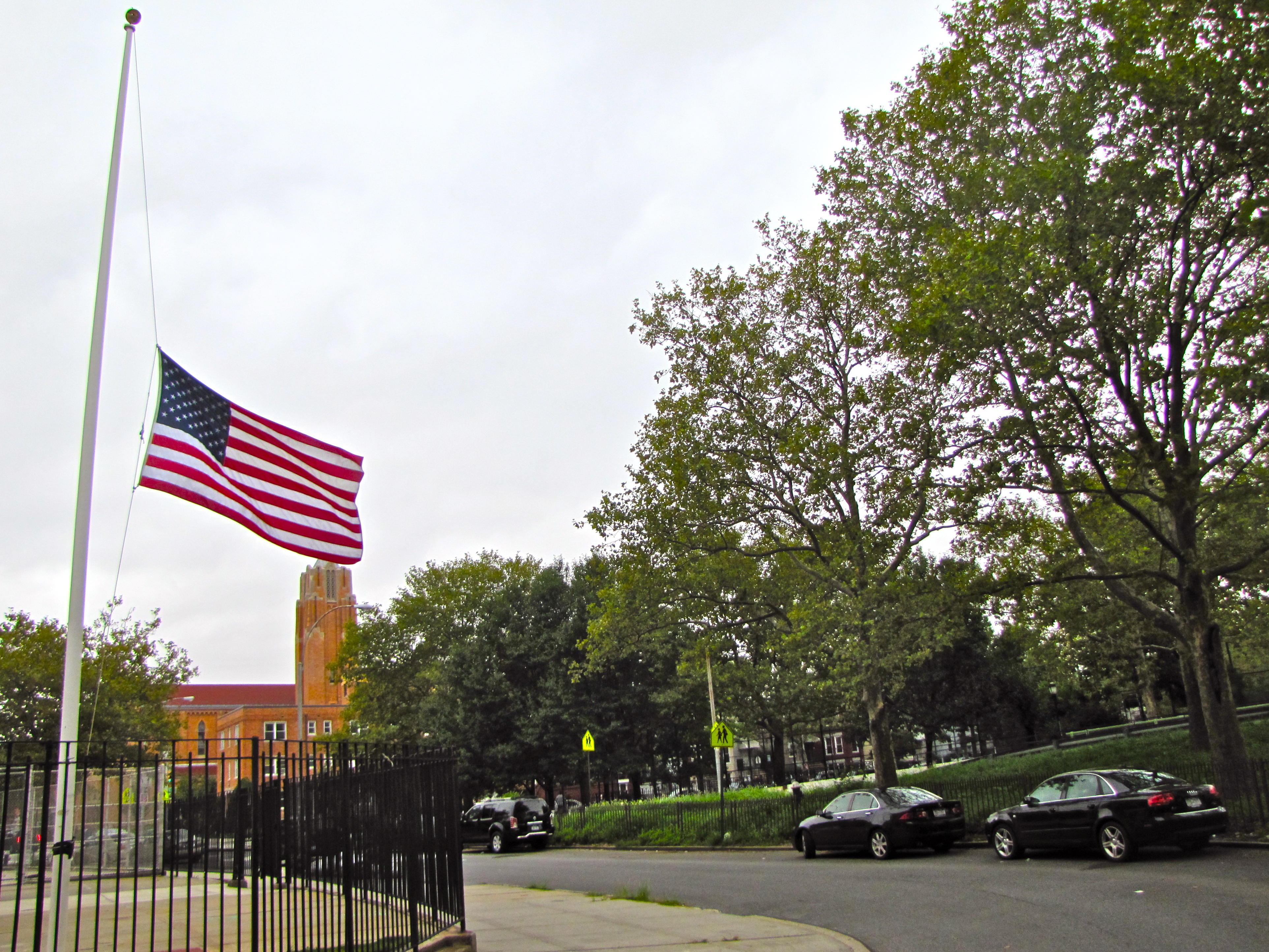
The Parkside School, Brooklyn, New York, September 11, 2011
Ten years ago, I went to work early. I was in the office before 8:00 am. I taught political science at Augustana College in Rock Island, Illinois. It was a beautiful blue-sky morning, and I hoped to get a lot of work done. My wife was in St. Louis on a work trip, so I was on my own. At some point in the morning, our Administrative Assistant, Jane, came running down the hall and ran into my office.
“A plane crashed into the World Trade Center!”
We went to the seminar room and turned on the television. Live coverage. There was the building, with smoke pouring out of it. Before I saw the pictures, I thought it must a be terrorist – but then once I saw the images I couldn’t believe it was a big plane. So I thought it was an accident. Maybe a small plane. And then, as Jane and I sat there, gape-mouthed and gazing at the television, another plane came into the view and hit the second tower. That was a big plane, and I couldn’t believe it.
After a bit, I went back to my office and put on the radio. I was listening to NPR as American Flight 77 crashed into the Pentagon. At this point, I thought we were under attack, at war, and I was terribly afraid of what might be next. We didn’t know who was doing this, and it was very frightening.
I was able to talk to my wife later that day. She was stuck at the airport in St. Louis for a day. She was stuck but okay, and I was relieved to speak with her. By midday, we knew what had happened, but it was still scary and hard to believe. A couple weeks later, we found out that she was pregnant. We were going to have a child.
Ten years on, I spent this anniversary of the attacks in Prospect Park, Brooklyn. My son, Noel, had his first flag football practice today. He’s been waiting for this day for a long time – he loves football and so wants to play. He was incredibly happy, happier than I have seen him in other sports, and it was a joy to watch him play.
While the kids were practicing with Coach Marc, the other dads recounted where they were on September 11, 2001. One worked just a few blocks from the towers and managed to escape the area as the towers were falling down to the ground. The other had witnessed attacks from his apartment in Brooklyn, where he had a clean view of the events. He’d been taking photos of the skyline that morning, and only later, upon developing his film, did he realize that he’d caught images of the second plane flying into the second tower.
I didn’t live in New York then, but I do now. Noel was born on May 28, 2002, and I am raising him here. New York – or Brooklyn, more precisely – will be the place he always calls home. He has no memory of 9-11, though he knows what happened. All his life, his country has been at war. When I think about his life and my life, this post-9-11 world seems like a weird and different place, and this America is not at all the country I grew up in. Yet this is his country, and on this day that I remember with somber feelings and sadness, he had a great football practice. Later, we went home and watched the games on television. Then I called my brother and wished him happy birthday, like I do every year on 9-11.
Notes and Credits
Photographs by the author. The first is of the flag at half-mast at PS 130, The Parkside School. The school is just next to the entrance to the Fort Hamilton Parkway Subway Station for the F and G trains in Brooklyn. It’s where we live, and the site of an earlier post, Without the Truth, You Are the Looser.
The photograph of the airplane in the clouds was taken in Prospect Park, near the “dog beach.” That’s where my son’s team was practicing this morning. Prospect Park is beneath one of the main approaches to LaGuardia Airport, and you can hear the planes fly over every couple of minutes most days. Today, it was cloudy, low clouds, and the planes could only be seen in the haze, rocketing over us on their way into the airport. Fifty-one years ago, a plane crashed into Park Slope along that flight path. It was one of the worst disasters in New York history to that point; 134 people died in the crash. From 2004 to 2006, I lived on Sterling Place, the street where the plan crashed in 1960. My neighbor, Ms. Phipps was a witness that day and had told me about it. You can find a photo essay of it here.
Planes and clouds. It seems we have always lived under flight paths. In Minnesota, we lived just under main approach to the Minneapolis Airport. Noel’s first word was “airplane.” As we were leaving Prospect Park after practice, we saw a man selling bubble-making kits for kids. He filled the playground with bubbles as he walked along.
You can make anything with Legos. They are a digitized dream machine spawning infinite variety from a small set of mainly similar little pieces. These plastic bricks stoke the imagination and allow minds—young and old alike—to turn ideas into things. Playing with Legos, one has a sense of creative power that is rare in my experience. Hours and even days can pass just building, building, building—then tearing down and building again.
I don’t remember when I got my first set of Legos. Nor do I recall when I stopped playing with them. What I do remember is that Legos were always part of my childhood and then quite absent from my young adulthood. That’s how it was for a long, long time, until I had my own child and, around the time he was two or three, I started playing with Legos again.
I noticed that Legos had changed a little in the thirty-or-so years since I’d last played with them. The basic Lego blocks in all their bright colors were still the main pieces, 1x1s, 1x2s, 2x2s, 2x3s, 2x4s, 2x8s, 2x10s, in regular height and the one-third flats. But they were packaged differently. Now there were commercial tie-ins to Star Wars, Spongebob, Harry Potter, and Pirates of the Caribbean, as well as special theme sets of cities, oceans, or ancient Egypt. Specialty pieces proliferated—hinges, odd shapes, and other pieces that gave Lego creations operational abilities (like flapping wings) and a verisimilitude that mainly existed in our minds when I was young.
Now, at 47 years of age, I look forward to each birthday (my son’s, that is) and Christmas for the Legos we’ll (I mean he’ll) get. On quiet evenings when we can make the time, he asks me to “play Legos” with him, and we sit there in the living or in his room just making up new stuff. We always make the items in the packages first, but these are torn apart immediately to build more interesting things and rarely do we redo them a second time (though we have all the directions in a folder, just in case we’d want to).
My favorite objects to build are houses—Legos are about dreaming and we all have different ways of dealing with the New York housing market. My son embraces greater variety—everything from dinosaurs to kitties, houses, spaceships, cars, and even cities. If I get busy, I’ll return to his room hours (or a day) later and find an entire theme park. He’ll explain me the rules and characters, and these will remain for days or weeks.
Perhaps the best thing about Legos, however, is the moment when I tuck him in to bed after we’ve created a jumble of buildings and other things and he says to me, “Daddy, it was fun playing Legos with you.” One day he’ll grow out of these Legos, but I’ll pack them away and keep them for my next turn at Legos in another twenty years.
Irene wasn’t really a hurricane when she finally reached New York after some 18 hours of waiting, waiting, waiting. By 6:00 am on Sunday, August 27, 2011 Irene was a tropical storm. The most horrifying aspect of the storm for us in Brooklyn was the waiting. It was like being stuck behind a slow walker or a tourist or a sudden-stopper on the sidewalk. Horribly aggravating, enough-so to ruin a day, or at least a morning.
I live across the street from the Prospect Park Parade Grounds. A number of photographs featured on this blog have come from this very street, Caton Ave, some even from the same dining room window from which these two Irene videos. From this vantage point I was able to record the storm safely. By 10 am on Sunday, the storm was largely over.
Finally, by the early afternoon I was ready to go find brunch. After being cooped up in the house for 24 hours, my son and I were eager to get into the fresh air. On our way, we documented our journey to the Windsor Cafe, just across Prospect Park from here.
Notes and Credits
These videos were taken with my new Canon Powershot SX20 IS. It’s a baby camera, a point-and-shoot, but it’s a good camera for me. These videos and hundreds of photos I have taken since buying the camera have convinced me of its fit with my needs. Ironically, I decided to buy the camera to document my vacation in Nova Scotia with my father and son. The vacation was set to begin Saturday morning, August 26. Then my father abruptly canceled, claiming that Hurricane Irene posed too great a danger to travel. On my end, I though the trip to Nova Scotia would be the perfect hurricane evacuation, which it would have been. My view, however, was not the majority view, and I lost. So for Irene, my son and I spent Friday night through Sunday afternoon preparing and enduring the storm. Ugh. It was so good to get outside and take these pictures!
I dreamt that we were around each other, but not really together. Our recent split was a wound still open, and I was trying to follow you, to get back to you, to make you see me again as yours. I knew that I had pushed you away in the first place and then raised the stakes for a reunion. I never claimed to be the complete master of my emotions. And you, being your locked-down self, said the same thing over and over, which in this case was like saying nothing at all, since I didn’t believe you wanted it to end.
All this was in the air around us when I saw the child, a young girl maybe two or three, walking around, uncertain perhaps where she was. She was small, dressed in a pink Hello Kitty onesy, carrying a stuffed animal. She bore a vague resemblance to you. It looked as if she would begin to cry at any moment.
I didn’t know whose child she was, and there were no other adults around. For reasons I don’t really understand or remember, I thought the child was with you, or that you knew where the parents were. I pursued you with the child, and I told you that we need to find the parents.
I don’t remember that you said anything, but you took the child from me.
Then we got into a car and you told me to drive. The car wasn’t yours, but I couldn’t figure out if it was stolen or rented. On the way there—a “there” that only became clear as we got closer, since I didn’t know where we were going and was only following your periodic directions—the air between us was frosty. Not much was said. You held on to the child.
We pulled into the parking lot of a drug store, one of those chain stores that all look and feel the same, regardless of the name on the sign out front. It was very white—the aisles, the light, the coats that people were wearing. You took the child back behind the pharmacy counter and began speaking to someone amid shelves of pills and ointments and jars. I couldn’t hear what you said, but you did something to divert me, something involving the car, and I left.
When I got back to the pharmacy, you were gone. I shouted into empty space, “We have to return the car! Whose is it?” Then I saw you running away.
I followed you into a massive, dark parking lot, the kind of multi-story affair you see next to stadiums, shopping malls, and airports. By the time I reached the spot, the car was gone and so were you. I thought: I must call you.
I awoke shaking and covered in sweat. I reached to the nightstand for the telephone, and that’s when I realized where I was.
Notes and Credits
This posting is fiction, but the dream was real.
Photography credit to Lara Wechsler, who let me use this photo for this posting. Lara’s work can be found on flickr, and on her own website. Her work is on exhibit with other local artists at 440 Gallery in Park Slope, Brooklyn. Her work is street photography, which mainly involves photos of street scenes and, in Lara’s case, photographs of people. The photograph I used in this posting is the rare one in her collection not of people (or even one person). In this case, it’s a shot that evokes a persona, the perfect image for this dream that made me think, over and over again, what do I want?
This is the third of three essays on grace. The three parts move through different aspects of grace—reason, beneficence, and the unknown—roaming across Sartre, the epistles of St. Paul, Flannery O’Connor, Roberto Bolaño, and Nassim Nicholas Taleb
Amalfitano
In the novel 2666, Roberto Bolaño’s character Amalfitano thinks about a drug store he used to go to in Barcelona. For convenience’s sake he would go in the middle of the night, and he always found the pharmacist reading in his chair. The pharmacist’s selections troubled Amalfitano.
“He chose The Metamorphosis over The Trial, he chose Bartelby over Moby-Dick, he chose A Simple Heart over Bouvard and Pécuchet, and A Christmas Carol over A Tale of Two Cities or The Pickwick Papers. What a sad paradox, thought Amalfitano. Now even bookish pharmacists are afraid to take on the great, imperfect, torrential works, books that blaze paths into the unknown.”
To Amalfitano, this was a kind of cultural laziness at best, at worst a cultural sclerosis leading one day (and perhaps soon) to the death of culture (as he knew it). Nothing will ever be learned about the world if we choose only the easy things, turning our heads away from those moments when, as Bolaño/Amalfitano continues, “the great masters struggle against that something, that something that terrifies us all, that something that cows us and spurs us on, amid blood and mortal wounds and stench.”
Trying to understand the world requires some effort and the willingness to get dirty doing so. To read the perfect works of the masters—indeed to rely on anything we might call “perfect”—is a graceless pleasure, for grace lurks in the shadows and cracks of the world, there for the taker, but only taken by the one who can see it.
The unknown is an essential, core element of grace. Maybe it is where grace comes from, or perhaps it is the conveyor of grace, the medium through which grace passes into the light of day to touch someone’s life. To recognize grace is to surrender control (or pride, hubris, arrogance—call it what you will), and in the surrender a new kind of freedom is born. It is the freedom to make something of what we are given.
Taleb
Nassim Nicolas Taleb is a statistician, philosopher, and financial trader who has made it his life’s work to understand random events. It all began when civil war erupted in Lebanon in the 1970s and Taleb, whose family included two deputy prime ministers and a supreme court justice, became swept into the conflict. The adults said the war would last only a few days, but it stretched to 17 years, and with each turn of events the adults came up with new reasons for it.
“Later, upon replaying the wartime events in my memory as I formulated my ideas on the perception of random events, I developed the governing impression that our minds are wonderful explanation machines, capable of making sense out of almost anything, capable of mounting explanations for all manner of phenomena, and generally incapable of accepting the idea of unpredictability.”
The random is cousin to the unknown, and Taleb’s business is harnessing knowledge about randomness in order to help people make decisions that protect their investments. His methodology separates randomness into two kinds: the known-unknowns (more or less predictable, manageable patterns of financial fluctuation), and the unknown-unknowns (big, system-altering shocks like the stock market crash of 1987, the attacks of 9-11, or the economic collapse of 2008). These unknown-unknowns Taleb calls “Black Swans.” These are things quite out of the ordinary that do, in fact, occur from time to time. Over his professional life, Taleb has made a modest fortune by dealing with risk and randomness in this way, both for himself and others.
Still, looking back at a quarter century of his work, he is troubled by his findings.
“Is the world unfair? I have spent my entire life studying randomness, practicing randomness, hating randomness. The more that time passes, the worse things seem to me, the more scared I get, the more disgusted I am with Mother Nature. The more I think about my subject, the more I see evidence that the world we have in our minds is different from the one playing outside. Every morning the world appears to me more random than it did the day before, and humans seem to be even more random than they were the previous day. It is becoming unbearable. I find writing these lines painful; I find the world revolting.”
Taleb, it seems, has caught Roquentin’s malaise. Yet like Roquentin, Taleb finds ways to cope, and at the end of the book, he provides a list of 10 principles that might minimize the effects of Black Swans and help us deal with them when they do happen. The last principle is the clincher and the most important: “Make an omelet with the broken eggs.” That is to say, whatever we might do to hedge again the worst events (encompassed in the first 9 principles), we should be ready to pick up the pieces after disaster strikes, be it a Hurricane Katrina or a stock market crash, and rebuild with what is left, in whatever condition we find it.
It’s a good list, but it was incomplete in some deeper way that could challenge the Black Swans on their own, definitive, inevitable terms that take no prisoners and offer no excuses. To do this required a trip back to his home town of Amioun, Lebanon. There, Taleb went to the cemetery and visited the graves of his father and other loved ones. With him, he carried the works of Seneca in the original Latin, bearing in mind an adage originally attributed to Cicero that “to philosophize is to learn how to die.”
“I wanted to prepare myself for where I will go next. This is my plan B. I kept looking at the position of my own grave. A Black Swan cannot so easily destroy a man who has an idea of his final destination.”
Grace
The Black Swans that Taleb writes about are mostly negative, harmful events. For St. Paul, grace was a Black Swan of a different sort, life-altering, inexplicable, yet beautiful and redeeming. For Ruby Turpin, recognizing grace in her life was the Black Swan that snuck up on her when Mary Grace threw a book at her and called her out for what she was.
For those who can recognize grace—whether in their own lives or in the operaton of the universe as a whole—grace becomes an expected part of life while remaining a Black Swan nonetheless, for they have no way of explaining their ability to recognize grace or why it was even visited upon them in the first place. There may not be a “reason for everything,” a reason that might console us, take away the unfairness of life, or explain why one person deserves something while others don’t. Truth be told, we really don’t need reasons for everything.
Be humble. Accept grace and build a good life because of it. Never count on it to last, but take it while it is given. Seek no reasons for grace, but live with it and share it with others freely, openly, with no reason for sharing it but that it is good.
Notes and Credits
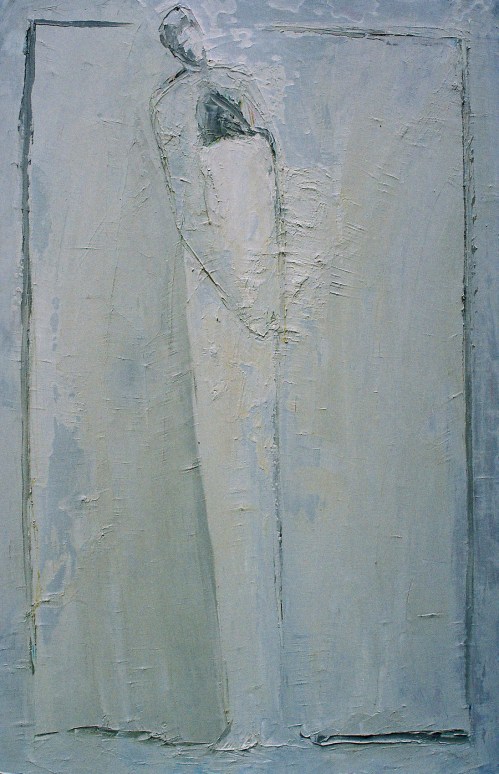
The images in all three essays on grace are the paintings of Macha Chmakoff, a French painter whose works can be found at http://www.chmakoff.com/. She has granted me reproduction rights for these images and provided high-resolution .jpgs for the postings, for which I am very grateful. This work is called Consolation, and it depicts a person in the arms of another. I have never seen these works on the canvas, up close; I have only seen them on the Web. Her use of color and muted, vague definition touches me. Ms. Chmakoff and I have struck up a friendship over her paintings and my writing, and that, too, is an element of grace that I am thankful for.
Direct quotations: Roberto Bolaño, 2666, trans. Natasha Wimmer (Picador, 2008 [orig. Spanish version 2004]), p. 227. Nassim Nicholas Taleb, The Black Swan (Random House: 2007), p. 10 (replaying wartime events), p. 215 (Is the world unfair?), and p. 375 (cemetery).
There is much more I could write on grace, and I may at some point soon. The twists and turns of grace in the history of the Reformation are instructive as a lesson in counter-intuitive consequences. Some of the reformers who sought to return to a simple Pauline church of grace and community wound up creating new order of oppression—Calvin comes to mind most prominently here. It’s a return to a fundamental question of the meaning of human will. For the Calvinists (and some extent all Protestants, from Luther forward), faith and salvation by grace alone—sola fide—was a doctrine that freed ordinary people from the scrutiny of the Church. In the Catholic doctrine, salvation through good works simply placed too much power in the hands of the church to rule on the affairs of ordinary people and political powers alike. Sola fide took the Church out of the picture, but almost as quickly the Protestants began to create political and other alliances that arrogated to their churches great powers that were used to enforce a new orthodoxy just as brutal (if not moreso) than the Catholic orthodoxy it replaced. This is, however, a discussion for another day.
This is the second of three essays on grace. The three parts move through different aspects of grace—reason, beneficence, and the unknown—roaming across Sartre, the epistles of St. Paul, Flannery O’Connor, Roberto Bolaño, and Nassim Nicholas Taleb
The Road to Damascus
A few years after the death of Jesus, a Jew named Saul of Tarsus, who was also a citizen of Rome, became a Christian and changed his named to Paul. Prior to his conversion, Saul persecuted the Christians. As Paul, however, he became the greatest apostle of the early church, moreso than St. Peter or the others who were with Jesus in his lifetime. Working tirelessly until his own execution at the hand of Rome, Paul established numerous churches throughout the Greco-Roman Mediterranean. Paul’s letters to these congregations provided definition for the faith and are a critical part of the Christian Bible.
Paul could not explain the change in his heart that occurred on the road to Damascus one day, when he was struck blind and heard the Lord speak to him. He had to accept this as an act of radical, unsolicited, and unreasonable beneficence. This he called the grace of God.
“For I am the least of the apostles and do not even deserve to be called an apostle, because I persecuted the church of God. But by the grace of God I am what I am, and his grace to me was not without effect.” (1 Cor 15:10)
The grace of St. Paul is a divine beneficence that is unknowable and without a cause such as we can recognize. To understand grace is to find a place in between the rigid certainty of dogma and the despair of Roquentin. With grace, we accept that good things happen for no reason that we can understand. In deeming God the author of grace in the universe, goodness is given a source and it is made relatable. Without needing to explain beneficence, one must simply accept this: You are loved, for no reason that you may know or understand. But you are loved.
Flannery O’Conner wrote stories that often dealt with the consequences of grace for proud people. They were crushed by grace. They could not bear beneficence. To a friend she wrote,
“All my stories are about the action of grace on a character who is not very willing to support it, but most people think of these stories as hard, hopeless and brutal.”
Let it Be
Grace presents a challenge: to live up to its goodness. This is a challenge to act freely, for one must choose to live up to the goodness one has been given, even when that goodness was given freely and with no good reason for it.
For Ruby Turpin, the protagonist of O’Connor’s story, “Revelation,” recognizing grace caused her to crash on the shoals of her own hypocrisy and bad faith. Mrs. Turpin was a well-(enough)-to-do woman in the Deep South whose Christian piety propped up her sense of racial superiority. She was self-righteous in the most ungenerous sort of way.
“If it’s one thing I am, it’s grateful. When I think who all I could have been besides myself and what all I got, I just feel like shouting, ‘Thank you, Jesus, for making everything the way it is!’ It could have been different!… Oh thank you, Jesus, thank you!”
The story is set in the reception room of a local doctor’s office, where Mrs. Turpin is telling all this to another woman in the room, a woman of similar class and beliefs it would seem, whose college-aged daughter, Mary Grace—a name well chosen—begins to seethe with each word out of Mrs. Turpin’s mouth. The climactic moment comes when Mary Grace finally boils over in rage and throws a book at Ruby Turpin, telling her quietly, “Go back to hell where you came from, you old wart hog!” After the incident, back on her farm, Mrs. Turpin sinks into filth and despair, overcome with a sickening sense, much like Roquentin when he discovered that his world wasn’t ordered the way he’d imagined it to be. As she slops her hogs, she has a revelation of the righteous ascending to heaven with her and her husband bringing up the rear at the very end of the pack.
For Saul of Tarsus, the recognition of grace provided a reason to change for the better, to set aside violence, hatred and pride. Writing to a different friend, O’Connor commented,
“There is a moment in every great story in which the presence of grace can be felt as it waits to be accepted or rejected, even though the reader may not recognize this moment.”
The nausea demanded of Roquentin that he become the sole author of his own life, but it also demanded a kind of surrender. To be author of own’s life was not a Promethean charge to become a god. Quite the contrary, this freedom was “rather like death” at first, until Roquentin realized that in this freedom he gave away precious things (his sense o right and order) in order to take up a different, ultimately more rewarding, task. This is a theme Sartre visited in later works, most notably his play, The Flies, in which freedom leads to persecution and hard choices about breaking laws or traditions in order to do the right thing.
Grace demands the humility to accept that we may neither deserve nor benefit from the goodness we receive. “There but for the grace of God go I,” as the saying runs, paraphrasing the English Protestant martyr John Bradford as he sat in jail and watched other prisoners being taken for execution.
Grace demands the humility to surrender, to “let it be.”
Notes and credits
The images in all three essays on grace are the paintings of Macha Chmakoff, a French painter whose works can be found at http://www.chmakoff.com/. She has granted me reproduction rights for these images and provided high-resolution .jpgs for the postings, for which I am very grateful. This work is called Paul, and it is one of her many Biblical paintings that are beautiful and stunning. I have never seen these works on the canvas, up close; I have only seen them on the Web. Her use of color and muted, vague definition seaks to me and touches me. Ms. Chmakoff and I have struck up a friendship over her paintings and my writing, and that, too, is an element of grace that I am thankful for.
For the early Christians, the time of Christ through the few decades after his death was a time without reason. They believed, Paul along with them, that the world would end soon, in their very lifetime. They believed that Jesus would return to judge the living and the dead, and that all those chosen by God would be taken to heaven with him. In the face human law, persecution, the might of Rome, and the weight of the old Jewish law, Jesus’ teachings tore down all conventions and laws that had come before. Jesus remade the world for these believers, and like Perpetua and Felicity in Carthage in 203 AD, they went to heroic lengths to demonstrate their faith.
In 67 AD, Paul was beheaded by the Roman Empire, an execution given him due to his Roman citizenship, less painful and drawn out than the crucifixions of Jesus and St. Peter, or the wild animals and soldiers who killed Perpetua and Felicity in the arena. The Frontline documentary, “From Jesus to Christ,” provides a robust discussion of the historical Jesus, the early Christian Church, and St. Paul’s role in defining the church and spreading the faith across the Mediterranean world.
The first Flannery O’Connor quotation, “All my stories …” I discovered on the blog Cage Wisdom, a site dedicated to the flms of Nicholas Cage. The second Flannery O’Connor quote, “There is a moment …” is from an essay by Patrick Galloway called “The Dark Side of the Cross,” which can be found here.
St Paul’s writings are foundational to the Christian Church. Differing interpretations of Paul were used by clerics and theologians on all sides of the Reformation, though by and large it’s possible to say that Reformed Protestantism is more singularly grounded on St. Paul than on the other letter writers of the New Testament. That is to say, branches of Reformed Protestantism represent a Pauline purism, while Catholicism balances St. Paul with the other traditions evident in the early church. As I am finishing the second part of this essay on grace, I am thinking of a fourth essay on St. Paul’s grace in modern Christianity. Perhaps it will come, but for now, I leave it out of this essay on grace, because my understanding of grace is more personal (and larger than) Christian theological traditions. My references are Christian because that is what I know, but I hope the notion of an unaccounted for, unexpected, superfluous experience of beneficence is something in the human experience that can stand apart from specific religious of philosophical tradition. Indeed, gratuitous beneficence is something any culture needs to understand.
In The Flies, Sartre uses the Greek Electra myth dramatize the proposition that people freely determine their own lives through their actions. Fleeing from responsibility for one’s actions, or from the consequences of those actions, is to flee from the truth. In the story, Electra’s brother Orestes must assume must assume responsibility for killing his mother and stepfather in Electra’s defense. She is too weak to do so, but in the act of assuming responsibility Orestes becomes fully human, finally showing throwing off the chains of self-denial and self-abnegation that Zeus and the gods used to keep people compliant and quiescent. Now free, Orestes walks into the future pursued by the Furies (giant fly-like beings) who peck at him and torment him. Such is the price of freedom.
After I published the essays, “The truth and moonshadows, 1-3,” a couple of my friends shared their own stories with me. The essays prompted them to think of their own fathers. They are two very dear friends, whose associations go back many years. This gave me an idea, and on this, my 47th birthday, I ask …
The Ask
What I seek from this posting is any email or correspondence concerning other fathers and sons. I’d like to collect some of our stories and figure out what they mean. Send me stories and photos and I will work with you to craft something that we can share. After you read this, post this to other websites, or email it to friends who are themselves fathers, whether of sons or daughters.
Peter
I met Peter in 1996 when I walked on to the campus of Augustana College as a newly minted Ph.D. with an office in a former closet next to his own office, which was small but had spectacular windows. Peter was my epitome of an academic, walls of books surrounding a neat desk from which he produced a steady stream of books and articles, all the while teaching a full spate of classes for dozens of undergrads who came through Augustana every year.
John,
I just finished reading the third installment of your look at fathers and sons, and maybe because I did so in the ancestral land of my own father—Finland (a place he never saw)—I thought back on our relationship. The summer after my first year at Michigan was the last time I lived at home. I got a job working for the mining company, the Cleveland Cliffs Iron Co. (“do or die for the CCI” was the old refrain in Ishpeming). My Dad had just retired from teaching and I think [he] was at something of a loss, trying to figure out what’s next and seeing his son giving indications that whatever his future was, it wasn’t going to be in the UP. Most days after work, we went fishing, something we really hadn’t done while I was growing up. He sought out all of the old small streams where you used to be able to catch brown trout. It would appear that by the summer of 1967 those streams were all fished out because I don’t recall catching anything, while being eaten alive by mosquitoes. The experience was, however, a moment of silent bonding that I never forgot.
When my son, while studying for his PhD at Tennessee, and I decided on a road trip that would take us from Nashville through to his place in Knoxville for a few days (including his treat: a John Hiatt concert as a replay of the first concert I took him to when he took up the guitar—John Hiatt and the Tennessee Queens at the Col Ballroom in Davenport), and then on to Ashville. We called it the “-ville tour” and decided then and there that we would do a comparable road trip each year. In fact, we had plotted out a trip that started in Memphis and headed south from there. Before that happened, Aaron proposed to Katie, they got married in Virginia last summer and thus Memphis wasn’t going to happen. I did help him with the move into New Jersey last summer and will do the same in July when they move to Providence, RI. I am really happy that Aaron got married, but I realized what my father was thinking about back in ’67.
By the way, you really do look like your father.
Best,
Peter
Jeff
Jeff and I met in 1986. In that year, I began the Master’s program in Latin American Studies at Tulane. Jeff had started in ’85, and so he was a veteran. He lived with a bunch of hippies and Dead-heads up off Broadway in the coolest house I’d ever seen. A year later I met my first wife in that house. I was a neophyte from New Orleans, going to school in New Orleans, who had never left New Orleans (save for a 1984 summer in Mexico City to study). I was a social justice oriented quasi-Marxist, inspired in equal doses by Liberation theologians and Sandinistas (who were sometimes the same people). What I said in seminars made sense in some ways; in others, however, it was inchoate and in need of focus. Jeff gave me a nickname I didn’t become aware of for many months: “Raw Material.” It was an affectionate nickname, meaning I would be capable of some very good things when I got more shape and maturity to my view. Of course, he was right. The summer before I left New Orleans for good, I lived in that house, subletting Jeff’s room while he was off somewhere in Colombia or Baltimore.
Nice read, John. It was challenging for me to focus on because M is on the phone in the kitchen, and for some reason is being really loud with her parents this morning. I started with part 1 and read all 3. The 3 generations of your family seem to share high emotional intelligence, which is usually repressed in our gender and looked down upon. My friends (especially those from work) look at me askance whenever I emote, unless it’s sarcasm, anger, or drunken boisterousness. I’ve always said that my dad has almost no affect—though he has a good sense of humor—and his only 2 emotions are love and anger. He’s never held back on the affection, but he doesn’t seem to be as insightful as you and your dad both seem to be. Noel is lucky that way. I’m also impressed that you can trace your family back to the 17th century!
Jeff
Notes and Credits
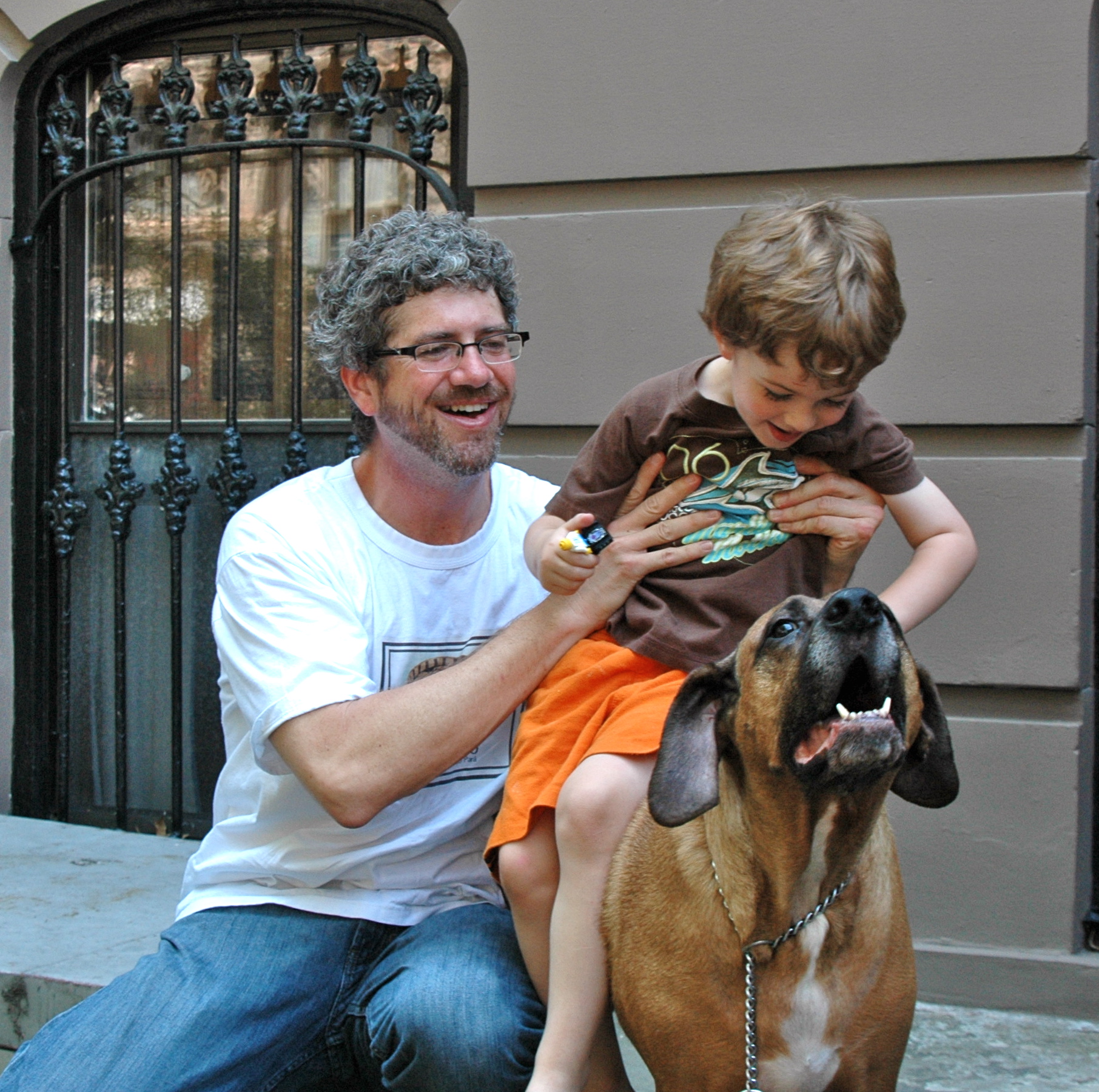
The photos are by the author. The first is of me and Noel and Duke, taken in the summer of 2006 in front of our home at 50 Sterling Place. Duke departed us in April 2009.
The “UP” to which Peter refers is Michigan’s “upper peninsula,” the triangular nose of land north of Wisconsin that sits between Lake Superior’s southern shore and Lake Michigan’s western shore. People from the UP are called “Yoopers,” and it was an area historically known for its iron mines, independent spirit, and Finnish settlers. In Marquette, there is Northern Michigan University, where another old friend from Augustana now teaches. Ishpeming, where Peter was from, is a few miles west of Marquette on Hwy 28.
Don’t tell me the moon is shining; show me the glint of light on broken glass. —Anton Chekhov
Glass can reveal you and other things in the world. Glass can challenge you.
Glass can cut you. Glass is a magical substance. Glass reflects things as truly as it distorts them.
Why, it’s a Looking-glass book, of course! And if I hold it up to a glass, the words will all go the right way again. —Alice, Through the Looking Glass, by Lewis Carroll
Stained in small pieces, it can create images and stories that tell us how God lived and died, saints turning sunlight and suffering into colored mists of other-worldly atmosphere here on earth.
You could be known as the most beautiful women who ever crawled across cut glass to make a deal. —Bob Dylan, “Sweetheart Like You”
Broken, glass becomes a metaphor for struggle laced with pain and suffering, love destroyed, the end of things that once were.
My whole life has crashed, won’t you pick the pieces up
’cause it feels just like I’m walking on broken glass —Annie Lennox, “Walking on Broken Glass”
Yet broken glass is more than this. Sometimes, what is broken becomes better than it was before.
“Now it’s just like the other horses . . . ” says Laura in Tennesee Williams’ The Glass Menagerie, when Jim knocks her glass unicorn to the floor, breaking its horn.
Breaking the glass at the conclusion of a Jewish wedding reminds of the fragility of human relationships, which need the greatest care. The broken glass is the world the couple came from, forever and irreparably changed by their union. New joy must live alongside the pain and suffering of the world.
Something fell from Nellie’s hand and knocked on the floor. She started, jumped up, and opened her eyes wide. One looking-glass she saw lying at her feet. The other was standing as before on the table. —Anton Checkov, “The Looking-glass”
The mirror reveals only what it is shown, and what it means to the looker can be something different altogether. The looking-glass is only one more opportunity to warp the matter of the world into shapes that suit deception, plotting, and retellings of post-hoc truths that matter now more than the time to which they refer.
Looking through the bent backed tulips
To see how the other half lives
Looking through a glass onion —John Lennon, “Glass Onion”
All that ends must be followed by something else. So it is with broken glass. The broken vase pictured at the opening of this essay was bought by a lover to whom I had sent roses after some transgression that I have long forgotten. She, too, is gone, though the vase remained with me after she left. It’s been filled by the flowers of other lovers who have come and gone, each one leaving a mark on my heart, life by a thousand cuts, as it were.
Then one day last year, my cat jumped up to the window sill in the middle of the night and the vase came crashing to the floor. The sound woke me and I went to look, shaking my head as I plodded back to bed, thinking that in the glint of that broken vase there was a story to be told. I will miss her.
Note: This is the third of three posts in an extended essay exploring my relationship with my father and my son through the songs of Cat Stevens/Yusuf Islam.
My son, Noel, plays baseball with the 78th Precinct Police Athletic League. He has a great throw and a yen to learn pitching. I am trying to teach him, and for inspiration I took him to websites with pictures and facts about Yankee legend Ron Guidry. I remember well the heady days in the seventies when Ron Guidry, The Ragin’ Cajun, was blowing away the Major Leagues and winning the World Series. Everyone in Louisiana became a Yankees fan at that time. My mom hatched a scheme to have my father, also Ron Guidry, sign baseballs and sell them to fans. This would be no lie, she said, but my father wouldn’t agree to it. On one occasion, he had his credit card refused at a gas station in Alexandria, Louisiana, because the clerk refused to believe that was his real name.
Noel Shanks Guidry
One night recently, as Noel and I were having dinner and watching TV-on-the-internet, I wondered what Noel might think of the song, “Father and Son.” I called up the video on YouTube and pointed at me when the lyrics indicated the father, and at him when they indicated the son. His comment at the end was that he didn’t ever want to “go away.” Of course, a few days ago, he’d announced his intent to go to college in Colorado (notably, he had just visited the state with his mom). Then he added quickly that he would come back to Brooklyn after college, saying “I’ll live in Brooklyn for ever.”
I said, “Sonny, it’s ok. All fathers and sons go through that.” He looked a little puzzled. I said that “going away” is not just moving to another place. It’s also about changing your mind or growing up into someone who isn’t like me or his mom. He perked up when I said this, as if it meant something to him. (I didn’t ask.) Then we listened to other Cat Stevens songs. When I played “Moonshadow” he said, “I feel like this song is familiar, but I don’t know why.” Then I told him about how I used to sing it to him when he was an infant.
In the years since my son was born, my father has come back to me in many ways. While Cat Stevens was busy becoming Yusuf and converting to Islam, Captain Ronald James Guidry was earning a Master’s Degree in Religious Studies and becoming Deacon Ron Guidry, ordained in the Roman Catholic Church. He serves as a Deacon to St. Louis Cathedral in the heart of the French Quarter and was for several years Master of Ceremonies for the Archbishop of New Orleans. He still doesn’t like guns and is trying to figure out if there is anything such as a “just war” – World War II perhaps, maybe Afghanistan in the early going, but certainly not Iraq (I or II) or the other imperial wars America has waged in the last 100 years. As Deacon, he has baptized all three of his grandchildren, including Noel.
I experience him now differently than I did as his young son. I watch him with Noel and see something I hadn’t expected. They understand each other and communicate in an intuitive way that seems both foreign and magic to me. The older man is more easy-going and less rigid than when I was young. I’ve imagined saying to him now, “where were you 35 years ago?” But I don’t. He has the right to grow old, to become whatever person he wants to become, even if it seems different from the father I used to know.
As I look at it now, it seems my father was growing older even as I was; while I was busy becoming someone, it turns out that he was becoming someone, too. This is something I can appreciate only now, seeing him with my own son. Such are the vagaries of time and companionship, and we are indeed companions, me and the Old Man, having survived my two marriages, bouts of unemployment and career redefinition on both sides, the loss of innocence and the freedom of wisdom, and on June 27, 2007, the loss of my mother and his beloved wife, Mary Krupa Guidry.
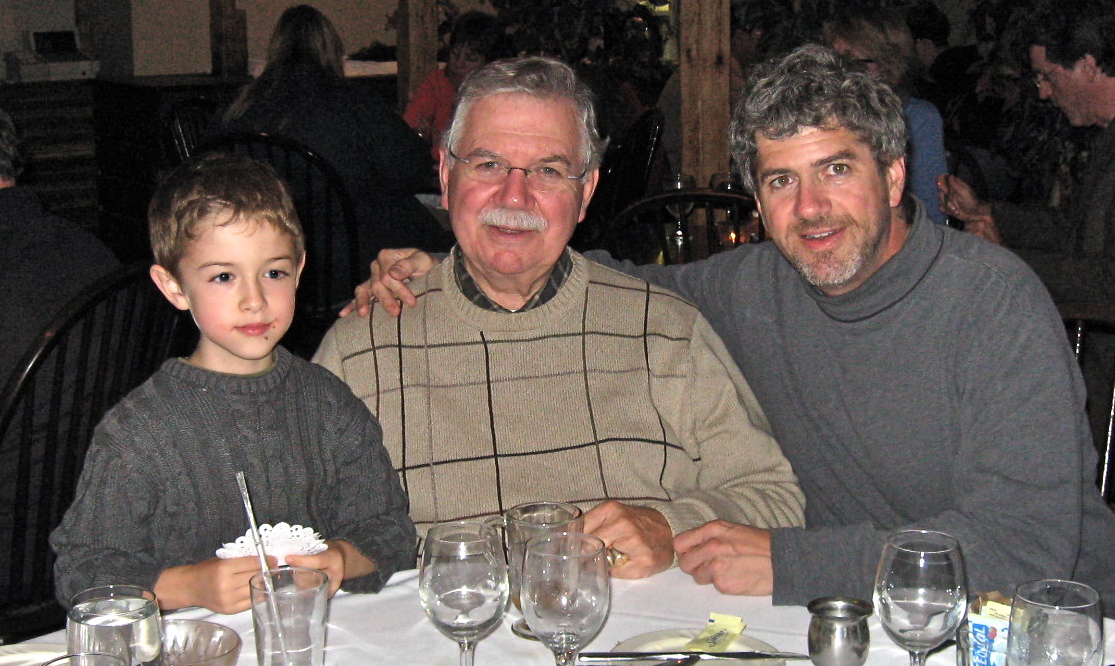
The Guidry boys - Noel, Ron, and John
At the end of the day, I’ve been able to return to my father and to Cat Stevens/Yusuf Islam, a famous singer who brought us together in odd ways many years ago. I listen both to the old Cat Stevens tunes (there are wonderful YouTube recordings) and the new Yusuf Islam recordings, his old songs and his new ones. The music he makes now is much like the music he made before, and he is still pursuing the same dreams. As Yusuf told Charlie Rose in 2009, “It’s the same old heart, you know, that’s the point.”
Last summer, my father did something he’d always wanted to do. He saw Joan Baez live in concert. He had always loved her voice and something about her message. The way he talked about seeing her in concert made me think a little of the consummation (albeit chaste) of a long and unrequited love affair, something like Love in the Time of Cholera, a book he has greatly admired and which he read at some point on those early Saturday mornings after my brother and I were gone from household to build our own lives. It’s wonderful to see him happy.
For my own part, I have mixed feelings about the passage of time and growing older. Cat Stevens was right—I had to go away, but sometimes I wish I never had. Then again, every time I look at my son, I am old, but I’m happy. And so is my father.
Notes and Credits
In August 2009, Yusuf Islam gave an interview to Charlie Rose, which I reference above. It’s a great interview, and it’s easy to see how Cat Stevens and Yusuf Islam are the same man. Particularly poignant is when he talks about how his own son’s interest in playing the guitar sparked Yusuf to pick it up again. The interview is on YouTube in two parts, found here (part 1) and here (part 2). Another great interview with Yusuf in Dublin is here.
The Cat Stevens entry in Wikipedia list among his influences a folksinger from New Orleans named Biff Rose. Biff went to college with my parents at Loyola University in the late 1950s. Rose went on to have a career of some prominence, and he returned to New Orleans to perform at the Penny Post coffee house in the mid-80s, where I met him when I was performing there. Around the same time, a young Emily Saliers played there as a student at Tulane University, following Lucinda Williams who’d passed through the venue years before. The Penny Post is one of America’s great coffeehouses, founded in the mid-1970s. It closed in the 1990s but has reopened as the Neutral Ground and continues to provide a space for singers of songs and teller of tales. The Penny Post story is told by Ray Oldenburg in The Great Good Place: Cafes, Coffee Shops, Bookstores, Bars, Hair Salons, and Other Hangouts at the Heart of a Community.
Note: This is the second of three posts in an extended essay exploring my relationship with my father and my son through the songs of Cat Stevens/Yusuf Islam.
With the passage of time, everything changed, as it always does. By 2002, Cat Stevens had been Yusuf Islam for 25 years, becoming a Muslim in late 1977 and appearing to disappear from Western public life altogether. During that time across the 1980s and 1990s, my brother and I both grew up. We moved far away from home, and we had sons of our own. My brother’s was named Joseph, after our mother’s father, Joe Krupa, a Slovak steelworker from the Allegheny Mountains in western Pennsylvania.
My son was named after one Noel Matherne, born around 1768 on the First German Coast of Louisiana. He married a woman named Charlotte Delmer on November 24, 1789, and among their children was one Eugene Matherne, among whose great-grandchildren was my own great-grandmother, Pauline Badeaux, born in 1896 and deceased in 1998. Pauline married Ernest John Guidry II in 1917. Their first-born son, Ernest John Guidry III, married Marie Lezina Vicknair on June 7, 1939, and on March 21, 1940, Ronald James Guidry was born. Ronald married Mary Krupa on September 7, 1963 and on June 3, 1964, John Alexis Guidry was born. On June 10, 2000, John married Denise Shanks and Noel Shanks Guidry was born on May 28, 2002.
From infancy through his third year, I sang Noel to sleep every night with “Moonshadow,” delighting in the playful exchange of eyes and ears and teeth and hands throughout the lyric.
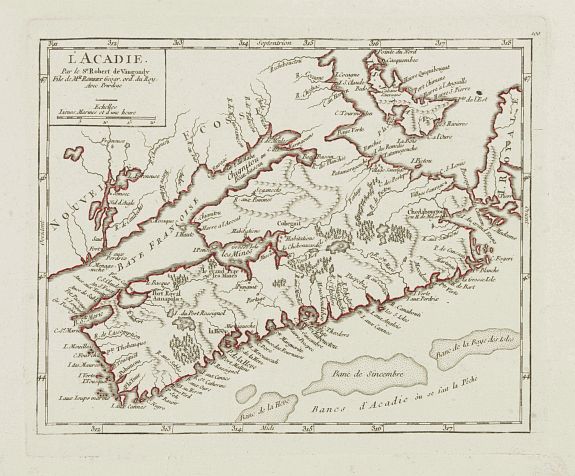
L’Acadie, c. 1749, R. de Vaugondy
This August of 2011, my father, my son, and I are travelling together to Nova Scotia. We’re going back to the Acadian homeland, called l’Acadie by its first European settlers. As Cajuns, we don’t really have a European homeland, which sets us apart from most white people in America. Our ancestor, Claude Guidry, was either born in l’Acadie in the 1640s or arrived there from France in 1671 (the records are disputed). There is no known Guidry prior to Claude, and the path backwards vanishes there.
He is known in the archives as Claude Guidry dit Laverdure dit Grivois. “Dit” means roughly “said to be” (like “also known as”), and Claude’s other names mean “The Green” (Laverdure) and “Saucy” (Grivois). “Saucy,” as far as the record indicates, appears to refer to Claude’s and children’s joviality and penchant for living life the way they saw fit. They were outlaw fishermen and trappers who intermarried with the local Micmac Indians and lived with them, thus exempting themselves from the early census of the colony in 1671, which didn’t count people in mixed-race marriages and their children.
We’re going to go to Claude’s old haunts in Lunenburg, LaHeve (Bridgeport), and Annapolis (Port Royale). If Claude was on the ship L’Oranger, which reached l’Acadie/Nove Scotia in 1671, he would have disembarked in Lunenburg, then known as Mirligueche. If he wasn’t on that ship, then he was already living there among the Micmac. Which story is true isn’t as important to me as simply knowing that I will walk the ground that Claude trod. It’s a dream I’ve had for many years, of standing with my son on the Eastern Coast of Nova Scotia, looking out across the Atlantic Ocean and telling him that our people came from that water, somewhere over there, leaving everything behind, and growing up here, on the land of the New World.
The British and French had both laid claim to Acadie since the early 1600s, and across time this tension provoked an independence in the people there, who preferred to mind their own business and generally refused to sign oaths to bear arms for either side. As it became apparent that the French might not support these renegades, Yankee forces in Boston and the lower colonies formed a plan to expel the Acadiens and repopulate the land with Protestant Scots and Germans, creating a prosperous market for the farms and factories of New England.
That’s how we ended up in Louisiana. How Noel and I ended up in New York is another story, but at least we’re not the first Guidry’s to make the move from Louisiana to New York.
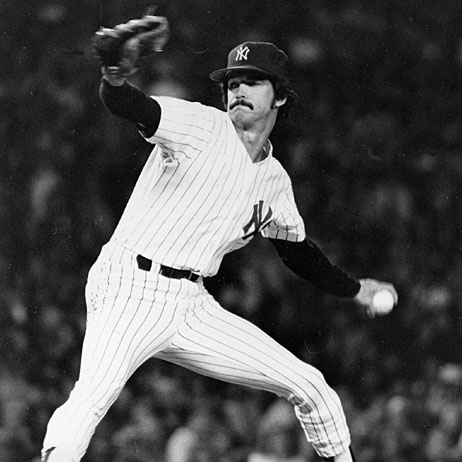
Ron Guidry, Yankee Legend
Notes and Credits
The photo of Ron Guidry was taken from the website Josh Q. Public, profiling some great pitchers, including our namesake, the Ragin’ Cajun.
Throughout the 1600s, both the British and French and tried to have the Acadiens sign oaths of allegiance. For the most part the people refused to do so, preferring to be left alone. Neither the French nor the British wanted to protect them, and they fit into neither country’s imperial schemes. Some yielded to the pressure, however, and on August 16, 1695, Claude Guidry signed an oath of allegiance to the British King. The record in Ancestry.com states,
The Oath read “We do Swear and Sincerely Promise That we will be Faithful and bear True Allegiance to his Majty King William, King of England, Scotland, France and Ireland. So help us God.” Captain Fleetwood Emes, Commander of the Sorlings Frigate administered the Oath at Port-Royal. In taking the Oath, Claude signed his name as “Claude Gaidry”.
On January 9, 1723, Claude Guidry “conditionally baptized” twin grand-daughters Helene and Marie-Josephe Guidry in Boston. They were there with other Acadiens who were prisoners and refugees of a war between the English and the Indians that lasted from 1722-25, known variably as “The Three Years War,” “Rale’s War,” “Lovewell’s War” and “Governor Dummer’s Indian War.” This is the last mention of Claude in any historical record. Not long after he returned to l’Acadie and passed away some time thereafter, among his family in his homeland.













 truth and rocket science