truth and rocket science has been included on this year’s “Park Slope 100,” a list compiled by Louise Crawford on her blog, “Only the Blog Knows Brooklyn.” Anyone from the neighborhood is familiar with Louise and her work, whether in her Smart Mom column in the weekly Brooklyn Paper, or the Brooklyn Reading Works, or the blog, or many other events. Obviously, she can’t place herself on the list, but all of us in the nabe know that she makes it that much better for the rest of to do things of value around here. A heartfelt thanks to Louise! What an honor to be on a list with favorite blogs like Fucked in Park Slope and Brit in Brooklyn, and writers like Frank McCourt.
Oh, and speaking of the Brooklyn Reading Works . . . truth and rocket science will be curating the April 15, 2010, edition of Brooklyn Reading Works, on “The Truth and Money” . . . of which more later. Keep tuned.
This post continues the story of my trip to rural Moju in 1993. Double-click the photos to see them in original size. One more installment of the story is left…
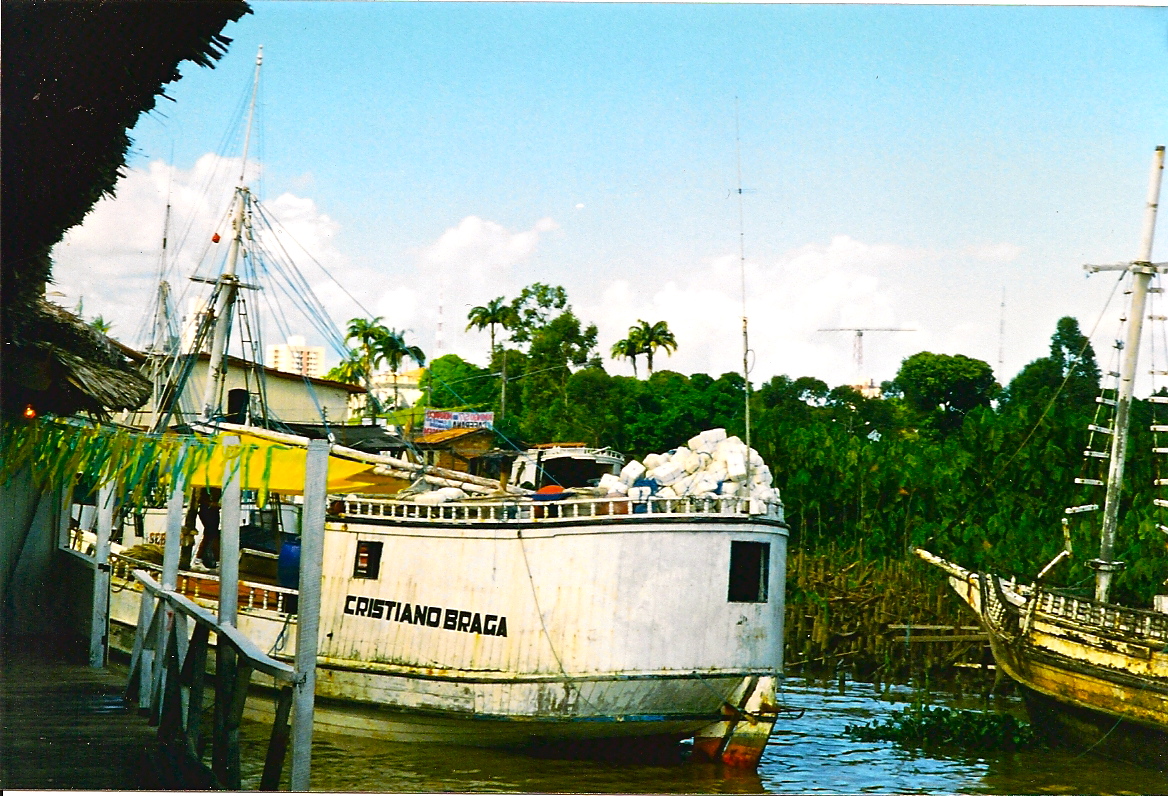
Rosângela was Nego’s aunt, and it turned out he and I knew all the same people, so I went home at 3 in the morning to collect my things and meet him back at the Tamba-Tajá. I brought my toothbrush, a blank notebook and a couple changes of clothes to last me through Tuesday. Back at his parents’ house, Nego and I got a couple hours’ semi-drunken sleep before we set off for the docks in Cidade Velha, Belém’s old quarter, from which you can get local boats for just about anywhere in the Amazon.
Everyone laughed at Nego and me in our hangovers. Aluízio, the patriarch, had seen this before. Nego’s twin brother ribbed us through our headaches. Nego’s mom just shook her head, while his sister chased after her 4 year old son, Hugo – her yelps of “ooooo-go!” “ooooo-go!” (in Portuguese the “H” in Hugo is silent) echoing throughout the trip as she tracked after the boy to keep him from falling off the boat, pull him away from knives, or just quiet him for a few minutes so we could rest our ears. Oscar, Hugo’s dad, hung with Aluízio and Nego’s mom, who made sure I was comfortable and happy as we set off.
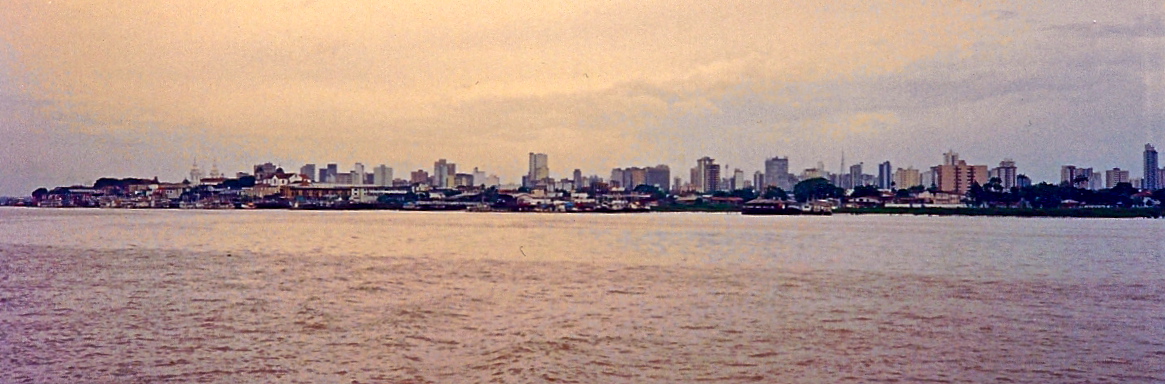
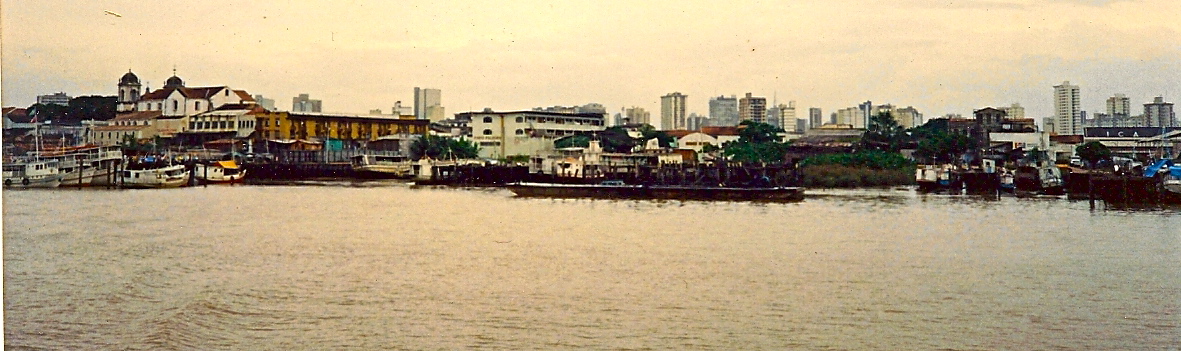
This was my first boat trip in Amazonia, crossing the Baía de Guajurá to the bus stop at Barcarena. As the boat backed away from the dock, we watched the city recede into a collection of smaller houses and palm trees, behind which rose a massive skyline of highrise apartment buildings. A lot of women from Jurunas live in those highrise apartments, in the maid’s quarters, next to ironing boards and sewing machines, just off the kitchen.
Belém, from the Baía de Guajurá
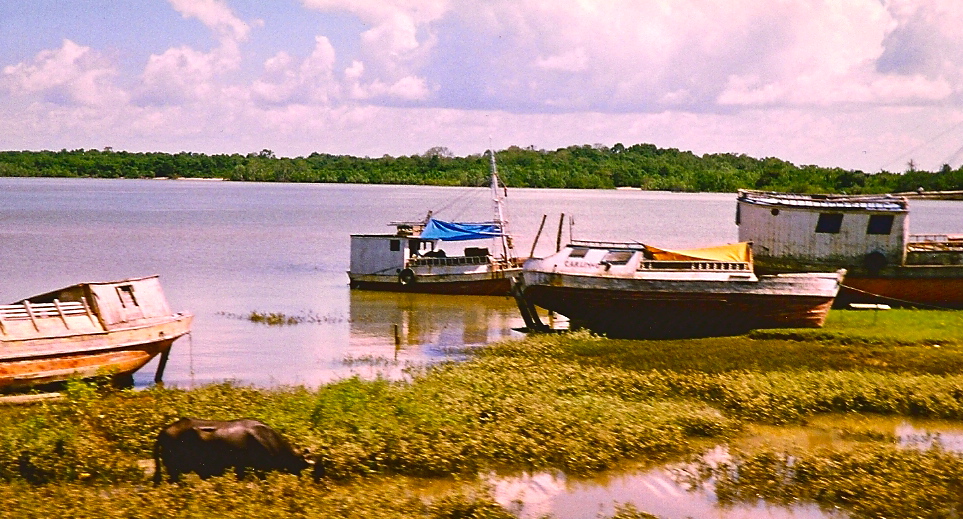
It took an hour to cross the bay, where we waited for the bus in a parking lot. Used to be you went everywhere by boat, Nego told me, and then it took a full 24 hours to get to their little farm in Moju. With the roads and busses the trip shrunk to about 5 hours, quite an advance from the past. The bus ride itself was broken into a couple of parts, because you had to cross the Moju River and then change busses in the town. At the river, everyone got out the bus and ran down to water, where dozens of men and boys waited to ferry people across in small, open, wooden boats, a few cruzeiros for each person. About 20 minutes later, we were on the other side, in Moju town.
Moju was a typical Amazon river-town – a collection of dusty buildings and streets, a trading post, some government buildings. In the center of town were the older houses, stuccoed and whitewashed, with Portuguese-blue lintels and trim. The further you went out from the center, the houses turned to wood and occasionally brick, getting smaller and more rustic. Nego had some relatives in Moju, one of whom was a political official of some sort.
Marajó 1998
Nego’s own family was from Marajó, the large island in the mouth of the Amazon, to the northwest of Belém. There, Aluízio had been a mayor in some small town at one time or another. He was a staunch member of the “PMDB” – Party of the Brazilian Democratic Movement – which was the official opposition party during the military regime in the 1970s and 1980s. By the 1990s, the PMDB was the official party of the state governor, Jader Barbalho, who rode the opposition wave to wealth and finally condemnation as one of Brazil’s most corrupt politicians. Aluízio complained that all his children were “petistas” – for the party initials “PT,” the Partido dos Trabalhadores (Workers Party), which was the main left-wing party that had emerged in 79 as a more radical alternative to the Aluízio’s own PMDB. Nego laughs when Aluízio says these things.
From Moju, we took the road again. It started out paved and but wound up in the same red clay as the streets of Jurunas. Thick rainforest alternated with cattle pastures. Charred stumps poked out the ground amid sparse tufts of long grass that would grow on the land for a couple of years, until the topsoil becomes barren and can support vegetation no more. All the life in Amazonia is in the trees and bushes, and the soil they sit on is barren. Charred stumps and lumps of clay. Loam. Shrublike bushes. Not too many cows out there, but it sure was hot.
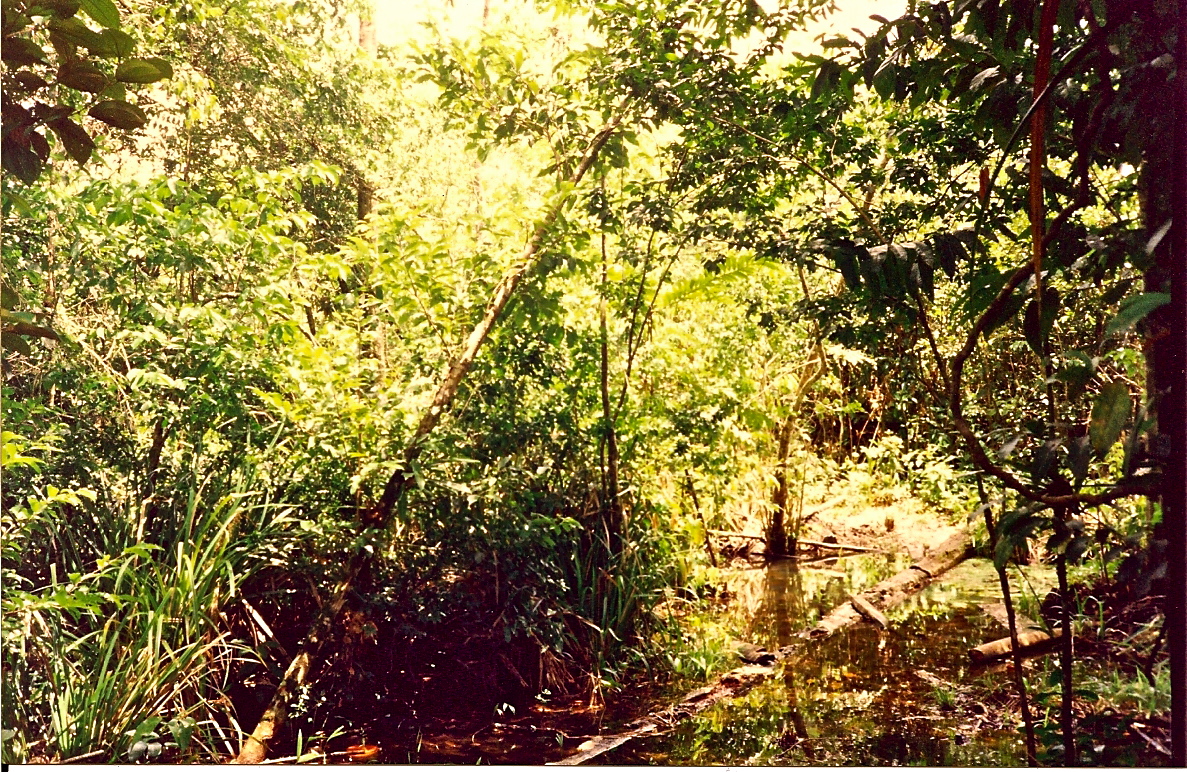
So we barreled on down the road toward some place I’d never seen. By early afternoon we stopped and got off the bus in front of a small wooden shack by the side of the road. A smaller path left the roadside and disappeared into forest behind the house. A man greeted us and we went inside to eat, have a drink of water, and talk about the latest events in the area. This man was Nego’s uncle. He has a small farm next to the road and lived there with his daughter. Fruit was everywhere, hanging from the trees and on a plate before us. Mangos, caju, goiaba, pineapple, coconut. There were rice and beans, chicken. Good food and a lot of it, for we still had a few kilometers to walk through the forest.
The forest around Moju, 1993
Notes and Credits
The photographs in this posting are all my own, taken on various trips to Belém and environs in the 1990s.
Right now the rainforest and Amazonian issues are stirring up heat at the COP-15 summit, and as someone who has lived a significant portion of my adult life in Belém and has traveled all over Amazônia, I am hoping that some good things might come of this. The ties between deforestation and cows and greenhouse gasses are tight, though as Brazilian researcher and advocate João Meirelles Filho notes, cows are a bigger problem than Brazil or the Amazon. I don’t hold out that much hope from politicians, however, but I do find a lot to inspire in guys like Doug, whose Amazon Pilgrim blog recounts his journey across the Amazon, from Belém to Peru, by bicycle.
You can find out more about Doug and his adventures at Green Upgrader, where he’s an editor.
And of course, we can always find inspiration with one of the most popular foreign rock bands in Brasil, or anywhere else, for that matter, outside of their home Germany – and I am speaking of course of The Scorpions, whose concerts in Manaus have been sold out for the good of Greenpeace and the rainforest. For a different kind of concert in Manaus by foreign travelers, check out “Our Jungle Journey,” a blog by a North American couple who moved to Manaus to play in the symphony orchestra and other music groups there. They’re enjoying the splendid, world famous Manaus Opera House, one of the true gems of the Amazon’s belle epoque during the rubber boom (1880s through 1920s).
One of the most interesting groups working in Amazonia on building sustainable lifestyles for the forest and the people who live there is IMAZON, Instituto do Homem e Meio-Ambiente da Amazônia (Institute for Man and the Environment in Amazonia), which was founded in the 1980s by a team of Brazilian and North American researchers. I’ve visited there several times in the 1990s and 2000, and they do great work.
I’d been introduced to the Tamba-Tajá by Marga, who was a Lutheran minister, human rights activist, and liberation theologist. The bar’s owners were her friends, Iza and Rosângela, who were related by marriage. Iza had been a revolutionary and women’s rights activist in Brazil for many years, including the worst years of the military dictatorship in the 1960s and 1970s. Rosângela was raising her children and grandchildren while selling apartment leases in Belém and generally dabbling in real estate.
They named their bar for a plant of local legend, called Tamba-Tajá by Amazonian natives, known as the Elephant Ear plant to others, which people grew in their yards. The Tamba-Tajá can tell if there is much love in the house, very little, or if one of the spouses is cheating. A friend of mine in Belém made a point of telling me that a smart woman always plants one in her yard.
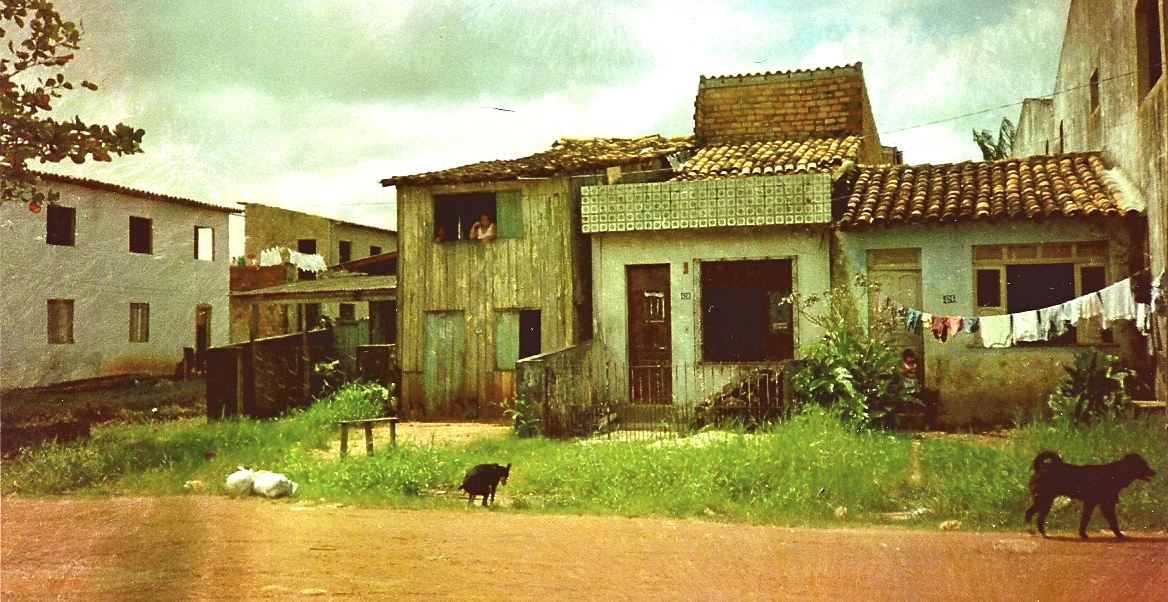
The bar called Tamba-Tajá was a family affair in the working class neighborhood of Jurunas. In January, during the height of the rainy season, the streets of Jurunas are deep with a mud of dark, red clay which can also be home to ferocious tribes of fire ants out in the countryside. People debate which is better, the mud during rainfall or the fine red dust kicked into the air when the streets are dry. The dust gets in your nostrils and mouth, leaving the taste of clay on your tongue. They say the dust causes the “gripe,” colds and fevers everyone lives with and no one likes.
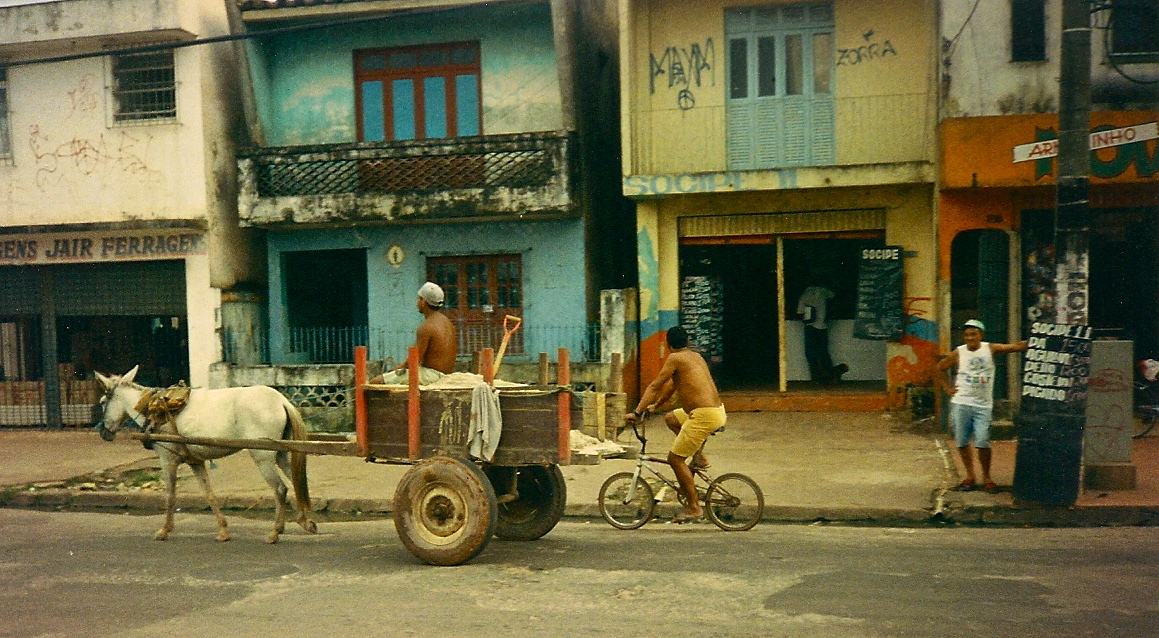
A street in Jurunas, 1993
The Tamba-Tajá opened right on to the unpaved street. It was in the bottom floor of the house where Iza’s estranged and still quite revolutionary husband lived. He was a poet of some local fame. The bar was completely open to the outside, inside and outside having little meaning in a place where inside is often outside, defined less by bricks or wood than by the way people inhabit those spaces. In the front, palm trees shade the patio and keep the rain off people as they eat and dance and drink.
The windows are open to the outside air, too, as there are no screens in Belém, except on Marga’s house, perhaps because she was descended from Germans. In the streets and through the windows of the Tamba-Tajá you can see dark silhouettes of palm trees swaying in the breeze over Jurunas and its little, wooden houses, home to too many people with too little money, though they always seem to have enough to stop by the Tamba-Tajá and the other housefront bars in the neighborhood on a Friday night. Cold beer beats the heat in Belém.
There’s a group of reggae musicians who hang out at the Tamba-Tajá, along with political dreamers and the friends and family of Iza and Rosângela. These musicians spin records on some nights and everyone dances. The sweat soaks your body as you twist and find a place in the scratchy rhythms booming from the old, battered speakers Ivan dragged to the bar on the back of his bicycle. Over crackling, jerry-rigged wires and pounding drums, Bob Marley lived for a while at the Tamba-Tajá.
The first time I went there was to meet Marga and celebrate Iza’s birthday. They had me play for them. The stereo wires were re-rigged to a microphone that had seen much better days many years ago, and they gave me a guitar that made the microphone look like a piece of new equipment. I didn’t know any Brazilian songs, but that’s not what they wanted to hear from me. “Let It Be” always brings down the house in Brazil. And it did again, that night at the Tamba-Tajá.
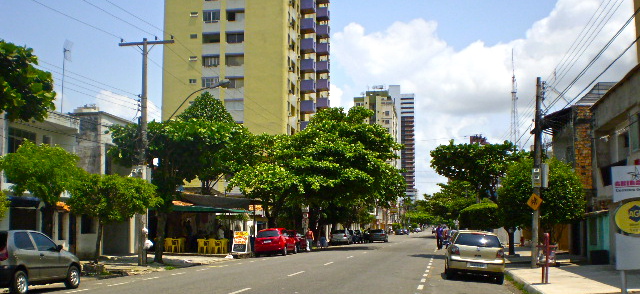
Rua Tupinambás
Now Iza’s birthday had passed, and it was a Friday night. I hadn’t been over to Tamba-Tajá for a while, and with no plans to speak of I headed for Jurunas, a slow walk about 10 blocks down Rua Tupinambás, like “Jurunas” the name of one of Brazil’s original, native peoples.
It had been a long day for me, with much work to do, and the rain storms were particularly hard. In Belém, the blue skies of morning typically give way to clouds and showers by mid-afternoon. From January to May the rain can start in the afternoon and not stop til near daylight. It washes the city and cleanses its ills and keeps the equatorial sun from burning everyone and everything to a crisp. In all, about 86 inches of rain falls in Belém each year, a little over 7 feet.
The rain leaves the air smelling fresh with the breeze off the giant Guarajá Bay, which brings the ocean to into the mouths of the three rivers that surround Belém: the Amazon, Toncantins and Guamá. The ocean tides are sometimes so strong that they send waves up the rivers, so that they seem to flow backwards for a while. Pororoca, they call it. All this water gives life to the land and its people.
As I walked down Tupinambás, I looked to the sky for signs of rain, letting my eyes graze the cloud bottoms and measure how far or close they might be. The city lights bounced back from the clouds, and the clouds glowed orange in the distance, a false sunset that lasts all night long until the clouds dissipate in the coolness of dawn and the new day.
Tonight at the Tamba-Tajá there was no one I knew, save for Rosângela. I greeted her, got a frosty Kaiser, and sat down at a table of strangers, just listening to the conversation. A man was speaking to a boy. The man held his right arm across his chest. He held his right arm with his left hand, as he would the neck of a guitar. The boy did the same.
So we began to speak about music. The man called himself “Nego,” which is a common nickname meaning “black dude.” The boy I recognized from reggae nights at the Tamba-Tajá. He had wide, brown eyes that spoke of youth. Nego had curly black hair thick atop his head, a round face and full lips like my own. His smile and manner drew me in. He asked me questions, about music, my life, why I was sitting in the Tamba-Tajá and what I was doing. We talked for a long time, over a few more Kaisers. The others round us had their own conversations, and we had ours.
Nego wanted to know if I’d ever been out of the city to see the forest. I hadn’t. He asked me if I’d like to go with his family to a farm they have in the middle of the forest, a day away from Belém in Moju. I said, “sure, Id love that.”
“We’ll leave in a couple hours,” he said.
Notes and Credits
This story, Tamba-Tajá, will be told in 3 parts on truth and rocket science. It recounts a visit I took to the bar on a Friday night in 1993, during my year of doctoral research on Belém. There I met a young man who became a close friend for most of 1993, and he invited me out to his family’s farm in the rainforest. I returned home on Tuesday.
I took the photo of Belém’s docks in the “Cidade Velha” in April 1993, as the boat left Belém for the journey that is recounted in this story. “Cidade Velha” means “old city” and refers to the original colonial settlement of Belém that was established in 1616 to consolidate Portugal’s claims over the Amazon. The other photos of Jurunas were taken around the same time by me, except for the photo of Rua Tupinambas. That photo comes form the site Skyscraper City, which contains a great number of photos of Belem. Very nice collection!
For more on my friend, Rosa Marga Rothe, see her Wikipedia page. Her daughter, Iva Rothe, is a accomplished musician.
The picture of the Tamba-Tajá plant in the text is from the website, “Pasarela Cultural,” which goes on to discuss the legend of the Tamba-Tajá.
The legend of the Tamba-Tajá can be found all over the Web. Silvana Nunes’s fotolog has a great photo of the plant and a simple text of the myth, which I have translated. Nunes, a teacher and photographer, has another blog called “Foi desse jeito que eu ouvi dizer…” (this is how I heard it…).
In the Macuxi tribe there was a very strong and intelligent Indian. One day, he fell in love with a beautiful Indian woman from his village. They were married a little later, and they were very happy, until one day the woman became very ill and was paralyzed.
So that he wouldn’t be separated from his love, the Macuxi man made a sling to carry the woman on his back, taking her everywhere he went. One day, however, the man noticed that his cargo was heavier than normal. When he untied the sling, he found that his beloved wife was dead.
The man went into the forest and dug a hole on the edge of a creek. He buried himself together with his wife, for there was no reason for him to continue living. Some time passed until a full moon appeared in the same place where they were buried, and a gracious plant unknown to the Macuxis began to grow there.
The plant was the Tamba-Tajá, with dark green triangular leaves, which have on their backside another, smaller leaf which appears similar to the female gentialia. Together, the two leaves symbolize the great love that the Macuxi couple had.
Amazonian caboclos grow the plant near their houses and attribute mystical powers to it. If, for example, the plant grows well with exuberant, lush leaves, it’s a sign that there is much love in that house. But if the larger leaves don’t have the smaller ones on their backs, there is no love in the house. If there is more than one smaller leaf on the backside of the larger one, one of the spouses if unfaithful.
The photo of the Tamba-Tajá plant in the story’s text shows the “small leaf” or flower on the backside of the Elephant Ear quite well. Without that flower, love ain’t going right in the house.
In the last few weeks, the post “The truth and change, 3a: From Life On Mars to Linden” has been getting a lot of hits. Its spike in the data has pushed it to the most-hit post of all time for me, past the old standards of “The truth and us” and “The truth and unicorns, parts 1and 2.” I am really interested to know how and why this spike is occuring from those visiting. Feel free to email me (jguidryDOT7ATgmailDOTcom) or Twitter (@truthandrockets) or leave a comment here.
I started to put this addendum together right after fininshing the Life on Mars post a few months ago. I had uncovered so much interesting stuff and, as it always happens, realized how much I had missed once I had published the posting. In spite of all my good intentions, I let the addendum lay in the to-do tray whilst writing up other things of interest to me. I continue to be fascinated by the way that virtual spaces and so-called “real life” affirm each other’s essential meaning in our world. I’ve also begun to write a longish story about organic/avatar relationships and welcome any interesting comments or links from people about their own stories or interests in the phenomenon. So here are some fun things . . .
The Arch is a blog about design and architecture in Second Life that goes into great detail on the kinds of Houses of Tomorrow that can exist today in the virtual world. They’ve posted a great short video on YouTube, and if you follow the “related videos” you can drop into a whole new world virtual vouyerism. Enjoy!
Elle Kirshner’s Second Spaces is an interior design blog that highlights the newest designs for your home in SL. Elle is a designer herself, and by just clicking through her site you can see a lot of the interesting concepts and designs about space that are important to virtual life. From Second Speaces, you can also link to Elle’s friends and other businesses, learning a lot about SL’s economic and social life.
One of the interesting and most wonderful consequences of my original post “From Life on Mars to Linden” was that I picked up a new Twitter follower (and presumably blog reader): Botgirl. Botgirl’s Tweets (@botgirlq) are a veritable library of hyper-current thinking on storytelling that have become a great source for me as I write and think. Should you Tweet and link through Botgirl’s world, you’ll realize that this Avatar and her RL typist brings into focus a whole world of multiple and parallel ontologies that really do get at (what I see as) the really important things about life. If you’re a storyteller then you need to become friends with Botgirl.
Virtual existence brings into high relief the way in which storytelling truly becomes part and parcel of being. Call it an auto-ontological environment, in you will, in which stories become magically real. Lanna Beresford’s blog “Avatars in Wonderland” takes up these themes and helps us see how to live on these parallel planes. In “All the virtual world’s a stage” she interviews role-player Salvatore Otoro.
Finally, the interest in the economics of virtual worlds is something I find truly captivating, not so much from the standpoint of getting into biz myself but rather from the perspective of learning how we create value. Intrinsically, there is no value in nature, and then we come along and begin to create value. Sometimes we create value out of scarcity, sometimes out of thin air. Eventually, it always comes to scarcity and control, however. With the Virtual Economy Research Network, you can keep up with a group of people doing some pretty serious study of virtual economics.
There’s much more to see. Much more to look at. Many more stories to create. We’ll keep writing . . .
E. Things that we never would have done had we known better, but that we must live with to the end of our days.
F. Wonderful things and great discoveries that never would have happened had we known better.
Note: E/F will be a recurring feature of truth and rocket science. If you have a half-glass photo to share, or want to create one, send it to me at jguidry.7 AT gmail DOT com and I’ll use it in a future posting, with full credit to you. Make sure that you tell me the story behind the photo, including the contents of the glass, in the following manner . . .
Credit: This standard Williams Sonoma pint glass is half-filled with Hoegaarden whitbier. Its taste is semi-tart and well-accented with a slice of lemon. It sits on a small faux-marble coffee table, in front of a love seat futon that was found on the sidewalk in Park Slope, Brooklyn, Sixth Avenue b/t Garfield and Carroll, on a spring day in 2008. As the mattress was clean and the frame in almost perfect shape, we took it home because we needed a sofa. Ah, providence.
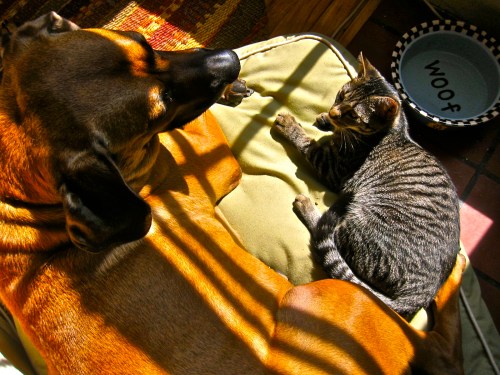
a comfortable living room, for people and cats
The paintings were acquired in Bahia, Brazil in the summer of 1998. The artist signs himself “Alberto,” and they are of mixed media, acrylic paint with splatters of sand and swatches of cloth added for texture. I don’t recall the name of the shop, but I could certainly find it in a minute upon return to the city.
The coffee table was given to me by a friend to hold for her while she moved back to Rockford, Illinois to live in the barn on the family farm while writing her first three books. One day she may want the table back, but until then, it’s here.
Pixie, ace mouser
Pixie, the cat, is about five and a half years old. She came into the family in February of 2005, for the specific purpose of eradicating the mice that had beset us in the fall of 2004. As I told Duke, Pixie was “a technician,” and she proved a very effective one: in her first 14 days, she took out 13 mice, and we never saw another one.
Brazil is a country of inspired appropriation. Its peoples, cultures, sounds, and visions grind against each other. They rise up and smash together like tectonic plates. In the collision of Brazil and Brasília, the city of candangos gave the country Renato Russo.
No “torso of steel,” no “[w]inged elbows and eyeholes,” but like Zweig and Plath a literary mind and poet, Russo’s voice became his generation’s. In his epic song, “Faroeste Caboclo,” Russo tells the story of a poor kid’s migration to Brasília across 159 lines of free verse, punk sensibilities, and an affecting melody that calls to mind the traditional country music of Brazil’s Northeast. Faroeste is what they call a “Western movie” in Brazil, and caboclo refers to the Brazilian mestiço everyman, a mixture of races and cultures, poor, seeking his or her fortune in some faraway place. Faroeste Caboclo is Walt Whitman, rogue-Gary Cooper and Joe Strummer together in Niemeyer’s white palace.
The hero is João de Santo Cristo, from Brazil’s Northeastern “backlands.” Brazilians call this region the Sertão, a rural, agrarian, drought-afflicted area that is the poorest place in the country and carries the deepest currents of Brazil’s premodern past. João robs the poor box from the church. He goes after the girls in the town. People don’t trust him. He feels the effect his skin color has on others who are lighter, more well-to-do. He’s arrested and goes to reform school, where he is raped and degraded. He is filled with hatred.
When a man on his way to Brasília decides not to go and gives his bus ticket to João, he becomes an accidental candango, leaving his past for the “beautiful city” where everything will be different. He works as a carpenter’s apprentice, but he can’t make ends meet and becomes a drug trafficker.
After some time in the criminal world, he tries to go straight when he falls in love Maria Lúcia, but eventually the drug trade pulls him back in. João’s enemy, Jeremias, steals Maria Lúcia and they have a child together. João challenges Jeremias to a duel, which is covered in the press and shocks the city’s elite but makes João a hero to the people. In the duel, Jeremias shoots João in the back and wounds him fatally. Maria Lúcia rushes to her first love and gives João a gun. He challeges Jeremias to die like a man and shoots him. In the end, Maria Lúcia and João die together in each other’s arms.
The people declared that João de Santo Cristo
Was a saint because he knew how to die
And the bourgeoisie of the city didn’t believe the story
That they saw on TV
And João didn’t accomplish what he desired like the devil
When he came to Brasília
What he wanted was to speak to the president
To help all the people that
Suffer
Russo and his bandmates in Legião Urbana (Urban Legion) grew up in Brasília in the late 1970s. Their songs of protest, love, and everyday struggles became the nation’s soundtrack to the last years of the military dictatorship and the re-emergence democracy in the 1980s.
“Será,” a love song with an anthemic refrain, could be heard blaring from sound trucks at the massive marches and rallies of the caras-pintadas (“painted faces”) in 1992, as they challenged the nation to bring down Fernando Collor, Brazil’s first democratically elected president since 1960.
So called because they painted their faces in the Brazilian national colors, green and yellow, the caras-pintadas had grown up under the military regime and saw their hopes threatened by Collor’s massively corrupt regime. They led the way for the whole country, which stopped each day at 7:00 for the allegorical soap opera, Deus Nos Acuda (God Help Us), a comedy in which the angel Celestina tries to save Brasil from the excesses of its social and political elite. In the show’s opening, the rich are smothered in mud and flushed down a whirlpool shaped like the country itself.
Collor was impeached and left office by the end of 1992.
Russo died on October 11, 1996, of AIDS-related illnesses. Russo’s wishes were to have his ashes spread over the gardens of Brazilian landscape artist Roberto Burle Marx, returning him to Brasília and its modernist vision.
In 2006, Fernando Collor was elected Senator for his home state, Alagoas, for an 8 year term (2007-2015). Brazil has absorbed Brasília.
Notes and Credits
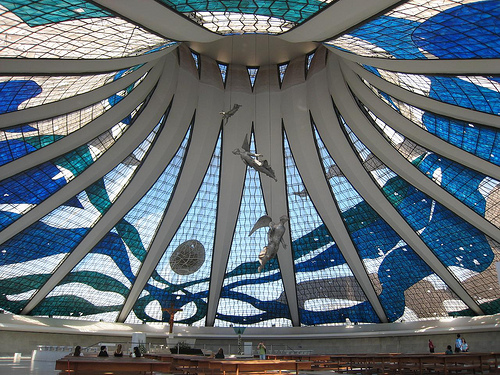
Photo: interior of the Brasília Metropolitan Cathedral. As with the previous post, the photo is taken from the Flickr site of Shelley Bernstein, aur2899. She works at the Brooklyn Museum (according to the Flickr “about”) and has a lot of pictures from Brasília and elsewhere. Her Brooklyn Museum blog posts are here.
Renato Russo was born Renato Manfredi, Jr., in Rio de Janeiro. He moved to Brasília in 1973 at the age of 13 and became a songwriter and musician. He renamed himself after the philosophers Rousseau and Bertrand Russell, and the painter Henri Rousseau.
Faroeste Caboclo plays on the iconic stories of migration from the Brazilian backlands, the sertão, to cities in search of a better life – one of the central storylines of Brazilian history. It’s a story of spiritual depth and apocalyptic reach, most famously told in Euclides da Cunha’s Os Sertões. Da Cunha’s book, published in 1903, tells of the Brazilian military’s destruction of the city of Canudos in the 1890s.
Canudos was a city that grew up around the milennial teachings of a folk preacher, Antonio Conselheiro, bringing tens of thousands of poor Brazilians together in a sertanejo enclave to await the last days. The Brazilian government saw the city as a grave threat to its own project of bringing Brazil into the community of modern republics while still maintaining the class and racial divisions of its colonial and plantation (slavery) past. Canudos was utterly destroyed by the military, and its inhabitants were massacred.
The destruction of Canudos removed one “sore” from the Brazilian body politic, but in the predictable irony of history and unintended consequences, Canudos gave birth to the next social threat. Soldiers from the campaign, unable to find work on retrn to civilian life, migrated south from the Northeast to Rio de Janeiro and built their own squatter colony on a hill. Thus was born the first favela, later to become the 21st century dystopian Canudos that continues to challenges the Brazilian modernizing project.
During 1992 and 1993, I lived in Belém and accompanied the protest marches through the city. I was officially a researcher, but I was also 28 years old, not much older than the caras-pintadas who I spoke to. Just a few years earlier, as a college student in New Orleans in the mid-1980s, I used to grab the New York Times every day to read up on the military’s exit from power in 1985. In 1992-93, like everyone else in Brazil, I was glued to the television every day for Deus Nos Acuda.
Another song that rang out from the sound trucks and radios everywhere was the first Legião Urbana hit, “Tempo Perdido,” with the echoing call of the refrain, selvagem, meaning wild, untamed. It was a song about love and not losing the time at hand, but it was also about the passion for breaking free of repression that made this song the “anthem of an entire generation” (O hino de toda uma geração), according to Alexandre Inagaki. In the video the band pays homage to all their forebears in rock and roll.
“Tempo Perdido” follows in the footsteps, or looking down from the shoulders of Raul Seixas and “Maluco Beleza.” Raul Seixas was Brazil’s Elvis (his idol), Jim Morrison, and John Lennon rolled into one. He “was not just a musician, but a philosopher of life …” (Raul não era apenas música, Raul era uma filosofia de vida), “Always Ahead of his Time.” See Jesse’s portrait of Raul on her blog, Mundo de Jesse. “Maluco Beleza” (“Crazy Beauty”) is for many the epic statement of individuality and creativity from the central icon of Brazilian rock.
Senhor Hype reports that the Brazilian RockWalk is in development, creating a walk of fame that will include both national artists as well as some international artists like the Scorpions.
For an English translation of “Faroeste Caboclo” along with the music, go here. The translation of the ending of the song above is taken from this video, and credit goes to Alexandre Mello and Andrea Hilland.
This series of posts springs from three sources. First, my research for “The truth and change,” recalled the poem Brasília, by Sylvia Plath. Second, I have lived in Brazil for long periods of time and consider Belém, the “cidade das mangueiras” at the mouth of the Amazon River, as my second home town. Third, The Collected Poems of Sylvia Plath was one of two English-language books I brought with me to Belém in 1992, as I began a year-long stay for my doctoral research.
These are stories of exile, suicide and hope in a world caught just between a despair-ridden past and an open-ended, possibly bright future. They are stories of writers and writing. They are stories close to my heart and deeply tied to my own passions. The first is that of Stefan Zweig’s tragic love affair with Brazil. The exiled Austrian Jew will give his story to Sylvia Plath, the expatriate American poet of Autsrian extraction writing of a metphor sprung from a city she never visited. Like Zweig, she died by her own hand in a foreign land. Finally, Renato Russo brings us back to his Brasília, in an epic poem that marries the cinematic Western to the story of his own country.
These are stories of gifted storytellers whose lives were dealt a blow by the hubris of others. Their achievements in the face of all this are a thing of drastic beauty and desperate truth. Life is hard, a friend of mine once said, and it is. But worth every ounce of the struggle, no matter how it ends.
The truth and Brasília, 1: Land of the future
In 1942, Stefan Zweig and his wife, Lotte, commited double suicide in Petrópolis, Brazil. Ever the writer – one of the world’s best known, at the time – Zweig left a note to explain why.
Zweig stated that his decision was “of my free will and in my right mind,” and he told the world why he chose to leave this life. In the dozen years up to this point, Zweig went from being the world’s most-translated author to literary refugee, fleeing his native Vienna for Britain in 1934, then the United States, and finally Brazil in 1941. By this time he was morally and spiritually homeless, “my own language having disappeared from me and my spiritual home, Europe, having destroyed itself.”
No mention is made of Lotte in the letter, so her role, contribution, or support in the decision is only as clear as the fact that she was there on the bed with Zweig at the end of it all, free of struggle, her body like his finally free of the life within it.
Had Zweig the wherewithal to hold out a few years, so the critics say, he might have been able to reinvigorate his spirits – but such conjecture is pointless. Europe in the late 1940s was no picnic, either, and the onset of the Cold War was for many simply a continuation of Europe’s long demise.
For Zweig, the tragedy of Europe was deeply important. He was a stalwart of the pacifist movement, going back to the early years of the century, and he was a famous champion of European integration. A secular Jew from Vienna, he was of the great class of pan-European intellectuals whose history and inclinations drove them to think of a larger cultural world of ideas and human progress. To see that dream dashed so spectacularly by fascism was indeed, I imagine, a tragic, numbing blow to the soul.
Zweig wrote two books in the final years of life that spell his struggle in simple letters. In 1941, he published Brazil: Land of the Future, a love letter to his newly adopted country. On the day before he committed suicide in 1942, Zweig mailed another manuscript to his publisher: The World of Yesterday, an autobiography. Zweig’s European world was on the brink of genocidal horror, and it was killing him. In Brazil, he was trying, heroically perhaps, to follow the European tradition of celebrating all that was American as a new world, a blank slate, a place of abundance unsullied by the tragic history of European struggle, war, and religious strife. He tried, but as he says in the suicide note, he was simply too old to keep on.
. . . after one’s sixtieth year unusual powers are needed in order to make another wholly new beginning. Those that I possess have been exhausted by long years of homeless wandering. So I think it better to conclude in good time and in erect bearing a life in which intellectual labor meant the purest joy and personal freedom the highest good on earth.
Even as Zweig lived and wrote and died, young Brazilian idealists like Lúcio Costa and Oscar Niemeyer were establishing themselves as world class designers and architects. After World War II, Niemeyer’s design for the United Nations in New York placed his ideas on the world’s stage – a House of Tomorrow for the hopes and dreams that Zweig himself had given up on.
Costa and Niemeyer would go on to design Brazil’s city of the future, Brasília, its capital of the future, a gleaming, white, rational city reflecting their beliefs in a truly democratic world that would work for everyone, regardless of class or any other distinction that made life difficult in the old world they inherited. Like Zweig, they looked to a land of the future that was their own Brazil.
Notes and Credits
Cidade das mangueiras = city of mango trees. It’s the local nickname for Belém, where the avenues are lined with mango trees. Every November, when the fruit falls, children scurry into the streets, dodging busses and cars (and sometimes horses) to pick up a free snack.
There are a number of wonderful blog sites, radio interviews, and other web resources available to learn about Stefan Zweig. My source for Zweig’s suicide note is Artopia: John Perreault’s Art Diary. WNYC’s Leonard Lopate did a radio show on August 13, 2007, for which he interviewed George Prochnik, who was working on a book about Stefan and Lotte Zweig. Monica Carter of Salonicawrites of Zweig’s Amok and Other Stories,
“Three out of the four stories in this collection put us in the hearts of those suffering from unrequited love. Zweig’s style is so elegant and descriptive, the purity of this love scares and engages us. The last story draws us in to man who cannot find his way home, due to the war. This is the story I found most tragic because of its autobiographical slant. Zweig and his wife committed suicide because the home that they knew, was one they could never get to again. These stories are so worthwhile and if there is any credence to the adage ‘write what you know’ then Zweig was a man who wrote about loss and love with equal knowledge.“
Zweig’s reputation in Brazil is uneven. As journalist Carlos Haag reported in 2006, Brazilians have discounted the authenticity and sincerity of Zweig’s book, from the 1940s onwards. The book was rumoured to be a quid pro quo with the Brazilian dictator at the time, Getúlio Vargas, who allegedly granted the famous exiles, Zweig and Lotte, permanent residency in exchange for the writer’s services. Brazil was to be the land of Zweig’s future, and perhaps nothing more than that.
I first heard of Zweig’s book while living in Brazil. The book has been appropriated for an insider joke about eternal contrast between Brazil’s riches and potential for greatness with its ever-present reality of income disparity, poverty, and crime. The joke plays on Zweig’s book title and figures in the second of these postings: Brazil is the country of future, and it always will be.
The statement, “In Brazil, [Zweig] followed the grand European tradition of celebrating all that was American as a new world, a blank slate, and a place of abundance unsullied by the tragic history of European struggle,” is a standard of European history. The notion of a “new world” was the result of Columbus’s discovery of a place that no one in Europe or Asia ever knew existed. John Locke backs up his understanding of the “blank slate” of human history and his state of nature theory with unrelenting references to the Native American societies who demonstrate his point.
Jean De Lery, a French doctor and Huguenot minister who travelled to the original French Colony of Rio de Janeiro (that’s right, it was a French town at he beginning), wrote a brilliant polemic, History of a Voyage to the Land of Brazil, aimed at demonstrating that the Tupi natives were more fully civilized than French Catholics, even if the Tupi had integrated cannibalistic rituals into their warfare. As Lery wrote, the French Catholic monarchy was persecuting the Huguenots and massacring them en masse.
Finally, the Founding Fathers of the United States were themselves European intellectuals in the Enlightenment tradition, who sought to enshrine their country’s ahistorical legacy into the very structure of governance. Article I, Section 9 of the U.S. Constitution abolished nobility and privileged relationships with nobles (who could only be from Europe); and the First Amendment’s protection of freedoms to religion, speech, press, assembly, and petition is itself a rejection of the entire course of European political struggle since the Reformation began in 1517.
The third post in this series, The truth and change, is split in two, 3a and 3b. They provide different outcomes for the multi-part essay on change and the future that I began a month ago. It wasn’t how I planned the posts, nor are these the only two ways things can work out. They are, instead, the unintended surprises at the end of a long chain of lateral thinking that has also suggested a set of follow-up postings down the line. It’s always nice to pile up things to do.
From Life on Mars to Linden
Avatars are nothing new to the human species, from the caves of Lascaux to the virtual worlds of Second Life and other large web-based games. These (brave?) new worlds carry out the same primeval urge that led people to create paintings of their daily lives 35,000 years ago. What began in the caves has become a massive wall written on by millions of people, together, sharing a world that they have imagined out of the very world in which they live.
The House of Tomorrow, 35,000 BCE
One of the interesting things about the virtual world is that it does create a “place” that didn’t exist before, uncovering new spaces in life that are hidden beneath the physical dimensions we take for granted. In the world of Massive Multiplayer Online Role Playing Games (MMORPGs, or MMOs) such as Second Life, people leave their organic beings and create virtual selves, societies, and places in cyberspace. These worlds are a social version of the extra-dimensional physics of string theory, “brane worlds,” and high energy model building that physicist Lisa Randall has written and spoken about. In MMOs, we are building new worlds in very small spaces inside the world of everyday experience.
The key thing about these virtual dimensions is their connectivity to real life, which engenders much greater imaginative potential than the escape to the “silver screen” that left the sad girl in David Bowie’s song wondering if there was “Life on Mars.” Ours is now a world of both cultural production and absolute reflexivity, in which the virtual world is like a magnifying mirror we hold to our organic lives.
In a fascinating example of this reflexivity, organic journalist Marcia Stepanek reports on Second Life journalistDraxtor Despres, who himself reports on the goings-on of the organic world for the people of Second Life. Their dialogue is like an 8-track tape, or a Möbius Strip in which one side is organic, the other side virtual, both surfaces effortlessly sliding into each other when they are attached in just the right way.
Already, the virtual economy is derived from, reflects, and ultimately contributes to the organic economy. In July of 2009, Second Life creator Philip Linden spoke to BOSL (Best of Second Life) Blog about how Linden Labs is creating various supports for crossover services involving both businesses and educators, who will use the SL platform to provide services in real life. Within SL, “Linden Dollars” are the basis of a vast economy of virtual goods that can be converted, ultimately, into organic dollars.
The virtual world embraces an entire crossover economy. Hermione Watanabe is a “virtual wealth coach” whose blog provides advice and information on the SL economy and how to grow income there and in the organic world. Perhaps the most compelling confirmation of the virtual world’s “real” existence is that the Federal Government is thinking about how to tax virtual economic activity.
The crossover continues in the amateur machinima that is becoming an art form of its own, sprawling across YouTube, Vimeo, and other video networking sites. Aenea Nori’s SL video for Kafka Dinzeo’s remix of Lily Allen’s “Littlest Things” brilliantly takes us through the wormholes that connect virtual dimensions to the organic and back again.
LauraMW12345 created an organic-virtual mix in which “Second Life Meets Real Life,” in which the green screen existed in SL and the “real world” had to be inserted as fictional background for the avatars. The video is set over the DNA remix of “Tom’s Diner,” which was one of the early, pioneering events in remix history, on the borders of different dimensions of musical creation and imagination.
This sliding between organic and virtual lives has inevitably encompassed the most ubiquitous and equalizing of human emotions: sex (and its correlate emotions). Love is in the virtual air, as people in Second Life and other MMOs mix, mingle, fall for each other, become married (virtually, but quite really), pledge love, cheat, cry, break up, and try again. For a while, people started to create real-world-like porn magazines on-line (in Second Life, Slustler was a phenomenon in 2005-07), but these have been displaced by other virtual services and games that better fit the medium, such as Red Light Center (which creates a very real organic economy for itself as well) and SL meeting places and adult parties.
Eventually, however, we come back to the connection between the virtual and organic worlds. They cannot function without each other. “If This is Second Life Why Is My Heart Breaking In Real Life?” is a machinima video created by Kirk Lancaster and Sandra Holyoke that explores the crossover of desire and heartache. The relationships we create in other dimensions reverberate in the organic world and behind them all lie one, beating, very organic heart.
The future, it seems, is not out there in the world, some place distant in either time or space. It’s in our minds, already, right now, and available for our scrutiny. This isn’t the future I imagined as a youth, or even when I began writing these postings. In this future, much of the world is simply brought to life from our own minds with the help of technologies that enable millions of minds to communicate in tandem, synced together to build a world that is every bit as real as the organic world even as it vanishes before us to live in our minds.
This brings me back to the Shetland Islands of the late 1940s, where Erving Goffman gathered observations and data for his book, The Presentation of Self in Everyday Life. It was published in 1959 and became a classic of American sociology; it’s still widely read and has never been thought out-of-date.
Immersing himself in the world of the Shetland Islanders, Goffmann looked at their everyday interactions through the lens of drama – people were actors in their own plays, as well as each other’s audiences. “All the world’s a stage,” Shakespeare famously said, and Goffmann set out to prove it. People work hard to create settings and situations in which they can enact a specific, intentional script. They have certain behaviors for their audience, as well as an array of backstage behaviors.
Goffman’s point of view was revolutionary at the time and cemented the foundation of a whole school of social thought. We construct our own worlds in the same way that we construct plays and dramas. The representational activity that started in places like Lascaux and ends up in MMOs is pretty much the same. The attractiveness of gaming and MMOs is clear: it’s what we already do in regular life, only in the MMO we get a greater degree of control over what we hide backstage.
This begs a question. Is the change we experience with this technology really anything more than a change in the venue (now virtual, created) for the same old desires we’ve always had? A vanity of vanities in which there’s nothing new under the sun except for the bottles that are filled with old wine? Does the virtual world of love and sex and desire change any of the fundamental emotions or relationships that constitute what it means to be human? When and where does the virtual world go beyond reflections and extrapolations of the organic?
When is the virtual world for-itself?
Notes and Credits
The opening photo is from the Flikr site of rikomatic. The photo shows a house for sale in Second Life, where participants engage in an extensive economy that has several dimensions – purely virtual, combined virtual and organic, and mainly oriented toward organic profit. In Second Life, people create their own houses by using virtual money (Linden dollars) to purchase land and materials in the virtual world.
Much thanks to Marcia Stepanek for introducing me to the world of machinima in her writing on Cause Global and Pop!Tech.
Aenea Nori’s machinima for the “Littlest Things (remix)” carries us through many layers of time and space. I would have embedded the video in the blog for people to see, except that WordPress (the free version, anyway) isn’t communicating with Vimeo. You should go to her site, however, and check out her video work. There is no recent activity on the Vimeo site or on her blog (the last activity is September 2008), but perhaps she’ll be back.
Lily Allen uses a lot of mixing, overdubbing, and sampling to build her songs, which are themselves an aural hypertext calling forth a multitude of associations and images. “Littlest Things” recalls Cat Stevens’ “Wild World,” morphing time across 35 years of cultural production. Listening to Allen’s work is stimulating – and now Aenea Nori and Kafka Dinzeo transport the music and associated images into another world altogether, sliding along a “brane” between the virtual and organic worlds.
Regina Lynn has written in Wired about the growth of the virtual sex world found in MMOs all over the web, some of which are lucrative businesses. WebMD posted a balanced article on the advantages of cybersex and “teledildonics,” which include a safe place to try out new ideas (both in terms of disease and in terms of emotional control), as well as the problems – it can become addictive and affect real-life relationships. The article quotes Regina Lynn, who brings the issue down to earth: “Does your partner know, and does your partner consent? Lying is cheating.” Over at True/Slant, Todd Essig writes about the cutting edge developments in the world of cyber sex – now, cyber-touch with lasers across world’s distances.
Taunt is a blog devoted to SL economics and SL sex life. SL and other MMOs feature escort services and erotic parties to cater to every taste, including many that are all but impossible to enact in organic life. “Second life guys can have it all, as long as they’re willing to pay,” according to Elle Kirshner, a Second Life designer and voiceover artist for Kirk Lancaster’s SL video, “Second Life Man.”
Overall, sex is actually the cutting edge of machinima and virtual reality. Why? Because it’s what we want so much in real life that our urges push the limits of technology so that we can pursue desire in every possible corner of existence, from dreams to waking life to virtual reality.
The 140 Characters Conferencewas held at the New World Stages in New York on June 16-17, 2009. The New World Stages are a large complex of five stages seating different audience sizes, up to about 500 people, along with lounges, lobbies, and galleries. Much of it is underground – one who’s never been there is quite unprepared for what he or she will find once inside the doors and down the escalator.
In the theatres, the seats rise on a steep gradient. Everything is painted black, and the lighting makes anything on stage come out into the setting, seeming to float in space, vividly in color.
During the conference, I was distracted by a low hum in the background: the sounds of fingers on keyboards. At least half the audience had their laptops open and were tapping away at all kinds of messages, dozens of Tweets being unleashed as each speaker spoke about the world of Twitter and Tweeting from some different point of view.
The hum was distant and faraway, sounding as though it came from some hollowed out source not quite in the room. It was enchanting, if in an industrial kind of way, bringing to my mind in a Proustian moment an incident that was altogether different and yet fundamentally similar.
Act 2: One dog, one man, and thousands of bees
On a sunny spring day in April of 2008, I laid down with Duke under a gnarly, knotted, scrubby, runty tree. There we rested for some time, children (including my own son) playing nearby, blue sky and warm yellow sunlight all around.
I noticed a bee flying just over me. It wasn’t trying to touch me, though it came close. As it buzzed off, I saw another coming down, slowly descending – then another, and another. Suddenly, hundreds of bees reminded me of World War II photographs of paratroopers, but unlike paratroopers, no bees landed on us. They came close and then flew off.
In the air above, I heard the low grade, ambient sound of buzzing. Unlike anything I’d ever heard, it was assuredly distant, warm, and safe. An aural blanket covering the scene, enchanting in a distinctly pre-industrial kind of way.
Act 3: Enter the Queen
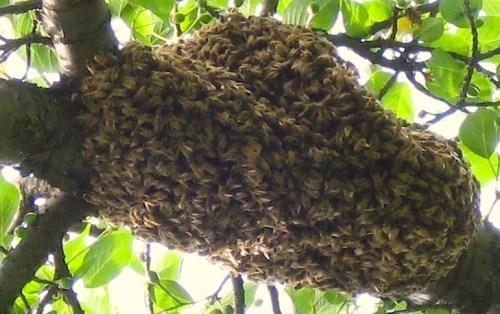
I sought a pattern in their behavior, and I soon found one. Each bee – after buzzing around in an inert, hovering, apparently directionless state – slowly made its way to an extended branch of that knotted tree. The swarm began packing itself on one part of the branch, growing from a small ball of bees to an enormous, undulating bulb. A huddled, tired mass, to be sure.
Swarms like this occur when the Queen decides it’s time to move the whole the colony to a new home, or when a new Queen is born and leaves with part of the old colony – her brothers and sisters and not her offspring – in order to establish a new one. Somewhere beneath the mass of bees above me was the Queen, who would be vulnerable until they built a new home.
Act 4: Of the social organism
In the Queen, the insect colony becomes incarnate and we see that very magic trick that occurs again and again in nature: the metaphysical made real. To live or die as an individual bee makes sense only as a function of the Queen’s existence. She alone carries the source, yet she cannot exist alone, without her offspring. The social organism is a whole that has no physical being in itself, but is instead a thing greater than sum of its irreducible, individual parts, each of which will fight to the death to protect the Queen.
The social impulse, according to Donald Ingber, is something we can see in fractals throughout organic nature, beginning with bacteria, single-cell based colony creatures, cellular cooperation in larger organisms, insects, and possibly ourselves.
One group of Argentine ants may have broken the geographical barrier between kinship and colony. These ants have created a kind of mega-colony that exists in North America, Europe, and Japan. Even though they live across such vast distances, they behave like ants who live in one colony, refusing to fight each other and yet ruthlessly destroying non-kin ants they find in their way. It is the “largest of its type ever known for any insect species, and could rival humans in the scale of its world domination.” Interestingly, these ants were able to establish such distant colonies because people, however unwittingly, carried them there.
Human beings are the only large animal that has managed to populate the world in numbers and social structures that can be compared to the social insects – ants, bees, termites. Our technologies – language, boats, smoke signals, printing presses, as well as the World Wide Web and Twitter – have enabled us to break the micro-social, hunter-gather barrier and form true social organisms.
Act 5: Living in the land of ideas
Unlike ants or bees, however, we may be creating a new kind of meta-social being that relies on the very gap between the individual and social organisms. In that gap, we remain as individuals happily, fruitfully, and contentedly human in the smallish communities that make our lives meaningful. Exploring that gap was the whole point of the 140 Characters Conference, as it is of the plethora of commentary on Twitter and social media that one can find all over the Web, from those who damn Twitter for destroying thoughtful cultural production to those who celebrate and explain its benefits.
Further distinguishing ourselves from social insects, each Twitterer and his or her followers constitute a kind of spontaneous swarm that exists only in cyberspace. Unlike the swarm of bees that I witnessed overhead last year, one very busy bee in Twitter can be part of many swarms, in addition to being the Queen of his or her own. These swarms are multiple, derivative, tumescent, and utterly human.
He notes such people are “lost in invisible worlds,” but that’s not true. They’re living in the spaces between very real and tangible worlds, seen and unseen, building swarms and with them the ethereal sounds of buzzing keyboards humming in the background of everyday life, as audible now to the rest of us as presumably the sounds of automobiles once were to our great-grandparents’ generation.
Dénouement
I doubt we’ll ever truly understand ourselves as a social organism. We are biologically individual creatures, and we perceive the world through individual minds, even when our perception is helped along by the grand edifice of knowledge and social consciousness that helps us understand the world.
Yet solipsism isn’t what it used to be.
We needn’t be as depressed and desperate as Sartre or Morrissey, nor as arrogant as Richard Dawkins, in order to understand how the gap between self and other makes us who we are. That gap is the place of creation: of all art, science, technology, storytelling, representation, and myth-making. Einstein, unicorns, cave paintings, and Twitter all come from the same urge to touch the whole, and in these bursts of creativity we see truth and beauty and all that makes our short time in the conscious world as good, or bad, as it can be.
Notes and credits
A special thanks goes to Marcia Stepanek, a friend and colleague whose Cause Global blog chronicles how new developments in technology and communications affect the worlds of philanthropy and cause-based action. She invited me out to the 140 Characters conference which made my observations on Twitter possible. You can also see her blog postings at Pop!Tech and the Stanford Innovation Review.
On the micro-social, hunter-gatherer societies: For people, these are the smallish, tribal societies that were the basic form of human social organization for most of our history, say from the time we began living on savannahs until the advent of large, social agriculture. This covered a time period of roughly a million years or more, depending on how you want to define human beings. In the animal world, wolves, lions, elephants, wasps, and a few other animals still use this form of social organization. Some of the writers I’ve read on this period of our history are Jared Diamond, in The Third Chimpanzee and Guns, Germs, and Steel, his blockbuster on technology and change in the social organization. Also quite interesting is Colin Tudge, The Time Before History, which examines human history and the impact of people on the planet for the last 5 million years. Tudge’s book is good fodder for thinking about global warming in a very long-vue sense.
William Saletan’s posting which I quote above was not about Twitter, but rather about Blackberry and cell phone usage. Interestingly, a search of Saletan’s blog at Slate for “Twitter” brings back no results. Full disclosure: his blog, “Human Nature,” has been a source of inspiration for a number of years.
Chris Weingarten’s presentation at the 140 Characters Conference was one of the more raucous and interesting. Among his provocations was this: “Crowd sourcing kills art,” and I reference him above as a critic of Twitter, who is also a constructive, critical user of it. At @1000TimesYes, Weingarten is reviewing 1000 CD’s on Twitter, even while he provides a very pointed view on the negative impact of Twitter on cultural production. Weingaretn’s blog is called Poisson d’Avril. Here you can see the Twitter reviews and appreciate the minimalist form of review on your own, such as the review of one of my favorites, Green Day, “If the world ends tonight, Green Day made the album of the year.” Or the more esoteric pan of someone whose music I have also enjoyed, Regina Spektor, “In New York, even our twee is meta.#4.5.” Gonna have to find the album just to figure out what he means, though I have an idea.
Counterpoint: Solipsism isn’t what it used to be, but for Chris Weingarten and lots of others, social media like Twitter have the ironic effect of increasing solipsism by creating flocks of people telling each other “all about me.” It’s a topic I am thinking about.
Robert S. McNamara struggled with his own humanity in the face of all he had done. His faith in statistics, systems theory, and science was equaled by his seeming allergy to human emotion, in spite of a life lived full of emotion. Whether his sense of duty was a righteous sham or a noble straightjacket cannot be answered now, but we do know that his sense of duty prevented him from acting on his beliefs. In not acting – not speaking out against the war and Johnson’s stubborn pursuit of it – McNamara’s misdeeds became the emblem of his life.
My perspective on McNamara is a luxury of history. In 1984, when I was working for the Mondale campaign as a College Democrat, we looked back on the 1960s with dim and misplaced nostalgia for something we didn’t understand. When we drew up our marches and rallies against the U.S. role in Central America, we wondered what had been lost since 1968.
With this in mind, I wrote my friend, Peter, who was there in 1968. I asked him to read the post and address one question: “[D]o you think I let him off too easily?”
He wrote me the following, which he allowed me to post here without editing:
McNamara remains something of an enigma to me. He was definitely my enemy back in the 1960s when I was going to school in Ann Arbor. I recently relived those days with one of my old friends. I was attending a conference in Dearborn and made a trip to AA on a beautiful spring day, and my buddy (I hadn’t seen him since 1984) drove in from western Michigan. We recalled the bombing of the ROTC building, the bombing of the CIA office hidden somewhere in downtown AA, various demonstrations we took part in, our first and subsequent encounters with teargas, etc., our first trip to DC to take part in an antiwar march, etc. (we didn’t leave out drugs and rock and roll in our tour of memory lane).
You are quite right about McNamara’s capacity for self-reflection and his—you don’t use these terms— almost theological understanding of what Paul Ricoeur would call “fallible man.” And of course this is what makes him so very different from the motherfuckers of recent vintage who got us into unnecessary wars. Not only will they never be described as the “best and the brightest,” but they provide ample evidence of a total incapacity for self-reflection and self-doubt. All this being said, one of the things that “The Fog of War” revealed was that there were definitely limits to McNamara’s willingness or ability to plunge into his psychic depths. I have a sense that he got near the heart of the matter, but perhaps because of what psychoanalysts call (or at least used to call) resistance, never quite managed to truly come to terms with the reasons for and consequences of his actions.
Errol Morris’s reflections came out in the New York Times yesterday, “McNamara in Context.” Morris points out that as McNamara saw it, his job was to keep us out of nuclear war, which he succeeded in doing even as he failed so spectacularly in other important ways. So much of his life’s work, including at the World Bank, created unintended consequences that were not good at all. Robert S. McNamara was one singularly influential person, a Robert Moses of death and destruction, who had it in his power to do so many things at the flick of a finger.
Like my friend Peter, Morris notes that McNamara never fully accounted for his individual role in the Vietnam War and the unnecessary death it caused, noting that he always used the first person plural when speaking of it. “We were wrong.” For Morris this is part of a greater conundrum: “… how do you say you’re sorry for history?” That kind of accountability is bigger than the individual who, if responsible for some large part of the problem, was surely not alone in it. McNamara was in over his head. He had no mind for the ideas and emotions that would have addressed the situation he was in.
We see now how Dick Cheney is living with his failures. It’s not likely his obituary will state that in his later years “he wore the expression of a haunted man. He could be seen in the streets of Washington — stooped, his shirttail flapping in the wind — walking to and from his office a few blocks from the White House, wearing frayed running shoes and a thousand-yard stare.”
That image, by Tim Weiner in the New York Timesobituary of McNamara, recalled for me another fallen genius of the same era: John Nash and his haunting of Princeton in his illness, prior to his resurfacing and recognition with the Nobel Prize in Economics. Both men were gripped by insanity at the height of their powers, only McNamara’s was an historical psychosis that had sanction and authority, while Nash’s was a bitterly lonely, neurological defect.
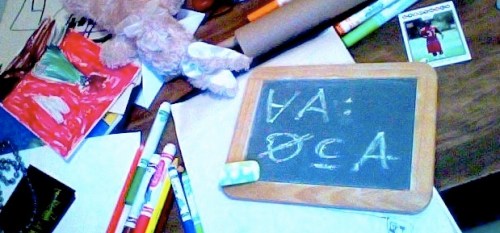
What is the line between the righteous pursuit of the good, however one conceives it, and real evil? Between clarity of vision and madness? Or perhaps more aptly stated: Who draws that line? The righteous believe they know, and that it’s a simple issue. But it’s not. Maybe there is no line at all, or maybe it gets dim or disappears from time to time. An unwelcome thought indeed, but in math, the empty set is always a subset of any set. ∀A: ∅ ⊆ A So it is with life.
This is not the same as saying there is no good or evil – for there is – only that in some situations truth and rocket science place us at a disadvantage, in a fog of righteousness and knowledge. McNamara was an outlier in the same population of which we are all members, and when we really look at outliers, we simply see ourselves, or at least parts of ourselves, magnified.
Notes
The mathematical notation ∀A: ∅ ⊆ A means that “for all sets A, the empty set (∅) is a subset of A.”
Robert Moses was the most powerful figure shaping the urban geography of the New York City metropolitan area. From the 1920s to the 1970s, he created park systems, highways, bridges, tunnels, and public housing that, taken together, are fundamental elements of any picture of 20th and 21st century New York. While few dispute the benefits of the parks, beaches, and swimming pools Moses created, his highways destroyed neighborhoods and isolated populations from each other. Along with the system of public housing he created, Moses is partly responsible for the patterns of racial segregation in New York, and according to Robert Caro’s Pulitzer Prize winning 1974 biography, The Power Broker: Robert Moses and the Fall of New York (Knopf), this was intentional. By the 1960s, Moses’s star began to wane, and he lost several public battles over new projects. One of Moses’s most influential critics was Jane Jacobs, whose The Death and Life of Great American Cities is considered a classic urban geography and community theory. Jacobs led the fight against Moses’s Lower Manhattan Expressway, which was never built. Like McNamara, Moses was an appointed official.
For six months in 2004, I lived on the Red Hook side of “the trench,” a stretch of the Brooklyn-Queens Expressway (a Moses project) that, along with the Gowanus Expressway (Moses) and Battery Tunnel (Moses), cuts off Red Hook from nearby Carroll Gardens. Red Hook’s public housing development (Moses, again) is one of the largest in New York, and its residents are largely non-white. Carroll Gardens is an old Italian neighborhood that has retained its character, though they had to fight make sure the BQE didn’t demolish their church. In the last few years, Red Hook is undergoing new change, as people from all over the city flock to the giant swimming pool in the park there (Moses), along with one of the newest, and largest IKEA stores (not Moses) in the metropolitan area. Another major (decidedly un-Moses) attraction to Red Hook today are the tacos, whose vendors recently won a touchy battle with the city in order to keep plying their delights for summer soccer fans. It was a struggle Jane Jacobs might have appreciated, as chronicled in part in the Brooklyn Paper.
I have not read Gladwell’s book, Outliers. I’ve read two of his other books and enjoyed them. In my own work as a social scientist, I’ve spent the last 20 years looking at the differences between outliers the rest of us. Not a fan of essentialisms, yet without denying the possibility of essential differences among some people, I tend to view difference as a matter of degrees and context. (see The truth and us).
















 truth and rocket science