The truth and unicorns, part 2

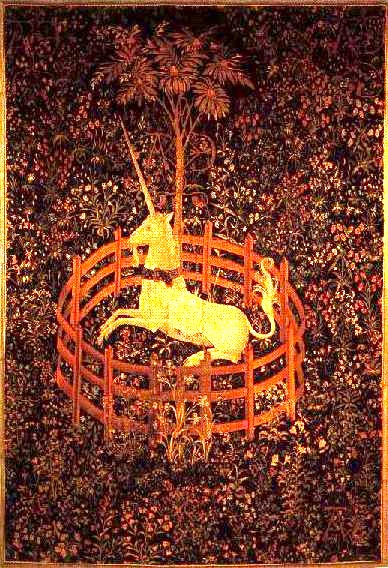
The Maiden Captures the Unicorn

The Maiden Captures the Unicorn

The Cloisters is the Medieval branch of the Metropolitan Museum of Art in New York City.  If you’re not in New York, drag your mouse here.  When you get there, you will find a large room, like the banquet hall of a castle, complete with a large, carved stone fireplace.  There is no table in the middle, and you will see hanging from the walls seven tapestries that date from the turn of sixteenth century (1495-1505).

They were woven in Brussels of wool, silk, silver, and gilt wefts by deft hands. Hanging twelve feet from ceiling-to-floor, the tapestries tell the story of a unicorn hunt, a standard Medieval myth, set against mille-fleurs backgrounds that show over one hundred species of plants. A group of well-armed nobles and knights search the countryside for a unicorn, but they can capture it only with the help of a Maiden, a virgin. They stab and gore the unicorn and set their dogs on it. Custom would have the capture killed on the spot – but the unicorn lives again in the final tapestry, The Unicorn in Captivity, which shows it tied to a pomegranate tree, surrounded by a low fence.  It is an allegory of the passion of Christ, or the cruelty of mankind, the rape of nature, the fierceness of men, the innocence of virgins, sexuality itself.

If you have the chance to visit the exhibit, read aloud Rainer Maria Rilke’s sonnet to the unicorn.  The echo in the room takes you out of time and space and into the sensual experience of near-fantasy.

O this is the beast who does not exist.
They didn’t know that, and in any case
– with its stance, its arched neck and easy grace,
the light of its limpid gaze – they could not resist

but loved it though, indeed, it was not. Yet since
they always gave it room, the pure beast persisted.
And in that loving space, clear and unfenced,
reared its head freely and hardly needed

to exist. They fed it not with grain nor chaff
but fortified and nourished it solely with
the notion that it might yet come to pass,

so that, at length, it grew a single shaft
upon its brow and to a virgin came
and dwelled in her and in her silvered glass.

Or see the following video (best when set to full screen, though the quality of photos suffers a little):

Rilke follows the Medieval European unicorn myth as it lived in the space between paganism and Gothic Christianity. The unicorn was brought into being by human desire, yet represented innocence. For this reason, it could be captured only by a Maiden, and not by men, as the tapestries illustrate so beautifully. Eros and Thanatos are deeply entwined in this story.

The contradictory portrayal of sexual desire and the crushing forces of denial are all on display:  Does the unicorn’s story celebrate the feminine or banish it to a world of fantasy and lost innocence that only serve the interests of men? How far do we have to go from the Maiden and the unicorn to witches and witch-hunts?  Is this story a well-dressed window of oppression, the Maidens who become women chained to the pomegranate tree and fenced in like the unicorn of the seventh tapestry? Is the unicorn Jesus, loved by women and destroyed by the cruelty and hubris of men? Does it show the men for the hypocrites they are, able for all their weaponry and warmongering to capture the unicorn only with the aid of the Maiden?

It makes me think of my trip to the Louvre to see the Mona Lisa. To get to the room with Da Vinci’s masterpiece, you must walk through long hallways of religious paintings that depict, over and over, the Christian martyrs, the Crusades, and scenes of religious violence reminiscent more of Sam Peckinpah than St. Francis. There were at least 2 Sebastians, pierced by dozens of arrows, bleeding on the stake.  There were 3 heads of John the Baptist brought to Salome. Countless crucifixions. Nothing but destruction, over and over. Visitors weren’t lingering. They were on their way to the Mona Lisa. The ropes begin well down the hallway from her painting, to order the crowd into a manageable queue.

I had expected to be underwhelmed, but that’s not what happened. Mona Lisa’s room was packed. We were all struck, in awe of how she followed us wth her eyes, the way her smile seemed to change as we moved. It was a magical moment, unicorn-worthy and lovely.

Steve Earle, one of my great songwriting heroes, wrote a song called “The Kind,” which is on his CD Jerusalem, dedicated to themes inspired by 9/11, the War on Terror, and the build-up to the Iraq War.  In this song he sings of a soldier who “wins the prize and gets the girl,” of a “cowboy with an achin’ heart,” and finally, of a “girl with a secret smile.”

Paint me a picture of a girl with a secret smile
Lookin’ back at ya ‘cross the years through ancient eyes
You’re standin’ there like an open door
‘Cause she’s seen it all before
That’s the kind of picture I like

The kind that makes you sigh

In spite of all the art devoted to destruction and terror, we were all there just to see the painting of this girl who smiles.  In that moment, as in the story of the unicorn, truth.

Note

“The truth and unicorns, part 3” is in preparation and will round out the unicorn series for now.  After the credits I include all 7 unicorn tapestries, in order.

Credits

Unicorn Sonnet:  Rainer Maria Rilke, Sonnets To Orpheus, Pt. 2, No. 4, trans Robert Hunter. Hulogosi Communications Inc., November 1993.

“The Kind,” by Steve Earle.  Included on the CD Jerusalem, 2002.

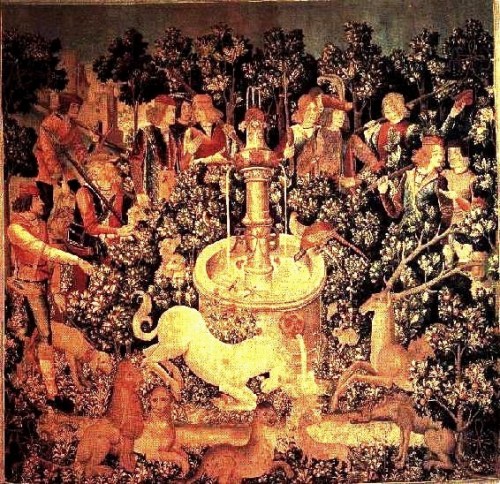
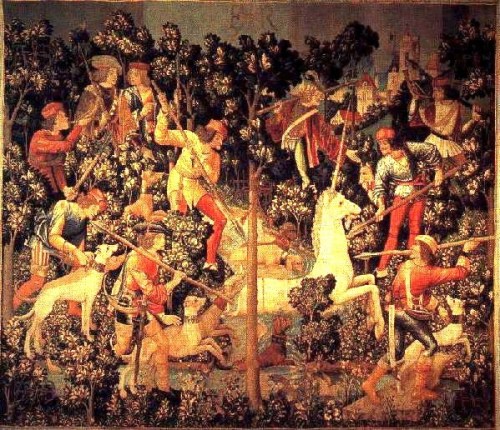
Photos of The Hunt: http://www.geocities.com/area51/corridor/5177/hunt.html.  I cannot figure out who is responsible for the site, but it lists an email address, amulet@geocities.com.  These photos are a bit darker than the tapestries; the photos on the Met’s Unicorn Tapestries site are much clearer and show the the color much better (but they cannot be dowloaded and are protected by copyright).  Here are the photos, in order.
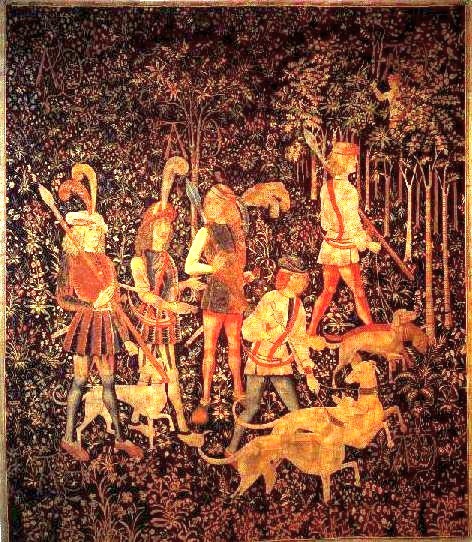
The start of the hunt
The start of the hunt

The unicorn is found
The unicorn is found

The unicorn at bay

The unicorn at bay

The unicorn leaps from the stream
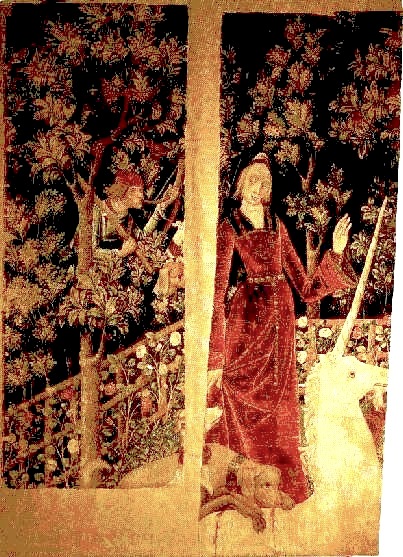
The unicorn leaps from the stream

The Maiden captures the unicorn
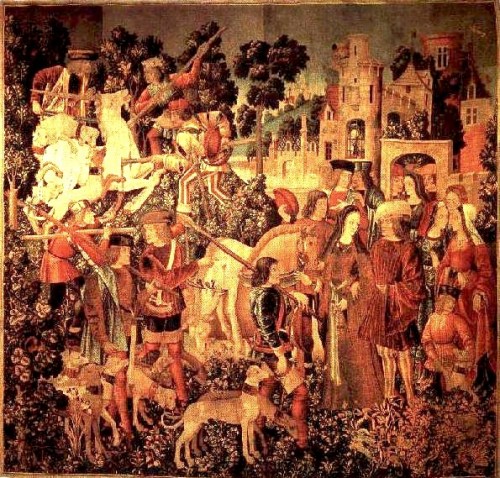
The Maiden captures the unicorn

The unicorn is killed and brought to the castle
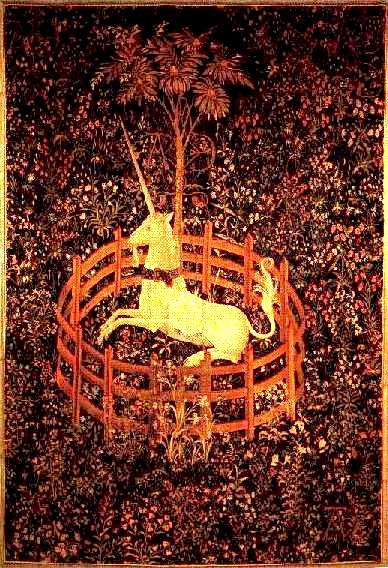
The unicorn is killed and brought to the castle

The unicorn in captivity
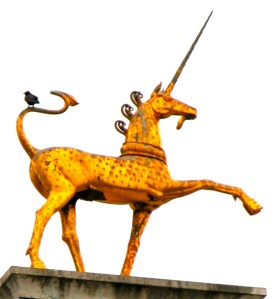
The unicorn in captivity

3 Comments

Filed under art, beauty, danger, death, love, myth

The truth and unicorns, part 1

unicorn-2

Unicorns are mythical creatures, but many people believe in them.  They don’t necessarily believe in the immanent possibility of seeing a unicorn on the street or in the woods any time soon.  They believe in believing in unicorns.

Myth speaks truth to reality, and the truth is that we need unicorns.  In the dialogue between myth and reality, we see the supposedly real world for what it really is:  impermanent, ever changing, mutable, a place that doesn’t have to be what it seems.  A place that isn’t really all that real, if by real you mean solid, concrete, tangible, or certain.

Without myth, the present is all we have (hello, Leonard Shelby).  Myth helps us to understand the world of now by freeing our dreams of worlds that might be, quite apart from whether or not they ever really happen.  Myth allows us the reveries of worlds lost, races won, loves cherished, sufferings endured.  Myth makes livable the stresses and oppressions of the moment.  Myth binds the present to the possible – the past that was, the past that could have been, the futures that may and may not come to pass, and the imaginary worlds that, without ever existing, will feed our passions and determine which future of the real world will, in fact, come to pass.

Myth is to our mundane world what relativity and quantum mechanics are to the world of Newtonian physics.  Newton’s laws work very well to explain the world of human-level sensory experience.  There’s a reason why an apple hits you on the head, and why every hanging apple on earth will do the same if you put a person under it at the right moment.  Newton explained the stuff we all see and helped us understand what was happening.  His laws extended our vision beyond the moment, predicting futures and explaining pasts.

Then came Einstein, whose Newtonian gaze extended much further than Newton could have dreamt, and in turn demanded a new reckoning.  With the theory of relativity, Einstein pushed our sight into the world of massive bodies – stars and galaxies – and the astronomical distances between them.  At the same time, Einstein’s discoveries also helped others (Max Plank, Neils Bohr, Erwin Schrödinger, and more) to gaze into the world of the infinitesimally small, smaller than the atom itself, and quantum mechanics was born.
The Unicorn in Captivity

The Unicorn in Captivity

At either end of the spectrum – the massive or the tiny – Newton’s laws don’t make sense, even though they explain the world in between quite well.  In relativity, things that happen now might occur before something that happened already, depending on where you’re looking from.  At the quantum level of subatomic particles like electrons and quarks, things can be in two places at the same time.  To believe in the physics of the massive, or of the tiny, is to suspend belief in the world we can see and touch.  And we can deal with that, because our minds constantly ask for more than what’s just beyond our noses.

This is why we have relativity, the 10 or 11 dimensions of string theory, the superposition of quantum particles, positrons and anti-matter, quarks, and unicorns.

Afternote: For a real treat on the marriage of design, art, and Isaac Newton, go to The Newton Project at the Dutch Art Institute.  Click on the artists’ names and see their designs.  My favorite is the one by Meiyu Tao.

Credits

Leonard Shelby:  See the post, “The truth and tattoos” and Memento.

Gold unicorn:  Norman Walsh, photographer, Bristol, England,  http://norman.walsh.name/2003/10/08/bristol.

The Unicorn in Captivity, from “The Hunt Tapestries,” Metropolitan Museum of Art, The Cloisters.  Image from:  http://www.geocities.com/area51/corridor/5177/hunt.html.

9 Comments

Filed under Albert Einstein, Erwin Schrödinger, ideas, Isaac Newton, Leonard Shelby, myth, philosophy, superposition

The truth and mirrors

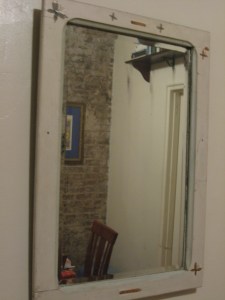
mirrorphoto

The eye of the beholder sees many things, and the beholder alone is the judge of what he or she sees.  The beholder sees beauty, or ugliness, or truth, or lies, and the beholder knows something.  The thing about eyes, however, is that they look out, not in.

Adam Smith, the great moral philosopher and economist, wrote that the solitary person “could no more think of his own character, of the propriety or demerit of his own sentiments and conduct, of the beauty or deformity of his own mind, than of the beauty or deformity of his own face.” The solitary person, in other words, can know little of himself – and so we need others.  “Bring him into society, and he is immediately provided with the mirror which he wanted [i.e. lacked] before.” This was key for Smith, for he believed that by considering the judgments and opinions that other people have of our actions, we achieve the basis of a moral society.

For Lou Reed, the mirror held the promise of love for those who couldn’t see their own beauty.

I’ll be your mirror
Reflect what you are, in case you don’t know …

When you think the night has seen your mind
That inside you’re twisted and unkind
Let me stand to show that you are blind …

I find it hard to believe you don’t know
The beauty that you are
But if you don’t let me be your eyes …

Michael Jackson took this a step further, hoping that the mirror could help a person look inside.

I’m starting with the man in the mirror
I’m asking him to change his ways …
If you wanna make the world a better place
Take a look at yourself, and then make a change

Jackson’s use of the mirror was a kind of solipsistic (or maybe just plain lonely) version of Freud’s:  “The doctor should be opaque to his patients and, like a mirror, should show them nothing but what is shown to him.”

But mirrors are tricky.  They are passive reflectors.  Place a lie in front of a mirror, and you will see only a lie.  Mirrors confuse and when combined with smoke, serve to hoodwink and swindle people out of the truth and what is real.  The mirror, a hoped-for source of truth, gives the world to magicians and con artists.

In the Middle Ages, ambitious politicians and intellectuals wrote books called Mirror of Princes, in order to curry favor and win state positions by writing about how a real prince could reflect the qualities of an ideal prince.  An elaborate form of flattery, it was a way to get a job, but the Mirror of Princes literature was a corrupt thing, the falsification of what mirrors were supposedly created for.

Machiavelli exploited the lie of the Mirror of Princes to write the definitive satire of political philosophy, The Prince, seen only in its reverse-mirror image of “Machiavellian” self-interested intrigue, deception, and cruelty.  Machiavelli wrote his satire only too well, and his republican and democratic self has been lost to history (except for the community of political theorists, who are a small community indeed).  Machiavelli was a good guy, who survived torture and other awful events for his commitment to democratic republicanism.  Such is the danger of playing in front of mirrors.

In The Lady from Shanghai, Orson Welles created the classic mirror scene, in which his central characters meet in a fun-house mirror maze and proceed to have a shootout amid the dozens of reflected images of themselves.  Just who would kill whom is a matter of luck, but both Everett Sloane and Rita Hayworth are mortally wounded, and their stupidity allows Michael, played by Welles, to walk away free.  The beauty of the scene consists in the way that the mirrors only serve to reflect the hubris of everyone involved, amplifying the conclusions that one might have hoped to see.

Mirrors can show us only what we put in front of them.  Our fun-house mirrors create images that satisfy and mollify at the expense of the truth.  We use mirrors to convince ourselves that we can see objectively, when we’re only seeing what we want to see.  Francis Bacon observed that “… human understanding is like a false mirror, which, receiving rays irregularly, distorts and discolors the nature of things by mingling its own nature with it.”

IMG_1601There are mirrors, and then there are fun-house mirrors, and then there are false mirrors.  Mirrors can’t solve our problems or help us find the truth.  Only honesty can, and that’s a thing apart from mirrors.  Don’t seek the truth in a mirror.  Close your eyes and seek the truth within.  You may not see it, but you may find it.
Credits

Adam Smith, The Theory of the Moral Sentiments, in The Essential Adam Smith, ed. R. Heilbroner (New York:  W. W. Norton, 1986), p. 101.

Lou Reed, “I’ll Be Your Mirror,” recorded by the Velvet Underground and Nico in 1967.

Michael Jackson, “Man in the Mirror, Bad, 1988.

Francis Bacon, Novum Organum, Aphorism 41.

7 Comments

Filed under existentialism, fiction, life, love

The truth and fiction

books2

They say that the truth is stranger than fiction.  This is true, but meaningless.  The truth may be strange, indeed, but good fiction is compelling.  That’s what makes fiction more real (or more true) than the truth.  Fiction speaks to you in ways that the truth never will.  The real question is not whether something is truth or fiction, but rather how good it is, either way.

Note for the concerned, erudite, elite, and critical:  Not all fiction is truer than truth.  Only the best fiction is, but we’re not talking about bad fiction here.  Danielle Steele fits here as good fiction.  And Nora Roberts.  There are good reasons to read DS and NR and James Joyce and Thomas Pynchon.  Good fiction is better than truth at helping us understand what is and isn’t true in the world.  [See my quote from Kafka in the quotes section of the blog.]

This is why poetry and fiction are utterly essential to life as we know it.  The arts make life possible, because only through the arts do we understand how we live together, relate to each other, learn from each other, and build the wherewithal to fall and love (or lust) and propagate the species.  This is because the arts are all about that one central feature of humanity that allows us to be who we are:  narrative.  Not mere communication, the narrative is a story, meta-communication with backstory, protagonists, antagonists, beginnings, middles, ends.  Narrative is the essence of being human.

So what happens when we use narrative to relate something that really happened?  We all know the old telephone game, and social science verifies in no uncertain terms how deeply flawed narrative is as a way to communicate what really happened, how it happened (which unfortunately stands in for “truth” with lots of people).  Eyewitness testimony, it turns out, is an awful way to find the truth and bring people to justice.  People remember what they want to remember and tell you the story that’s important to them.  As a teacher and trainer of interviewers and researchers I am adamant:  The worst way to find out about something is to ask about it directly.  That’s because everything we say (including this very post) is really about doing some specific emotional work for the speaker.

This is a key concept:  emotional work.  Our stories have a two-fold nature.  They convey information, but because we’re usually invested in that information in important personal ways, we tell our stories in ways that satisfy important personal needs.  This creates a paradox of truth and fiction, however, because it makes some truths utterly false and irrelevant, and much fiction important, compelling, and utterly true.

IMG_2221

The paradox of truth and fiction is revealed in James  Frey’s   story with Oprah – how he “embellished” his memoir, A Million Little Pieces, to the point at which is was less memoir than perhaps creative non-fiction or even a novel “based on a true story.”  It’s worth noting that Frey did try to offer the work as a novel when he started out.

I never read A Million Little Pieces.  I read My Friend Leonard, the sequel.  I was deeply moved by Frey’s writing and admit I was choked up at the end of Leonard.  Frey’s writing style was gripping and compelling and the story he told was true in ways that deeply connected with so many readers.  Frey’s work holds up, no matter how embellished it is.

When the truth becomes shrill, does it really matter?

When fiction speaks the truth, it surely does.

5 Comments

Filed under art, fiction, James Frey

The truth and us

zebras-1

There’s no one else just like you.

That’s right – your fingerprints, your DNA, your handwriting, the way you walk, and so on – all this is distinctly original.  Our brains are hardwired to discern the smallest features that distinguish one face from another, so that we never forget a face, even at a distance.

Then again, on another level, there are a lot of people just like you.  Most people, in fact.  Look at the diagram of the bell curve.

normal1

In the middle of the curve is the average, also called  the “mean.”  68% of people tend to be clustered closely around the average – within one standard deviation, as it is called.  This is true of anything that is randomly distributed – height, IQ, athletic abilities, some behavioral characteristics, and much more.  Most of what your we think of as unique is, in fact, randomly distributed and subject to a whole set of scientific laws that we’ll never be able to change.  Indeed, the illusory character of uniqueness is captured perfectly by the term standard deviation.

Go out two standard deviations from the mean, and you have accounted for about 96% of all people.  The people who really make things happen lie in the “tails,” two standard deviations or more out from the mean.

The territory of the tails, on both sides, includes the super-geniuses and super-morons, the saints and sociopaths, the superstars and the ne’er-do-well’s.  Each tail has about 2% of the population, which means that about 4% of people are truly unique.  Only one of the tails contains the people that are usefully unique; the other contains the 2% who must be institutionalized or monitored in some important, and usually costly, way.  In a lot of ways, parents playing the odds just might hope their kids are more like everyone else than not.

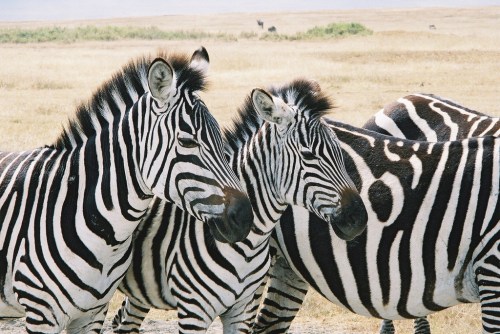
Think about it this way:  all leopards have spots, and no two leopards have the same spots.  The same goes for zebras and their stripes.  Penguins can distinguish the call of their mate from among thousands of squawking birds in the colony.  But they all look and sound the same to me, and they’re all beautiful, too.

Maybe the same goes for us.  What do the zebras see when they look at a crowd of people?

It’s great to be yourself, an individual, someone with special talents.  But every once in a while, it’s good to celebrate what we are just as much as what I am.

__________

Credits:  Photo of zebras, being all different from each other:  http://animalphotos.info/a/topics/animals/mammals/zebras/.

Graphic of normal curve and distribution by http://classes.kumc.edu/sah/resources/sensory_processing/learning_opportunities/sensory_profile/bell_curve.htm.

6 Comments

Filed under individuality, life, normal distribution, statistics

The truth and angels

img_14902

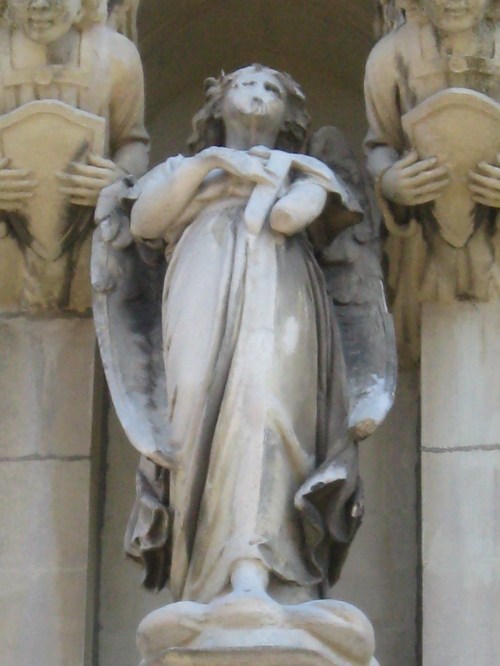
Angel with dark wings

She used to come when I got scared, talk to me a bit
Lay real close and touch my hair, bring me warm milk and tears
Tell me there’s nothing to fear, kiss me, call me Johnny dear
Made me believe

I told her I would be alright, if I could see the end
I was afraid to close my eyes, asked her if it was a dream
Asked if she would come with me, she said, “baby, we’ll see”
When we got better

But in the end, who was helping who?
Who was really blue?
Who needed just to break on through?
Get out of here and fly away?
My angel with dark wings

I tried to find her a gift, I was thinking about her smile
Couldn’t find nothing that fit, something was out of place
Something she could never name but everyone could feel the shame
Settle in the room

And in the end, who was helping who?
Who was really blue?
Who needed just to break through?

Oh, in the end, I couldn’t say good-bye
To her reasons and her rhymes, all the things behind her eyes
My angel with dark wings

There’s a secret that I know, something that we shared
And I’ll never tell a soul, won’t open up my heart
Show the world the blackest parts, where she reached deep and far
And showed me how to live

Oh, in the end, who was helping who?
Who was really blue?
Who needed just to break through?
Get on out of here and fly away?
My angel with dark wings

__________

Credits and story:  About a year ago, I watched a video of a band called Seether.  The song was called “Broken,” and the video featured Amy Lee, of Evanescence, as an angel with charcoal colored wings.  I was hit by the image and picked up my guitar.  I turned the sound off and started to play some chords and just put words in the air.  Soon enough, a few lines became a verse, and then an image popped into my mind:  the story James Frye told in the book, My Friend Leonard, about Lilly, the woman he fell in love with while in rehab.  The story affected me deeply, and watching Amy Lee in those charcoal wings brought it back to me vividly.  From that moment on, the song wrote itself.

All the pictures in the video are photos I have captured over the last several years in my neighborhood and world.  I put them together to tell a sort of story.

3 Comments

Filed under Amy Lee, death, freedom, James Frey, love, Seether

Truth and sleeping dogs

img_1353

Truth is a sleeping dog.

Truth is in the details.

Truth is a black-light poster in the valley of darkness.

Truth is a symptom of consciousness.

Truth is fear itself.

Truth is the ballad of Echo and Narcissus.

Truth is the other shoe.

Truth is the uncertainty principle.

Truth is a mirage.

Truth is other people.

Truth is superposition.

Truth is the fruit of the tree of the knowledge of good and evil.

Truth is an oasis.

Truth is a fetish.

Truth is just another word for nothing left to do.

Truth is anisotropic.

Truth is a sandcastle.

Truth is absolutely necessary without necessarily being absolute.

Truth is the essence of dissolve.

Truth has fallen in the forest.

Let the truth lie.

__________

In memoriam: Duke, 1999 – April 5, 2009.  He was a really good dog.

img_1340

100-0010_img

15 Comments

Filed under Duke, existentialism, superposition

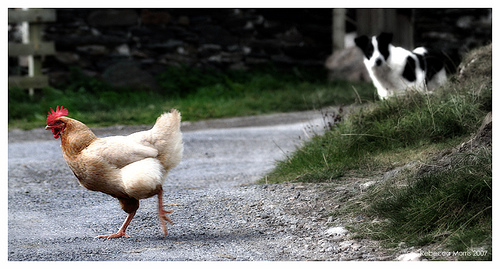
The truth and chickens

chicken

Which came first, the chicken or the egg?

Why did the chicken cross the road?

The first question is impossible to answer according to the ordinary laws of humanly observable nature.  This makes the second question all the more difficult, since we cannot answer it unless we discern whether it was the chicken, or the egg, that crossed the road in the first place.

Like Kafka, chickens have provoked controversies over some very important issues.  And, as with Kafka, the answers to these questions become harder and harder to find the deeper we get into the mundane circumstances of the chicken’s world.  Their lives are a maze of small doors and windows followed by a short plunk on the head in the service of something they will never understand.  They know not who their warders are, and their warders won’t even call the chickens (or the eggs) by name.

Note:  Cage-free chickens, their owners, and their consumers comfort themselves in the thought that these “free” chickens have been spared the Kafkaesque world of their cousins, but they haven’t – and you don’t need to be Sartre to see through this fowl illusion.  Their maze is just bigger and harder to see.  This will become apparent when free chickens reach a road.

The explanation provided by quantum mechanics is mathematically elegant and scientifically consistent, even if it’s at odds with the observable universe:  The superpositioned chicken and egg coexist in perfect harmony until the very moment you attempt to answer the question.  Then you have trouble, because the question forces you to put one thing before the other when in fact their natural state is to coexist in perfect, yet completely reasonable, contradiction.  The superpositioned chicken is both egg and chicken, and it is on both sides of the road at the same time.

This is the paradox of Schrödinger’s chicken.

__________

Credit: http://animalphotos.info/a/, photo of chicken crossing road with Schrödinger, or possibly Kafka, disguised as a dog, watching in the background.

Inspiration:  http://maghanlusk.com/category/exploration/, “Are You and Antiterminalist?”

See also:  “Schrödinger’s cat”

3 Comments

Filed under danger, Erwin Schrödinger, existentialism, Franz Kafka, freedom, Jean-Paul Sartre, superposition

The truth and love

htr_mrlincoln3

I love you.

We fall in love, declare love, make love, and do crazy little things for love.  We search for love in all the wrong places and find the most incredible fulfillment in even the slightest glimpse of love in our lives.  The trouble with love is that, like the truth, love creates its own parallel universes of contradictory meanings and motives.  Lovers create worlds of intoxicating beauty and lasting contentment, but lovers do things that threaten to destroy love altogether.  Why is it so much easier to reveal our secrets and anxieties to strangers, rather than just tell the one we love?  By the time we can let it out, it’s all too much.

An old pop standard put it like this,

You always hurt the one you love
The one you shouldn’t hurt at all
You always take the sweetest rose
And crush it till the petals fall

You always break the kindest heart
With a hasty word you can’t recall
So If I broke your heart last night
It’s because I love you most of all

Love is the moral equivalent of the superposition of quantum particles – this is the phenomenon in which a small particle, like an electron, seems to be doing two contradictory things at once.  Like an electron, love spins right-side up and upside down all at the same time, and any attempt to know what is going on collapses its ability to be two things at once.  And if it’s not both things at once, it’s not quite the love we desire.  Love is always and everywhere on the precipice of its own demise, the strongest trust suddenly shattered by the right amount of pressure in the right place, the right place being that fault line we’re never really aware of.

The trick with love is to know when to leave well enough alone.  None of this means that love is doomed, or that love isn’t beautiful all on its own.  It is beautiful.  Love moves us, but like Heisenberg, we find that knowing one thing about love essentially blinds us to some other quality that will catch up with us later.

Like love, the truth requires us to remember that beyond the words we say, something else is always implied, even if we can never know what it is until we’ve lost something else.  To bring truth into relationships requires us to remember that contradictions are no mere accidents.  Contradictions – in principles, thoughts, words, or actions – are the substance of the truth and par for the course in the truth of love.

Truth dares us to learn how to heal.  Love dares us to be vulnerable, to be open, and to live without knowing everything about the one we love.  Love is a dangerous beauty, as another well-known song records it,

Some say love, it is a river
that drowns the tender reed
Some say love, it is a razor
that leaves your soul to bleed

Some say love, it is a hunger
an endless aching need
I say love, it is a flower
and you its only seed

At the end of the day, love and truth challenge us to be open to the greatest rewards, in spite of any risk.

Credits:  Allan Roberts and Doris Fisher, “You Always Hurt the One You Love,” sung by many, among other Clarence Frogman Henry and Ringo Starr

Amanda McBroom, “The Rose,” made most famous by Bette Midler

http://www.flowerpictures.net , rose photo.

10 Comments

Filed under beauty, Bette Midler, Clarence Frogman Henry, danger, love, superposition

The truth and living well

There are three simple steps to living well.  They are:

  • Do something
  • Expect nothing
  • Get everything

The fine print:

Step one: The truth of our lives is in our actions.  Simply put, we are what we do, and attempting to flee from our actions won’t help anyone.  Thoughts, visions, dreams, and internal reckonings are necessary elements of action, but alone they don’t suffice.  The truth is that words (and thoughts and dreams, etc.) are cheap, but be sure to choose well what you do, because regrets come cheaply, too.

Step two: If you’re a receiver in a football game, and you’re running for a pass, do what you need to catch the ball and don’t think about what will happen next.  If you think about anything but catching it, you’ll drop the ball, even it hits you in the chest.  Same goes for trying to catch a fly in baseball, or in the kitchen, for that matter.  Or shooting hoops.  Or writing something great – if you spend your time thinking about what this contribution to thought and science will get you, then you’ll produce something that will get you nowhere.  When you take your eyes off what you’re doing in order to see what’s around, what to expect, what dangers or bonuses are lurking in the environs – when you start thinking about what you might get – you’ll stop doing (see step one) – and you’ll mess it up.

Step three: You can now experience what happens when everything – in this case nothing – contains its opposite and you reap your reward.  The reward is everything, but like truth, this comes with some unspoken qualifiers that actually make everything, in this case, much more rich and interesting.  Get everything that you truly need. The Rolling Stones’ song is quite right, but there’s even more at stake.  Get everything that you truly need, because anything else is too much and will kill you. Which implies the following sub-step:  Don’t take everything you get. Too drastic?  Abundance is the wellspring of dead-living.

True riches come to us without asking.  They are in the things we cannot see, prove, or make tangible in any permanent way.

4 Comments

Filed under riches