Category Archives: philosophy

The truth and money

The truth is that money is often a divisive influence in our lives.  We keep our bank balances secret because we worry that being candid about our finances will expose us to judgment or ridicule—or worse, to accusations of greed or immorality.  And this worry is not unfounded.

Jenny Offill and Elissa Schappell, Money Changes Everything (New York:  Doubleday, 2007), p. xi

Brooklyn Reading Works:
The Truth and Money

On April 15, 2010, the Brooklyn Reading Works will present its monthly writers’ program on “tax day.”  This happy accident, observed last summer in a casual conversation over coffee with Louise Crawford, resulted in the idea for a panel called “The Truth and Money,” a reading and Q & A with three authors whose work has taken on money in some significant way.

Our three panelists are:

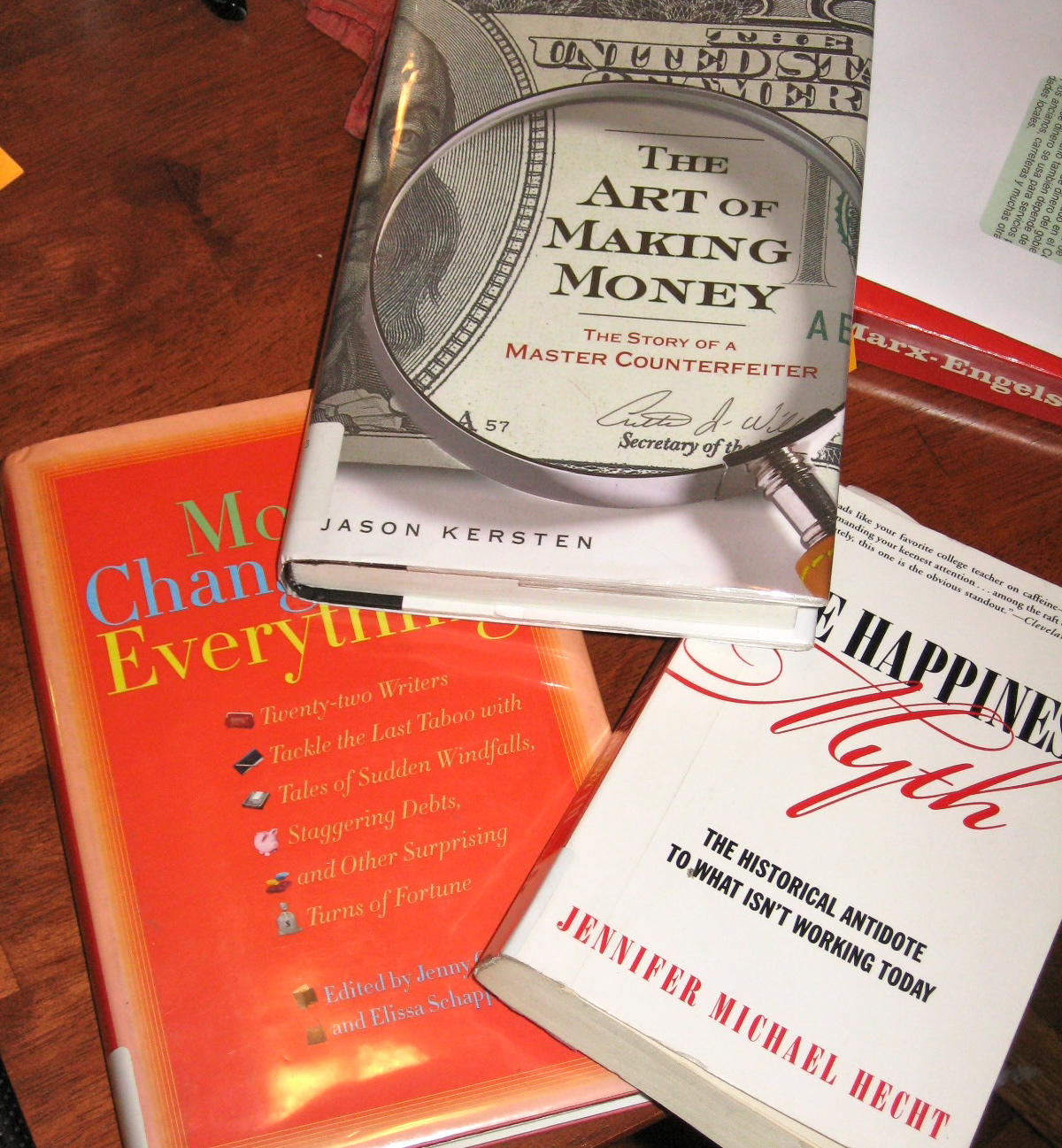
Elissa Schappell, a Park Slope writer, the editor of “Hot Type” (the books column) for Vanity Fair, and Editor-at-large of the literary magazine Tin House. With Jenny Offill, Schappell edited Money Changes Everything, in which twenty-two writers reflect on the troublesome and joyful things that go along with acquiring, having, spending, and lacking money.

Jennifer Michael Hecht, a best-selling writer and poet whose work crosses fields of history, philosophy, and religious studies.  In The Happiness Myth, she looks at what’s not making us happy today, why we thought it would, and what these things really do for us instead.  Money—like so many things, it turns out—solves one problem only to beget others, to the extent that we spend a great deal of money today trying to replace the things that, in Hecht’s formulation, “money stole from us.”

Jason Kersten, a Park Slope writer who lives 200 feet from our venue and whose award-winning journalism has appeared in Rolling Stone, Men’s Journal, and Maxim.  In The Art of Making Money, Kersten traces the riveting, rollicking, roller coaster journey of a young man from Chicago who escaped poverty, for a while at least, after being apprenticed into counterfeiting by an Old World Master.

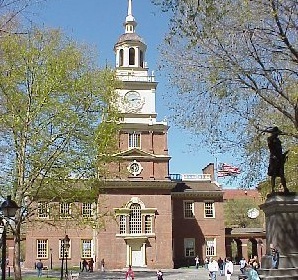
Please join us for the event at 8:00 p.m. on Thursday, April 15, 2010, at the Old Stone House in Washington Park, which is located on 5th Avenue in Park Slope, between 3rd and 4th Streets, behind the playground.

Read about all the Brooklyn Reading Works events at Only the Blog Knows Brooklyn and the BRW website.  For info on the Old Stone House and its role in the Battle of Brooklyn (1776) and contemporary life in Park Slope, go here.

Many thanks from all of us at Truth and Rocket Science to Louise Crawford, of Only the Blog Knows Brooklyn, for making this possible.

Money, It’s a Gas

The subtitle on the cover of Elissa Schappell’s book says everything you need to know about the stories within:  Twenty-two writers tackle the last taboo with tales of sudden windfalls, staggering debts, and other surprising turns of fortune. “The last taboo” is how Schappell and her co-editor, Jenny Offill, characterize our behavior when it comes to money, because nobody really wants to talk about it.

People are secretive and embarrassed—for having too little, or too much, or something to hide about the reasons either way.  In a country where everyone seems to have a story of how they, or their parents or grandparents, used to be poor, any personal narrative but “hard work” is out of the question.  Even hardened criminals revel in detailing the blood, sweat, and tears that go into their “work.”  No one, it seems, can sit back and say with no embellishment or apology, “I got lucky, that’s all.”  Money is the measure of what we deserve, and in our society what we deserve is in some sense who we are.

In The Happiness Myth, Jennifer Michael Hecht seeks to disentangle why things that are supposed to make us happy frequently don’t.  To the notion that “money doesn’t buy happiness,” she shows that it does, to an extent.  For most of human history (and pre-history), people have lived in conditions of terrible, frightening, life-threatening scarcity that money in no small part has eradicated for all but a very small fraction of Americans.  (In line with Schappell’s notion of money-taboo, I now feel the urge to apologize and state something statistical about hardship and inequality in America, but I won’t.  We deserve ourselves and all of our money issues.)  Hecht writes,

“We need to remember that most people through history have been racked by work that was bloody-knuckled drudgery, the periodic desperate hunger of their children, and for all but the wealthiest, the additional threat of violent animals.  Nowadays a lot of what we use money for is a symbolic acting-out of these triumphs.”

Once out of poverty, in other words, what we do with money—or more precisely the things we feel when using money—have a lot to do with ancient urges and inner conflicts that endure in our minds, bodies, and culture across time and without, so it seems, our self-conscious awareness of them.  Money does buy happiness, up to the point we’re out of poverty, and then the real problems begin.

Like the craving for fat and things that are sweet, the urges we satisfy with money are deeply embedded in our being, fundamental to the way we evolved in the most far-away places and times.  It’s all fine and easy to understand or forgive, but we all know what happens when you eat too many doughnuts.

Doughnuts to Dollars

Yet money is not like a doughnut.  This we all know—money isn’t some thing, it’s just some non-thing you use to get doughnuts or whatever else you think you need.  The economists’ word for this quality is fungible.  Adam Smith introduced money in his great book on wealth by reviewing the things that societies have used for exchange measures over time, including cattle, sheep, salt, shells, leather hides, dried codfish, tobacco, sugar, and even “nails” in a village in Scotland that Smith knew of.  All this was terribly inconvenient, and Smith noted that the use of precious metal as a stand-in for things of value constituted a considerable advance—

“If, on the contrary, instead of sheep or oxen, he had metals to give in exchange for it, he could easily proportion the quantity of the metal to the precise quantity of the commodity which he had immediate occasion for.”

Money in this sense becomes nothing but a means of measurement, and it would be perfect indeed if money’s effects on the world ended there, but we all know that they don’t.

Money—as Elissa Schappell and Jenny Offill, Cyndi Lauper and conventional wisdom tell us—changes everything.  Money’s magical qualities go well beyond simple notions like greed.  Money’s powers are existential, transformative, and really weird.  Money makes us into things we are not.  Karl Marx was pretty blunt about this—

“Money’s properties are my properties and essential powers … what I am and am capable of is by no means determined by my individuality.  I am ugly, but I can buy for myself the most beautiful of women.  Therefore I am not ugly, for the effect of ugliness—its deterrent power—is nullified by money.  I, in my character as an individual, am lame, but money furnishes me with twenty-four feet.  Therefore I am not lame.  I am bad, dishonest, unscrupulous, stupid; but money is honored, and therefore so is its possessor.  Money is the supreme good, therefore its possessor is good.  Money, besides, saves me the trouble of being dishonest:  I am therefore presumed honest.  I am stupid, but money is the real mind of all things and how then should its possessor be stupid?”

Marx may have fallen short as an economist, but then again so do most official economists.  In terms of money’s most basic ontological properties, however, it’s worth noting that he got money right.

The Glow

In the story of master counterfeiter Art Williams, Jason Kersten tells one such story of how money changes people, their values, and the truths that bind them together.  Art’s counterfeit was of an extraordinarily high quality, and its effect on people was fascinating to behold.  Art called it The Glow—“They would get this look on their face … a look of wonder, almost like they were on drugs.  It was like they were imagining the possibilities of what it could do for them, and they wanted more.”

Like the anonymous subjects of history in Hecht’s writing (note:  that’s us), Art wanted something that money, or the lack of it, had apparently stolen from his life.  Art’s “pursuit had very little to do with money, and the roots of his downfall lay in something impossible to replicate or put a value on.  As he would say himself, ‘I never got caught because of money.  I got caught because of love.’”

So where does money get us?  It’s easy to tell stories of money and doom, but we all know that without enough of it we’d be unable to do anything we need to do, let alone the supposedly unnecessary things that seem to make up for the drudgery of a life built upon doing the things we need to do.  Is the grubbiness of money as it comes off in the Pink Floyd song all there is to it?  Or is there more?

Join us on April 15, after affirming the give-away of twenty-eight percent (for most of us) of your annual harvest.

Questions:  jguidry.7@gmail.com or 212.729.7209.

Credits and Notes

Many thanks to Louise Crawford for inviting me to curate the Tax Day BRW panel, through the Truth and Rocket Science blog.  A sincere debt of gratitude, not to mention late fees, is owed to the Brooklyn Public Library, for enabling my research and inquiry into this topic.  The BPL’s copies are indeed those photographed on my dining room table to lead the blog post.

Jenny Offill and Elissa Schappell, Money Changes Everything (New York:  Doubleday, 2007).

Jennifer Michael Hecht, The Happiness Myth (New York:  Harper One, 2007), p. 129.

Adam Smith, The Wealth of Nations, in Robert L. Heilbroner, ed., The Essential Adam Smith (New York:  W. W. Norton, 1986), p. 173.

Karl Marx, Economic and Philosophic Manuscripts of 1844, in Robert C. Tucker, editor, The Marx-Engels Reader, 2nd ed. (New York:  W. W. Norton, 1978), p. 103.

Jason Kersten, The Art of Making Money (New York:  Gotham Books, 2009), p. 152 (first quotation) and p. 4 (second quotation).
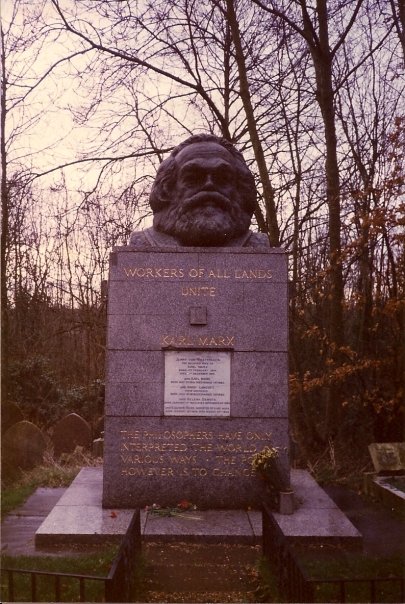
Photo Karl Marx’s grave, Highgate Cemetary, London, taken by the author in January, 1994, while on layover on the way to South Africa and its historical elections later that year.


5 Comments

Filed under Adam Smith, art, beauty, body, freedom, ideas, individuality, love, money, myth, philosophy, riches, truth, vanity

E/F – the glass of knowledge

halfglass-apple-1

E.  “. . . the eyes of both of them were opened, and they realized that they were naked . . .”   Genesis 3:6

F.  “A little learning is a dang’rous thing;
Drink deep, or taste not the Pierian spring:
There shallow draughts intoxicate the brain,
And drinking largely sobers us again.”

Alexander Pope, “Essay on Criticism,” ll. 215-18

For some, knowledge leads down the path to hubris, a “revenge of the intellect” as Susan Sontag warned (ironically, some might say) in “Against Interpretation” (1966).  For others, knowledge is the source of enlightenment.  Know thyself:  as inscribed on the Temple of Apollo at Delphi and lived by Socrates, for whom the knowledge of anything was only as good as its limits.

However we look upon knowledge or follow where it leads, it’s almost certain we’ll wind up somewhere never intended, with consequences for good or ill that we may barely understand.  Such is the way of truth.

The glass and St. Rita’s Church

The tumbler is half-filled with Apple and Eve apple juice, all natural, no added sugar, of unknown yet possible relation to the juice of the apples of the tree of the knowledge of good and evil.  At least that’s what I take away from the company’s name.

The etching on the glass is of St. Rita’s Church, Harahan, which was founded in 1950 by Monsignor Roy Champagne, who was a young priest at the time.  The tumbler was part of a larger set created in 2000 for the parish’s 50th anniversary.

I went to St. Rita’s school from the fourth through seventh grades, and Fr. Champagne (he wasn’t a Monsignor yet) was still walking the grounds with the children and saying mass on Sundays.  I attended church there until I left my parents’ home in 1986.  For many years, I performed with, and then led, the youth choir.  My son was baptized at St. Rita’s.  I now attend St. John’s Episcopal Church in Park Slope, Brooklyn, but St. Rita’s is a cherished part of my life.  It is a place I return to from time to time, to walk in the past and present, and to reflect on the lessons of knowledge and ignorance in my own life.

The desk and a dual journey from Michigan to Illinois

The tumbler was photographed on my desk, a sturdy workshop piece in the Mission Style, dating from the 1920s or 1930s (I am guessing here).  I bought it in Rock Island, Illinois, in 1997 for $100.00 in rough but usable shape.

IMG_3245

a sturdy writing companion

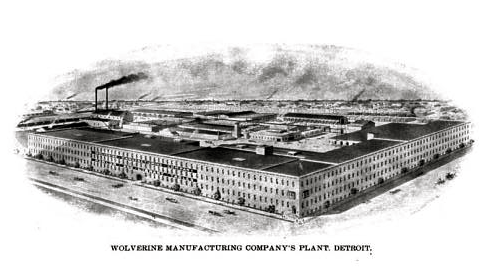
The desk was made in Michigan, by the Wolverine Manufacturing Company of Detroit.  The company was organized in 1887, according to the tag, and at least this one desk is still going strong.  Wolverine Manufacturing was one of the historical suppliers of parlor and other furniture in the Arts and Crafts style.  I wonder sometimes at the happenstance (some might say magic) by which I took a similar route from Michigan, where I obtained my doctorate in 1996 from the university in Ann Arbor, to Rock Island, where I began my first teaching appointment the same year.

Almost everything that has been posted in truth and rocket science was written at this desk.

Notes and credits

The photos of the tumbler and the desk were taken by the author.

This image of the Wolverine Manufacturing Plant was taken from the State of Michigan’s Twentieth Annual Report of the Bureau of Labor and Industrial Statistics (Lansing, 1903), as found on Google Books.

Geotag: St. Rita’s is at 7100 Jefferson Highway, Harahan, Louisiana, 70123.  St. John’s Episcopal is at 139 St. John’s Place, Brooklyn, New York, 11217.

2 Comments

Filed under beauty, ideas, knowledge, Park Slope, philosophy, truth, youth

The truth and amoebas

The mighty amoeba

Your body isn’t your own,
exposed for all it really is:
permeable, full of holes,
part of the world.
A floating thing tossed and spit
on tumbling water not always clear,
you become home to others,
little animals here
at play in the world.
You could be a tree, or grass, under
tiny feet that make no sound of their own,
their steps heard in quickened heartbeats
and restless groans
that shake the world.
You’re full of holes that leave
you open, a window lost of glass,
panes rattling, short of breath,
waiting, waiting, hoping to pass
this sense of a world
stumbling moments from death,
moments from life.

____________

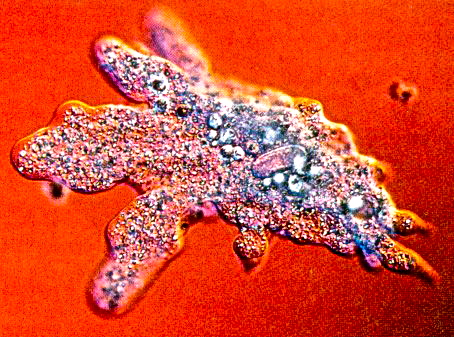
The name of the poem is Sickness.  I wrote it in Belém in February of 1993, as I was coping with the onset of amoebic dysentery.  It was rather a rough time, and this, the worst and latest in a cascade of different ailments since my arrival in Brazil the previous November.  I was adjusting to my new home, I told myself, but I began to re-conceive my relationship to the world.  Except for a bout of the flu at age 9 and a one-day bug at age 13, I’d never been seriously ill in my life.  When I met the amoebas, my body-as-fortress gave way to a new understanding of myself as a being in the world, no different really than a bug, participating in the world along with all the other creatures of existence, open to all those creatures, part of the landscape.  In the world – the amoebas helped me understand Heidegger and Sartre.

We’re all part of the landscape here, guests of each other, parts of each other.  Somewhere in the human genome, shot through my body and yours, there is DNA that we inherited from a common of ancestor with amoebas.  According to Richard Dawkins in his lovely The Ancestor’s Tale, our most recent common ancestor (MRCA in biospeak) would have existed between about 1.3 and 2 billion years ago.  This being, some kind of single-celled thing, would have eventually given rise to amoeba and other protozoans, in one evolutionary path, and the things that became plants and animals on another path.

Most recent common ancestor, collapsed tree

All creation is locked in struggle for the limited energy of this world.  This struggle produces rainforests when so many beings stretch to outdo others in an effort to trap the sun.  The struggle produces abundance as well as scarcity, cooperation as often as annhiliation, and a long-standing collaboration between us humans and the hoards of friendly bacteria (and even some amoeba) that live inside our bodies and help us be “human,” as it were.

Notes and Credits

A really interesting article about amoebas can be found here, by Wim van Egmond, and it includes really great photos of amoebas in action.  The photo of an amoeba at the beginning of this posting is taken from the site, Helpful Health Tips, which discusses the causes and treatments for amoebic dysentery.  More detail on the different kinds of amoebas can be found in this piece on Innvista.  Getting past dysentery meant mountains of Flagyl and a lot of examinations and tests, not only in Brazil but also after I got back to the US in 1993 and in 1994.  I never was the same again, but then again, were we ever?

When I was looking around the web for amoeba-related sites, photos, and such, I came across this company, Rogue Amoeba Software, LLC, and it’s blog.  It has nothing to do with this post specifically, except that it’s a very cool name for a company, and especially suggestive for a software firm.  Our computers and their software are, like our bodies, permeable, full of holes,
part of the world
.  We’ve made information systems in our image, both on purpose and by accident, just as it was presumed by some we ourselves were made.

4 Comments

Filed under ageing, body, brasil, Brazil, entropy, existentialism, life, philosophy, truth, vanity, youth

The truth and the still

Parintins, Brasil 1993

The still photograph is not so still.  The photograph asks questions.  It suggests a story.  It presents an idea in a language without words.  It is even as it signifies. Video killed nothing, and the still photograph survives (even as the radio star carries on).  Unlike video, you can take the still photograph in.  You have a role in your experience of the photograph.  It speaks to you at a speed that you can handle, that doesn’t overwhelm, that invites your participation and imagination.  You can look into its nooks and crannies and seek out all it has to offer.  All this at your own pace, and for your own reasons.

Snow on Sterling Place, Brooklyn 2005

The still photograph is a water that runs deep.  If it seems to sit there, that’s its charm.  The still makes you active, because it’s impossible to just look.  Indeed, that’s the point, and all the while the still is not nearly inert.  It just moves differently, at a different pace, like a tree.

Detail of a rock on the beach, Long Island Sound, 2009

You fill the stillness with motion, the silence with voices.  You hear these people, feel the breeze come across the flowers, sympathize with a long face or smile with happy eyes.  Or you imagine the immediate suspension of all motion and noise and concentrate on only the image and the miracle of capturing time itself.

Intensity . . .Prospect Park, Brooklyn, 2009

Video?  Its harsh, grating noise, the motion too fast to keep up with – video steals your ability to think about what you’re seeing and replaces your mind with its own images.  The difference between the still photograph and video is the difference between democracy and dictatorship.

Fixing the sidewalk, Prospect Park Parade Grounds, Brooklyn 2009

Notes and Credits

On December 15, 2009, I had the opportunity to hear two award-winning photographers, Lynsey Addario and Damon Winter, discuss their work at the Museum of the City of New York.  After the panel discussion, one member of audience asked them if they were experimenting with video, given the prominence of video on the Web and current developments in social media and journalism.  Of course they were interested, but they were still committed to the still photograph.  That’s what got them aroused in the first place, and the still continues to drive them today.  Moderater Kathy Ryan, photo editor for the NYT Magazine, chimed in that photos are still much more popular than videos on the Magazine’s website, perhaps because the photos allow the viewer to control what they are seeing.  So that got me thinking . . .

Sidewalk fixed, December 2009

All the photos featured in this post were taken by the author.  Go back and double-click them to see a larger view.  Enjoy.  If you want to see some interesting and incredible photos by others more talented and adept with shutters than I, check out the work of some friends at T’INGS, Chloe, and the No Words Daily Pix on Only the Blog Knows Brooklyn.

Astor Place, New York 2009

6 Comments

Filed under art, beauty, Brazil, freedom, ideas, journalism, life, media, Park Slope, philosophy, politics, truth

The truth and Brasília, 1: Land of the Future

zweig

This series of posts springs from three sources.  First, my research for “The truth and change,” recalled the poem Brasília, by Sylvia Plath.  Second, I have lived in Brazil for long periods of time and consider Belém, the “cidade das mangueiras” at the mouth of the Amazon River, as my second home town.  Third, The Collected Poems of Sylvia Plath was one of two English-language books I brought with me to Belém in 1992, as I began a year-long stay for my doctoral research.

These are stories of exile, suicide and hope in a world caught just between a despair-ridden past and an open-ended, possibly bright future.  They are stories of writers and writing.  They are stories close to my heart and deeply tied to my own passions.  The first is that of Stefan Zweig’s tragic love affair with Brazil.  The exiled Austrian Jew will give his story to Sylvia Plath, the expatriate American poet of Autsrian extraction writing of a metphor sprung from a city she never visited.  Like Zweig, she died by her own hand in a foreign land.  Finally, Renato Russo brings us back to his Brasília, in an epic poem that marries the cinematic Western to the story of his own country.

These are stories of gifted storytellers whose lives were dealt a blow by the hubris of others.  Their achievements in the face of all this are a thing of drastic beauty and desperate truth.  Life is hard, a friend of mine once said, and it is.  But worth every ounce of the struggle, no matter how it ends.

The truth and Brasília, 1:  Land of the future

In 1942, Stefan Zweig and his wife, Lotte, commited double suicide in Petrópolis, Brazil.  Ever the writer – one of the world’s best known, at the time – Zweig left a note to explain why.

Zweig stated that his decision was “of my free will and in my right mind,” and he told the world why he chose to leave this life.  In the dozen years up to this point, Zweig went from being the world’s most-translated author to literary refugee, fleeing his native Vienna for Britain in 1934, then the United States, and finally Brazil in 1941.  By this time he was morally and spiritually homeless, “my own language having disappeared from me and my spiritual home, Europe, having destroyed itself.”

No mention is made of Lotte in the letter, so her role, contribution, or support in the decision is only as clear as the fact that she was there on the bed with Zweig at the end of it all, free of struggle, her body like his finally free of the life within it.

Had Zweig the wherewithal to hold out a few years, so the critics say, he might have been able to reinvigorate his spirits – but such conjecture is pointless.  Europe in the late 1940s was no picnic, either, and the onset of the Cold War was for many simply a continuation of Europe’s long demise.

For Zweig, the tragedy of Europe was deeply important.  He was a stalwart of the pacifist movement, going back to the early years of the century, and he was a famous champion of European integration.  A secular Jew from Vienna, he was of the great class of pan-European intellectuals whose history and inclinations drove them to think of a larger cultural world of ideas and human progress.  To see that dream dashed so spectacularly by fascism was indeed, I imagine, a tragic, numbing blow to the soul.

Brazil-16-map

Zweig wrote two books in the final years of life that spell his struggle in simple letters.  In 1941, he published Brazil:  Land of the Future, a love letter to his newly adopted country.  On the day before he committed suicide in 1942, Zweig mailed another manuscript to his publisher:  The World of Yesterday, an autobiography.  Zweig’s European world was on the brink of genocidal horror, and it was killing him.  In Brazil, he was trying, heroically perhaps, to follow the European tradition of celebrating all that was American as a new world, a blank slate, a place of abundance unsullied by the tragic history of European struggle, war, and religious strife.  He tried, but as he says in the suicide note, he was simply too old to keep on.

. . . after one’s sixtieth year unusual powers are needed in order to make another wholly new beginning. Those that I possess have been exhausted by long years of homeless wandering. So I think it better to conclude in good time and in erect bearing a life in which intellectual labor meant the purest joy and personal freedom the highest good on earth.

Even as Zweig lived and wrote and died, young Brazilian idealists like Lúcio Costa and Oscar Niemeyer were establishing themselves as world class designers and architects.  After World War II, Niemeyer’s design for the United Nations in New York placed his ideas on the world’s stage – a House of Tomorrow for the hopes and dreams that Zweig himself had given up on.

Costa and Niemeyer would go on to design Brazil’s city of the future, Brasília, its capital of the future, a gleaming, white, rational city reflecting their beliefs in a truly democratic world that would work for everyone, regardless of class or any other distinction that made life difficult in the old world they inherited.  Like Zweig, they looked to a land of the future that was their own Brazil.

Notes and Credits

Cidade das mangueiras = city of mango trees.  It’s the local nickname for Belém, where the avenues are lined with mango trees.  Every November, when the fruit falls, children scurry into the streets, dodging busses and cars (and sometimes horses) to pick up a free snack.

There are a number of wonderful blog sites, radio interviews, and other web resources available to learn about Stefan Zweig.  My source for Zweig’s suicide note is Artopia:  John Perreault’s Art Diary.  WNYC’s Leonard Lopate did a radio show on August 13, 2007, for which he interviewed George Prochnik, who was working on a book about Stefan and Lotte Zweig.  Monica Carter of Salonica writes of Zweig’s Amok and Other Stories,

Three out of the four stories in this collection put us in the hearts of those suffering from unrequited love. Zweig’s style is so elegant and descriptive, the purity of this love scares and engages us. The last story draws us in to man who cannot find his way home, due to the war. This is the story I found most tragic because of its autobiographical slant. Zweig and his wife committed suicide because the home that they knew, was one they could never get to again. These stories are so worthwhile and if there is any credence to the adage ‘write what you know’ then Zweig was a man who wrote about loss and love with equal knowledge.

Zweig’s reputation in Brazil is uneven.  As journalist Carlos Haag reported in 2006, Brazilians have discounted the authenticity and sincerity of Zweig’s book, from the 1940s onwards.  The book was rumoured to be a quid pro quo with the Brazilian dictator at the time, Getúlio Vargas, who allegedly granted the famous exiles, Zweig and Lotte, permanent residency in exchange for the writer’s services.  Brazil was to be the land of Zweig’s future, and perhaps nothing more than that.

The photograph of the colonial map of Brazil can be found in the Wikimedia Commons at http://en.wikipedia.org/wiki/File:Brazil-16-map.jpg.  The photograph is in the public domain.

I first heard of Zweig’s book while living in Brazil.  The book has been appropriated for an insider joke about eternal contrast between Brazil’s riches and potential for greatness with its ever-present reality of income disparity, poverty, and crime.  The joke plays on Zweig’s book title and figures in the second of these postings:  Brazil is the country of future, and it always will be.

The statement, “In Brazil, [Zweig] followed the grand European tradition of celebrating all that was American as a new world, a blank slate, and a place of abundance unsullied by the tragic history of European struggle,” is a standard of European history.  The notion of a “new world” was the result of Columbus’s discovery of a place that no one in Europe or Asia ever knew existed. John Locke backs up his understanding of the “blank slate” of human history and his state of nature theory with unrelenting references to the Native American societies who demonstrate his point.

lery

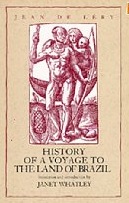
Jean De Lery, a French doctor and Huguenot minister who travelled to the original French Colony of Rio de Janeiro (that’s right, it was a French town at he beginning), wrote a brilliant polemic, History of a Voyage to the Land of Brazil, aimed at demonstrating that the Tupi natives were more fully civilized than French Catholics, even if the Tupi had integrated cannibalistic rituals into their warfare.  As Lery wrote, the French Catholic monarchy was persecuting the Huguenots and massacring them en masse.

Finally, the Founding Fathers of the United States were themselves European intellectuals in the Enlightenment tradition, who sought to enshrine their country’s ahistorical legacy into the very structure of governance.  Article I, Section 9 of the U.S. Constitution abolished nobility and privileged relationships with nobles (who could only be from Europe); and the First Amendment’s protection of freedoms to religion, speech, press, assembly, and petition is itself a rejection of the entire course of European political struggle since the Reformation began in 1517.

1 Comment

Filed under death, failure, freedom, ideas, life, philosophy, politics, truth, war

Another year, and we remember

IMG_1220

This is the view from the window next to my desk.  From that window, I took the photo that was the first masthead for this blog (it’s in the page on “the blog” if you want to take a look).

This was the view last night, from the ground, at the corner of 6th Avenue and Union Street in Brooklyn.

911-sarah-alt

My downstairs neighbor, Sarah, took that photo, and I saw it on her Flickr.

For the last three years, I have engaged a small ritual on or about September 11, when I can see the beams of light from Ground Zero over downtown from this window.

I turn out the lights.  I sit for a few minutes, 10 minutes or so.  My son is asleep in the next room, or maybe he’s at his mom’s apartment, just a few blocks away in the neighborhood.  Either way, he’s safe, while I gaze at the lights.  Irony is not the word for this.

I know my fate.  One day my name will be associated with a memory of something tremendous—a crisis without equal on earth, the most profound collision of conscience, conjured up against everything that had been believed, demanded, hallowed so far … Where you see ideals, I see what is human, alas, all too human.

Nietzsche’s words stream through my mind as I look at the beams and write my friends—

The clouds have cleared now and I have turned off the lights.  I just want to look out at the beams of light streaming up to the heavens.  So strange to think of the world before that day, and the world we have now.  And it made me feel like reaching out to a few people who matter to me.  I hope you’re all well.

As it happens, I never have taken a photo of the 9.11 beams from this window.  Tonight I will try, but I fear it’s going to be cloudy.  That’s unfortunate, because over the last couple of years, the view was so spectacular, iconic – and this year, 2009, will be my last at this window.  I will be moving at the end of September, to a new apartment in “Prospect Park South” which is the trendy name for what has often been called “Kensington” or simply “Flatbush” in the local dialect.

As all things happen, however, Providence gives us what we need, and Sarah’s photo from last night is such a gift.  So:  Thank you much to Sarah for this photo.  To all those who have touched my life, or whom I have touched in any way however small, I say this,

Be well and cherish those whose love you share.  We have no way to change what was, and our attempts to shape what will be never have their intended effect.  Where we are absolute, however, is the moment at hand.  Let us live that moment well, with love, and with all the peace that the world so deeply needs.  Only then do we stand a chance against the forces of darkness.  Strange as it may seem, those are pretty good odds.

Notes and Credits

Sarah’s photo: http://www.flickr.com/photos/37558372@N03/3908398726/

The precise address of our building is 211 Sixth Avenue.  Or the Union Market, at 754 Union Street, Brooklyn.  11215.

The quote from Nietzsche was taken from the opening of the BBC documentary of him, which can be seen here.  See also this and this.

My own quoted email was what I sent in 2007, the first year I sat at this window.  I cannot find last year’s email, which was a little more focused.  My three years of having this view have been important to me, because this window was a starting-over in many ways.  I will miss the view – but mostly I will hold dear the fact that I have the chance to have this view for a little while.  I only hope that the folks who come next to this little apartment are able to appreciate it as well.

Personal Note

I moved to New York in May of 2004.  In 2001, I was in Rock Island, Illinois, teaching at Augustana College.  On that particular day, I was in my office early.  Jane, who was the secretary for the departments of History and Political Science, came running down the long hallway to my office – we might have been the only two people on the floor.  She told me that I needed to come to the television and see what happened.  Her husband had called and said that a plane crashed into the World Trade Center.  Jane and I watched the rest of it happen, in a conference room on the campus of Augustana College which from its own window had a wonderful view of the Mississippi River and America’s own “heartland” on the border of Illinois and Iowa.  We saw the second plane crash into the other tower, and we saw the buildings fall to the ground, all live.  In my office, I heard about the plane crashing into the Pentagon, live.  I was very afraid.  My wife was out of town, and she was very possibly pregnant with our child (we had this confirmed just weeks after 9.11).  My country was under attack.

I don’t know if folks in New York know what it was like to experience 9.11 outside of this city.  It was pretty dreadful.   Nothing like here, of course, but awful nonetheless.  For a little while, we had no idea where this would lead, and everyone feared bombs and flames and explosions.

A few weeks later, November 10-12, 2001, we were in New York.  My wife had some meetings and I was along for the ride and the visit.  We knew then that our child would be expected some time in May or June.  I had some good runs in the city, in Central Park, along the avenues, but not on the West Side Highway.  It was blocked, for security reasons.  As we prepared to leave on the 12th, we heard odd news suddenly:  all the bridges and tunnels were closed, and so were the airports.  A plane had crashed in Queens.

Downstairs, we spoke to the hotel personnel.  The looks on their faces and the emotions in the air are emblazoned on my mind, in a way that makes me think of my parents’ generation when they talk about what they were doing when Kennedy was assassinated.  I won’t forget that.

6 Comments

Filed under danger, death, existentialism, ideas, philosophy, politics, truth, Uncategorized, war

The truth and change, 1: From Perfection to Dystopia

The House of Tomorrow, 1776

The House of Tomorrow, 1776

For as long as I can remember, people have been trumpeting the big changes that were supposed to occur in my lifetime.  In this span of years, roughly the 1960s-forward, change was the key ingredient of the future, which amounted to three alternatives:  progress, dystopia, or annihilation.  Looking back on the future of the last 45 years, however, it turns out that these aren’t mutually exclusive alternatives.

Einstein observed that the experience of an event is subject to relational factors like who’s observing it, where, and under what conditions.  So it is with the future.  It may not be the world itself that changes, but rather how we experience it, a future that happens inside our bodies to make the world look, sound, feel, taste, and smell different.  The House of Tomorrow may well be the house of yesterday, but it won’t feel that way.

This is the first of three posts on The truth and change.  The series will look at how tangled, ironic, and weird (to invoke a favorite category of Hunter S. Thompson’s) the future will be, if it’s not that already.  The exercise in lateral thinking takes us from perfection to dystopia, annihilation, technoredemption, slacker paradise, Qoheleth, Big Pharma, and cyberchange.

From perfection to dystopia

The future, change, and progress are products of The Enlightenment.  For millennia, people were assumed to be what they were.  Thinkers in the West and the East had explored all sorts of ideas about how to create good societies, find peace, and achieve enlightenment (The Buddha’s kind) – but there was no belief in a “future” that would be different from the past.  Differences in politics, spirituality, or technology were seen as superficial, and the great wheel of history rolled along.

Vanity of vanities, says Qoheleth, vanity of vanities! All things are vanity! …
One generation passes and another comes, but the world forever stays …
What has been, that will be; what has been done, that will be done.
Nothing is new under the sun.  [Eccl. 1: 2, 4, 9]

Then in the eighteenth century the philosophes in France and other spots around Europe started to think about the life we could have on Earth through science, reason, and (in one form or another) “democracy.”  The twin notions of change and the future became tangible, captured in a repurposing of the word “progress.”  In The Invention of Air, Stephen Johnson shows how these ideas were tied together across science, politics, and religion.  Ben Franklin, Thomas Jefferson, and Joseph Priestly (the nominal subject of Johnson’s book) were scientists and radicals who imprinted the American Revolution with the Enlightenment’s vision of the future.

As Jefferson wrote to Priestly after the presidential inauguration in 1800, “We can no longer say there is nothing new under the sun.  For this whole chapter in the history of man is new.”  In another context, Jefferson famously quipped, “Every generation needs a new revolution.”  Compromised as Jefferson’s revolution was, eventually even the enslaved and formerly enslaved African Americans, written out at the beginning, would build their own revolution to insist on (some of) Jefferson’s ideals, among others.  The times, they would be a-changing, and the early Abolition movement itself was a part of the Enlightenment’s vision of change.

New industries and the “New World” conjured an image of humankind’s infinite malleability – we were blank slates on which a better world would be drawn.  People were, in a word, perfectible.  Yet perfection was a contestable quality, and disagreements over perfectibility would draw the lines of ideological battles that lasted from 1776 to 1989.  One of the central lines in the struggle over change was who would make change happen best — freely acting individuals, private corporate entities, or the state.

These conflicts underlay Adam Smith’s own writings.  He placed great faith in individuals and very little in either the state or corporations.  In Smith’s ideal world, we were a self-correcting society of individuals guided “by an invisible hand to promote an end which was no part of [their] intention.”  In other words, people following purely individual motives could create social good, almost accidentally.

Smith applied his faith in individuals to economic life, but he saw a conflict between the capacity of individual action to create a moral world and the effects of capitalism’s main motor for change, the division of labor.  Far from perfecting mankind, the nature of industrial production (and with it, the creation of wealth) would render the bulk of people ever more ignorant even as democracy expanded their ability to affect their world:

The man whose whole life is spent in performing a few simple operations, of which the effects too are, perhaps, always the same, or very nearly the same, has no occasion to exert his understanding, or to exercise his invention in finding out expedients for removing difficulties which never occur.  He naturally loses, therefore, the habit of such exertion, and generally becomes as stupid and ignorant as it is possible for a human to creature to become.  The torpor of his mind renders him, not only incapable of relishing or bearing part in any rational conversation, but of conceiving any generous, noble, or tender sentiment … Of the great and extensive interests of his country, he is altogether incapable of judging …

This would be the product of capitalism, said Smith, “unless government takes some pains to prevent it.”  Smith never resolved this conflict in his understanding of change, and his fans have ignored it and instead dwelled on the “invisible hand” alone, taking this half-premise to logical extremes.

In Atlas Shrugged, Ayn Rand made a grand dystopian plea for her version of capitalist utopia that in general (if less radical) terms is part of everyday political discourse in the United States, where faith in powerful, dynamic individuals is strong.  The fear of the state is great, and the relation to mass politics is complicated.  The masses are fickle and in general not to be trusted (even by the masses).  To wit:  In the wake of the economic collapse of 2008, “going John Galt” has become the calling card of dissident financiers holding out against the reactions of the federal government and the populist fervor aimed at them, though this fervor was short-lived and now is turned against the government and health care reform.

Over time, dystopia transcended the narrow limitations of the conflicts between capitalism and socialism, seeing in both a massification of industrial society that used technology to dampen the very urges toward freedom and expression unleashed by the forces that Jefferson and Priestly heralded with such optimism.  Yevgeny Zamyatin’s novel We combined his experiences in the Russian Revolution and in the British factories of World War I to describe a true dystopia that was the forerunner of Orwell’s 1984.  Aldous Huxley’s Brave New World concentrated our gaze on the manufacture of pleasure as a way of breeding conformity and social order from the “torpor of mind” that Smith lamented in 1776.

Yet numbing sameness wasn’t the only threat to Jefferson and Priestly’s House of Tomorrow.  The rocket scientists who stood on their shoulders (among so many others) eventually helped us create weapons of unparalleled destruction that could end all life as we know it.  Beyond dystopia, the future created by reason might actually annihilate us all.  These were our choices by the time I was growing up:  Smith, Marx, Rand, Huxley, Orwell, Dr. Strangelove, or Charlton Heston on a beach some time in the distant future.

The Apes were able to perfect themselves greatly with people out of the way.  The surviving humans, able to carry on through accidents of history and rocket science, became vermin and slaves until the moment in which Taylor and Nova became a new Adam and Eve under the ruins of the Statue of Liberty, now a fallen, man-made Tree of the Knowledge of Good and Evil.  If you look hard enough, you can see in the background the shadows of Priestly, Paine, Jefferson, Franklin, Einstein, Oppenheimer, and Teller.  Thoreau and Whitman are nowhere to be found.  They were buried by the knowledge of good and evil.

Notes and Credits

The quotation from the opening of Ecclesiastes is taken from the New American Bible, Eccl. 1: 2, 4, 9.

Jefferson’s statement setting aside Qoheleth is cited by Stephen Johnson in The Invention of Air:  A Story of Science, Faith, Revolution, and the Birth of America (New York:  Riverhead Books, 2008), p. 199.  Overall, this book is a real treat that shows a rare and impressive achievement of lateral thinking.  To extend your thinking, visit Johnson’s blog, where he is further ruminating on ecosystems, technology, and change.

My quotations from Adam Smith are taken from The Essential Adam Smith, ed. Robert L. Heilbronner (New York:  W. W. Norton, 1986), pp. 265 and 302.  Read this book, which includes abridged versions of both the Theory of the Moral Sentiments and The Wealth of Nations.  They are indispensable critiques of the world that Smith’s fans seem to adore.

1 Comment

Filed under Albert Einstein, danger, death, freedom, ideas, individuality, philosophy, politics, revolution, Uncategorized, war

The truth and unicorns, part 1

unicorn-2

Unicorns are mythical creatures, but many people believe in them.  They don’t necessarily believe in the immanent possibility of seeing a unicorn on the street or in the woods any time soon.  They believe in believing in unicorns.

Myth speaks truth to reality, and the truth is that we need unicorns.  In the dialogue between myth and reality, we see the supposedly real world for what it really is:  impermanent, ever changing, mutable, a place that doesn’t have to be what it seems.  A place that isn’t really all that real, if by real you mean solid, concrete, tangible, or certain.

Without myth, the present is all we have (hello, Leonard Shelby).  Myth helps us to understand the world of now by freeing our dreams of worlds that might be, quite apart from whether or not they ever really happen.  Myth allows us the reveries of worlds lost, races won, loves cherished, sufferings endured.  Myth makes livable the stresses and oppressions of the moment.  Myth binds the present to the possible – the past that was, the past that could have been, the futures that may and may not come to pass, and the imaginary worlds that, without ever existing, will feed our passions and determine which future of the real world will, in fact, come to pass.

Myth is to our mundane world what relativity and quantum mechanics are to the world of Newtonian physics.  Newton’s laws work very well to explain the world of human-level sensory experience.  There’s a reason why an apple hits you on the head, and why every hanging apple on earth will do the same if you put a person under it at the right moment.  Newton explained the stuff we all see and helped us understand what was happening.  His laws extended our vision beyond the moment, predicting futures and explaining pasts.

Then came Einstein, whose Newtonian gaze extended much further than Newton could have dreamt, and in turn demanded a new reckoning.  With the theory of relativity, Einstein pushed our sight into the world of massive bodies – stars and galaxies – and the astronomical distances between them.  At the same time, Einstein’s discoveries also helped others (Max Plank, Neils Bohr, Erwin Schrödinger, and more) to gaze into the world of the infinitesimally small, smaller than the atom itself, and quantum mechanics was born.
The Unicorn in Captivity

The Unicorn in Captivity

At either end of the spectrum – the massive or the tiny – Newton’s laws don’t make sense, even though they explain the world in between quite well.  In relativity, things that happen now might occur before something that happened already, depending on where you’re looking from.  At the quantum level of subatomic particles like electrons and quarks, things can be in two places at the same time.  To believe in the physics of the massive, or of the tiny, is to suspend belief in the world we can see and touch.  And we can deal with that, because our minds constantly ask for more than what’s just beyond our noses.

This is why we have relativity, the 10 or 11 dimensions of string theory, the superposition of quantum particles, positrons and anti-matter, quarks, and unicorns.

Afternote: For a real treat on the marriage of design, art, and Isaac Newton, go to The Newton Project at the Dutch Art Institute.  Click on the artists’ names and see their designs.  My favorite is the one by Meiyu Tao.

Credits

Leonard Shelby:  See the post, “The truth and tattoos” and Memento.

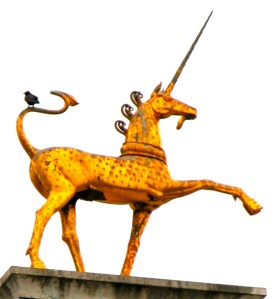
Gold unicorn:  Norman Walsh, photographer, Bristol, England,  http://norman.walsh.name/2003/10/08/bristol.

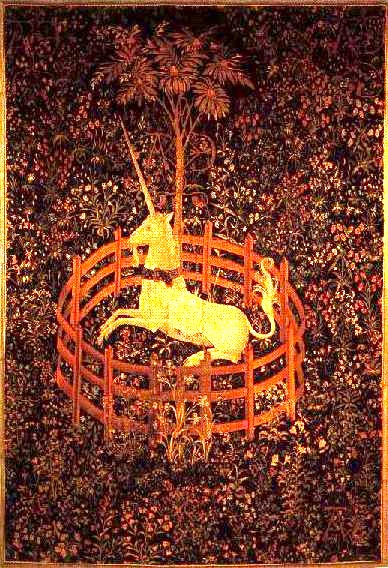
The Unicorn in Captivity, from “The Hunt Tapestries,” Metropolitan Museum of Art, The Cloisters.  Image from:  http://www.geocities.com/area51/corridor/5177/hunt.html.

9 Comments

Filed under Albert Einstein, Erwin Schrödinger, ideas, Isaac Newton, Leonard Shelby, myth, philosophy, superposition