E. Things that we never would have done had we known better, but that we must live with to the end of our days.
F. Wonderful things and great discoveries that never would have happened had we known better.
Note: E/F will be a recurring feature of truth and rocket science. If you have a half-glass photo to share, or want to create one, send it to me at jguidry.7 AT gmail DOT com and I’ll use it in a future posting, with full credit to you. Make sure that you tell me the story behind the photo, including the contents of the glass, in the following manner . . .
Credit: This standard Williams Sonoma pint glass is half-filled with Hoegaarden whitbier. Its taste is semi-tart and well-accented with a slice of lemon. It sits on a small faux-marble coffee table, in front of a love seat futon that was found on the sidewalk in Park Slope, Brooklyn, Sixth Avenue b/t Garfield and Carroll, on a spring day in 2008. As the mattress was clean and the frame in almost perfect shape, we took it home because we needed a sofa. Ah, providence.
a comfortable living room, for people and cats
The paintings were acquired in Bahia, Brazil in the summer of 1998. The artist signs himself “Alberto,” and they are of mixed media, acrylic paint with splatters of sand and swatches of cloth added for texture. I don’t recall the name of the shop, but I could certainly find it in a minute upon return to the city.
The coffee table was given to me by a friend to hold for her while she moved back to Rockford, Illinois to live in the barn on the family farm while writing her first three books. One day she may want the table back, but until then, it’s here.
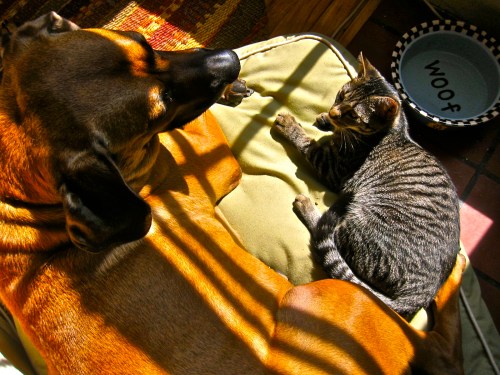
Pixie, ace mouser
Pixie, the cat, is about five and a half years old. She came into the family in February of 2005, for the specific purpose of eradicating the mice that had beset us in the fall of 2004. As I told Duke, Pixie was “a technician,” and she proved a very effective one: in her first 14 days, she took out 13 mice, and we never saw another one.
Brazil is a country of inspired appropriation. Its peoples, cultures, sounds, and visions grind against each other. They rise up and smash together like tectonic plates. In the collision of Brazil and Brasília, the city of candangos gave the country Renato Russo.
No “torso of steel,” no “[w]inged elbows and eyeholes,” but like Zweig and Plath a literary mind and poet, Russo’s voice became his generation’s. In his epic song, “Faroeste Caboclo,” Russo tells the story of a poor kid’s migration to Brasília across 159 lines of free verse, punk sensibilities, and an affecting melody that calls to mind the traditional country music of Brazil’s Northeast. Faroeste is what they call a “Western movie” in Brazil, and caboclo refers to the Brazilian mestiço everyman, a mixture of races and cultures, poor, seeking his or her fortune in some faraway place. Faroeste Caboclo is Walt Whitman, rogue-Gary Cooper and Joe Strummer together in Niemeyer’s white palace.
The hero is João de Santo Cristo, from Brazil’s Northeastern “backlands.” Brazilians call this region the Sertão, a rural, agrarian, drought-afflicted area that is the poorest place in the country and carries the deepest currents of Brazil’s premodern past. João robs the poor box from the church. He goes after the girls in the town. People don’t trust him. He feels the effect his skin color has on others who are lighter, more well-to-do. He’s arrested and goes to reform school, where he is raped and degraded. He is filled with hatred.
When a man on his way to Brasília decides not to go and gives his bus ticket to João, he becomes an accidental candango, leaving his past for the “beautiful city” where everything will be different. He works as a carpenter’s apprentice, but he can’t make ends meet and becomes a drug trafficker.
After some time in the criminal world, he tries to go straight when he falls in love Maria Lúcia, but eventually the drug trade pulls him back in. João’s enemy, Jeremias, steals Maria Lúcia and they have a child together. João challenges Jeremias to a duel, which is covered in the press and shocks the city’s elite but makes João a hero to the people. In the duel, Jeremias shoots João in the back and wounds him fatally. Maria Lúcia rushes to her first love and gives João a gun. He challeges Jeremias to die like a man and shoots him. In the end, Maria Lúcia and João die together in each other’s arms.
The people declared that João de Santo Cristo
Was a saint because he knew how to die
And the bourgeoisie of the city didn’t believe the story
That they saw on TV
And João didn’t accomplish what he desired like the devil
When he came to Brasília
What he wanted was to speak to the president
To help all the people that
Suffer
Russo and his bandmates in Legião Urbana (Urban Legion) grew up in Brasília in the late 1970s. Their songs of protest, love, and everyday struggles became the nation’s soundtrack to the last years of the military dictatorship and the re-emergence democracy in the 1980s.
“Será,” a love song with an anthemic refrain, could be heard blaring from sound trucks at the massive marches and rallies of the caras-pintadas (“painted faces”) in 1992, as they challenged the nation to bring down Fernando Collor, Brazil’s first democratically elected president since 1960.
So called because they painted their faces in the Brazilian national colors, green and yellow, the caras-pintadas had grown up under the military regime and saw their hopes threatened by Collor’s massively corrupt regime. They led the way for the whole country, which stopped each day at 7:00 for the allegorical soap opera, Deus Nos Acuda (God Help Us), a comedy in which the angel Celestina tries to save Brasil from the excesses of its social and political elite. In the show’s opening, the rich are smothered in mud and flushed down a whirlpool shaped like the country itself.
Collor was impeached and left office by the end of 1992.
Russo died on October 11, 1996, of AIDS-related illnesses. Russo’s wishes were to have his ashes spread over the gardens of Brazilian landscape artist Roberto Burle Marx, returning him to Brasília and its modernist vision.
In 2006, Fernando Collor was elected Senator for his home state, Alagoas, for an 8 year term (2007-2015). Brazil has absorbed Brasília.
Notes and Credits
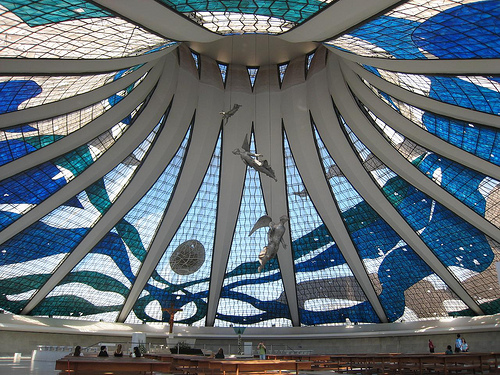
Photo: interior of the Brasília Metropolitan Cathedral. As with the previous post, the photo is taken from the Flickr site of Shelley Bernstein, aur2899. She works at the Brooklyn Museum (according to the Flickr “about”) and has a lot of pictures from Brasília and elsewhere. Her Brooklyn Museum blog posts are here.
Renato Russo was born Renato Manfredi, Jr., in Rio de Janeiro. He moved to Brasília in 1973 at the age of 13 and became a songwriter and musician. He renamed himself after the philosophers Rousseau and Bertrand Russell, and the painter Henri Rousseau.
Faroeste Caboclo plays on the iconic stories of migration from the Brazilian backlands, the sertão, to cities in search of a better life – one of the central storylines of Brazilian history. It’s a story of spiritual depth and apocalyptic reach, most famously told in Euclides da Cunha’s Os Sertões. Da Cunha’s book, published in 1903, tells of the Brazilian military’s destruction of the city of Canudos in the 1890s.
Canudos was a city that grew up around the milennial teachings of a folk preacher, Antonio Conselheiro, bringing tens of thousands of poor Brazilians together in a sertanejo enclave to await the last days. The Brazilian government saw the city as a grave threat to its own project of bringing Brazil into the community of modern republics while still maintaining the class and racial divisions of its colonial and plantation (slavery) past. Canudos was utterly destroyed by the military, and its inhabitants were massacred.
The destruction of Canudos removed one “sore” from the Brazilian body politic, but in the predictable irony of history and unintended consequences, Canudos gave birth to the next social threat. Soldiers from the campaign, unable to find work on retrn to civilian life, migrated south from the Northeast to Rio de Janeiro and built their own squatter colony on a hill. Thus was born the first favela, later to become the 21st century dystopian Canudos that continues to challenges the Brazilian modernizing project.
During 1992 and 1993, I lived in Belém and accompanied the protest marches through the city. I was officially a researcher, but I was also 28 years old, not much older than the caras-pintadas who I spoke to. Just a few years earlier, as a college student in New Orleans in the mid-1980s, I used to grab the New York Times every day to read up on the military’s exit from power in 1985. In 1992-93, like everyone else in Brazil, I was glued to the television every day for Deus Nos Acuda.
Another song that rang out from the sound trucks and radios everywhere was the first Legião Urbana hit, “Tempo Perdido,” with the echoing call of the refrain, selvagem, meaning wild, untamed. It was a song about love and not losing the time at hand, but it was also about the passion for breaking free of repression that made this song the “anthem of an entire generation” (O hino de toda uma geração), according to Alexandre Inagaki. In the video the band pays homage to all their forebears in rock and roll.
“Tempo Perdido” follows in the footsteps, or looking down from the shoulders of Raul Seixas and “Maluco Beleza.” Raul Seixas was Brazil’s Elvis (his idol), Jim Morrison, and John Lennon rolled into one. He “was not just a musician, but a philosopher of life …” (Raul não era apenas música, Raul era uma filosofia de vida), “Always Ahead of his Time.” See Jesse’s portrait of Raul on her blog, Mundo de Jesse. “Maluco Beleza” (“Crazy Beauty”) is for many the epic statement of individuality and creativity from the central icon of Brazilian rock.
Senhor Hype reports that the Brazilian RockWalk is in development, creating a walk of fame that will include both national artists as well as some international artists like the Scorpions.
For an English translation of “Faroeste Caboclo” along with the music, go here. The translation of the ending of the song above is taken from this video, and credit goes to Alexandre Mello and Andrea Hilland.
This series of posts springs from three sources. First, my research for “The truth and change,” recalled the poem Brasília, by Sylvia Plath. Second, I have lived in Brazil for long periods of time and consider Belém, the “cidade das mangueiras” at the mouth of the Amazon River, as my second home town. Third, The Collected Poems of Sylvia Plath was one of two English-language books I brought with me to Belém in 1992, as I began a year-long stay for my doctoral research.
These are stories of exile, suicide and hope in a world caught just between a despair-ridden past and an open-ended, possibly bright future. They are stories of writers and writing. They are stories close to my heart and deeply tied to my own passions. The first is that of Stefan Zweig’s tragic love affair with Brazil. The exiled Austrian Jew will give his story to Sylvia Plath, the expatriate American poet of Autsrian extraction writing of a metphor sprung from a city she never visited. Like Zweig, she died by her own hand in a foreign land. Finally, Renato Russo brings us back to his Brasília, in an epic poem that marries the cinematic Western to the story of his own country.
These are stories of gifted storytellers whose lives were dealt a blow by the hubris of others. Their achievements in the face of all this are a thing of drastic beauty and desperate truth. Life is hard, a friend of mine once said, and it is. But worth every ounce of the struggle, no matter how it ends.
The truth and Brasília, 1: Land of the future
In 1942, Stefan Zweig and his wife, Lotte, commited double suicide in Petrópolis, Brazil. Ever the writer – one of the world’s best known, at the time – Zweig left a note to explain why.
Zweig stated that his decision was “of my free will and in my right mind,” and he told the world why he chose to leave this life. In the dozen years up to this point, Zweig went from being the world’s most-translated author to literary refugee, fleeing his native Vienna for Britain in 1934, then the United States, and finally Brazil in 1941. By this time he was morally and spiritually homeless, “my own language having disappeared from me and my spiritual home, Europe, having destroyed itself.”
No mention is made of Lotte in the letter, so her role, contribution, or support in the decision is only as clear as the fact that she was there on the bed with Zweig at the end of it all, free of struggle, her body like his finally free of the life within it.
Had Zweig the wherewithal to hold out a few years, so the critics say, he might have been able to reinvigorate his spirits – but such conjecture is pointless. Europe in the late 1940s was no picnic, either, and the onset of the Cold War was for many simply a continuation of Europe’s long demise.
For Zweig, the tragedy of Europe was deeply important. He was a stalwart of the pacifist movement, going back to the early years of the century, and he was a famous champion of European integration. A secular Jew from Vienna, he was of the great class of pan-European intellectuals whose history and inclinations drove them to think of a larger cultural world of ideas and human progress. To see that dream dashed so spectacularly by fascism was indeed, I imagine, a tragic, numbing blow to the soul.
Zweig wrote two books in the final years of life that spell his struggle in simple letters. In 1941, he published Brazil: Land of the Future, a love letter to his newly adopted country. On the day before he committed suicide in 1942, Zweig mailed another manuscript to his publisher: The World of Yesterday, an autobiography. Zweig’s European world was on the brink of genocidal horror, and it was killing him. In Brazil, he was trying, heroically perhaps, to follow the European tradition of celebrating all that was American as a new world, a blank slate, a place of abundance unsullied by the tragic history of European struggle, war, and religious strife. He tried, but as he says in the suicide note, he was simply too old to keep on.
. . . after one’s sixtieth year unusual powers are needed in order to make another wholly new beginning. Those that I possess have been exhausted by long years of homeless wandering. So I think it better to conclude in good time and in erect bearing a life in which intellectual labor meant the purest joy and personal freedom the highest good on earth.
Even as Zweig lived and wrote and died, young Brazilian idealists like Lúcio Costa and Oscar Niemeyer were establishing themselves as world class designers and architects. After World War II, Niemeyer’s design for the United Nations in New York placed his ideas on the world’s stage – a House of Tomorrow for the hopes and dreams that Zweig himself had given up on.
Costa and Niemeyer would go on to design Brazil’s city of the future, Brasília, its capital of the future, a gleaming, white, rational city reflecting their beliefs in a truly democratic world that would work for everyone, regardless of class or any other distinction that made life difficult in the old world they inherited. Like Zweig, they looked to a land of the future that was their own Brazil.
Notes and Credits
Cidade das mangueiras = city of mango trees. It’s the local nickname for Belém, where the avenues are lined with mango trees. Every November, when the fruit falls, children scurry into the streets, dodging busses and cars (and sometimes horses) to pick up a free snack.
There are a number of wonderful blog sites, radio interviews, and other web resources available to learn about Stefan Zweig. My source for Zweig’s suicide note is Artopia: John Perreault’s Art Diary. WNYC’s Leonard Lopate did a radio show on August 13, 2007, for which he interviewed George Prochnik, who was working on a book about Stefan and Lotte Zweig. Monica Carter of Salonicawrites of Zweig’s Amok and Other Stories,
“Three out of the four stories in this collection put us in the hearts of those suffering from unrequited love. Zweig’s style is so elegant and descriptive, the purity of this love scares and engages us. The last story draws us in to man who cannot find his way home, due to the war. This is the story I found most tragic because of its autobiographical slant. Zweig and his wife committed suicide because the home that they knew, was one they could never get to again. These stories are so worthwhile and if there is any credence to the adage ‘write what you know’ then Zweig was a man who wrote about loss and love with equal knowledge.“
Zweig’s reputation in Brazil is uneven. As journalist Carlos Haag reported in 2006, Brazilians have discounted the authenticity and sincerity of Zweig’s book, from the 1940s onwards. The book was rumoured to be a quid pro quo with the Brazilian dictator at the time, Getúlio Vargas, who allegedly granted the famous exiles, Zweig and Lotte, permanent residency in exchange for the writer’s services. Brazil was to be the land of Zweig’s future, and perhaps nothing more than that.
I first heard of Zweig’s book while living in Brazil. The book has been appropriated for an insider joke about eternal contrast between Brazil’s riches and potential for greatness with its ever-present reality of income disparity, poverty, and crime. The joke plays on Zweig’s book title and figures in the second of these postings: Brazil is the country of future, and it always will be.
The statement, “In Brazil, [Zweig] followed the grand European tradition of celebrating all that was American as a new world, a blank slate, and a place of abundance unsullied by the tragic history of European struggle,” is a standard of European history. The notion of a “new world” was the result of Columbus’s discovery of a place that no one in Europe or Asia ever knew existed. John Locke backs up his understanding of the “blank slate” of human history and his state of nature theory with unrelenting references to the Native American societies who demonstrate his point.
Jean De Lery, a French doctor and Huguenot minister who travelled to the original French Colony of Rio de Janeiro (that’s right, it was a French town at he beginning), wrote a brilliant polemic, History of a Voyage to the Land of Brazil, aimed at demonstrating that the Tupi natives were more fully civilized than French Catholics, even if the Tupi had integrated cannibalistic rituals into their warfare. As Lery wrote, the French Catholic monarchy was persecuting the Huguenots and massacring them en masse.
Finally, the Founding Fathers of the United States were themselves European intellectuals in the Enlightenment tradition, who sought to enshrine their country’s ahistorical legacy into the very structure of governance. Article I, Section 9 of the U.S. Constitution abolished nobility and privileged relationships with nobles (who could only be from Europe); and the First Amendment’s protection of freedoms to religion, speech, press, assembly, and petition is itself a rejection of the entire course of European political struggle since the Reformation began in 1517.
This is the concluding post in the series, The truth and change. As part 3b, it offers a final alternative future. In 3a, I looked at how technology is bringing out the futures within our minds and imaginations. The virtual world is deeply connected to the organic world, and the “crossover” realm may well be the real space in which we do live.
The present posting, 3b, picks up where 3a left off – wondering about the potential for change in the essential emotional experience of being human. This leads to a Huxleyesque future of chemical alterations and experiential morphing.
From Gilgamesh to Pharma
Gilgamesh, the God-King of Uruk, is the oldest surviving literary protagonist in human history. He was a real man, who built the walls of his famous town, after which the modern nation of Iraq is named. His story was told in the Epic of Gilgamesh, which has inspired writers, readers and listeners alike for over 4,700 years.
Preserved on cuniform tablets, the Epic tells how Gilgamesh grieved the loss of his friend Enkidu. In his sorrow and listlessness Gilgamesh became consumed with death and set out on a quest for immortality. Gilgamesh’s inner turmoil at this point is no different than any of us will have over the death of a loved one.
Some years later, but still long ago – 2,300 years ago to be more precise – the Hebrew prophet Qoheleth wrote that there would be nothing new under the sun, and about 2,267 years later The Beatles got a number 1 hit with the same message.
There’s nothing you can do that can’t be done.
Nothing you can sing that can’t be sung.
Nothing you can say but you can learn how to play the game …
If there’s nothing we can do that can’t be done, then what is there? Do the changes that have occurred in the world really matter when it comes to the fundamental experience of what it means to be human? The issue is not about change in the world, or change in the nature of social organization, or the changes we can effect on the world. It’s about who we are inside:
What about being human has ever changed in some undeniably essential way?
This question doesn’t deny the reality of change. Societies are different. Mores and belief systems change over time. That some technological changes have made life better for some people is absolutely true. Some illnesses and conditions no longer make life miserable for people. Basic everyday machines like vacuum cleaners and refrigerators have liberated countless numbers of people from demeaning and exhausting chores, even while they take up new chores for new reasons.
The undeniably essential experiences I am thinking of, however, belong to other moments in our lives. They are moments of being. They are fundamental. They are emotional. They are constitutional. They are moments critical of passage: birth, love, marriage, death, loss, success, envy, anger. In these kinds of moments, has what it means to be human really changed all that much?
The answer is yes, maybe, sort of. These are emotional moments, and emotions are not purely given, because we can tinker with them. A change in scenery is sometimes enough to change one’s emotional state. Want to feel better? Find the sun. Get some air. Climb a hill. Have a drink. It is in the last instance that we people began to find real power over our emotions.
The House of Tomorrow, 2009, Park Slope Version
We’ve been tinkering with chemical alterations to emotions for millions of years, well before Gilgamesh. This may not even be unique to the human species; chimps use chemicals, too. People, however, have a way of taking things to extremes, as any history of the species will demonstrate. There’s a cost to chemical happiness in terms of addictions. Some chemicals even change who we are and give rise to social ills, such that most societies ban certain forms of chemicals.
What gets banned and what doesn’t – or as Jennifer Michael Hecht poses the issue, what makes a good drug bad – is really an outcome of cultural power politics (though other issues are also involved). From the late 1800s, upper middle class, liberal, Americans of Northern European descent acted out their concern for the disruptive behaviors of less-welcome immigrants (Irish, Italians, Slavs, Jews) and African Americans by banding together to ban alcohol, which they did successfully from 1920 to 1933. For the last 40 years, “drugs”gained a connotation of “mind altering experience” that became associated in our society with illegality, rebellion, and tragedy, but that’s nothing new either.
What is different today is the industrialization and institutionalization of mass drug consumption designed to create an emotional social fabric that breeds order, productivity, and “happiness” (not “high,” but “happy” and “productive”). These are the legal drugs that big, powerful companies want us to take under the guise of “freedom,” the kinds of drugs that appeal to people who believe there’s something fundamentally different between the urge to eat Xanax as opposed to psilocybin mushrooms.
In this scenario, prescription drugs are the real gadgets making the future happen, and “health care reform” is the Trojan Horse that Big Pharma will ride into the future (and into our minds and bodies), a “PhRMA payoff” in the words of journalist Matt Taibbi. The great gorging that the drug companies will continue to enjoy will fuel research and development into drugs that can normalize every possible quirk, peak, and valley of human experience.
This has been at least a century in the making: from snake oil, to heroin (created by Bayer in 1898 as a cough remedy), to Hadacol, to the array of drugs advertised directly to you on television but which you need to make a doctor’s appointment to demand. Whether there’s a government option for insurance in the reform won’t change this: belief in pill-popping is one thing that everyone agrees on.
The pills we have for depression, anxiety, weak erections, high cholesterol, urine flow, restless leg, bacterial infections, low sex drive, menstruation, motherhood, and every other imaginable “malady” (a word chosen advisedly here) are what the future is about – and it’s not about change.
The future according to Pharma is about muting our experiences so that change doesn’t matter.
The original, brilliant video for “Ashes to Ashes” can be seen here (it can’t be embedded).
Epilogue
I wrote this to explore an alternative future, not to predict it. The creative spaces opened up by the Internet and virtual lives (The truth and change, 3a) are far more interesting and preferable to me.
When it comes to the issues in this posting, there are a lot of grassroots ways to challenge the way that health reform is going on. Changes in diet and lifestyle practices can prevent a great many problems that are currently medicated out of us. Organizations like the Economic Policy Institute provide informative coverage of the issues with data that make sense.
A stern willingness to explore the nature of illness and suffering is another way to challenge the future: we all get sick and must live with it. We’ll all die. Why not die with dignity and leave on one’s own terms? There will be sadness as surely as there will be joy, and the latter is only made deeper and richer by contrast to our experience of the former.
Notes and Credits
The songs of David Bowie have guided my thinking along the way through these four posts on “The truth and change.” At every turn I found another one to make me think even more deeply about these topics, forcing my mind to link further and further afield into the other areas I was reading about now or had some knowledge of in a past life.
The photo of Walgreen’s at the head of the post was taken by Monique S. Guidry. It’s at 3004 North St, Nacogdoches, TX 75965-2858. The photo of the Prospect Gardens Pharmacy, at 89 7th Ave., Brooklyn, NY 11217, was taken by the author. That pharmacy is a nice little store in the gentrifying Park Slope neighborhood, subject of recent contretemps among the Park Slope literary and blogging community. The New York Times ran an interesting story about Amy Sohn’s novel, Prospect Park West and yet another possible TV series to shoot here (what happened to Darren Starr’s?). Local blogger Louise Crawford ran two versions of a review, one on her blog, “Only the Blog Knows Brooklyn,” and the other in the Brooklyn Paper, where she also writes the “Smartmom” column. Fucked in Park Slope absolutely loved the book.
In The Happiness Myth (New York: Harper Collins, 2007), Jennifer Michael Hecht looks at the relationship between drugs and happiness, beginning with a chapter entitled “What Makes a Good Drug Bad.” Along the way (pp. 78-79), she tells the story of Bayer’s invention and marketing of Heroin against the backdrop of an inquiry into what we really want out of drugs in our society. The book is an unrelenting look at things that are supposed to make us “happy” and how misplaced our ideas about “happiness” today might be. She explores her subject across time and cultures to make a pretty good case that happiness isn’t all it’s been cracked up to be.
In the first installment of The truth and change, I wrote about how the Enlightenment gave us a new kind of science and social discourse that pictured a perfectible mankind, which would be the basis of real democracy and freedom in the future. Yet it was really a Greek tragedy.
Jefferson snubbed the ancients by declaring that there will be something new under the sun, and a hundred years later the world embarked on a century that would witness versions of apocalypse previously imaginable onlyin epics and divine texts. Everything that the Enlightenment made it possible to imagine, it also made it possible to destroy. That was the dilemma of my generation . . .
Technoredemption Goes Pro
The 1933 Chicago World’s Fair gave us the “House of Tomorrow,” which still stands in Indiana and at 78 years old combines the future and past in one space. Like most dream houses created since the 1930s, it has a double garage, with a twist – one for an automobile and one for the airplane that “World’s Fair optimists assumed every future family would own …”
One can only imagine how this garage has played out of time – rumpus room, game room, massive mud room, cluttered workshop where grandpa used to build boats in bottles, and now the place where mom and dad surf the internet when the other isn’t looking.
The House of Tomorrow held out a vision of the future at odds with much of what was going on around it. A few years earlier, World War I gave people a glimpse of the horror to be wrought by chemical warfare and bombs. In 1933, faith in individual action and the capitalist economy was well under seige. On February 27 of that year, Hitler burned the Reichstag and The Third Reich began. World War II, with its multiple Holocausts of genocide, firebombing, and nuclear warfare would be soon upon us.
The House of Tomorrow, 1933, Berlin version
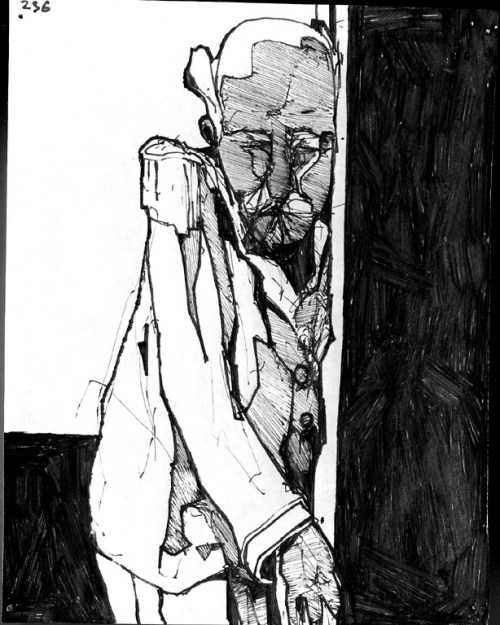
Thomas Pynchon’s Gravity’s Rainbow (published in 1973) portayed this entire destructive arc of the twentieth century. Science fuelled a spiral of violence, which unleashed and unbound human emotions both zany and horrific. Pynchon captured this most vividly in Brigadier Pudding’s humiliation scene, a Pavlovian experiment in the malleability/perfectibility of mankind that was a living annihilation at the border between the past and our future in which Pudding relived and relieved himself of the filth of Ypres and Passechendaele over and over again. The ritual became the center of his being.
Zak Smith: Brigadier Pudding, p. 236
Still, annihilation and holocaust were not the only ideas on the table. The playfulness of Pynchon’s novel and its main character, Tyrone Slothrop, held out the competing narratives of innocence and technologial redemption, impulses ironically (and perhaps hypocritcally) present in Robert Moses’s 1964 New York World’s Fair. This was the year of my birth and the year in which Stanley Kubrik gave us Dr. Strangelove. At the Fair, GM’s “Tomorrow Land” provided a delightful tour of the wonders yet to be bestowed on us by reinforced concrete, steel, and plastic. Tomorrow Land was a glimpse into the world that could be, minus the evils of nuclear war, poverty, and exploitation.
At the Fair’s Pepsi Pavilion, “Children of the World” used mechanized dolls and music to showcase a world of hope and diversity. This became Disney’s “It’s a Small World,” leading to the installation of its relentlessly saccharine theme song in the minds of millions of people every year, some of whom must wish that Slim Pickins would ride a missile into Orlando and put an end to the little dolls and gadgets just so they could get that song out of their heads.
The world we inherited in the Reagan years was reeling between the Jetsons and Dr. Strangelove as Paul Westerberg wrote “we’ll inherit the earth, but we don’t want it.” If we were finally, really going to do it, to blow it up, I’d at least try to spend my last years thinking of other things.
The Mighty "Trash-80"
In 1981, I bought a TRS-80, Model III. I was 17 and had saved up the money from my job at the pizza parlor down the street. I read Alvin Toffler’s The Third Wave and John Nesbitt’s Megatrends. A future of progress was much more appealing future than the one forecast by the “Doomsday Clock” on the cover of the Bulletin of the Atomic Scientists. Such was the future according to Generation X, as we stumbled between slackerism and technoredemption.
In 1989, I remember being in my kitchen, washing dishes and listening to NPR when they announced that people had climbed over the Berlin Wall and were taking it apart. In my own mind, I replaced The Day After with Blondie and hummed “Atomic” over and over again as I felt relief wash over me.
Then in the mid-1990s, Newt Gingrich started invoking Alvin Toffler at every opportunity. 1984 and Y2K came and went with neither Orwellian nor apocalyptic futures taking hold. The most prescient glimpse of the future provided in my entire lifetime was not Space 1999 but Prince’s 1999, which accurately forecast exactly what I, and countless others around the world, were doing in 1999. Whatever the future would be, it would be weird, and once Tim Berners Lee put the World Wide Web up, Gen X went online and, as if following Hunter S. Thompson’s consultation to our parents, we went pro.
Technoredemption provided a kind of cure-all for anxiety about the future. Today it feeds the relentlessly positive assessments of Twitter’s contribution to revolution and freedom around the world. Yet the same technology can bring us back to Huxley or Orwell, and we know it. Evgeny Morozov writes that even as “activists and NGOs are turning to crowdsourcing to analyze data, map human rights violations, scrutinize the voting records of their MPs, and even track illegal logging in the Amazon”, ” governments are also relying on crowdsourcing to identify dissenters and muzzle free speech.”
Technoredemption remains as much a promise now as it was in 1776, 1933, 1964, or 1989. Rousseau’s famous line from the opening of On the Social Contract – “Man is born free, and everywhere he is in chains” – strikes me as quite true today, in the same sense that Rousseau meant it, and with the same consequences.
We didn’t need nuclear bombs alone to create armageddons of pain and horror. Madhukar Shukla writes “The Firebombing of Tokyo was as devasting as the nuclear, Hidden in the history of that time, is an unnoticed footnote – the ‘Tokyo Fire-Bombing,’ which the Western press would not touch, and the Japanese survivors would not like to dwell upon [was an] event which happened months before the atom-bombs and with far more lethal consequences.” Shukla’s blog is called “Alternative Perspective” and his homepage is here.
The illustration of Brig. Pudding is by Zak Smith, from his work Pictures Showing What Happens on Each Page of Thomas Pynchon’s Gravity’s Rainbow. Much thanks to Zak for granting me permission to use the image. The series of illustrations was featured in the 2004 Whitney Biennial (agh, just before I arrived in New York!) and is now part of the permanent collection at the Walker in Minneapolis. In the episode referenced above, Brig. Pudding must undergo a scatological humiliation scene with Domina Nocturna as part of his atonement for his role in Ypres and Passechendaele, a scene occupying pp. 232-36 of the book (Viking Press, 1973). Click on the image and you will be taken to a website featuring all of the illustrations.
Among Pynchon’s themes we count the Europeans’ damning of the world to endure the repetitive future of their own racist, colonial past, which sits perversely at the heart of American innocence and condemns America (white America, especially) to this struggle between technoredemption, dystopia, and annihilation. Like Rousseau, Pynchon sees the chains that reason has placed on mankind. He continues to explore that theme in his writing, with impressive intensity in Mason and Dixon, in which the two famous astronomers are contracted to create an artificial boundary between two artificial entites (Pennsylvania and Maryland) that have been imposed on something like a state of nature.
Pynchon’s new novel, Inherent Vice, goes into the territory of detective fiction and film noir, two of my favorite genres. I am giddy and cannot wait to read this book. Expect more posts related to TP.
On August 31, 2006, Douglas Coupland posted a wonderfully ironic vision of the future as past and present on his New York Times blog. At that point he boldly foresaw the Kindle-future, as he predicted that books will “cease to exist” and become “extinct.” Looking at his old novels and thinking of insects, he began to think about how wasps made paper from wood, and then he used his own mouth to pulp his novels and make nests from them. The resulting photos are quite beautiful, and the blog posting shows what Generation X looks like as a nest.
I learned about Evgeny Morozov’s blog post in a Tweet from Cause Global’s Marcia Stepanek.
The ice age is coming, the sun’s zooming in
Engines stop running, the wheat is growing thin
A nuclear error, but I have no fear
Cause London is drowning and I, I live by the river
For as long as I can remember, people have been trumpeting the big changes that were supposed to occur in my lifetime. In this span of years, roughly the 1960s-forward, change was the key ingredient of the future, which amounted to three alternatives: progress, dystopia, or annihilation. Looking back on the future of the last 45 years, however, it turns out that these aren’t mutually exclusive alternatives.
Einstein observed that the experience of an event is subject to relational factors like who’s observing it, where, and under what conditions. So it is with the future. It may not be the world itself that changes, but rather how we experience it, a future that happens inside our bodies to make the world look, sound, feel, taste, and smell different. The House of Tomorrow may well be the house of yesterday, but it won’t feel that way.
This is the first of three posts on The truth and change. The series will look at how tangled, ironic, and weird (to invoke a favorite category of Hunter S. Thompson’s) the future will be, if it’s not that already. The exercise in lateral thinking takes us from perfection to dystopia, annihilation, technoredemption, slacker paradise, Qoheleth, Big Pharma, and cyberchange.
From perfection to dystopia
The future, change, and progress are products of The Enlightenment. For millennia, people were assumed to be what they were. Thinkers in the West and the East had explored all sorts of ideas about how to create good societies, find peace, and achieve enlightenment (The Buddha’s kind) – but there was no belief in a “future” that would be different from the past. Differences in politics, spirituality, or technology were seen as superficial, and the great wheel of history rolled along.
Vanity of vanities, says Qoheleth, vanity of vanities! All things are vanity! …
One generation passes and another comes, but the world forever stays …
What has been, that will be; what has been done, that will be done.
Nothing is new under the sun. [Eccl. 1: 2, 4, 9]
Then in the eighteenth century the philosophes in France and other spots around Europe started to think about the life we could have on Earth through science, reason, and (in one form or another) “democracy.” The twin notions of change and the future became tangible, captured in a repurposing of the word “progress.” In The Invention of Air, Stephen Johnson shows how these ideas were tied together across science, politics, and religion. Ben Franklin, Thomas Jefferson, and Joseph Priestly (the nominal subject of Johnson’s book) were scientists and radicals who imprinted the American Revolution with the Enlightenment’s vision of the future.
As Jefferson wrote to Priestly after the presidential inauguration in 1800, “We can no longer say there is nothing new under the sun. For this whole chapter in the history of man is new.” In another context, Jefferson famously quipped, “Every generation needs a new revolution.” Compromised as Jefferson’s revolution was, eventually even the enslaved and formerly enslaved African Americans, written out at the beginning, would build their own revolution to insist on (some of) Jefferson’s ideals, among others. The times, they would be a-changing, and the early Abolition movement itself was a part of the Enlightenment’s vision of change.
New industries and the “New World” conjured an image of humankind’s infinite malleability – we were blank slates on which a better world would be drawn. People were, in a word, perfectible. Yet perfection was a contestable quality, and disagreements over perfectibility would draw the lines of ideological battles that lasted from 1776 to 1989. One of the central lines in the struggle over change was who would make change happen best — freely acting individuals, private corporate entities, or the state.
These conflicts underlay Adam Smith’s own writings. He placed great faith in individuals and very little in either the state or corporations. In Smith’s ideal world, we were a self-correcting society of individuals guided “by an invisible hand to promote an end which was no part of [their] intention.” In other words, people following purely individual motives could create social good, almost accidentally.
Smith applied his faith in individuals to economic life, but he saw a conflict between the capacity of individual action to create a moral world and the effects of capitalism’s main motor for change, the division of labor. Far from perfecting mankind, the nature of industrial production (and with it, the creation of wealth) would render the bulk of people ever more ignorant even as democracy expanded their ability to affect their world:
The man whose whole life is spent in performing a few simple operations, of which the effects too are, perhaps, always the same, or very nearly the same, has no occasion to exert his understanding, or to exercise his invention in finding out expedients for removing difficulties which never occur. He naturally loses, therefore, the habit of such exertion, and generally becomes as stupid and ignorant as it is possible for a human to creature to become. The torpor of his mind renders him, not only incapable of relishing or bearing part in any rational conversation, but of conceiving any generous, noble, or tender sentiment … Of the great and extensive interests of his country, he is altogether incapable of judging …
This would be the product of capitalism, said Smith, “unless government takes some pains to prevent it.” Smith never resolved this conflict in his understanding of change, and his fans have ignored it and instead dwelled on the “invisible hand” alone, taking this half-premise to logical extremes.
In Atlas Shrugged, Ayn Rand made a grand dystopian plea for her version of capitalist utopia that in general (if less radical) terms is part of everyday political discourse in the United States, where faith in powerful, dynamic individuals is strong. The fear of the state is great, and the relation to mass politics is complicated. The masses are fickle and in general not to be trusted (even by the masses). To wit: In the wake of the economic collapse of 2008, “going John Galt” has become the calling card of dissident financiers holding out against the reactions of the federal government and the populist fervor aimed at them, though this fervor was short-lived and now is turned against the government and health care reform.
Over time, dystopia transcended the narrow limitations of the conflicts between capitalism and socialism, seeing in both a massification of industrial society that used technology to dampen the very urges toward freedom and expression unleashed by the forces that Jefferson and Priestly heralded with such optimism. Yevgeny Zamyatin’s novel We combined his experiences in the Russian Revolution and in the British factories of World War I to describe a true dystopia that was the forerunner of Orwell’s 1984. Aldous Huxley’s Brave New World concentrated our gaze on the manufacture of pleasure as a way of breeding conformity and social order from the “torpor of mind” that Smith lamented in 1776.
Yet numbing sameness wasn’t the only threat to Jefferson and Priestly’s House of Tomorrow. The rocket scientists who stood on their shoulders (among so many others) eventually helped us create weapons of unparalleled destruction that could end all life as we know it. Beyond dystopia, the future created by reason might actually annihilate us all. These were our choices by the time I was growing up: Smith, Marx, Rand, Huxley, Orwell, Dr. Strangelove, or Charlton Heston on a beach some time in the distant future.
The Apes were able to perfect themselves greatly with people out of the way. The surviving humans, able to carry on through accidents of history and rocket science, became vermin and slaves until the moment in which Taylor and Nova became a new Adam and Eve under the ruins of the Statue of Liberty, now a fallen, man-made Tree of the Knowledge of Good and Evil. If you look hard enough, you can see in the background the shadows of Priestly, Paine, Jefferson, Franklin, Einstein, Oppenheimer, and Teller. Thoreau and Whitman are nowhere to be found. They were buried by the knowledge of good and evil.
Notes and Credits
The quotation from the opening of Ecclesiastes is taken from the New American Bible, Eccl. 1: 2, 4, 9.
Jefferson’s statement setting aside Qoheleth is cited by Stephen Johnson in The Invention of Air: A Story of Science, Faith, Revolution, and the Birth of America (New York: Riverhead Books, 2008), p. 199. Overall, this book is a real treat that shows a rare and impressive achievement of lateral thinking. To extend your thinking, visit Johnson’s blog, where he is further ruminating on ecosystems, technology, and change.
My quotations from Adam Smith are taken from The Essential Adam Smith, ed. Robert L. Heilbronner (New York: W. W. Norton, 1986), pp. 265 and 302. Read this book, which includes abridged versions of both the Theory of the Moral Sentiments and The Wealth of Nations. They are indispensable critiques of the world that Smith’s fans seem to adore.
Last week, I went to the 140 Characters Conference here in New York. There, hundreds of people met to explore how Twitter, new media, and micro-blogging are disrupting life these days. People were asking important questions of all this new technology: What do we get out of it? Is it changing anything that matters in any interesting way? Where’s it going? What does it mean?
The conference couldn’t have been more timely, though this was completely an accident of fate: On the very days of the meeting, June 16 and 17, the Iranian people were using Twitter, cell phones, and other inventions to coordinate and narrate a national uprising to protest the (allegedly) fraudulent results of the recent presidential elections. The story is available only over the internet, because Iranian control of the press and media have made it impossible for regular journalists to cover the events on the ground. Thus we turn to Twitter and bloggers to understand what’s going on. Huffington Post’s Nico Pitney is singularly inserting himself into the moment by providing the only comprehensive, live blog of the event.
These are the largest and most disruptive public demonstrations since the Iranian Revolution of 1979, when masses of Iranians overthrew the US-backed Shah of Iran. The Iranian Revolution was one of the few documented true revolutions (to use a political science term!), in which the structure of society itself, and not merely the regime, was changed in a rapid convulsion of political will.
Something similar might be happening today.
The events of 1979 have an interesting parallel to the present, for the earlier Revolution was spurred along by the innovative application of a radical new technology that not only subverted the regime but also fit neatly into the lifestyles and habits of regular Iranians. The new technology was accessible to everyone, regardless of education, age, gender, or geographical location. I am referring, of course, to cassette tape recordings, which in the 1970s took the entire world on a quantum leap of do-it-yourself cultural production, re-production, and mashing-up.
In the West, this took the form of the mix tape. We used the songs of our favorite bands to declare love or war, to apologize for insensitivity, to make a stand, break up, explain any of the preceding, or simply state the case for plain, animal lust. The truly radical could even place Yes, The Clash, and Air Supply on the same tape, just to make a point. The mix tape reached its all-time high with Nick Hornby’s novel, High Fidelity, in the mid-1990s, which was later immortalized on the silver screen with John Cusak at the very moment in time when the cassette tape itself was tossed into the dustbin of history by the arrival mix-CDs, MP3 playlists, and (a few years later) the iPod.
At the same time that mix tapes reshaped the possibilities for personal expression in the West, Iranians were gathering in private, often hidden, rooms to listen to cassette tapes of sermons by Ayatollah Ruhollah Khomeini, a prominent religious leader who was exiled from Iran in 1964. Khomeini took refuge first in Iraq, which has a large (majority) population of Shiite Muslims, and later in France. His sermons were smuggled into Iran, where they met a large audience, hungry for his words.
Khomeini’s message was both religious and social. He married basic Islamic piety to a consciousness of poverty, economic injustice, and outrage at the atrocities of the Shah’s violently repressive state. The Iranian Revolution of 1979 was deeply tied to Islam’s notions of charity and essential human equality (not the same as “freedom” in any Western sense), tenets of belief that the Shah’s regime violated so openly and egregiously. Cassette recordings overcame the literacy barrier and brought this message to wide audiences that might have missed him had he been restricted to paper texts and photocopies. Cassette tapes were the samizdat of the Islamic world in the 1970s. Anyone could listen.
Cassette tapes allowed the Iranian opposition to gather, communicate, and plan for a better day. When that day came, in the heady rebellion of 1978-79, it seemed as if the world exploded, just like it did this week as Iran commanded center stage everywhere. It’s no small coincidence, it might be added, that some of the chief protagonists of the present turmoil – Ayatollah Montazeri, Mir Hossein Mousavi, and Hashemi Rafsanhani – were there in 1979, in similar roles, only as much younger people.
So Twitter brings us full circle, from cyber space and cell phones – whose ubiquitous flip-top form bears more than a passing resemblance to the original Star Trek Communicator – back to cassette tapes. Déjà vu all over again, as Yogi Berra once noted.
Today, Twitter and cell phone videos are our cassette tapes of Iranian change, bringing us the haunting images of people shouting Allahu Akbar from the rooftops at night, just like they did in 1979. Then, as now, regular people sang the traditional Muslim declaration, “God is great,” to indict the regime in power.
That’s the original cultural source of change in Iran.
Note
This is the first of 3 postings on “The truth and Twitter.” More to come…
She used to come when I got scared, talk to me a bit
Lay real close and touch my hair, bring me warm milk and tears
Tell me there’s nothing to fear, kiss me, call me Johnny dear
Made me believe
I told her I would be alright, if I could see the end
I was afraid to close my eyes, asked her if it was a dream
Asked if she would come with me, she said, “baby, we’ll see”
When we got better
But in the end, who was helping who?
Who was really blue?
Who needed just to break on through?
Get out of here and fly away?
My angel with dark wings
I tried to find her a gift, I was thinking about her smile
Couldn’t find nothing that fit, something was out of place
Something she could never name but everyone could feel the shame
Settle in the room
And in the end, who was helping who?
Who was really blue?
Who needed just to break through?
Oh, in the end, I couldn’t say good-bye
To her reasons and her rhymes, all the things behind her eyes
My angel with dark wings
There’s a secret that I know, something that we shared
And I’ll never tell a soul, won’t open up my heart
Show the world the blackest parts, where she reached deep and far
And showed me how to live
Oh, in the end, who was helping who?
Who was really blue?
Who needed just to break through?
Get on out of here and fly away?
My angel with dark wings
__________
Credits and story: About a year ago, I watched a video of a band called Seether. The song was called “Broken,” and the video featured Amy Lee, of Evanescence, as an angel with charcoal colored wings. I was hit by the image and picked up my guitar. I turned the sound off and started to play some chords and just put words in the air. Soon enough, a few lines became a verse, and then an image popped into my mind: the story James Frye told in the book, My Friend Leonard, about Lilly, the woman he fell in love with while in rehab. The story affected me deeply, and watching Amy Lee in those charcoal wings brought it back to me vividly. From that moment on, the song wrote itself.
All the pictures in the video are photos I have captured over the last several years in my neighborhood and world. I put them together to tell a sort of story.
The first question is impossible to answer according to the ordinary laws of humanly observable nature. This makes the second question all the more difficult, since we cannot answer it unless we discern whether it was the chicken, or the egg, that crossed the road in the first place.
Like Kafka, chickens have provoked controversies over some very important issues. And, as with Kafka, the answers to these questions become harder and harder to find the deeper we get into the mundane circumstances of the chicken’s world. Their lives are a maze of small doors and windows followed by a short plunk on the head in the service of something they will never understand. They know not who their warders are, and their warders won’t even call the chickens (or the eggs) by name.
Note: Cage-free chickens, their owners, and their consumers comfort themselves in the thought that these “free” chickens have been spared the Kafkaesque world of their cousins, but they haven’t – and you don’t need to be Sartre to see through this fowl illusion. Their maze is just bigger and harder to see. This will become apparent when free chickens reach a road.
The explanation provided by quantum mechanics is mathematically elegant and scientifically consistent, even if it’s at odds with the observable universe: The superpositioned chicken and egg coexist in perfect harmony until the very moment you attempt to answer the question. Then you have trouble, because the question forces you to put one thing before the other when in fact their natural state is to coexist in perfect, yet completely reasonable, contradiction. The superpositioned chicken is both egg and chicken, and it is on both sides of the road at the same time.
This is the paradox of Schrödinger’s chicken.
__________
Credit: http://animalphotos.info/a/, photo of chicken crossing road with Schrödinger, or possibly Kafka, disguised as a dog, watching in the background.
Hypothesis, H2: The mullet is the truth of all haircuts.
First, no matter how good or bad the truth is, it’ll always grow out, though this follows a distinct trajectory depending on how bad, good, or great the haircut (or truth) was in the first place. The first few weeks of hair growth can turn a really bad haircut into a thing of beauty. If the haircut was good in the first place, it becomes truly great during these first few weeks, as the early growth adds that “natural” look to a solid foundation.
By contrast, a really great haircut has nowhere to go but down: it’s too good to be true (or too true to be good?). Consider this a lesson in how to learn about truth from your hair. Starting out at the top is never a good thing. Adding insult to injury, you never realize how great that haircut really was until you see how bad it looks with just a couple weeks’ growth.
Null hypothesis, H0: The “truly great haircut” can endure.
Second, there are two undeniable truths about mullets:
(a) No matter how unpopular the mullet may be in any given place or time, there will be at all times some community, somewhere, in which the mullet rules.
(b) For this reason, the mullet is indeed the universal haircut, even though it will never be universally dominant in all places at one time.
This is the essence of the truth: like the mullet or a proposition by Michel Foucault, the truth is everywhere and nowhere at all. The only other thing one could wish for is a picture of Foucault with a mullet.
Third, the mullet passes muster as a universal truth. I can still recall a group of kids in Brazil I knew about 15 years ago, playing soccer one afternoon. They were poor kids, gang kids, people I worked with. The star player was the spitting image, in miniature, of Richard Dean Anderson, complete with a picture-perfect MacGyver mullet – and of course all the boys called him MacGyver.
Finding: The mullet is a transcultural, transhistorical, and (potentially) post-national metanarrative that can reconcile Michel Foucault and Allan Bloom in less than 500 words.
Fourth and for further research, the mullet, like the truth, sets you free. Ask anyone who has ever had a one. When your hair is just a little bit longer in the back than in the front, anything is possible. People will listen to you, fear you, love you, and revere you, like Billy Ray Cyrus in 1992. But that’s the thing with mullets and truths and the freedom they create.
Mulletude, like truth and fame and some other, more ubiquitous pleasures, seems to last about fifteen minutes at a time.


















 truth and rocket science