Category Archives: existentialism

The truth and amoebas

The mighty amoeba

Your body isn’t your own,
exposed for all it really is:
permeable, full of holes,
part of the world.
A floating thing tossed and spit
on tumbling water not always clear,
you become home to others,
little animals here
at play in the world.
You could be a tree, or grass, under
tiny feet that make no sound of their own,
their steps heard in quickened heartbeats
and restless groans
that shake the world.
You’re full of holes that leave
you open, a window lost of glass,
panes rattling, short of breath,
waiting, waiting, hoping to pass
this sense of a world
stumbling moments from death,
moments from life.

____________

The name of the poem is Sickness.  I wrote it in Belém in February of 1993, as I was coping with the onset of amoebic dysentery.  It was rather a rough time, and this, the worst and latest in a cascade of different ailments since my arrival in Brazil the previous November.  I was adjusting to my new home, I told myself, but I began to re-conceive my relationship to the world.  Except for a bout of the flu at age 9 and a one-day bug at age 13, I’d never been seriously ill in my life.  When I met the amoebas, my body-as-fortress gave way to a new understanding of myself as a being in the world, no different really than a bug, participating in the world along with all the other creatures of existence, open to all those creatures, part of the landscape.  In the world – the amoebas helped me understand Heidegger and Sartre.

We’re all part of the landscape here, guests of each other, parts of each other.  Somewhere in the human genome, shot through my body and yours, there is DNA that we inherited from a common of ancestor with amoebas.  According to Richard Dawkins in his lovely The Ancestor’s Tale, our most recent common ancestor (MRCA in biospeak) would have existed between about 1.3 and 2 billion years ago.  This being, some kind of single-celled thing, would have eventually given rise to amoeba and other protozoans, in one evolutionary path, and the things that became plants and animals on another path.

Most recent common ancestor, collapsed tree

All creation is locked in struggle for the limited energy of this world.  This struggle produces rainforests when so many beings stretch to outdo others in an effort to trap the sun.  The struggle produces abundance as well as scarcity, cooperation as often as annhiliation, and a long-standing collaboration between us humans and the hoards of friendly bacteria (and even some amoeba) that live inside our bodies and help us be “human,” as it were.

Notes and Credits

A really interesting article about amoebas can be found here, by Wim van Egmond, and it includes really great photos of amoebas in action.  The photo of an amoeba at the beginning of this posting is taken from the site, Helpful Health Tips, which discusses the causes and treatments for amoebic dysentery.  More detail on the different kinds of amoebas can be found in this piece on Innvista.  Getting past dysentery meant mountains of Flagyl and a lot of examinations and tests, not only in Brazil but also after I got back to the US in 1993 and in 1994.  I never was the same again, but then again, were we ever?

When I was looking around the web for amoeba-related sites, photos, and such, I came across this company, Rogue Amoeba Software, LLC, and it’s blog.  It has nothing to do with this post specifically, except that it’s a very cool name for a company, and especially suggestive for a software firm.  Our computers and their software are, like our bodies, permeable, full of holes,
part of the world
.  We’ve made information systems in our image, both on purpose and by accident, just as it was presumed by some we ourselves were made.

4 Comments

Filed under ageing, body, brasil, Brazil, entropy, existentialism, life, philosophy, truth, vanity, youth

The truth and Brasília, 2: Torsos of Steel

brasilia-trespoderes

The Dream

From 1956 to 1960, Brazilian architects, engineers and peasant laborers called candangos built a new capital, Brasília.  This was the realization of a dream first voiced in 1827, just 5 years after the country became independent, when an advisor to Emporer Pedro I suggested that he move the capital from the colonial city of Rio de Janeiro, on the coast, to a new city in the interior.

Brasília, as it eventually came to be called, was a Brazilian version of Luso-Manifest Destiny.  The new city was built on the legacy of the Bandeirantes, slave hunters and prospectors whose journeys into the South American interior in the 16th and 17th centuries extended Portuguese holdings – Brasil – at the expense of the Spanish crown.

President Juscelino Kubitschek asked Oscar Niemeyer to head up the team that would create the new capital.   A native of Rio de Janeiro, Niemeyer was already an internationally renowned architect, his design for the United Nations Head Quarters in New York an immediate icon of post-war modernism.  His designs for Brasília’s government buildings, plazas, monuments, and National Cathedral created something of a modernist theme park in Brasília, and in 1987 the city was designated a World Heritage Site by UNESCO.

For Brasília, Niemeyer collaborated with another celebrated Brazilian designer, Lucio Costa, whose plans for the city took the national dream into the air itself – from above, Brasília’s layout looks like a giant bow, loaded and aimed at the heart of the continent.  Costa’s Brasília conformed to the modernist Athens Charter of 1933 almost to the letter, creating a city of functionalism and (for many) modern alienation.  Landscaping was done by Roberto Burle Marx, another of the generation of Brazilian modernists whose work defined an era in South American history.

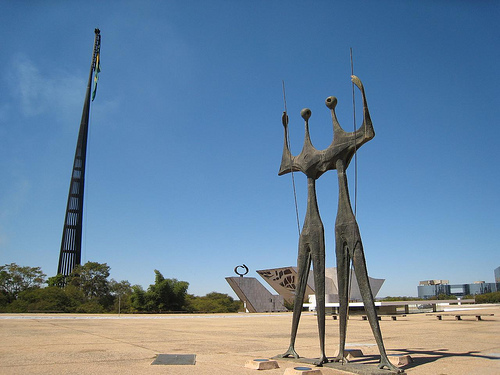
In the Plaza of the Three Powers, Bruno Giorgi’s sculpture, Os Candangos, memorialized the northeastern Brazilians who built the capital.  In the national discourse of the time, these impoverished peasants were living symbols of Brazil’s colonial and agrarian past.  By coming to Brasília and building the city, they were transformed into new pioneers who would settle the vast empty spaces of the country’s interior, from the dry plains of Brasília through the vast green desert of the Amazon.  Unlike the North American slaves who built the White House and the U.S. Captiol buildings, the candangos were memorialized as part and parcel of Brasília’s futurist vision.

The architect must think that the world has to be a better place, that we can end poverty . . . . it is important that the architect think not only of architecture but of how architecture can solve the problems of the world . . . The architect has to always be political.

—Oscar Niemeyer, 2009

Hard Winter

Meanwhile, in London, Sylvia Plath was pregnant again.  Her husband, Ted Hughes, was having an affair with another woman, and they were destined to separate soon after the birth of their son, Nicholas.  In the 13 months after Nick’s birth, Plath wrote most of the poems in her second collection, Ariel, and published her autobiographical novel, The Bell Jar.  Then on February 11, 1963, Plath left her children sleeping in their room, sealed the door with wet towels, and committed suicide with oven gas in the kitchen.

Among the poems she wrote in this period was Brasilia, which was not published in Ariel.  Like Zweig, Plath was thinking about the past and the future and the trouble with seeing it through.

Will they occur,
These people with torso of steel
Winged elbows and eyeholes

Awaiting masses
Of cloud to give them expression,
These super-people! –
And my baby a nail
Driven, driven in.
He shrieks in his grease

Bones nosing for distance.
And I, nearly extinct,
His three teeth cutting

Themselves on my thumb –
And the star,
The old story.

In the lane I meet sheep and wagons,
Red earth, motherly blood.
O You who eat

People like light rays, leave
This one
Mirror safe, unredeemed

By the dove’s annihilation,
The glory
The power, the glory.

It was one of the coldest winters on record in England, and Sylvia Plath’s life was falling apart even as she was bringing new life on.  How long she had intended to take leave of this life is not something we can know.  She had attempted suicide before, and she was troubled by deep emotional struggles that went back to childhood.  Her relationship with Hughes held some high points in her life, but now he had left her for another woman.  What is clear, however, is that once she made her decision, she executed it with consummate intentionality.  She meticulously protected her children as she took her own life.

Like Zweig, she left two works for posthumous publication, one pointing backwards, one pointing forward.  The Bell Jar was on its way to publication; in this, her semi-autobiographical novel, she exposed a world she knew in the past, a world she tried to leave once before.  As she died, the manuscript for Ariel and Other Poems, her masterwork, lay on the desk, each poem typed and left in the precise order she wanted for the book.  The first word of the first poem, “Morning Song,” was “love.”  The last word of the last poem, “Wintering,” was “spring.”

Like Zweig, Plath thought she left a book pointing to a better future, but that wasn’t to be.  The Ariel that was published under Ted Hughes’s editorial guidance was not the same book.  The poems were reordered, others added, and a few, like Brasilia, removed.  This Ariel was darker, seeming to foreshadow Plath’s end, but whatever the critics of Hughes’s intentions, this Ariel made Plath who she is today.

Cold War

On March 31, 1964, the Brazilian military overthrew the democratically elected government.  As the military took control, they created the model for the “bureaucratic authoritarian state” in the developing world.  Niemeyer and Costa’s modernist visions were perverted into symbols of Latin America’s dark period, the capital’s bland functionality and order representing the kind of control that the military celebrated in its culture, the kind of functionality they wished to instill in the rest of the country.

Behind the gleaming white façades of Brasília’s futuristic vision, the Brazilian military contributed to the “dirty wars” against the left in Brazil, Argentina, Chile, and Uruguay.  These regimes took the lives of tens of thousands of people who dreamed of a different kind of democracy than the region had known.  Beyond those killed, many more were tortured, and hundreds of thousands were forced into exile.  Niemeyer, a Communist and therefore enemy of the state, went into exile in Europe.

When the opposition movements eventually took power in the late 1980s and 1990s, the world was a very different place.  Brasília was a bigger city, showing some age, surrounded by “satellite cities” and large favelas – the squatter settlements that the military tried to eradicate in Rio de Janeiro with less than efficient results.  Costa’s rationally designed city had its flaws, its ups and downs, and its critics.  For some, it seemed as if Brazil, and Brasília, had turned Zweig’s book into a joke:  Brazil is the country of the future, and it always will be.

The future that Brasília promised, that Plath saw in her mind and in her children, didn’t work out according to the original plans.  Yet life goes on.  I will continue these themes in the next posting on the The truth and Brasília, 3:  Faroeste Caboclo.

plath-tat

Notes and Credits

The critics of Brasília’s ambitious design and lofty principles are many.  I am not one of them.  I am writing to explore what Brasília means, not its shortcomings, and my approach should indicate that I believe the city’s meaning far outshines any of its shortcomings.

Lauro Cavalcanti provides a beautiful guide to Brazil’s modernist architecture that places Brasília in perspective.  In Brasília, the government sought to “turn the state into a spectacle,” and Brasília is indeed the enactment of a dream.  If you can’t go to Brasília but can find your way to New York, go to Lincoln Center, and you can witness Neimeyer and Brasília’s influence on one of the great cultural centers of the world.

Photo of the Praça dos Três Poderes, with the statue of Os Candangos, is from the Flickr site of Shelley Bernstein, aur2899.  She works at the Brooklyn Museum (according to the Flickr “about”) and has a lot of pictures from Brasília and elsewhere.  Her Brooklyn Museum blog posts are here.

The candangos are publicly memorialized in Brazil, in marked contrast to the North American squelching of the slave labor employed to build our own White House.  Without suggesting that Brazil is any less racist than the U.S., or that either country has a better social model for dealing with its racial legacy, I point this out as a matter of historical interest.  The reader may regard these facts as he or she wishes.

Niemeyer and Costa’s designs were political statements.  They expressed political beliefs in modernity, order, and democracy in the layout of the city.  Niemeyer himself was a Communist, whose architeture reflected his beliefs in a world of collective and individual democracy, the triumph of working people over the old regime and the capitalist governing class.

Oscar Niemeyer is 101 years old, and he is still working.  The quotation in this posting is taken from an interview he did with Santiago Fernandez-Stelley for Vice magazine online, at some point in 2009.  The interview can be seen on video at VBS.TV.  The video of the interview is simply inspirational.

The photo of the Sylvia Plath tattoo is from a photobucket listing from PaperCuttt.  I found it first on this site for literary tattoos.  You can also find material from the same person at another livejournal channel.  She notes that she altered the original slightly (“As I listened to the old bray of my heart….I am. I am. I am.”) but that it contains the same spirit.

I have long been greatly motivated by the poetry and writing of Sylvia Plath.  As I mentioned in the introduction to this series of posts, her Collected Poems was one of two English language books I brought to Brazil in 1992 for my year of doctoral reserach in Belém.  Over my life I have read many books on her and her life.  These resources include:  the poems themselves. Anne Stevenson, Bitter Fame; Jacqueline Rose, The Haunting of Sylvia Plath; Linda Wagner, Critical Essays on Sylvia Plath; and Erica Wagner, Ariel’s Gift.  I’ve tried to read as much as possible, and to work through the thicket of political controversy around her work and life.  I also read Ted Hughes’ Birthday Letters and have some to a deeper appreciation of how Sylvia Plath affected all those around her.  The tragedy of her son’s suicide last year brought me a several days of stark reflection on emotions, depression, and the struggle of human consiousness and life against itself.


12 Comments

Filed under art, beauty, existentialism, failure, ideas, order

Another year, and we remember

IMG_1220

This is the view from the window next to my desk.  From that window, I took the photo that was the first masthead for this blog (it’s in the page on “the blog” if you want to take a look).

This was the view last night, from the ground, at the corner of 6th Avenue and Union Street in Brooklyn.

911-sarah-alt

My downstairs neighbor, Sarah, took that photo, and I saw it on her Flickr.

For the last three years, I have engaged a small ritual on or about September 11, when I can see the beams of light from Ground Zero over downtown from this window.

I turn out the lights.  I sit for a few minutes, 10 minutes or so.  My son is asleep in the next room, or maybe he’s at his mom’s apartment, just a few blocks away in the neighborhood.  Either way, he’s safe, while I gaze at the lights.  Irony is not the word for this.

I know my fate.  One day my name will be associated with a memory of something tremendous—a crisis without equal on earth, the most profound collision of conscience, conjured up against everything that had been believed, demanded, hallowed so far … Where you see ideals, I see what is human, alas, all too human.

Nietzsche’s words stream through my mind as I look at the beams and write my friends—

The clouds have cleared now and I have turned off the lights.  I just want to look out at the beams of light streaming up to the heavens.  So strange to think of the world before that day, and the world we have now.  And it made me feel like reaching out to a few people who matter to me.  I hope you’re all well.

As it happens, I never have taken a photo of the 9.11 beams from this window.  Tonight I will try, but I fear it’s going to be cloudy.  That’s unfortunate, because over the last couple of years, the view was so spectacular, iconic – and this year, 2009, will be my last at this window.  I will be moving at the end of September, to a new apartment in “Prospect Park South” which is the trendy name for what has often been called “Kensington” or simply “Flatbush” in the local dialect.

As all things happen, however, Providence gives us what we need, and Sarah’s photo from last night is such a gift.  So:  Thank you much to Sarah for this photo.  To all those who have touched my life, or whom I have touched in any way however small, I say this,

Be well and cherish those whose love you share.  We have no way to change what was, and our attempts to shape what will be never have their intended effect.  Where we are absolute, however, is the moment at hand.  Let us live that moment well, with love, and with all the peace that the world so deeply needs.  Only then do we stand a chance against the forces of darkness.  Strange as it may seem, those are pretty good odds.

Notes and Credits

Sarah’s photo: http://www.flickr.com/photos/37558372@N03/3908398726/

The precise address of our building is 211 Sixth Avenue.  Or the Union Market, at 754 Union Street, Brooklyn.  11215.

The quote from Nietzsche was taken from the opening of the BBC documentary of him, which can be seen here.  See also this and this.

My own quoted email was what I sent in 2007, the first year I sat at this window.  I cannot find last year’s email, which was a little more focused.  My three years of having this view have been important to me, because this window was a starting-over in many ways.  I will miss the view – but mostly I will hold dear the fact that I have the chance to have this view for a little while.  I only hope that the folks who come next to this little apartment are able to appreciate it as well.

Personal Note

I moved to New York in May of 2004.  In 2001, I was in Rock Island, Illinois, teaching at Augustana College.  On that particular day, I was in my office early.  Jane, who was the secretary for the departments of History and Political Science, came running down the long hallway to my office – we might have been the only two people on the floor.  She told me that I needed to come to the television and see what happened.  Her husband had called and said that a plane crashed into the World Trade Center.  Jane and I watched the rest of it happen, in a conference room on the campus of Augustana College which from its own window had a wonderful view of the Mississippi River and America’s own “heartland” on the border of Illinois and Iowa.  We saw the second plane crash into the other tower, and we saw the buildings fall to the ground, all live.  In my office, I heard about the plane crashing into the Pentagon, live.  I was very afraid.  My wife was out of town, and she was very possibly pregnant with our child (we had this confirmed just weeks after 9.11).  My country was under attack.

I don’t know if folks in New York know what it was like to experience 9.11 outside of this city.  It was pretty dreadful.   Nothing like here, of course, but awful nonetheless.  For a little while, we had no idea where this would lead, and everyone feared bombs and flames and explosions.

A few weeks later, November 10-12, 2001, we were in New York.  My wife had some meetings and I was along for the ride and the visit.  We knew then that our child would be expected some time in May or June.  I had some good runs in the city, in Central Park, along the avenues, but not on the West Side Highway.  It was blocked, for security reasons.  As we prepared to leave on the 12th, we heard odd news suddenly:  all the bridges and tunnels were closed, and so were the airports.  A plane had crashed in Queens.

Downstairs, we spoke to the hotel personnel.  The looks on their faces and the emotions in the air are emblazoned on my mind, in a way that makes me think of my parents’ generation when they talk about what they were doing when Kennedy was assassinated.  I won’t forget that.

6 Comments

Filed under danger, death, existentialism, ideas, philosophy, politics, truth, Uncategorized, war

The truth and mirrors

mirrorphoto

The eye of the beholder sees many things, and the beholder alone is the judge of what he or she sees.  The beholder sees beauty, or ugliness, or truth, or lies, and the beholder knows something.  The thing about eyes, however, is that they look out, not in.

Adam Smith, the great moral philosopher and economist, wrote that the solitary person “could no more think of his own character, of the propriety or demerit of his own sentiments and conduct, of the beauty or deformity of his own mind, than of the beauty or deformity of his own face.” The solitary person, in other words, can know little of himself – and so we need others.  “Bring him into society, and he is immediately provided with the mirror which he wanted [i.e. lacked] before.” This was key for Smith, for he believed that by considering the judgments and opinions that other people have of our actions, we achieve the basis of a moral society.

For Lou Reed, the mirror held the promise of love for those who couldn’t see their own beauty.

I’ll be your mirror
Reflect what you are, in case you don’t know …

When you think the night has seen your mind
That inside you’re twisted and unkind
Let me stand to show that you are blind …

I find it hard to believe you don’t know
The beauty that you are
But if you don’t let me be your eyes …

Michael Jackson took this a step further, hoping that the mirror could help a person look inside.

I’m starting with the man in the mirror
I’m asking him to change his ways …
If you wanna make the world a better place
Take a look at yourself, and then make a change

Jackson’s use of the mirror was a kind of solipsistic (or maybe just plain lonely) version of Freud’s:  “The doctor should be opaque to his patients and, like a mirror, should show them nothing but what is shown to him.”

But mirrors are tricky.  They are passive reflectors.  Place a lie in front of a mirror, and you will see only a lie.  Mirrors confuse and when combined with smoke, serve to hoodwink and swindle people out of the truth and what is real.  The mirror, a hoped-for source of truth, gives the world to magicians and con artists.

In the Middle Ages, ambitious politicians and intellectuals wrote books called Mirror of Princes, in order to curry favor and win state positions by writing about how a real prince could reflect the qualities of an ideal prince.  An elaborate form of flattery, it was a way to get a job, but the Mirror of Princes literature was a corrupt thing, the falsification of what mirrors were supposedly created for.

Machiavelli exploited the lie of the Mirror of Princes to write the definitive satire of political philosophy, The Prince, seen only in its reverse-mirror image of “Machiavellian” self-interested intrigue, deception, and cruelty.  Machiavelli wrote his satire only too well, and his republican and democratic self has been lost to history (except for the community of political theorists, who are a small community indeed).  Machiavelli was a good guy, who survived torture and other awful events for his commitment to democratic republicanism.  Such is the danger of playing in front of mirrors.

In The Lady from Shanghai, Orson Welles created the classic mirror scene, in which his central characters meet in a fun-house mirror maze and proceed to have a shootout amid the dozens of reflected images of themselves.  Just who would kill whom is a matter of luck, but both Everett Sloane and Rita Hayworth are mortally wounded, and their stupidity allows Michael, played by Welles, to walk away free.  The beauty of the scene consists in the way that the mirrors only serve to reflect the hubris of everyone involved, amplifying the conclusions that one might have hoped to see.

Mirrors can show us only what we put in front of them.  Our fun-house mirrors create images that satisfy and mollify at the expense of the truth.  We use mirrors to convince ourselves that we can see objectively, when we’re only seeing what we want to see.  Francis Bacon observed that “… human understanding is like a false mirror, which, receiving rays irregularly, distorts and discolors the nature of things by mingling its own nature with it.”

IMG_1601There are mirrors, and then there are fun-house mirrors, and then there are false mirrors.  Mirrors can’t solve our problems or help us find the truth.  Only honesty can, and that’s a thing apart from mirrors.  Don’t seek the truth in a mirror.  Close your eyes and seek the truth within.  You may not see it, but you may find it.

Credits

Adam Smith, The Theory of the Moral Sentiments, in The Essential Adam Smith, ed. R. Heilbroner (New York:  W. W. Norton, 1986), p. 101.

Lou Reed, “I’ll Be Your Mirror,” recorded by the Velvet Underground and Nico in 1967.

Michael Jackson, “Man in the Mirror, Bad, 1988.

Francis Bacon, Novum Organum, Aphorism 41.

7 Comments

Filed under existentialism, fiction, life, love

Truth and sleeping dogs

img_1353

Truth is a sleeping dog.

Truth is in the details.

Truth is a black-light poster in the valley of darkness.

Truth is a symptom of consciousness.

Truth is fear itself.

Truth is the ballad of Echo and Narcissus.

Truth is the other shoe.

Truth is the uncertainty principle.

Truth is a mirage.

Truth is other people.

Truth is superposition.

Truth is the fruit of the tree of the knowledge of good and evil.

Truth is an oasis.

Truth is a fetish.

Truth is just another word for nothing left to do.

Truth is anisotropic.

Truth is a sandcastle.

Truth is absolutely necessary without necessarily being absolute.

Truth is the essence of dissolve.

Truth has fallen in the forest.

Let the truth lie.

__________

In memoriam: Duke, 1999 – April 5, 2009.  He was a really good dog.

img_1340

100-0010_img

15 Comments

Filed under Duke, existentialism, superposition

The truth and chickens

chicken

Which came first, the chicken or the egg?

Why did the chicken cross the road?

The first question is impossible to answer according to the ordinary laws of humanly observable nature.  This makes the second question all the more difficult, since we cannot answer it unless we discern whether it was the chicken, or the egg, that crossed the road in the first place.

Like Kafka, chickens have provoked controversies over some very important issues.  And, as with Kafka, the answers to these questions become harder and harder to find the deeper we get into the mundane circumstances of the chicken’s world.  Their lives are a maze of small doors and windows followed by a short plunk on the head in the service of something they will never understand.  They know not who their warders are, and their warders won’t even call the chickens (or the eggs) by name.

Note:  Cage-free chickens, their owners, and their consumers comfort themselves in the thought that these “free” chickens have been spared the Kafkaesque world of their cousins, but they haven’t – and you don’t need to be Sartre to see through this fowl illusion.  Their maze is just bigger and harder to see.  This will become apparent when free chickens reach a road.

The explanation provided by quantum mechanics is mathematically elegant and scientifically consistent, even if it’s at odds with the observable universe:  The superpositioned chicken and egg coexist in perfect harmony until the very moment you attempt to answer the question.  Then you have trouble, because the question forces you to put one thing before the other when in fact their natural state is to coexist in perfect, yet completely reasonable, contradiction.  The superpositioned chicken is both egg and chicken, and it is on both sides of the road at the same time.

This is the paradox of Schrödinger’s chicken.

__________

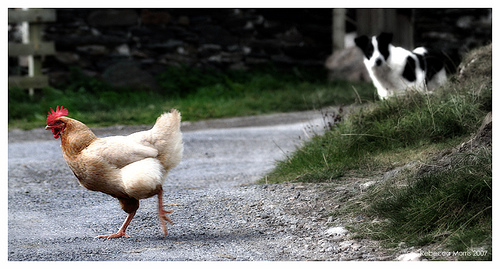
Credit: http://animalphotos.info/a/, photo of chicken crossing road with Schrödinger, or possibly Kafka, disguised as a dog, watching in the background.

Inspiration:  http://maghanlusk.com/category/exploration/, “Are You and Antiterminalist?”

See also:  “Schrödinger’s cat”

3 Comments

Filed under danger, Erwin Schrödinger, existentialism, Franz Kafka, freedom, Jean-Paul Sartre, superposition