Category Archives: life

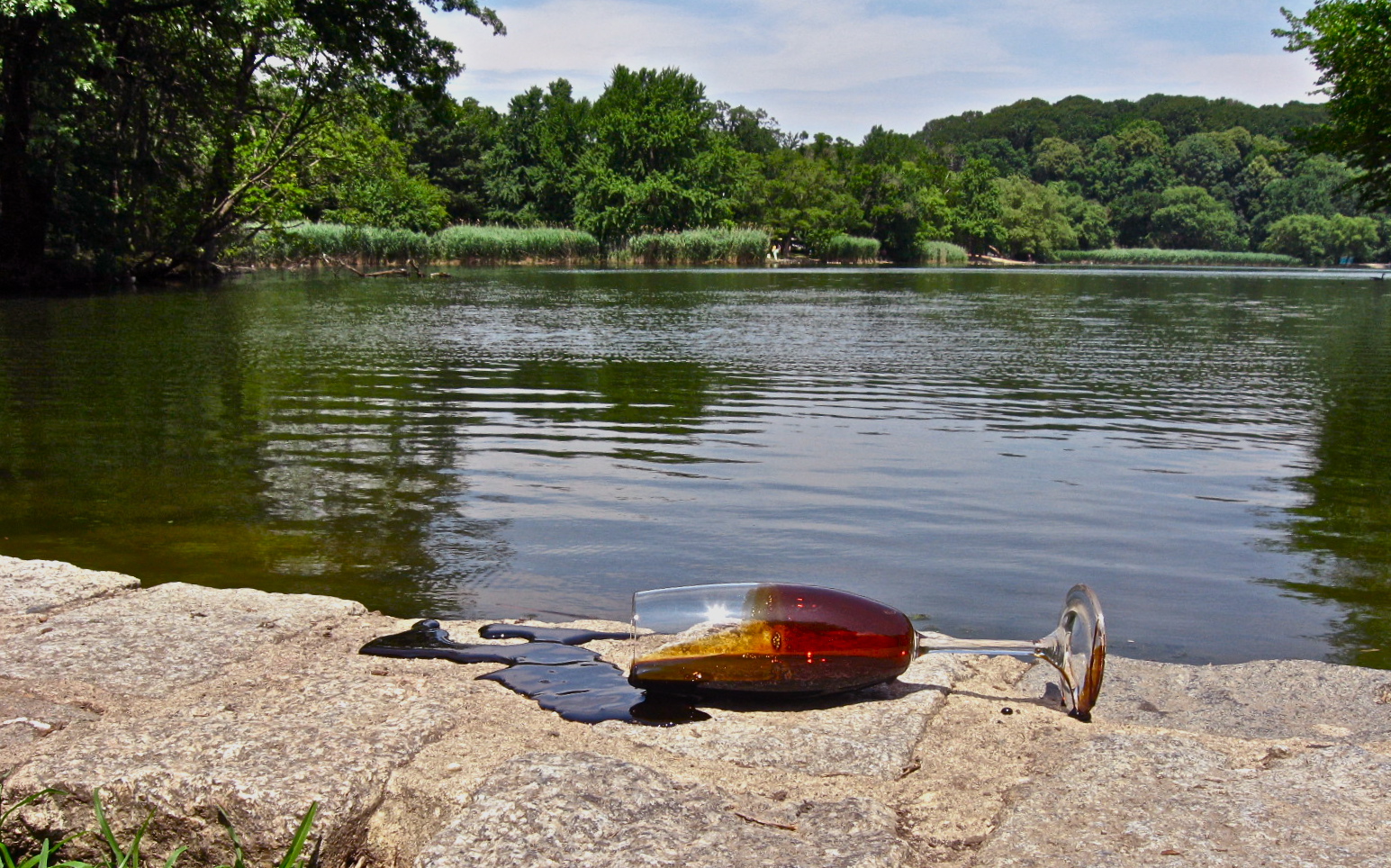
E/F – The glass of oil

There are jobs, and then there are jobs.

We built our world on petroleum, especially in the state I come from, Louisiana.  We power our cars and computers and houses with petrol and its funky little brother, natural gas.  Over the course of the long twentieth century, the automobile fueled explosive growth in the American economy and allowed people to spread out in endless suburbs that offered relief and tranquility compared with the noise and chaos of urban life.

Along the Gulf Coast and elsewhere, countless thousands of jobs are devoted to the exploration, drilling, refining, distributing, selling, purchasing, and using of petrol in its many forms.  We create our food with petrochemical fertilizers that rely on the abundant natural gas deposits found deep in the Gulf of Mexico along with oil.  The plastic bags we carry our food in are made of petroleum.  Cosmetics and personal lubricants are made of petrol.

Oil and other fossil fuels have made everything we know possible, from the things we use to the lifestyle of abundance that for some seems an American birthright.  We Americans are the people of the tar.

We eat the oil, and the oil eats us

Back in the 1970s, when gas prices shot through the roof because of the Arab Oil Embargo, the rest of the country went into a tailspin while Louisiana thrived on oil.  The construction of the New Orleans Superdome, opened in 1975, started a downtown building boom in New Orleans that reshaped the city before my eyes as I grew up. Then in the early 1980s, when oil prices fell as the country’s economy recovered, New Orleans and Louisiana went into a tailspin.  The oil companies moved their offices to Houston and drilling shut down as oil fell below $15 a barrel, the price at which it was no longer economical to produce oil in Louisiana.  As the oil money left, people lost jobs all over the state and everyone suffered.

Now, as the Deepwater Horizon blowout has become the world’s worst man-made environmental disaster, Americans face an impasse.  Do we follow Louisiana’s own politicians and call for more drilling?  These are the same politicians who along with other (mainly Republican) politicians around the country created an environment of contempt for business regulation that fueled a lawless world in the boardroom, on the factory floor, and in the marshes and mountains and wildlife prerserves.  Corporate lobbyists wrote environmental and workplace protection laws.  Our social world—our values and the values reflected by our government—made it the casual business of the day to celebrate the sub-prime mortgage market, overlook safety in coal mines, and build drilling rigs without proper blowout protection.  It was the time of our life and there wasn’t an American alive—left, right, or independent—who didn’t just love their IRAs, home equity, air conditioning, and cheap gas.

Un-natural disasters
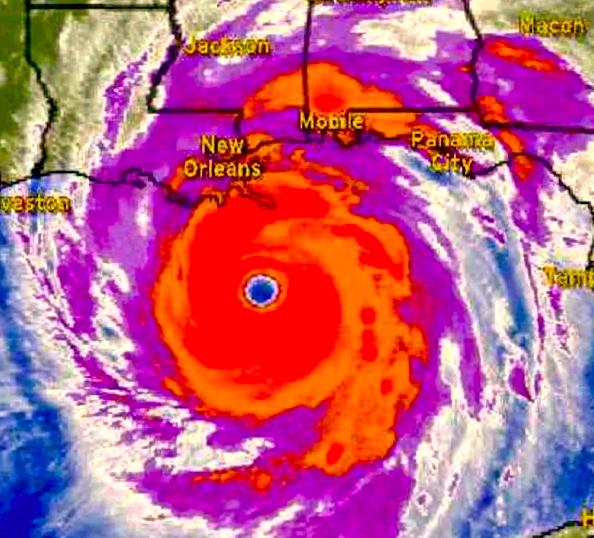
Deepwater Horizon comes almost 5 years after the “natural” disaster of Hurricane Katrina, which continues to show us what can happen when the government abandons its people.  The Katrina disaster was neither inevitable nor natural.  It was a man-made disaster of the first degree, founded upon the same neglect and abdication of social responsibility that are at the core of America’s post-Reagan social contract.

Our world will change as the oil runs out, which it will do one day, sooner rather than later by current predictions.  How many disasters do we need to learn that all of us are made better by a government that provides social protections and guarantees against exploitation—of people, environments, and resources?  The BP oil disaster is our opportunity now for the national courage to get off oil.  Such a matter of fundamental change could be achieved only by a massive state-led effort akin to the New Deal.

For comparison’s sake, here’s The Deal We Got:  oil will kill us, either way.  It’s already started.  If it doesn’t kill us now, it will kill our children or grandchildren.  There’s no going back now on the damage oil has done and will do to Louisiana and the Gulf Coast at large.  Add one hurricane to it this year and it’s over.

Imagine

Can we just think about ending oil?  It doesn’t matter how realistic it seems.  It will hurt.  It hurts to stop any self-destructive addiction.  Yet while it’s going to hurt one way or another, it doesn’t hurt to dream a little.  Ask any hurting person.  Or these pelicans.  Why not …

… deploy the government’s resources to bail out the regular people of Louisiana who will lose their jobs in this tragedy? If it’s good enough for Goldman Sachs it’s good enough for the Bayou State.

… put the Army Corps of Engineers to work creating a levee system that channels the immense force of the Mississippi River to the restoration of the coast? The same government agency that corralled the river in the first place ought to be able to set it free.  Indeed, by cutting off the annual flood, the levees have helped erode the Louisiana wetlands at the rate of one acre per hour. Restoring the annual flood just might be the best way to combat the effects of the oil spill.

… cut our addiction to automobiles and airplanes by building railways—high speed and local—that can rely on wind, hydro, and other safer energy sources? Start with rails in Louisiana so that people there don’t have to buy gas and can still get to work. Put these guys to work at home and let them become a corps of railroad builders who can teach the rest of the nation how it’s done.

Imagine a permanent, federally funded project of restoring and then maintaining one of the world’s most vital and richest wetlands.  Call it real conservation and tip your hat to Teddy Roosevelt (the ex-Republican Bull Moose).  The point is that this is not just an oil spill.  It’s the big one, the wake-up call.  If the fear of losing jobs is what keeps people in Louisiana under the thumb of big oil, then let’s find them other jobs.  Are we slaves?

This isn’t rocket science.  It’s a matter of will.  We are the richest country on Earth, and we can do this if we want to.  While we’re at it, we can finally clean up the mess and set things to right from Katrina.  What America does shows the world—and more importantly, ourselves—what we really want and what we really care about.   What shall we do this time?
The glass

The glass is a champagne flute from Williams Sonoma.  I photographed it on the southern edge of the pond in Prospect Park, Brooklyn.  The pond is home to a lot of turtles.  Fish are stocked and then fished out by the people who live in the neighborhood.  Macy’s sponsors an annual fishing tournament in the park.  Swans, geese, ducks and other birds make the pond home, for at least part of the year.  Of late, there has been a series of mysterious animal deaths in the park, prompting outrage and concern by folks all over the city.  Comprehensive coverage of what started with an injury to John Boy the Swan, which later resulted in his death, can be found in Gothamist and in the Brooklyn Paper.  Video of John Boy can be found here.

Notes and Credits

All photographs are by the author, unless otherwise noted.

On the petrochemical sources of our food, no one has written more eloquently than Michael Pollan.  In his book, Omnivore’s Dilemma, he provides an accounting of the carbon footprint beneath the food we buy so cheaply in the supermarket, as well as the government policies that prop up the union of agribusiness and petroleum.

The sub-title, “We eat the oil and the oil eats us,” paraphrases the title of June Nash’s classic book about Bolivian tin miners, We Eat the Mines and the Mines Eat Us.  The book’s title comes from the way the miners talked about their relationship to the mines, mining, the mountains, and the tin companies that exploited them so ruthlessly.  Louisiana is like that, a place being eaten up by big companies who could care less about the local people apart from their willingness to work for low wages without union representation.  When I was a kid, we sometimes called New Orleans “The Tegucigalpa of the North.” It was sort of joke, just sort of.

On levees and their importance—I grew up about a half mile from the levee.  I used to play behind the levee every day in the batture, the swampy land between the levee and the river itself.  We played army and pirates behind the levee when we were little.  Then we smoked pot and made out.  When I was in college at Loyola University in New Orleans, I used to ride my bike from home (commuter student) to the college on the levee.  I wrote one of my best songs, “Down By the River,” about falling in love with a brown-eyed girl who gave me my first kiss on the levee.  It’s a bluegrass tune.

I took the satellite image of Hurricane Katrina from weather.com a few days before it made landfall.  I was holed up in Dallas, Texas, at my mother-in-law’s.  I happened to be there visiting, for reasons that had nothing at all to do with the storm.  My parents went to my brother’s place in Nacogdoches, Texas—now they were storm refugees and only went home at the end of October, after 2 months in Texas.  I kept that image of Katrina.  In my anger over the storm and the abandonment of New Orleans, I made it the wallpaper of my computer desktop, not changing it for a couple of years.

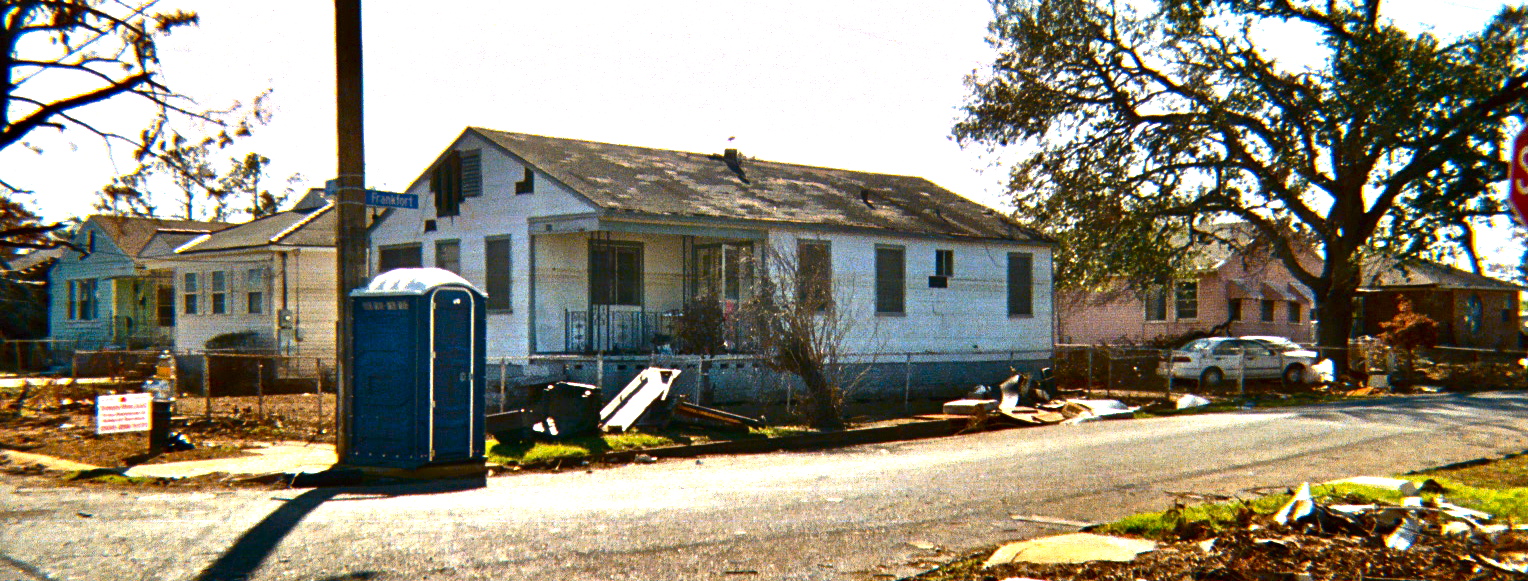
The battered house is where my father grew up in the 1940s and 50s.  It was on the corner of Lafaye and Frankfort Streets, which was in a new subdivision being made up near the shore of Lake Ponchatrain, where the Air Force had major installations during World War II.  My grandparents moved there after the war, once my grandfather— “Grumpy” as we called him—got home from the Pacific and took a job with the Postal Service, where he would work until his retirement.  I remember that house in the 1960s and early 70s.  I was all of 5 and everything was happy there.  Grumpy made ice cream in the back yard and told us funny stories.  He let us grandkids take a turn or two each on the hand-crank.  It was good ice cream.  The house is no longer there.

Environmental Impact Statement

None of the fish, turtles, geese, ducks, or swans that call Prospect Park home were endangered in any way by this photo shoot.  In place of oil, I used all-natural, unsulphered molasses, which has the look of oil but is quite sticky and tastes much better.

Molasses is a rather suitable substitute for oil in other ways as well, since it’s a Louisiana product that probably does much less damage than oil.  My grandparents grew up on sugar plantations up the river from New Orleans.  Grumpy used to tell us how they refined sugar from cane, every single step, including molasses.  He knew sugar.  Granny used molasses to sweeten the pecan pies she made every year with the nuts she gathered from the tree in her own backyard.  Molasses has been around for a long time without causing the epidemic of obesity that can be traced to high fructose corn syrup, which in turn can be traced be to the agricultural policies of the Nixon administration (will we ever run out Republicans in this story?), which in turn can be traced to petrochemical fertlizers and in the end:  oil, oil, oil.

The use of the first-person, plural possessive—we—in this essay is intentional.  We all own the oil spill.  The politicians who created the culture of disregard for public safety and environmental sustainability in business and corporate life are there because they received enough votes to win office.  The people who voted them in office did so for various reasons that Thomas Frank documents pretty well in What’s the Matter with Kansas and which for Louisiana are intricately related to the famed “Southern Strategy” that the Republican party adopted with Richard Nixon’s successful presidential campaign in 1968.  The race politics that underlay all of this are a tangled (yet quite simple) web that deserve another essay in their own right.  This is how America is, for whatever it’s worth.  Those of us who didn’t vote for these politicians, we’re also complicit.  We use the energy that comes from petrol.  We might want to laugh at Sarah Palin’s convoluted explanation of how environmentalists are really responsible for the Deepwater Horizon tragedy, but it’s our culture and we’ll keep driving to work every day, even if on a bus powered by gasoline or its funky little brother, “natural” gas.

We are the people of the tar.
10 Comments

Filed under danger, death, failure, freedom, hubris, life, Louisiana, Park Slope, politics, riches, truth

The truth and type-casting

There are two kinds of people:  those who follow and those who don’t.  Of followers, there are two kinds:  those who stay put, and those who go somewhere.  Of followers who go somewhere, there are two kinds:  those who are led and those who are pushed, the latter including those who fall in holes  whether pushed or not (go ask Alice).  Of followers who stay put, there are two kinds:  those who stay in a place, and those who stay in a particular frame of mind.

Of those who do not follow, there are three kinds:  poets, prophets, and migrants.  Of poets, it is said that they show us who we are.  Of prophets, it is said that they show us who we should be.  Of migrants, it is said they show us where to go next.

Poets, prophets, and migrants are called.  They do not choose who they are, and mistakes can be made when callings are crossed, whether by the one who is called or by those doing the calling.  When poets are mistaken for prophets, everyone is deceived.  Cults are formed and lives are wasted.

There’s a whole lot of people in trouble tonight from the disease of conceit
Whole lot of people seeing double tonight from the disease of conceit
Give you delusions of grandeur and an evil eye
Give you the idea that you’re too good to die
Then they bury you from your head to your feet
From the disease of conceit.

Bob Dylan, “Disease of Conceit”

Prophets are rarely mistaken for poets, but when they are, they are generally neither and the poetry is awful.  Though it is nearly impossible for a poet to be a prophet, either might be a migrant, whether on land, in dreams, or of the mind.

Leadership is an attribute given by those who follow to someone else, who may or not be the kind of person who follows.  The truth is—leadership has nothing to do with being a follower or not.  In the end, perhaps there really are only two kinds of people:  those who do well when type-cast, and those who only begin to thrive when cast against type.

Notes and Credits

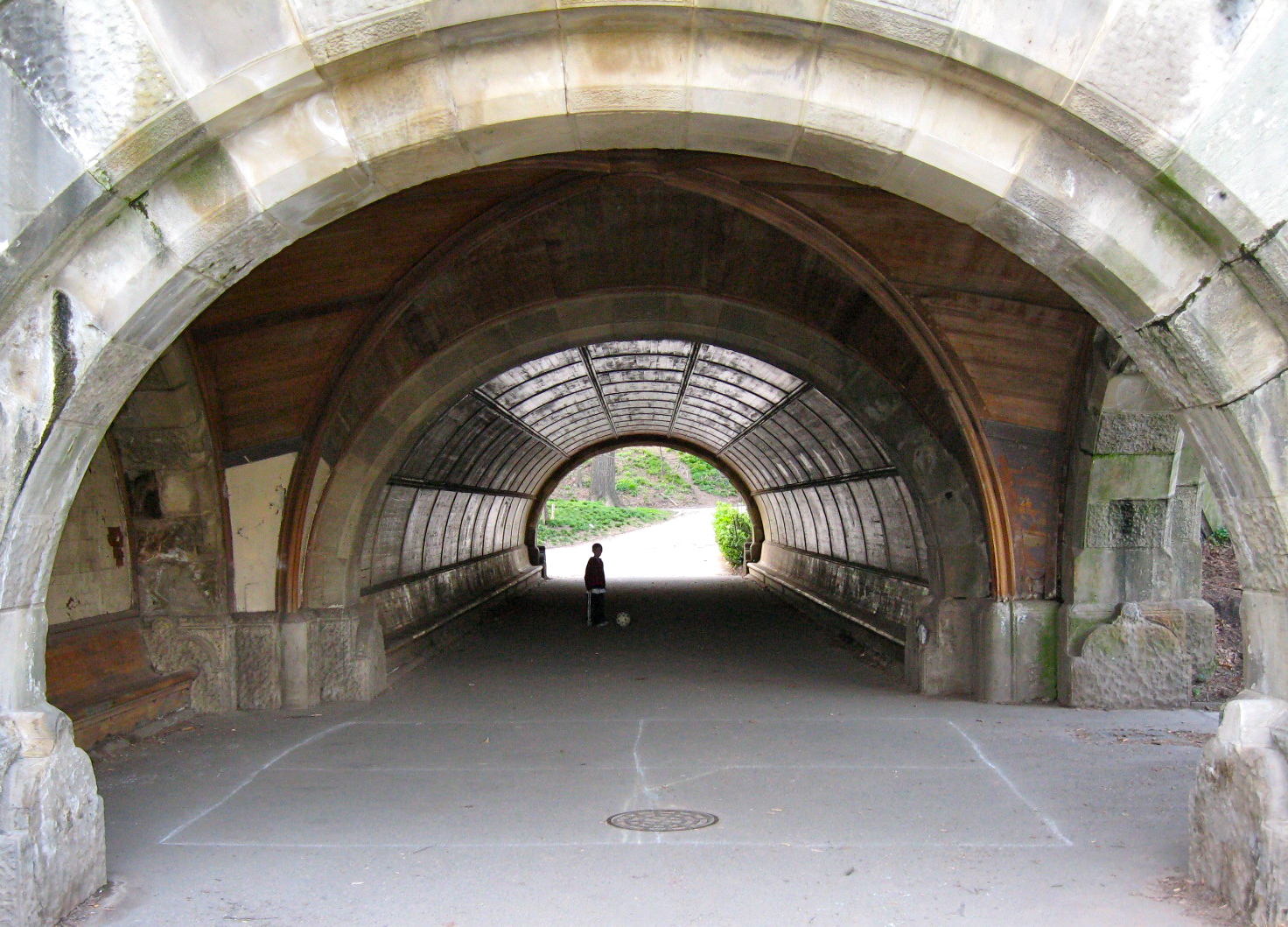
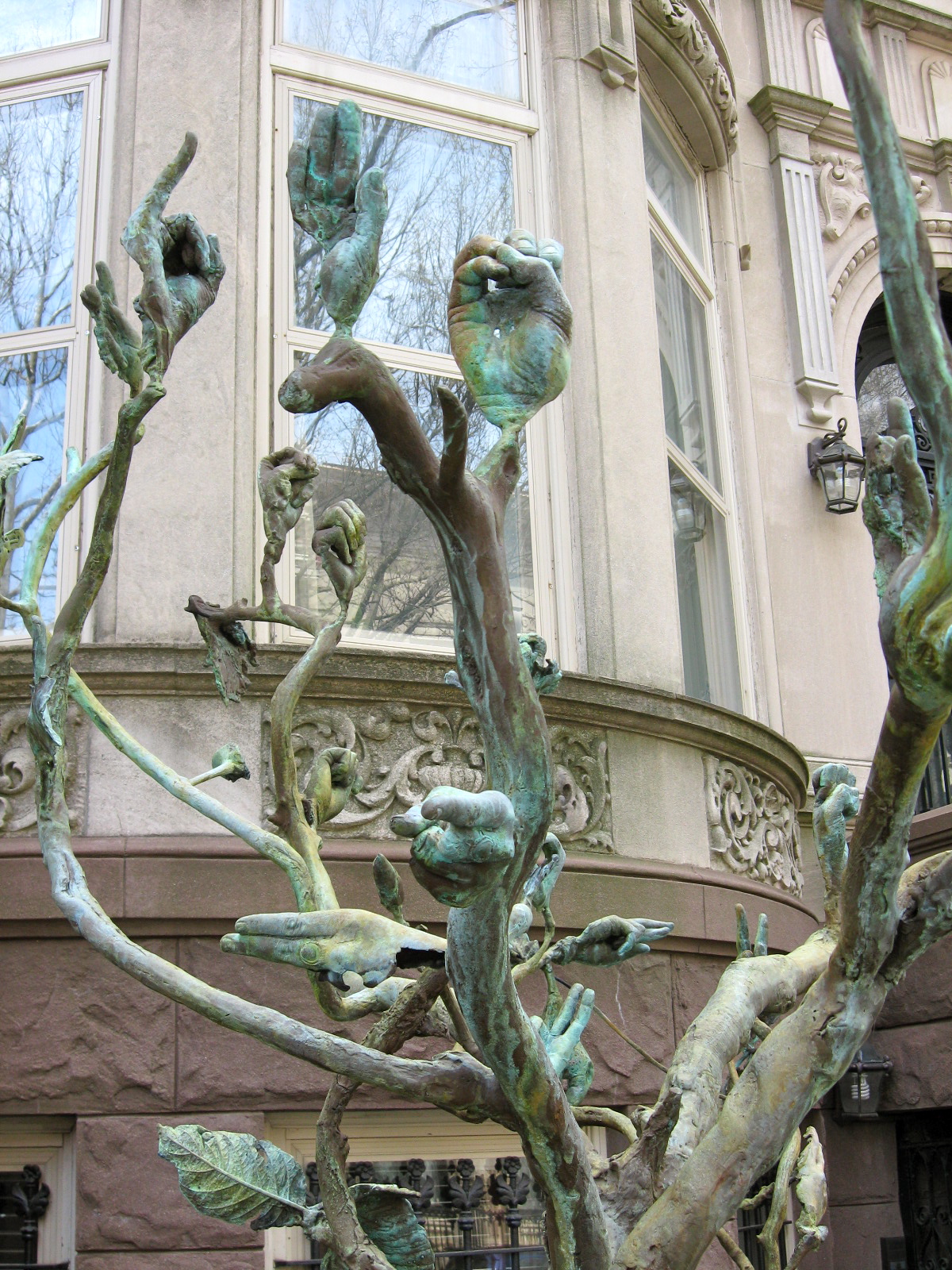
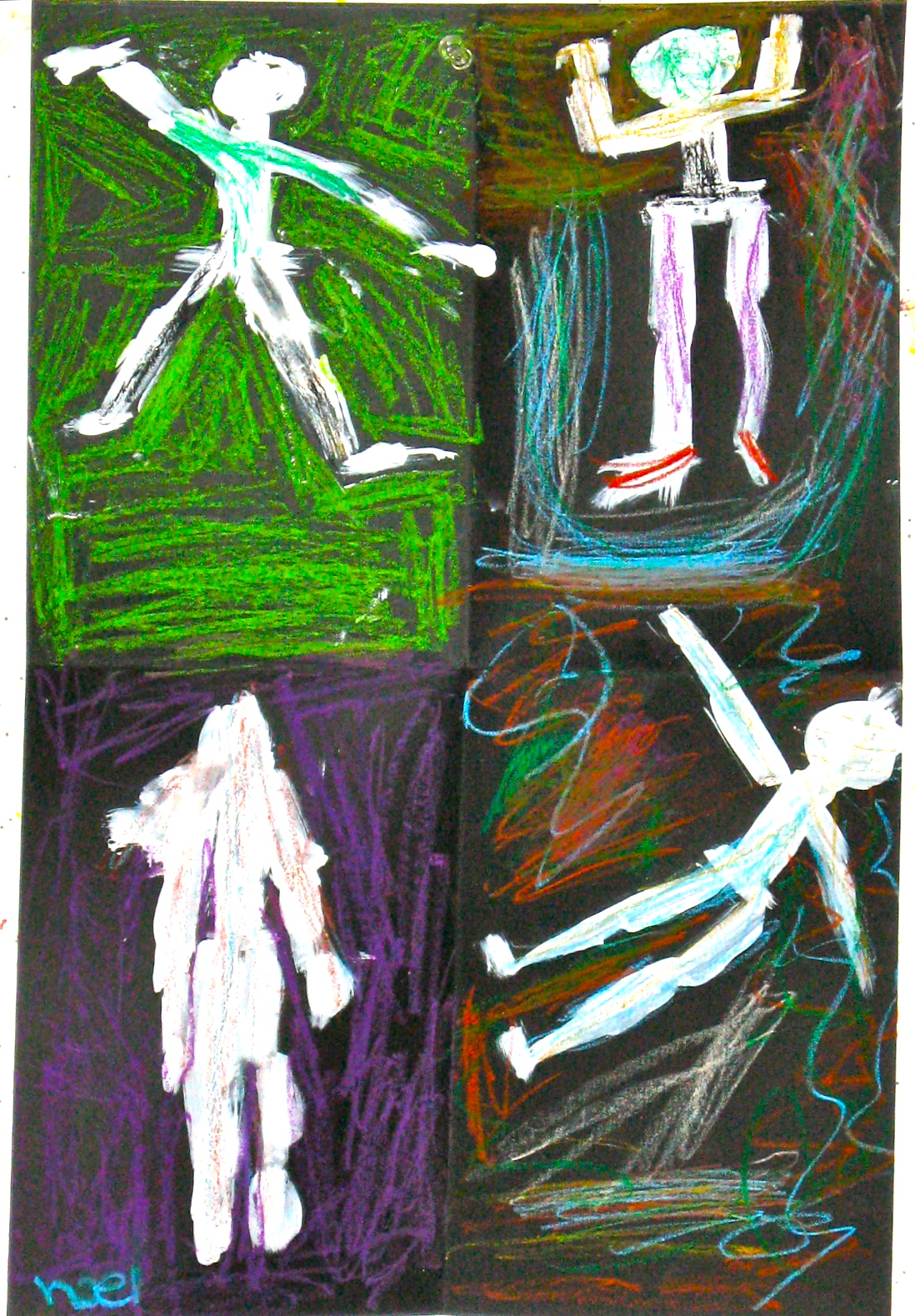
The photos were all taken by the author in the neighborhood of Park Slope, Brooklyn, in 2008, 2009, and 2010.  The first is a photo of an art project my son did in the first grade (2009), drawing the human form.  The second is the tunnel at the northwestern entrance of Prospect Park.  The third is a garden scultpure in front of a house on 2nd Street, near the corner with Prospect Park West.

Bob Dylan was called to be a poet, but the people who loved him wanted him to be a prophet.  It cost him, and some of those loved him, twenty years. After years of reflection, Dylan wrote that by the mid-1980s “[e]verything was smashed.  My own songs had become strangers to me. I didn’t have the skill to touch their raw nerves, couldn’t penetrate the surfaces.  It wasn’t my moment of history any more.  I couldn’t wait to retire and fold the tent”—Chronicles, Vol. One (Simon and Schuster, 2004), p. 148.

Dylan wrote “Disease of Conceit,” in 1987 as he began to explore a new musical identity more aligned with his own sense of self and his mission as an artist. The song would be the eighth track on Oh Mercy, the album that set him on the path to redeeming his career with a whole new audience by the mid-1990s.  In the fall of 1989, I saw him perform at Hill Auditorium on the University of Michigan Campus in Ann Arbor.  It was the third show of his I had seen at that point in my life and by far the best.  Toward the end of the show – as either the closing song or the last encore – he brought down the house with “Disease of Conceit.”  The poetry was breathtaking.

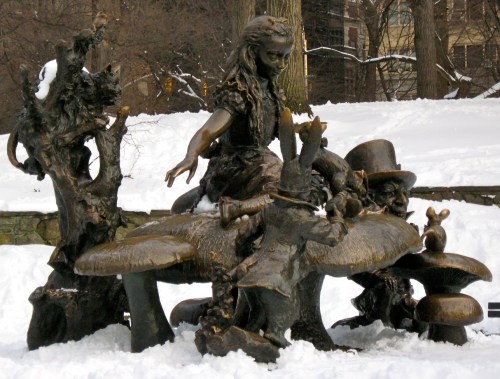
As for those who fall down holes …

Alice on the toad-stool, Central Park, New York, December 20, 2009

3 Comments

Filed under art, freedom, ideas, life, Park Slope, poetry, truth, vanity

E/F – The glass of life

God looked at everything he had made, and he found it very good (Genesis 1:31).

Life is full of contradiction, and so are attempts to understand where life came from, why we are here, and what will become of us.

An old English proverb proclaims:  There but for the grace of God go I. The proverb sums up the randomness of the universe—the order-out-of-chaos, the utter, unexplained, and unaccounted for contingency of life itself—as a matter of Divine will.

Some have interpreted this idea darkly, as for example the Reverend Jonathan Edwards, whose God is angry and holds sinners over the pit of hell “much as one holds a spider, or some loathsome insect over the fire.”  For Edwards, only God’s “pleasure” or “arbitrary will” stood in the way of eternal suffering, and the sinner “hang[s] by a slender thread, with the flames of divine wrath flashing about it …”  Lions and tigers and bears seem meek by comparison—oh my.

For those who dwell on the goodness of the Earth, however, life as a gift of grace is a liberating thought, providing the freedom to leave other-worldly issues alone.  Instead, one’s gaze turns to the things that matter in this world, and in this moment a new kind of human freedom is born.  The world beyond this one is indeed arbitrary and unknowable, but in this world what we do matters.  Here we, not God, are responsible.

This notion of contingency, of the arbitrary nature of causality in the universe, isn’t a terribly God-bound thought.  The grace of God in the proverb can be understood in quite godless terms as the general force of randomness as it functions in the entropy of the universe.  Either way, life is contingent on a lot of things that are completely out of our control, and in that contingency, ironically, good and evil are placed in human hands and human hands alone.

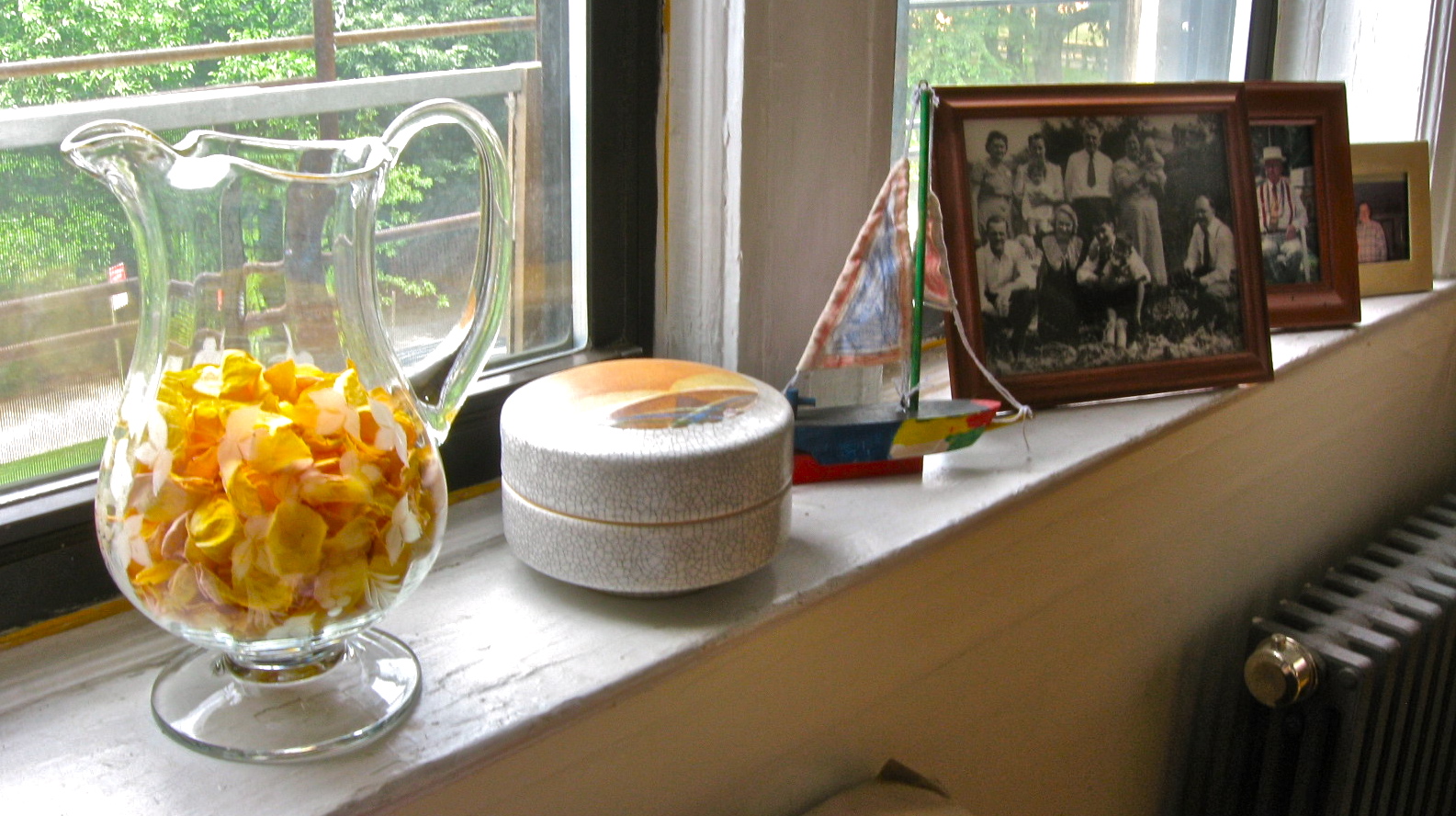
The pitcher and its window sill

A couple months ago, I had a party.  I’d moved into a new apartment and wanted to share the space with some friends.  We prepared for the party all day, cleaning house and eventually going out to buy some good cheese, wine, bread, the makings of spinach salad, and such.  Along the way, my girlfriend bought a dozen yellow roses.

After the party, once the roses had dried, I took the petals from the stems and placed them in a bowl.  I had hoped they would smell like roses and I would crush them to place them in a bowl as potpourri.  Alas, they never smelled so good, but the yellow petals were very pretty and I put them in the pitcher, which sits on the window sill and now adds a dash of yellow to the room.

On this window sill in my living room, I keep a number of things.  There is a ceramic covered bowl that I bought in 1989 the first time I ever went to the Ann Arbor Art Fair.  It was made by Rob Wiedmaier, who worked out of St. Joseph, Missouri.  Next to that is a little wooden toy sailboat that my son made from a kit he received in the gift bag at another boy’s birthday party.  And then there are three photographs of my family.

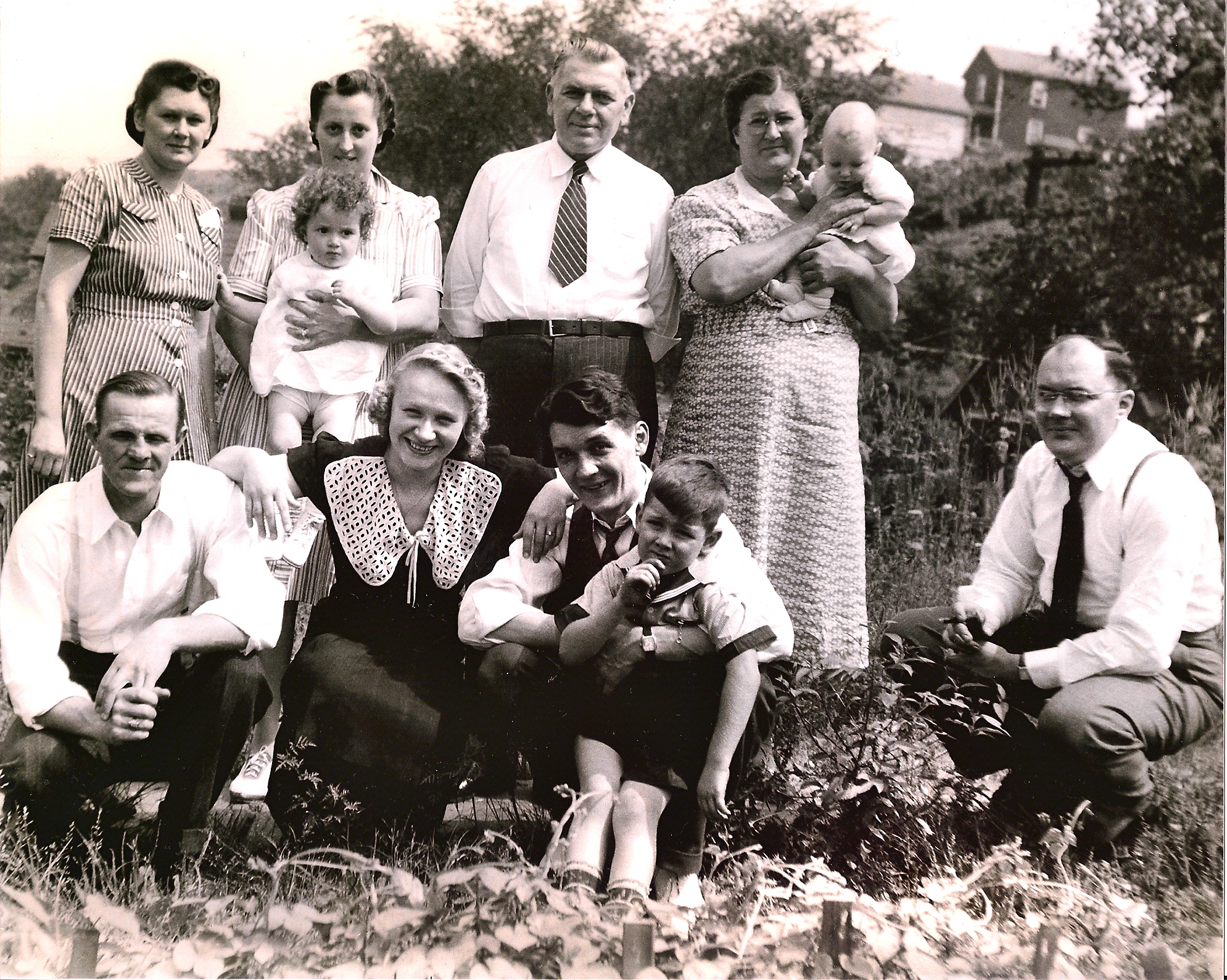
Buddy-Buddy, Grandpa #1

In the first photograph, we have the Krupas, from about 1941 or so.  The patriach, great-grandpa Krupa, stands in the center.  His three children are there—Joe, Johnny, and Annie.  Joe was my grandfather, who my brother and I called “Buddy-Buddy,” because he that’s what he was, our buddy.  Next to great-grandpa Krupa is my grandmother, Joe’s wife, Mary Niznik.  She’s is holding my mother, Mary, who is about one year old in this photo, looking bright with her Shirley Temple curls.  These were good Slovak people from the hills of the Monongahela Valley in western Pennsylvania.

Buddy-Buddy was a steelworker. After he died in 1969, my grandmother came to live with us, and for the next seven years, she was the most wonderful storyteller, babysitter, friend, and ally my brother and I ever had.  She made stuffed cabbage roles, she ground her own meat, and she made the Easter Bread every year, just like in the old country, which she called “Austria-Hungary.”  I took Joseph as my confirmation name in the memory of my Buddy-Buddy.  My brother named his son Joseph.

Grumpy, Grandpa #2

The next photo over is of my other grandfather, Ernest John Guidry, III.  In the photo he is old, in his mid-70s, sitting in his back yard decked out for Mardi Gras.  My brother and I never called him “grandpa.”  We always called him “Grumpy,” a nickname that my mother gave him because he was always so jolly and full of life.  He had 17 grandchildren, and he called each and every one of us “Peanut.”  When this photo was taken, he had recently been diagnosed with Parkinson’s Disease.  He died within a year or two of the diagnosis, thankfully, we all felt.

The good fight

In the final photo, half hidden behind the rest on the window sill, are my mother and father.  They were photographed in the den/living room of their house in River Ridge, Louisiana, the house where I grew up.  I remember the first time I saw the place.  It was in 1973, late summer. Mom took my brother and I there—we were all of 8 and 9—and there wasn’t much of a house.  Just a slab of concrete on a sand lot with lots of trees all around.  There were only four houses on the street.  A couple months later, there was a house on our slab, and we moved.  Such it was in the 70s.  My father still lives there.

The photo is from the better days, before the multiple sclerosis put mom in a wheelchair and changed her body and all of our lives in ways that are all but impossible to describe.  She passed away on June 27, 2007, and for her funeral mass, she had the following read from Paul’s second letter to Timothy, which I forever think of when I think of her—

I for my part am already being poured out like a libation.  The time of my dissolution is near.  I have fought the good fight, I have finished the race, I have kept the faith. —2 Timothy 4:6-7
Consider the lilies

Such is life, with no reason to be and no reason to end, but every reason for the living to live.  Do not ask, but live.  Run the race you are given.  Be simple and don’t strive.  Be like the flowers of the field.

lilies

Consider the lilies how they grow: they toil not, they spin not; and yet I say unto you, that Solomon in all his glory was not arrayed like one of these. —Luke 12:27

Notes and Credits (Grandpa #3)

The photographs of the pitcher, the window sill, and the lily were taken by author.  The window sill was photographed as it appears in my living room.  Behind it, through the window, is the Bowling Green of the Prospect Park Parade Grounds in Brooklyn, which has been the photographic subject of a few postings so far.
The lily grows in my apartment building’s garden next to the sidewalk.  The garden isn’t kept or tended very well.  It mainly just grows there, though I do see Bart’s mother, the landlord, sweeping and cleaning and watering from time to time.  I saw the flower when returning home from a run in the park with my son.

Of all the people in the photographs, only one is still alive, my father.  He is 70 years-old now, in quite robust health, and determined to reach 100.  His odds are better than average.  His father, who was pictured as described, died at 77, quite young for our family.  My father’s mother died at 91.  His grandmother, EJ’s mother, died at 101 or 102.  The rest of our aunts and uncles are in their 80s and 90s.  My odds, on the other hand, are something of a split decision, for my mother’s side of the family—the Krupas and Nizniks—mainly seem to die in their 50s and 60s.  Mom was 67 when she died, like her mother, who made the cabbage rolls and the Easter Bread.  Buddy-Buddy was about 58 when he passed on.  There but for the grace of God go any one of us, on any given day, at any given age.

For the record, my son and his cousins call my father “Grandpa,” because that’s what he is.

The Family Krupa, c. 1941

3 Comments

Filed under ageing, body, entropy, existentialism, freedom, life, philosophy, truth

E/F – The glass of writing

“… let no mournful yesterdays
disturb thy peaceful heart.”

Ellen M. Huntington Gates, “Sleep Sweet”

“Of the making of many books there is no end,
and in much study there is weariness for the flesh.”

Ecclesiastes 12:12

When the glass is empty the writer searches, at times desperately, for some truth or experience to put on the page.  The writer writes to make life real.  It is an alchemy that turns nothing into something.  Without writing, the writer is hollow, small, almost nothing.

When the glass is full the writer becomes like a god, though not so much a god of creation as one who reorders worlds that already exist.  The writer recreates what he or she has known in order to say something about it.  At the end of the day, it is a gratifying act.

Reverie

In 1967, Gloria Steinem interviewed Truman Capote for an article that was published in McCall’s.  It was a candid interview.  She asked him how he would like to be described as a writer and as a person—adding “without false modesty,” just in case.  Capote replied with grace and clarity.

“As a writer, that I’m a good artist, a serious craftsman; that my writing gives pleasure in itself, regardless of what I’m writing about.  I spend a great deal of time with that object in mind.  Because to me, the greatest pleasure of writing is not what it’s about, but the inner music that words make.”

Early in his career, Capote was praised for the beauty of his sentences.  His prose was impeccable and his writing almost alone brought him into social circumstances the likes of which he never could have dreamed as the model for Dill in Harper Lee’s To Kill a Mockingbird, a lonely child of divorce in a small Alabama town.

But Capote flew too close to sun.  In a terrific irony—the exception that proves the rule, it seems—Capote’s downfall came when he tried to write what he (thought he) knew.  The serialized chapters of his long-awaited novel, Answered Prayers, hewed too closely to the real lives of his New York socialite crowd.  Scandalized, Capote’s supposed friends abandoned him and he learned how far, indeed, Monroeville, Alabama, was from New York’s Upper East Side.

Capote had abandoned the “inner music” of his words for a cloying attempt that was less writing what he knew than writing what he both coveted and hated.  Such is vanity.

Vanity

To write is to be like a god, one of those fundamental acts of hubris that always results in a fall, whether in the Garden of Eden or Greek mythology.  The “inner music” of Capotean reverie was to Franz Kafka a siren call to vanity and self-worship through the admiration of others.  To his close friend and ally, Max Brod, Kafka wrote in 1922—

“Writing is a sweet and wonderful reward, but a reward for what?  Last night it was as clear to me as the catechism learned in childhood that it is a reward for devil worship. This descent to the powers of darkness, the dubious embraces, and all the other things that doubtless occur down below and which we know nothing about up here when we write our stories in the sunshine.  Perhaps there are other kinds of writing, this is only one I know…”

The writer was oblivious to this affliction, mindlessly scribbling away beneath a penumbra of vanity that surrounded the sun itself.  Like sex, writing was at once a sensual and gratifying pact with the devil that was utterly essential to living experience—and at the same time, an act that obscured and defamed the very essence of love itself.

“It is the vanity and the hedonism, which flutter around and around either one’s own or another’s form in a ceaseless search for pleasure until in the end, by this constant repetition, a whole planetary system of vanity is created.”

Kafka’s life was filled with deep and vital relationships, with both women and men.  His Madonna-whore complex notwithstanding, he knew how to connect with others, recoiling only from those women he thought of marrying.  Writing was Kafka’s only salvation, the only thing that made him seem real to himself.

As a writer, however, Kafka was a failure in his own estimation.  His work remains for us mainly because his close friend and literary executor, Max Brod, famously chose to ignore to Kafka’s request to destroy all the remaining manuscripts, which included his novels The Trial, The Castle, and Amerika.

Prayer, a writerly cup

The photo of the cup of tea at the beginning of this post was given to me by a friend, Maghan Lusk.  She is from South Carolina.  In 2008-09, she wrote a blog called “[a creative writer’s] life, uncensored.”  On the blog, she wrote about writing, managing seamlessly to intersperse her own experiences with topical matter.  Her writing and point of view suggested a very thoughtful person who took the time to understand why people were doing what they did, rather than judging them and tossing off opinions.

In 2009, she shut down her blog to work on her first novel, which she has now completed.  Of her desk and cup she wrote—

“When I sit down to write, I make a pot of Ceylon orange pekoe (2 tbsp of loose tea, 1 tbsp of lemon curd, 1 tbsp of honey).  And I warm the pot before I add the boiling water – it’s a highly methodical process.  I like the color, so I always drink from a glass tea cup.  The pot in the back belonged to my mom before she married my dad (27 years ago).”

Before Maghan turned the pot to the support of her writer’s craft, her mother used it to warm the water she soaked her feet with.  Behind the pot, on the edge of the chest-of-drawers, is a framed poem, “Sleep Sweet,” by Ellen M. Huntington Gates.

The desk itself is piled high with the artifacts of Maghan’s life and work.  In the stack of books are admired pieces, atop which sits Marilynne Robinson’s Gilead, the much-celebrated novel set in Iowa, in which the Rev. John Ames writes out a family history for his young son.  The Reverend’s wife calculated that all the sermons he had written across his life of preaching would come to 67,500 pages of prose, or 225 books by the Rev.’s own calculation, “which puts me up there with Augustine and Calvin for quantity.”  In Robinson’s prose, Rev. Ames takes us to a place in writing so much finer and wonderful than Kafka’s, less self-involved than Capote’s, more human and more in touch with the real reasons we write—to reach out to someone else.

“For me writing has always felt like praying, even when I wasn’t writing prayers, as I was often enough.  You feel that you are with someone.  I feel that I am with you now, whatever that can mean …”

Feeding the Wolves

There is a famous Cherokee fable that goes like this.

An elder Cherokee was teaching his grandchildren about life. He said to them, “A fight is going on inside me. It is a terrible fight and it is between two wolves.  One wolf represents fear, anger, envy, sorrow, regret, greed, arrogance, self-pity, guilt, resentment, inferiority, lies, false pride, superiority, and ego.  The other stands for joy, peace, love, hope, sharing, serenity, humility, kindness, benevolence, friendship, empathy, generosity, truth, compassion, and faith. This same fight is going on inside you, and inside every other person, too.”

The children thought about it for a minute and then one child asked his grandfather, “Which wolf will win?”

The old Cherokee simply replied, “The one you feed.”

Capote fed both wolves, with his life and with his words.  He was as destroyed by writing as he was acclaimed for it.  The same thing happened to Hemingway.  Kafka—and possibly Faulkner—fed the wolves with words alone, leaving their lives to become shambles of unrequited desire.

Sylvia Plath fed both wolves.  She fed them with her words and her flesh.  She married a man, Ted Hughes, who believed that a writer had the duty to live beyond all morality, to use his or her own life to build the experiences that would come to life in words.

To be an artist is a dangerous thing.  It is a special role, a special calling that cannot be resisted.  From the beginning of time—Lascaux to the Bible to Pynchon and Picasso and Joe Strummer—artists have helped us know who we are and how we live.  Some of them handle the role better than others.

Notes and Credits

I owe thanks to Maghan Lusk for sharing her photos and story for this posting, as well as for insightful correspondence over issues of writing, spirituality, and living in the Deep South over the last year or so.

Capote’s interview was by Gloria Steinem, “‘Go Right Ahead and Ask Me Anything.’  (And So She Did) An Interview with Truman Capote.”  McCall’s 95 (November 1967), 76-77, 148-52, 154.

Kafka from: Letter to Max Brod, July 5, 1922, in Franz Kafka, I Am a Memory Come Alive:  Autobiographical Writings, ed. N Glatzer (New York:  Schocken, 1974), p. 223.  An interesting source for Kafka information (though not the only one I used, of course) and condominiums in Miami can be found here.

Gilead quotation:  p. 19 of the Picador, 2004, edition.

The Cherokee fable of the two wolves is widely known.  The version posted here was taken from a website called “First People, The Legends.”  The story is the much the same in its various posting around the Web.

The photographs of books were taken by the author, on his own desk.  Disclosure:  I have not read Gilead, but I will do so shortly.  I have not read In Cold Blood, but I saw the movie with Robert Blake a long time ago on late-night tv.  I have not seen the movies of Capote’s life, neither Toby Jones’s nor Philip Seymour Hoffman’s.  The copy of In Cold Blood in the photograph was found on the sidewalk in Park Slope one day.  I have read much of Kafka’s writing—novels, stories, and letters, and I saw the movie.

2 Comments

Filed under art, beauty, danger, failure, fiction, ideas, life, love, risk, truth, writing

The truth and spring-time

April is the cruellest month, breeding
Lilacs out of the dead land, mixing
Memory and desire, stirring
Dull roots with spring rain.

These, I, singing in spring, collect for lovers
Collecting, I traverse the garden, the world—but soon I pass the gates,
Now along the pond-side—now wading in a little, fearing not the wet …

Everything here is yellow and green
the ground, that winter nightmare,
has cured its sores and burst
with green birds and vitamins

The bees are flying. They taste the spring.

I took a broken root to fling
Where the proud, wayward squirrel went,
Taking delight that he could spring

Oh, give us pleasure in the flowers to-day;
For this is love and nothing else is love,
The which it is reserved for God above

Notes and Credits

T. S. Eliot, The Waste Land, ll. 1-4

Walt Whitman, Leaves of Grass, #38, These, I, Singing in Spring, ll. 1, 4-5

Anne Sexton, It is a Spring Afternoon, ll. 1, 30-32

Sylvia Plath, Wintering, l. 50

W. B. Yeats, An Appointment, ll. 2-4

Robert Frost, A Prayer in Spring, ll. 1, 13-14

All the photos were taken by the writer in Prospect Park, Brooklyn – except for the white roses, which bloom every year in Tom and Laura’s backyard in Park Slope, Brooklyn.  The squirrel is the most recent, taken as he chopped up and dropped leaves and twigs and flowers on all of us baseball parents while our children were at practice last week.

For the W. B. Yeats poem, I credit Jim Tolstrup, who posted on this poem and squirrels and anarchy a couple months ago.

9 Comments

Filed under beauty, life, love, Park Slope, poetry, truth

The truth and every purpose

February 10 , 2010

There is an appointed time for everything,
and a time for every affair under the heavens.

A time to be born, and a time to die;
a time to plant, and a time to uproot the plant.

April 21, 2010

A time to kill, and a time to heal;
a time to tear down, and a time to build.

A time to weep, and a time to laugh;
a time to mourn, and a time to dance.

October 31, 2009

A time to scatter stones, and a time to gather them;
a time to embrace, and a time to be far from embraces.

A time to seek, and a time to lose;
a time to keep, and a time to cast away.

December 21, 2009

A time to rend, and a time to sew;
a time to be silent, and a time to speak.

A time to love, and a time to hate;
a time of war, and a time of peace.

April 29, 2010

Notes and Credits

The photos of the tree at the beginning of this post were taken by the author from my dining room window on Caton Avenue in Brooklyn, 11218.  The tree is in the Bowling Green of the Prospect Park Parade Grounds.

The photos of the trees forming an arch over the sidewalk were taken by the author at the Prospect Park Parade Grounds, Caton Avenue sidewalk, 11218.

The story:  Ecclesiastes 3:1-8

And a time to sing whilst riding on horses …

4 Comments

Filed under beauty, death, existentialism, freedom, ideas, life, Park Slope, philosophy, truth, vanity

E/F – The Glass of New Orleans: a tale of sons, fathers, Mannings, my mother, and a bunch of Superbowls

E.  All the blood, sweat, and tears it takes to realize that you’ll never appreciate winning unless you know how to lose.

F.  The resilience of the forgotten, the underdogs, the left-behind, and the lost in time, whose story one day becomes everyone’s, making all of us just a little bit better than we were before.

Oh – and the smell of garlic bread and fried oysters, creamy red beans, and my grandmother’s tomato-colored jambalaya.  Ernie K-Doe’s mother-in-law.  Po-boys at Domilise’s.  And above all, the New Orleans Saints.

The Glasses

Half-time, February 7, 2010.  Superbowl 44.  New Orleans Saints 6, Indianapolis Colts, 10.  The glasses aren’t so full.  The Maker’s Manhattan was just ordered by a New Orleanian wanting to soothe his anxiety.  The next beer, at half mast, was being nursed by a lawyer from New Jersey who wasn’t so deeply invested in the game but nonetheless wanted us all to be happy.  The last glass, beer again, belonged to an office administrator from New Jersey who discovered an unforeseen attachment to the Saints as her emotions boiled up and over during the course of this back-and-forth duel between an intrepid underdog and a (s)lumbering giant.  Our locale:  The Village Pourhouse (64 3rd Ave at 11th Street, Manhattan).  An hour and a half later, the game was over:  New Orleans Saints 31, Indianapolis Colts 17.  Who dat say they gonna beat them Saints?

The Story

When I was little, we used to listen to the Saints games on the radio while doing chores around the house – cleaning the garage, trimming the lawn, weeding the gardens, and so on.  The games were called on WWL-AM by Wayne Mack and Danny Abramowicz.  Mack had achieved fame as “The Great McNutt,” a local radio and television personality who ran Three Stooges shorts on Channel 6.  Abramowicz was the Saints’ leading receiver from 1967 (their first season) to 1972.

Whenever I could, I wore my #8 Archie Manning jersey to school beneath my khaki uniform.  I used to hide the jersey from my mother to keep it out the wash and continue wearing it.  Archie was incarnation of our city, a would-be superstar hobbled by a supporting cast that never allowed him to shine like we all knew he could.  Archie’s 35 wins, 101 losses, and 3 ties is the worst winning percentage (26.3) among NFL quarterbacks with more than 100 starts.  But you wouldn’t know that from the way we still talk about him.  Archie eventually joined Danny and Wayne to call the games on WWL.

On December 9, 1973, I went to my first Saints game at what was then Tulane (or Sugar Bowl) Stadium.  I was all of 9.  We drove up and parked somewhere uptown, and then we walked to the stadium on the “neutral ground” (what folks in New Orleans called the median) of South Claiborne Avenue – my brother, my father, me, Uncle Howard, and cousin Brett.  The Saints played the San Francisco 49ers that day and won, 16 to 10.  The odds of catching a winning game at that point in the team’s history were about 1 in 3.

Later, in high school, our band joined 3 other Catholic High Schools to form a mega-marching band when the Saints played Philadelphia on September 16, 1979.  Conley, the tuba player, ran into to Archie coming out of the tunnel and reported the encounter to all of us like one who had run into a Titan.  The Saints’ first touchdown was a 52 yard bomb from Archie to Wes Chandler.  Our guys lost, but it didn’t matter.  They were our heroes and we got to march on the greatest field in the world in front of all the fans.  It was the highlight of our marching band season.

The next year, the Saints went 1 and 15 and the fans began coming to the games with paper bags over their faces – mimicking the then-famous Unknown Comic of Gong Show fame and calling the team The New Orleans Ain’ts.  The agony of what it was to be a Saints fan can be summed up, Harper’s Index-like, by reviewing their stats over the team’s 44 years of history, including the Superbowl season of 2009.

First season:  1967

First season to break-even: 1979

First winning season:  1987

First playoff victory:  2000

Total winning seasons:  9 (of 44)

Total break-even seasons:  7

Total losing seasons:  27

Number of seasons with double-digit losses:  14

I was of course elated and ecstatic on February 7 when Tracy Porter intercepted Peyton Manning, Archie’s hall-of-fame son, toward the end of Superbowl 44 and returned the pic for a touchdown, all but sealing the Saints’ victory.  As they shouted “who dat” here in New York, I remembered when they first started saying “Who Dat?” back in the day when winning 2 games in a row resulted in shouts of “The Saints are going to the Superbowl!”  Now here it was.  Finally.  And they actually won the game.  The Bible itself holds no words to describe such an event.

From my perch at The Village Pourhouse on Manhattan’s Lower East Side, I called my father, who was at my brother’s house in Nacogdoches, Texas.  Over the background din in both of our respective locales, I choked up a bit and said, “Mom would have loved to see this.  She must be smiling up in heaven.”

Mom’s First Big Superbowl

The Saints victory brought me back in time, to 1975, when the Pittsburgh Steelers won their first Superbowl.  It was a family event that had us all together around the television, breathless, excited, and cheering.  My mother grew up in Monessen, Pennsylvania, a steeltown on the Monongahela River about an hour outside of Pittsburgh. In 1969, her mother left Pennsylvania and moved in with us in Louisiana.  I remember them talking about it after the game – “after 40 years, finally!  It’s about time!”  The Steelers were apparently as hapless as the Saints for most of their history to that point.  It took the mighty Steelers, who now own 6 Superbowl titles (more than any other team) 42 years to get it done.  The Steelers pre-Superbowl stats:

First season:  1933

First season to break even:  1936

Mom is born, Monessen, Pennsylvania:  1940

First winning season:  1942

Total winning seasons, of first 42:  10

Total break-even seasons:  5

Total losing seasons:  25

Number of seasons with double-digit losses:  4

Superbowl:  1974 (season)

Of Fathers and Sons

Nowadays in my Brooklyn apartment, I sometimes listen to the Giants games on 660 WFAN.  Archie’s youngest son, Eli, calls the signals for Big Blue.  “Manning drops back and fires one over the middle . . .” and I am right there in 1978, cleaning the garage, growing up, wearing my Archie Manning jersey.  Only I’m not.  I’m 46 and my 7-year old son is listening to the Giants game with me.  He’s got his own Manning jersey, big and blue #10, for Eli.

Drew, Brittany, and Baylen in the glow of victory

One of the beautiful things about life is its circularity, and that’s how it felt on February 7.  The great wheel goes round again and again, and with it our memories and lives lived, yet alive again.  Archie Manning never played in a Superbowl, much less a winning season, but his sons Peyton and Eli each quarterbacked Superbowl victories in 2007 and 2008, and each was named MVP for the game.  In the moments after drew Brees won his Superbowl MVP in 2010, he lifted his own baby boy up in the blaring lights.  Father to son, and father to son, so it goes.

Of all this, my mom, mother to two sons, would be proud.

Notes and Credits

The opening photo of glasses on the bar at the Village Pourhouse is from the author’s personal collection.

The photo of Drew Brees with his son, Baylen, and wife Brittany, was taken by David Bergman and is used here with permission.  The photo made the cover of Sports Illustrated – Bergman’s 8th SI cover – the week after the game.  David’s site has much more about his work, and you can watch the slides roll past of photo after wonderful photo.

The New Jersey office administrator whose quarter-filled beer is in the lead photo is hereby forgiven for her devotion to the Boston Red Sox.

On a personal note, I began writing this post the day after the Superbowl, but it took a while to finish.  The main reason was that I recently took a regular paying job and had a bottleneck of work to complete that is finally playing out.  The light at the end of the tunnel seems to be growing, with new essays and a number of E/F postings in the weeks to come.

In Memoriam

Mary Krupa Guidry, 1940-2007

9 Comments

Filed under death, fathers, ideas, life, sons, struggle, truth

The truth and amoebas

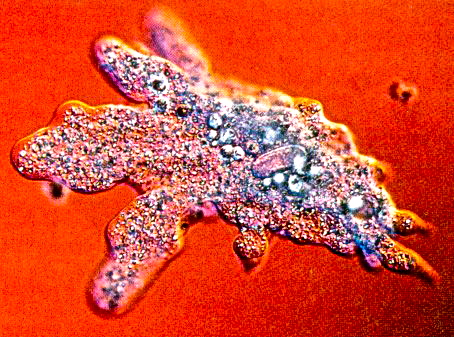
The mighty amoeba

Your body isn’t your own,
exposed for all it really is:
permeable, full of holes,
part of the world.
A floating thing tossed and spit
on tumbling water not always clear,
you become home to others,
little animals here
at play in the world.
You could be a tree, or grass, under
tiny feet that make no sound of their own,
their steps heard in quickened heartbeats
and restless groans
that shake the world.
You’re full of holes that leave
you open, a window lost of glass,
panes rattling, short of breath,
waiting, waiting, hoping to pass
this sense of a world
stumbling moments from death,
moments from life.

____________

The name of the poem is Sickness.  I wrote it in Belém in February of 1993, as I was coping with the onset of amoebic dysentery.  It was rather a rough time, and this, the worst and latest in a cascade of different ailments since my arrival in Brazil the previous November.  I was adjusting to my new home, I told myself, but I began to re-conceive my relationship to the world.  Except for a bout of the flu at age 9 and a one-day bug at age 13, I’d never been seriously ill in my life.  When I met the amoebas, my body-as-fortress gave way to a new understanding of myself as a being in the world, no different really than a bug, participating in the world along with all the other creatures of existence, open to all those creatures, part of the landscape.  In the world – the amoebas helped me understand Heidegger and Sartre.

We’re all part of the landscape here, guests of each other, parts of each other.  Somewhere in the human genome, shot through my body and yours, there is DNA that we inherited from a common of ancestor with amoebas.  According to Richard Dawkins in his lovely The Ancestor’s Tale, our most recent common ancestor (MRCA in biospeak) would have existed between about 1.3 and 2 billion years ago.  This being, some kind of single-celled thing, would have eventually given rise to amoeba and other protozoans, in one evolutionary path, and the things that became plants and animals on another path.

Most recent common ancestor, collapsed tree

All creation is locked in struggle for the limited energy of this world.  This struggle produces rainforests when so many beings stretch to outdo others in an effort to trap the sun.  The struggle produces abundance as well as scarcity, cooperation as often as annhiliation, and a long-standing collaboration between us humans and the hoards of friendly bacteria (and even some amoeba) that live inside our bodies and help us be “human,” as it were.

Notes and Credits

A really interesting article about amoebas can be found here, by Wim van Egmond, and it includes really great photos of amoebas in action.  The photo of an amoeba at the beginning of this posting is taken from the site, Helpful Health Tips, which discusses the causes and treatments for amoebic dysentery.  More detail on the different kinds of amoebas can be found in this piece on Innvista.  Getting past dysentery meant mountains of Flagyl and a lot of examinations and tests, not only in Brazil but also after I got back to the US in 1993 and in 1994.  I never was the same again, but then again, were we ever?

When I was looking around the web for amoeba-related sites, photos, and such, I came across this company, Rogue Amoeba Software, LLC, and it’s blog.  It has nothing to do with this post specifically, except that it’s a very cool name for a company, and especially suggestive for a software firm.  Our computers and their software are, like our bodies, permeable, full of holes,
part of the world
.  We’ve made information systems in our image, both on purpose and by accident, just as it was presumed by some we ourselves were made.

4 Comments

Filed under ageing, body, brasil, Brazil, entropy, existentialism, life, philosophy, truth, vanity, youth

The truth and the still

Parintins, Brasil 1993

The still photograph is not so still.  The photograph asks questions.  It suggests a story.  It presents an idea in a language without words.  It is even as it signifies. Video killed nothing, and the still photograph survives (even as the radio star carries on).  Unlike video, you can take the still photograph in.  You have a role in your experience of the photograph.  It speaks to you at a speed that you can handle, that doesn’t overwhelm, that invites your participation and imagination.  You can look into its nooks and crannies and seek out all it has to offer.  All this at your own pace, and for your own reasons.

Snow on Sterling Place, Brooklyn 2005

The still photograph is a water that runs deep.  If it seems to sit there, that’s its charm.  The still makes you active, because it’s impossible to just look.  Indeed, that’s the point, and all the while the still is not nearly inert.  It just moves differently, at a different pace, like a tree.

Detail of a rock on the beach, Long Island Sound, 2009

You fill the stillness with motion, the silence with voices.  You hear these people, feel the breeze come across the flowers, sympathize with a long face or smile with happy eyes.  Or you imagine the immediate suspension of all motion and noise and concentrate on only the image and the miracle of capturing time itself.

Intensity . . .Prospect Park, Brooklyn, 2009

Video?  Its harsh, grating noise, the motion too fast to keep up with – video steals your ability to think about what you’re seeing and replaces your mind with its own images.  The difference between the still photograph and video is the difference between democracy and dictatorship.

Fixing the sidewalk, Prospect Park Parade Grounds, Brooklyn 2009

Notes and Credits

On December 15, 2009, I had the opportunity to hear two award-winning photographers, Lynsey Addario and Damon Winter, discuss their work at the Museum of the City of New York.  After the panel discussion, one member of audience asked them if they were experimenting with video, given the prominence of video on the Web and current developments in social media and journalism.  Of course they were interested, but they were still committed to the still photograph.  That’s what got them aroused in the first place, and the still continues to drive them today.  Moderater Kathy Ryan, photo editor for the NYT Magazine, chimed in that photos are still much more popular than videos on the Magazine’s website, perhaps because the photos allow the viewer to control what they are seeing.  So that got me thinking . . .

Sidewalk fixed, December 2009

All the photos featured in this post were taken by the author.  Go back and double-click them to see a larger view.  Enjoy.  If you want to see some interesting and incredible photos by others more talented and adept with shutters than I, check out the work of some friends at T’INGS, Chloe, and the No Words Daily Pix on Only the Blog Knows Brooklyn.

Astor Place, New York 2009

6 Comments

Filed under art, beauty, Brazil, freedom, ideas, journalism, life, media, Park Slope, philosophy, politics, truth

Tamba-Tajá, 3

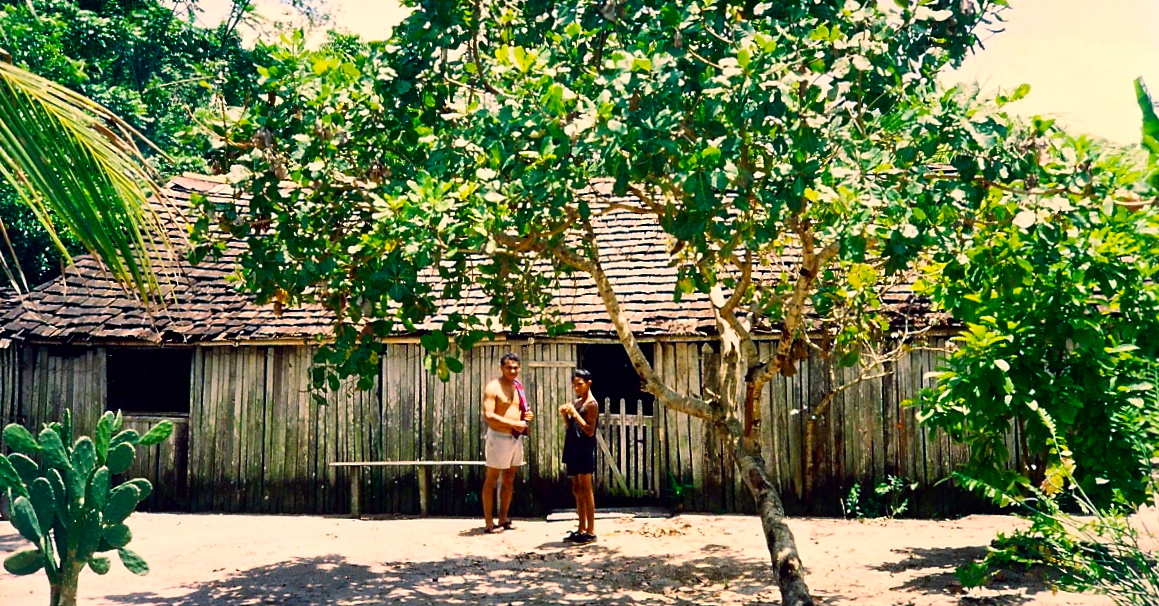
Nego and his little brother outside the family’s house in Moju.  This the final installment of Tamba-Tajá, the story of a trip to rural Amazonia in 1993.  Double-click the photos to see them in original size.

______________________________________________________

We ate our fill at Nego’s uncle’s place.  It was nice, after a long morning of travelling on a hangover.  We had a lot of things to carry, bags of food and drinks, some clothes, and things from the city that Aluízio brought for the people we’d see on the way.  All fed, we started down the path single file, away from the road, the little house, the clearing, and into the woods.  We were carrying a lot, but behind us we left some sacks of food and other things – we’d be back to get them.

The family farm was a couple more kilometers through the woods.  The trees were tall and lush and green.  Leaves littered the forest floor off the path, which began to turn and then turn back again, as if cutting back to go up a steep hill or mountain, only the land was flat.  Flat and densely covered with trees and shrubs.

After a good bit of walking, we came to a creek – igarapé – that had cut a gorge about 6 feet deep and maybe 20 feet across.  It wasn’t terribly deep, but it was enough to slow us down a bit.  Another 20 or 30 minutes and we arrived at the house, which was surrounded by fruit trees of all sorts.  Huge limes hung from one, and we’d use those limes later to bathe in the igarapé behind the house.  The house was shingled on one side, straight boards on another, with windows open to the air and what seemed like a lot of space as we approached.  You could see through the spaces between the boards.  There was no electricity.  The water came from a well drawn by a hand crank, up to a thousand-liter tank 10 meters up atop a scaffold.  PVC piping brought the water down from the tank and into the house.

On the other side of the path, in front of the house, there were fields of manioc and pepper plants.  Pepper was supposed to the salvation of Amazonian smallholders, a marketable crop easy to grow in the climate and soil conditions.  Some folks made money on it, but few were truly saved.

The women settled into the house.   They wiped the dust from the tables and chairs.  They opened the hammocks we would sleep in and hung them from the house’s frame.  They began cooking.  The man who took care of the place while the family was in Belém came round with the horse, and we took the charrette back to the road to fetch sacks of food and other things needed for the next few days.

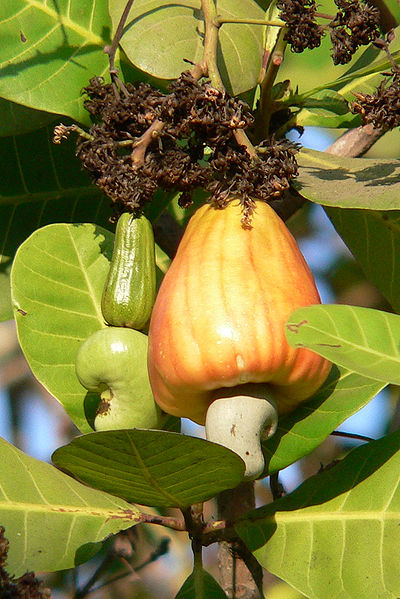
Cajú

Later, I went off with the men into the forest.  Aluízio wanted to show me his Amazonia.  We brought a bottle of cachaça (ka-SHA-sa), a clear, potent cane liquor, and we walked along pulling cajú from the trees.  The cajú grows as a fruity, pulpy bulb with a nut, the cashew, hanging from its end.  After a slug of cachaça, you suck on the juice from the cajú to dissipate the burning sensation of alcohol on your tongue.  We did this for an hour, stopping from time to time for Aluízio to show me the plants near the ground and explain each one’s medicinal purpose.

After a bit, we reached the virgin rainforest.  The trees were as large around as any I’d ever seen, taking three or four men to encircle a trunk, hand to hand. They grew high in their struggle for sunlight, competing with each other as they threw up ever larger leaves, leaving very little light to filter down to the forest floor, were it was damp and cool.  In the forest, you feel a chill even as you sweat under the leaves.

Vines hung everywhere and swayed with the gentle breeze that ran through the trees.  Bird sounds came from every direction, a dense concert in the round of cackling and crowing, the flapping of wings and stirring of leaves.  Echoing caws of differing pitch and resonance shot through the distance from near and far.  This was the sound of the forest breathing.

We took a twisted path through the woods and then headed back to more settled places.  We stopped to visit neighbors who lived further from the beaten path, in houses of wattled clay daubed onto wood frames made of sapling branches and topped with palm fronds.  The clay dried hard as bricks, but I thought it must take a beating in the rain.

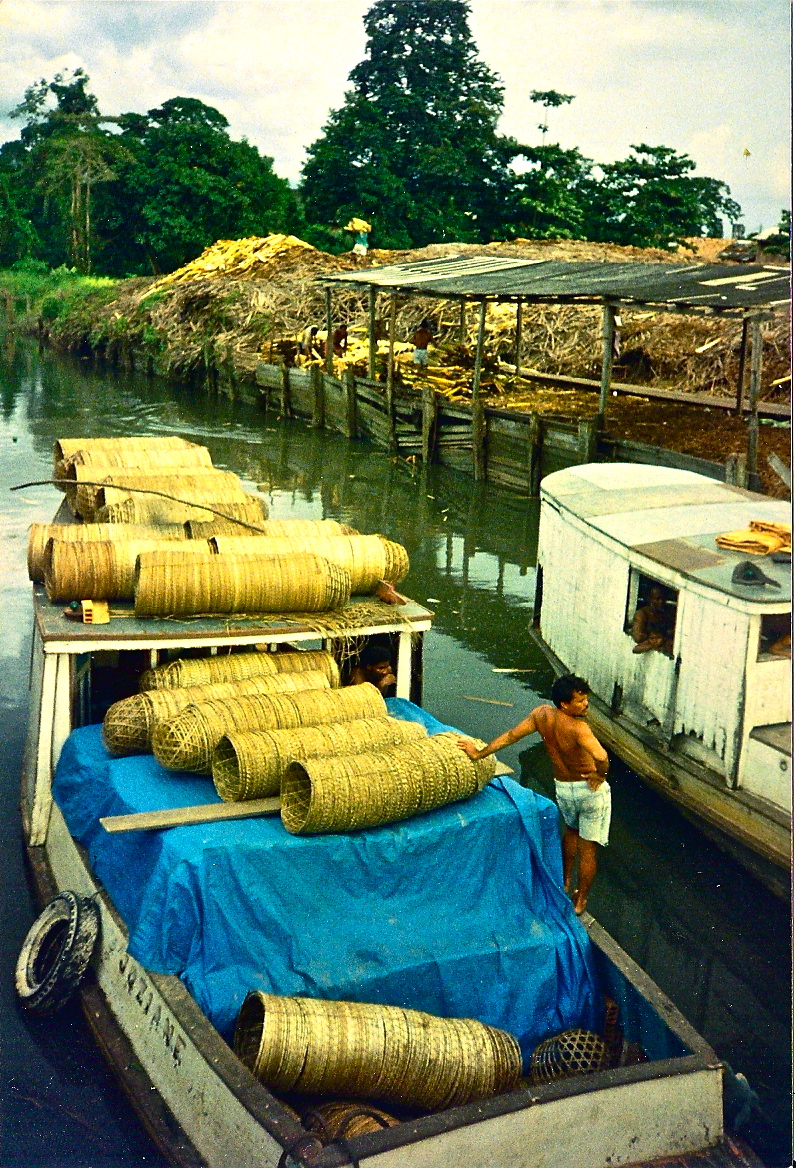
One man was making birdcages from reeds and bamboo, fine little pieces fitted together.  He caught forest birds and sold them to another man, who took the birds in their hand-made cages to Belém, where he sold them to another man, who in turn sold them on the streets of the city to visitors and local people alike.  Of the three men involved, the one in the middle made the most money.

The farmers were talking about the price of pepper and whether or not they’d make any money this year.  Then the conversation turned to the price of lumber, and Aluízio asked one farmer if he was going to cut the madeira nobre – the valuable wood, like mahogany – on his land.  Some of it might wind up going into beautiful headboards and armoires for sale at specialty importers in Chicago.  Some would wind up as yet another wall for yet another room on yet another house in Jurunas.

Back at the farm, darkness began to close in as the women put out the food for dinner.  Beans with chicken and meat, rice, fruit, bread, crackers, coffee and farinha, the raw manioc flour grown right there.  We mixed the farinha into everything. Farinha de manioc isn’t much to speak of in taste or nutrition, but it stretches the food on your plate and lets you “fool the stomach” into thinking you’ve eaten much more than you have.  It tastes good with the beans and brings a crunchy texture to the soupy froth.

By dark, the house was lit with a couple of kerosene lamps not larger than Bunsen burners.  A soft light, it brought out the curves and contrasts in everyone’s faces as we talked about life, the weather, the family.  OOOOOO-go!, the boy’s mother rang out time and again as the he ran about making noise, upsetting things carefully stowed and stacked and, in general, being a boy.  Nego took out his guitar, and we all went outside to sit under the trees and sing.  Nego played.  His brother played.  I played.  We shared our stories and ideas and adventures.

Between songs and laughter, the forest told its own stories as the birds calmed and other noises came.  Nego told of the time he spent a week at the house by himself.  The forest noises scared him so much he would never do it again.  Aluízio told older stories about jaguars and snakes and mythical creatures who came out of the forest at night and are sometimes men in appearance.  Legend had it that the boto, the pink freshwater dolphin found in the Amazon, would turn into a tall white man in a white hat and white suit, showing up at the village dance to sweep a young girl off her feet and take her back to the enchanted city under the river, where the boto made her his queen.

We became tired and went inside.  I crawled into my hammock and pulled up the sheet under a chill.  I listened to the night forest and fell asleep to the sounds of snoring and swaying hammocks.

Crossing the Moju River, Aluízio, Dona Maria, and Nego (Augusto)

Notes and Credits

The photos for this installment of Tamba-Tajá are all from my 1993 trips to the farm with Nego, except for the photo of the cajú, which is from Wikipedia Commons.  The Tamba-Tajá closed by 1995.  Nego got married and moved to a small town in the interior of Pará, a town much like Moju, where he became a school teacher – music of course.  The small town life in Amazônia is what suited him, so I imagined he was, and still is, happy there.

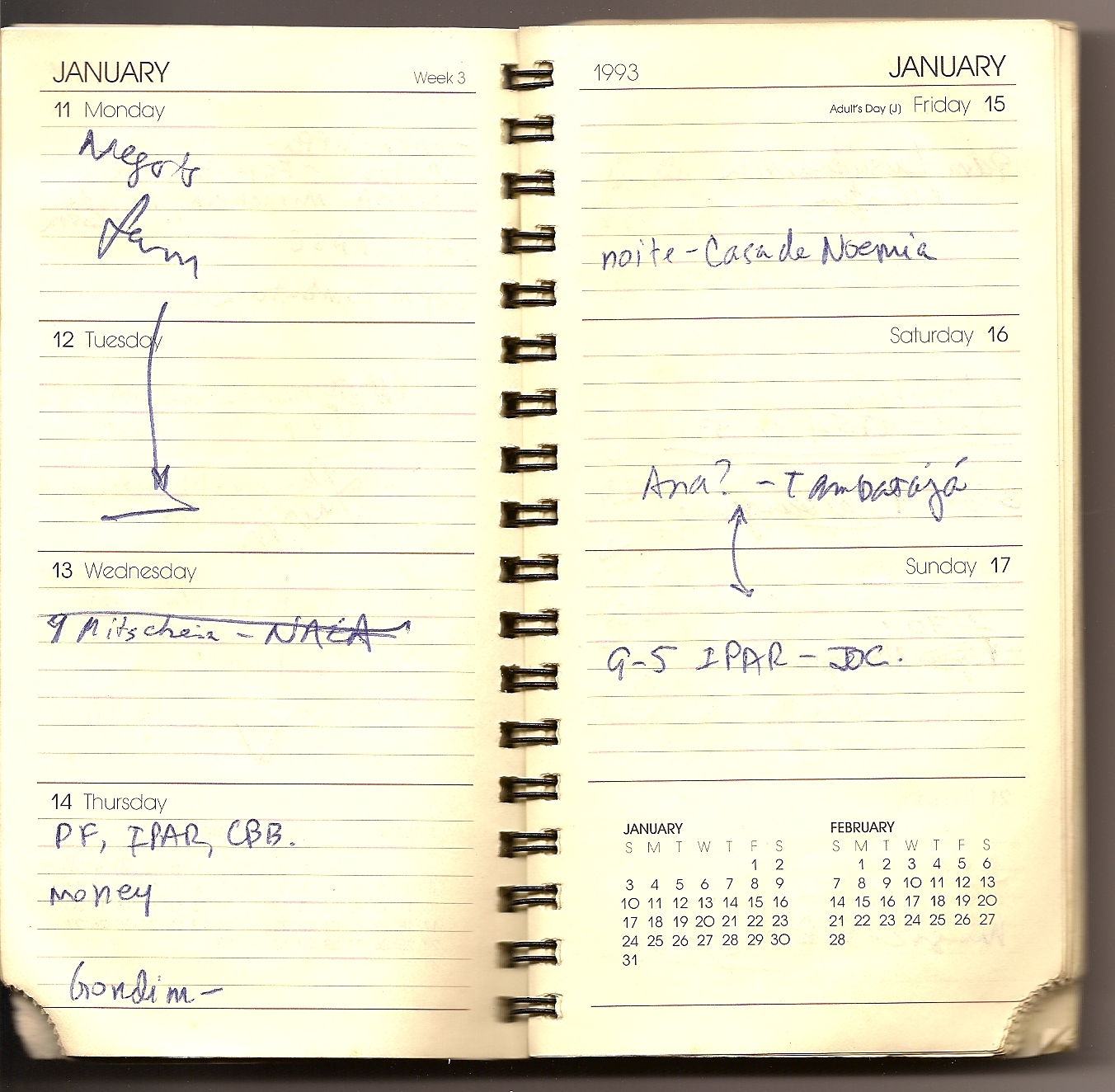
Writing this post has taken me on an interesting journey through my old photos and Brazilian research material, in search of journals and photographs, things to help jog my memory about certain events.  I know I have a journal entry somewhere on this trip, but I can’t find it.  It’s probably on an old 3.5″ floppy disk somewhere in a box under my son’s bed.  I looked through those boxes just now.  Among other things, I found the daily calendar I kept in 1993, showing the dates of the trip recounted in this story:  I arrived at the Tamba-Tajá around 10 p.m. on Friday, January 8 and came back on Tuesday, January 12.  It was the first of a couple more trips, including Holy Week and Easter, April 8-11.  One day I will find the journal entries and figure out how well my memory has recounted these events so many years later.

The land issues encountered by the smallholders who Aluízio talked with in this story are quite difficult.  I deleted a couple paragraphs from an earlier version of the story that got into those issues; they didn’t work for the story I wrote.  But they are real.  The further south you go from Belém, the more dangerous it gets, southern Pará being rife with more land conflict than any other place in Brazil during the 1990s.  Church people and unionists tried to organize the small farmers and ranch hands, but they were constantly harassed by the big farmers and their henchmen, who as often as not were also the local police.

A good up-to-date article on land issues in Amazônia appears here, by Paulo Cabral for the BBC.  The murder of Sr. Dorothy Stang, of the Sisters of Notre Dame de Namur, an international Catholic religious order that works for social justice and human rights, was a major issue in Brazil and internationally.  A lot more could be written and said about these issues, and I’m working on writing something that was inspired by Rosa Marga Rothe and the Book of Daniel.  Coming soon …

For now, I’d like to leave this story with a photo I took of Rosa Marga and Iza that I took in 1998, not too long before Iza passed away.  They started this story, and so they should end it.

Marga and Iza, Belém 1998

2 Comments

Filed under beauty, brasil, Brazil, danger, food, life, truth