There is an appointed time for everything,
and a time for every affair under the heavens.
A time to be born, and a time to die;
a time to plant, and a time to uproot the plant.
April 21, 2010
A time to kill, and a time to heal;
a time to tear down, and a time to build.
A time to weep, and a time to laugh;
a time to mourn, and a time to dance.
October 31, 2009
A time to scatter stones, and a time to gather them;
a time to embrace, and a time to be far from embraces.
A time to seek, and a time to lose;
a time to keep, and a time to cast away.
December 21, 2009
A time to rend, and a time to sew;
a time to be silent, and a time to speak.
A time to love, and a time to hate;
a time of war, and a time of peace.
April 29, 2010
Notes and Credits
The photos of the tree at the beginning of this post were taken by the author from my dining room window on Caton Avenue in Brooklyn, 11218. The tree is in the Bowling Green of the Prospect Park Parade Grounds.
The photos of the trees forming an arch over the sidewalk were taken by the author at the Prospect Park Parade Grounds, Caton Avenue sidewalk, 11218.
E. All the blood, sweat, and tears it takes to realize that you’ll never appreciate winning unless you know how to lose.
F. The resilience of the forgotten, the underdogs, the left-behind, and the lost in time, whose story one day becomes everyone’s, making all of us just a little bit better than we were before.
Oh – and the smell of garlic bread and fried oysters, creamy red beans, and my grandmother’s tomato-colored jambalaya. Ernie K-Doe’s mother-in-law. Po-boys at Domilise’s. And above all, the New Orleans Saints.
The Glasses
Half-time, February 7, 2010. Superbowl 44. New Orleans Saints 6, Indianapolis Colts, 10. The glasses aren’t so full. The Maker’s Manhattan was just ordered by a New Orleanian wanting to soothe his anxiety. The next beer, at half mast, was being nursed by a lawyer from New Jersey who wasn’t so deeply invested in the game but nonetheless wanted us all to be happy. The last glass, beer again, belonged to an office administrator from New Jersey who discovered an unforeseen attachment to the Saints as her emotions boiled up and over during the course of this back-and-forth duel between an intrepid underdog and a (s)lumbering giant. Our locale: The Village Pourhouse (64 3rd Ave at 11th Street, Manhattan). An hour and a half later, the game was over: New Orleans Saints 31, Indianapolis Colts 17. Who dat say they gonna beat them Saints?
The Story
When I was little, we used to listen to the Saints games on the radio while doing chores around the house – cleaning the garage, trimming the lawn, weeding the gardens, and so on. The games were called on WWL-AM by Wayne Mack and Danny Abramowicz. Mack had achieved fame as “The Great McNutt,” a local radio and television personality who ran Three Stooges shorts on Channel 6. Abramowicz was the Saints’ leading receiver from 1967 (their first season) to 1972.
Whenever I could, I wore my #8 Archie Manning jersey to school beneath my khaki uniform. I used to hide the jersey from my mother to keep it out the wash and continue wearing it. Archie was incarnation of our city, a would-be superstar hobbled by a supporting cast that never allowed him to shine like we all knew he could. Archie’s 35 wins, 101 losses, and 3 ties is the worst winning percentage (26.3) among NFL quarterbacks with more than 100 starts. But you wouldn’t know that from the way we still talk about him. Archie eventually joined Danny and Wayne to call the games on WWL.
On December 9, 1973, I went to my first Saints game at what was then Tulane (or Sugar Bowl) Stadium. I was all of 9. We drove up and parked somewhere uptown, and then we walked to the stadium on the “neutral ground” (what folks in New Orleans called the median) of South Claiborne Avenue – my brother, my father, me, Uncle Howard, and cousin Brett. The Saints played the San Francisco 49ers that day and won, 16 to 10. The odds of catching a winning game at that point in the team’s history were about 1 in 3.
Later, in high school, our band joined 3 other Catholic High Schools to form a mega-marching band when the Saints played Philadelphia on September 16, 1979. Conley, the tuba player, ran into to Archie coming out of the tunnel and reported the encounter to all of us like one who had run into a Titan. The Saints’ first touchdown was a 52 yard bomb from Archie to Wes Chandler. Our guys lost, but it didn’t matter. They were our heroes and we got to march on the greatest field in the world in front of all the fans. It was the highlight of our marching band season.
The next year, the Saints went 1 and 15 and the fans began coming to the games with paper bags over their faces – mimicking the then-famous Unknown Comic of Gong Show fame and calling the team The New Orleans Ain’ts. The agony of what it was to be a Saints fan can be summed up, Harper’s Index-like, by reviewing their stats over the team’s 44 years of history, including the Superbowl season of 2009.
First season: 1967
First season to break-even: 1979
First winning season: 1987
First playoff victory: 2000
Total winning seasons: 9 (of 44)
Total break-even seasons: 7
Total losing seasons: 27
Number of seasons with double-digit losses: 14
I was of course elated and ecstatic on February 7 when Tracy Porter intercepted Peyton Manning, Archie’s hall-of-fame son, toward the end of Superbowl 44 and returned the pic for a touchdown, all but sealing the Saints’ victory. As they shouted “who dat” here in New York, I remembered when they first started saying “Who Dat?” back in the day when winning 2 games in a row resulted in shouts of “The Saints are going to the Superbowl!” Now here it was. Finally. And they actually won the game. The Bible itself holds no words to describe such an event.
From my perch at The Village Pourhouse on Manhattan’s Lower East Side, I called my father, who was at my brother’s house in Nacogdoches, Texas. Over the background din in both of our respective locales, I choked up a bit and said, “Mom would have loved to see this. She must be smiling up in heaven.”
Mom’s First Big Superbowl
The Saints victory brought me back in time, to 1975, when the Pittsburgh Steelers won their first Superbowl. It was a family event that had us all together around the television, breathless, excited, and cheering. My mother grew up in Monessen, Pennsylvania, a steeltown on the Monongahela River about an hour outside of Pittsburgh. In 1969, her mother left Pennsylvania and moved in with us in Louisiana. I remember them talking about it after the game – “after 40 years, finally! It’s about time!” The Steelers were apparently as hapless as the Saints for most of their history to that point. It took the mighty Steelers, who now own 6 Superbowl titles (more than any other team) 42 years to get it done. The Steelers pre-Superbowl stats:
First season: 1933
First season to break even: 1936
Mom is born, Monessen, Pennsylvania: 1940
First winning season: 1942
Total winning seasons, of first 42: 10
Total break-even seasons: 5
Total losing seasons: 25
Number of seasons with double-digit losses: 4
Superbowl: 1974 (season)
Of Fathers and Sons
Nowadays in my Brooklyn apartment, I sometimes listen to the Giants games on 660 WFAN. Archie’s youngest son, Eli, calls the signals for Big Blue. “Manning drops back and fires one over the middle . . .” and I am right there in 1978, cleaning the garage, growing up, wearing my Archie Manning jersey. Only I’m not. I’m 46 and my 7-year old son is listening to the Giants game with me. He’s got his own Manning jersey, big and blue #10, for Eli.
Drew, Brittany, and Baylen in the glow of victory
One of the beautiful things about life is its circularity, and that’s how it felt on February 7. The great wheel goes round again and again, and with it our memories and lives lived, yet alive again. Archie Manning never played in a Superbowl, much less a winning season, but his sons Peyton and Eli each quarterbacked Superbowl victories in 2007 and 2008, and each was named MVP for the game. In the moments after drew Brees won his Superbowl MVP in 2010, he lifted his own baby boy up in the blaring lights. Father to son, and father to son, so it goes.
Of all this, my mom, mother to two sons, would be proud.
Notes and Credits
The opening photo of glasses on the bar at the Village Pourhouse is from the author’s personal collection.
The photo of Drew Brees with his son, Baylen, and wife Brittany, was taken by David Bergman and is used here with permission. The photo made the cover of Sports Illustrated – Bergman’s 8th SI cover – the week after the game. David’s site has much more about his work, and you can watch the slides roll past of photo after wonderful photo.
The New Jersey office administrator whose quarter-filled beer is in the lead photo is hereby forgiven for her devotion to the Boston Red Sox.
On a personal note, I began writing this post the day after the Superbowl, but it took a while to finish. The main reason was that I recently took a regular paying job and had a bottleneck of work to complete that is finally playing out. The light at the end of the tunnel seems to be growing, with new essays and a number of E/F postings in the weeks to come.
The truth is that money is often a divisive influence in our lives. We keep our bank balances secret because we worry that being candid about our finances will expose us to judgment or ridicule—or worse, to accusations of greed or immorality. And this worry is not unfounded.
Jenny Offill and Elissa Schappell, Money Changes Everything (New York: Doubleday, 2007), p. xi
Brooklyn Reading Works:
The Truth and Money
On April 15, 2010, the Brooklyn Reading Works will present its monthly writers’ program on “tax day.” This happy accident, observed last summer in a casual conversation over coffee with Louise Crawford, resulted in the idea for a panel called “The Truth and Money,” a reading and Q & A with three authors whose work has taken on money in some significant way.
Our three panelists are:
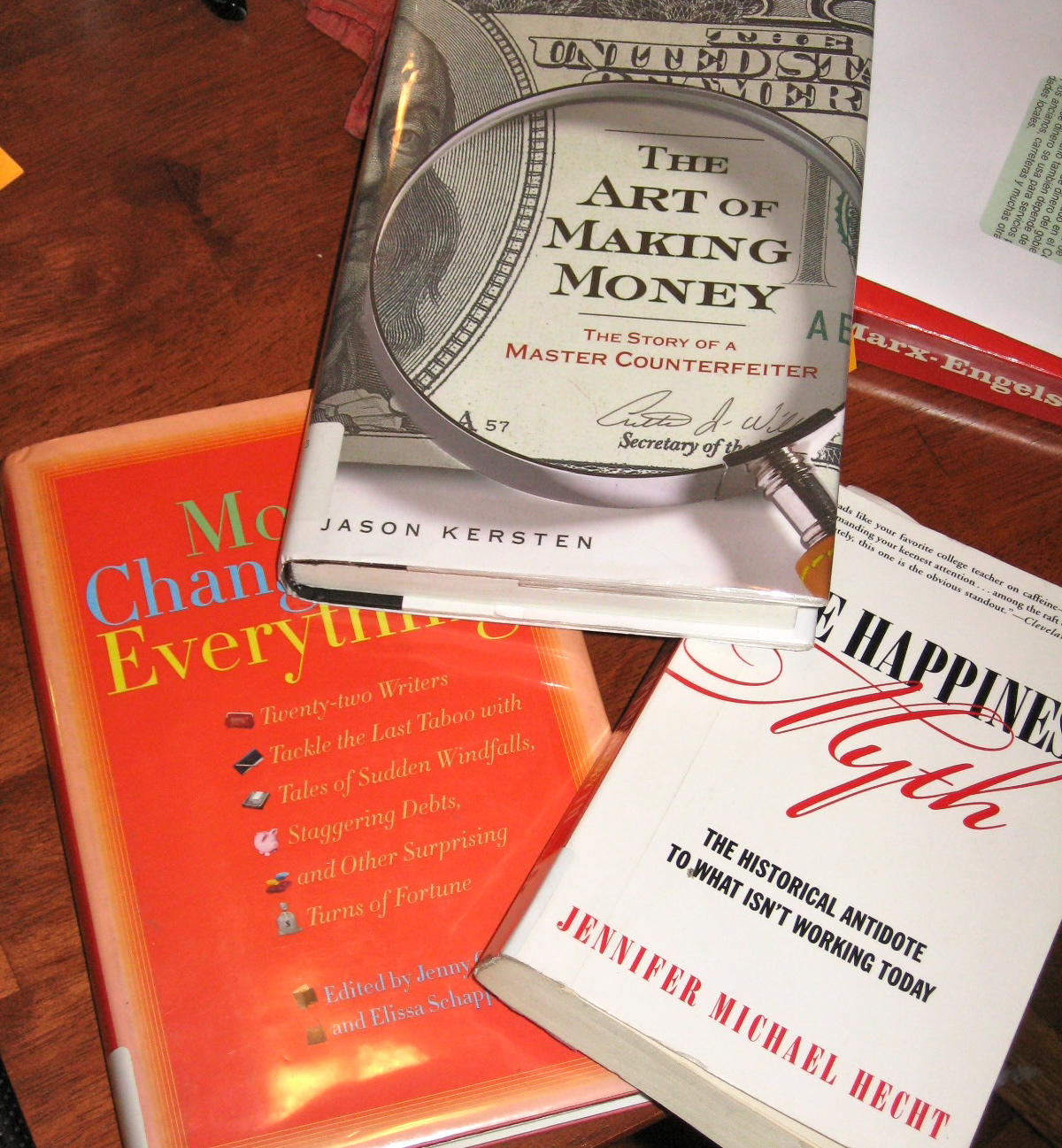
Elissa Schappell, a Park Slope writer, the editor of “Hot Type” (the books column) forVanity Fair, and Editor-at-large of the literary magazine Tin House.With Jenny Offill, Schappell edited Money Changes Everything, in which twenty-two writers reflect on the troublesome and joyful things that go along with acquiring, having, spending, and lacking money.
Jennifer Michael Hecht, a best-selling writer and poet whose work crosses fields of history, philosophy, and religious studies. In The Happiness Myth, she looks at what’s not making us happy today, why we thought it would, and what these things really do for us instead. Money—like so many things, it turns out—solves one problem only to beget others, to the extent that we spend a great deal of money today trying to replace the things that, in Hecht’s formulation, “money stole from us.”
Jason Kersten, a Park Slope writer who lives 200 feet from our venue and whose award-winning journalism has appeared in Rolling Stone, Men’s Journal, and Maxim. In The Art of Making Money, Kersten traces the riveting, rollicking, roller coaster journey of a young man from Chicago who escaped poverty, for a while at least, after being apprenticed into counterfeiting by an Old World Master.
Please join us for the event at 8:00 p.m. on Thursday, April 15, 2010, at the Old Stone House in Washington Park, which is located on 5th Avenue in Park Slope, between 3rd and 4th Streets, behind the playground.
Many thanks from all of us at Truth and Rocket Science to Louise Crawford, of Only the Blog Knows Brooklyn, for making this possible.
Money, It’s a Gas
The subtitle on the cover of Elissa Schappell’s book says everything you need to know about the stories within: Twenty-two writers tackle the last taboo with tales of sudden windfalls, staggering debts, and other surprising turns of fortune. “The last taboo” is how Schappell and her co-editor, Jenny Offill, characterize our behavior when it comes to money, because nobody really wants to talk about it.
People are secretive and embarrassed—for having too little, or too much, or something to hide about the reasons either way. In a country where everyone seems to have a story of how they, or their parents or grandparents, used to be poor, any personal narrative but “hard work” is out of the question. Even hardened criminals revel in detailing the blood, sweat, and tears that go into their “work.” No one, it seems, can sit back and say with no embellishment or apology, “I got lucky, that’s all.” Money is the measure of what we deserve, and in our society what we deserve is in some sense who we are.
In The Happiness Myth, Jennifer Michael Hecht seeks to disentangle why things that are supposed to make us happy frequently don’t. To the notion that “money doesn’t buy happiness,” she shows that it does, to an extent. For most of human history (and pre-history), people have lived in conditions of terrible, frightening, life-threatening scarcity that money in no small part has eradicated for all but a very small fraction of Americans. (In line with Schappell’s notion of money-taboo, I now feel the urge to apologize and state something statistical about hardship and inequality in America, but I won’t. We deserve ourselves and all of our money issues.) Hecht writes,
“We need to remember that most people through history have been racked by work that was bloody-knuckled drudgery, the periodic desperate hunger of their children, and for all but the wealthiest, the additional threat of violent animals. Nowadays a lot of what we use money for is a symbolic acting-out of these triumphs.”
Once out of poverty, in other words, what we do with money—or more precisely the things we feel when using money—have a lot to do with ancient urges and inner conflicts that endure in our minds, bodies, and culture across time and without, so it seems, our self-conscious awareness of them. Money does buy happiness, up to the point we’re out of poverty, and then the real problems begin.
Like the craving for fat and things that are sweet, the urges we satisfy with money are deeply embedded in our being, fundamental to the way we evolved in the most far-away places and times. It’s all fine and easy to understand or forgive, but we all know what happens when you eat too many doughnuts.
Doughnuts to Dollars
Yet money is not like a doughnut. This we all know—money isn’t some thing, it’s just some non-thing you use to get doughnuts or whatever else you think you need. The economists’ word for this quality is fungible. Adam Smith introduced money in his great book on wealth by reviewing the things that societies have used for exchange measures over time, including cattle, sheep, salt, shells, leather hides, dried codfish, tobacco, sugar, and even “nails” in a village in Scotland that Smith knew of. All this was terribly inconvenient, and Smith noted that the use of precious metal as a stand-in for things of value constituted a considerable advance—
“If, on the contrary, instead of sheep or oxen, he had metals to give in exchange for it, he could easily proportion the quantity of the metal to the precise quantity of the commodity which he had immediate occasion for.”
Money in this sense becomes nothing but a means of measurement, and it would be perfect indeed if money’s effects on the world ended there, but we all know that they don’t.
Money—as Elissa Schappell and Jenny Offill, Cyndi Lauper and conventional wisdom tell us—changes everything. Money’s magical qualities go well beyond simple notions like greed. Money’s powers are existential, transformative, and really weird. Money makes us into things we are not. Karl Marx was pretty blunt about this—
“Money’s properties are my properties and essential powers … what I am and am capable of is by no means determined by my individuality. I am ugly, but I can buy for myself the most beautiful of women. Therefore I am not ugly, for the effect of ugliness—its deterrent power—is nullified by money. I, in my character as an individual, am lame, but money furnishes me with twenty-four feet. Therefore I am not lame. I am bad, dishonest, unscrupulous, stupid; but money is honored, and therefore so is its possessor. Money is the supreme good, therefore its possessor is good. Money, besides, saves me the trouble of being dishonest: I am therefore presumed honest. I am stupid, but money is the real mind of all things and how then should its possessor be stupid?”
Marx may have fallen short as an economist, but then again so do most official economists. In terms of money’s most basic ontological properties, however, it’s worth noting that he got money right.
The Glow
In the story of master counterfeiter Art Williams, Jason Kersten tells one such story of how money changes people, their values, and the truths that bind them together. Art’s counterfeit was of an extraordinarily high quality, and its effect on people was fascinating to behold. Art called it The Glow—“They would get this look on their face … a look of wonder, almost like they were on drugs. It was like they were imagining the possibilities of what it could do for them, and they wanted more.”
Like the anonymous subjects of history in Hecht’s writing (note: that’s us), Art wanted something that money, or the lack of it, had apparently stolen from his life. Art’s “pursuit had very little to do with money, and the roots of his downfall lay in something impossible to replicate or put a value on. As he would say himself, ‘I never got caught because of money. I got caught because of love.’”
So where does money get us? It’s easy to tell stories of money and doom, but we all know that without enough of it we’d be unable to do anything we need to do, let alone the supposedly unnecessary things that seem to make up for the drudgery of a life built upon doing the things we need to do. Is the grubbiness of money as it comes off in the Pink Floyd song all there is to it? Or is there more?
Join us on April 15, after affirming the give-away of twenty-eight percent (for most of us) of your annual harvest.
Many thanks to Louise Crawford for inviting me to curate the Tax Day BRW panel, through the Truth and Rocket Science blog. A sincere debt of gratitude, not to mention late fees, is owed to the Brooklyn Public Library, for enabling my research and inquiry into this topic. The BPL’s copies are indeed those photographed on my dining room table to lead the blog post.
Jenny Offill and Elissa Schappell, Money Changes Everything (New York: Doubleday, 2007).
Jennifer Michael Hecht, The Happiness Myth (New York: Harper One, 2007), p. 129.
Adam Smith, The Wealth of Nations, in Robert L. Heilbroner, ed., The Essential Adam Smith (New York: W. W. Norton, 1986), p. 173.
Karl Marx, Economic and Philosophic Manuscripts of 1844, in Robert C. Tucker, editor, The Marx-Engels Reader, 2nd ed. (New York: W. W. Norton, 1978), p. 103.
Jason Kersten, The Art of Making Money (New York: Gotham Books, 2009), p. 152 (first quotation) and p. 4 (second quotation).
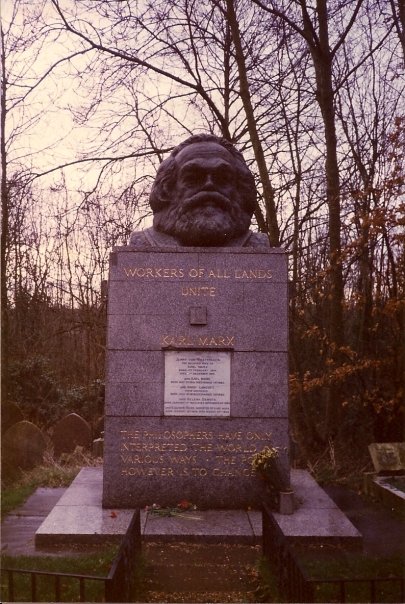
Photo Karl Marx’s grave, Highgate Cemetary, London, taken by the author in January, 1994, while on layover on the way to South Africa and its historical elections later that year.
E. “. . . the eyes of both of them were opened, and they realized that they were naked . . .” Genesis 3:6
F. “A little learning is a dang’rous thing;
Drink deep, or taste not the Pierian spring:
There shallow draughts intoxicate the brain,
And drinking largely sobers us again.”
Alexander Pope, “Essay on Criticism,” ll. 215-18
For some, knowledge leads down the path to hubris, a “revenge of the intellect” as Susan Sontag warned (ironically, some might say) in “Against Interpretation” (1966). For others, knowledge is the source of enlightenment. Know thyself: as inscribed on the Temple of Apollo at Delphi and lived by Socrates, for whom the knowledge of anything was only as good as its limits.
However we look upon knowledge or follow where it leads, it’s almost certain we’ll wind up somewhere never intended, with consequences for good or ill that we may barely understand. Such is the way of truth.
The glass and St. Rita’s Church
The tumbler is half-filled with Apple and Eve apple juice, all natural, no added sugar, of unknown yet possible relation to the juice of the apples of the tree of the knowledge of good and evil. At least that’s what I take away from the company’s name.
The etching on the glass is of St. Rita’s Church, Harahan, which was founded in 1950 by Monsignor Roy Champagne, who was a young priest at the time. The tumbler was part of a larger set created in 2000 for the parish’s 50th anniversary.
I went to St. Rita’s school from the fourth through seventh grades, and Fr. Champagne (he wasn’t a Monsignor yet) was still walking the grounds with the children and saying mass on Sundays. I attended church there until I left my parents’ home in 1986. For many years, I performed with, and then led, the youth choir. My son was baptized at St. Rita’s. I now attend St. John’s Episcopal Church in Park Slope, Brooklyn, but St. Rita’s is a cherished part of my life. It is a place I return to from time to time, to walk in the past and present, and to reflect on the lessons of knowledge and ignorance in my own life.
The desk and a dual journey from Michigan to Illinois
The tumbler was photographed on my desk, a sturdy workshop piece in the Mission Style, dating from the 1920s or 1930s (I am guessing here). I bought it in Rock Island, Illinois, in 1997 for $100.00 in rough but usable shape.
a sturdy writing companion
The desk was made in Michigan, by the Wolverine Manufacturing Company of Detroit. The company was organized in 1887, according to the tag, and at least this one desk is still going strong. Wolverine Manufacturing was one of the historical suppliers of parlor and other furniture in the Arts and Crafts style. I wonder sometimes at the happenstance (some might say magic) by which I took a similar route from Michigan, where I obtained my doctorate in 1996 from the university in Ann Arbor, to Rock Island, where I began my first teaching appointment the same year.
Almost everything that has been posted in truth and rocket science was written at this desk.
Notes and credits
The photos of the tumbler and the desk were taken by the author.
This image of the Wolverine Manufacturing Plant was taken from the State of Michigan’s Twentieth Annual Report of the Bureau of Labor and Industrial Statistics (Lansing, 1903), as found on Google Books.
Geotag: St. Rita’s is at 7100 Jefferson Highway, Harahan, Louisiana, 70123. St. John’s Episcopal is at 139 St. John’s Place, Brooklyn, New York, 11217.
The still photograph is not so still. The photograph asks questions. It suggests a story. It presents an idea in a language without words. It is even as it signifies. Video killed nothing, and the still photograph survives (even as the radio star carries on). Unlike video, you can take the still photograph in. You have a role in your experience of the photograph. It speaks to you at a speed that you can handle, that doesn’t overwhelm, that invites your participation and imagination. You can look into its nooks and crannies and seek out all it has to offer. All this at your own pace, and for your own reasons.
Snow on Sterling Place, Brooklyn 2005
The still photograph is a water that runs deep. If it seems to sit there, that’s its charm. The still makes you active, because it’s impossible to just look. Indeed, that’s the point, and all the while the still is not nearly inert. It just moves differently, at a different pace, like a tree.
Detail of a rock on the beach, Long Island Sound, 2009
You fill the stillness with motion, the silence with voices. You hear these people, feel the breeze come across the flowers, sympathize with a long face or smile with happy eyes. Or you imagine the immediate suspension of all motion and noise and concentrate on only the image and the miracle of capturing time itself.
Intensity . . .Prospect Park, Brooklyn, 2009
Video? Its harsh, grating noise, the motion too fast to keep up with – video steals your ability to think about what you’re seeing and replaces your mind with its own images. The difference between the still photograph and video is the difference between democracy and dictatorship.
Fixing the sidewalk, Prospect Park Parade Grounds, Brooklyn 2009
Notes and Credits
On December 15, 2009, I had the opportunity to hear two award-winning photographers, Lynsey Addario and Damon Winter, discuss their work at the Museum of the City of New York. After the panel discussion, one member of audience asked them if they were experimenting with video, given the prominence of video on the Web and current developments in social media and journalism. Of course they were interested, but they were still committed to the still photograph. That’s what got them aroused in the first place, and the still continues to drive them today. Moderater Kathy Ryan, photo editor for the NYT Magazine, chimed in that photos are still much more popular than videos on the Magazine’s website, perhaps because the photos allow the viewer to control what they are seeing. So that got me thinking . . .
Sidewalk fixed, December 2009
All the photos featured in this post were taken by the author. Go back and double-click them to see a larger view. Enjoy. If you want to see some interesting and incredible photos by others more talented and adept with shutters than I, check out the work of some friends at T’INGS, Chloe, and the No Words Daily Pix on Only the Blog Knows Brooklyn.
truth and rocket science has been included on this year’s “Park Slope 100,” a list compiled by Louise Crawford on her blog, “Only the Blog Knows Brooklyn.” Anyone from the neighborhood is familiar with Louise and her work, whether in her Smart Mom column in the weekly Brooklyn Paper, or the Brooklyn Reading Works, or the blog, or many other events. Obviously, she can’t place herself on the list, but all of us in the nabe know that she makes it that much better for the rest of to do things of value around here. A heartfelt thanks to Louise! What an honor to be on a list with favorite blogs like Fucked in Park Slope and Brit in Brooklyn, and writers like Frank McCourt.
Oh, and speaking of the Brooklyn Reading Works . . . truth and rocket science will be curating the April 15, 2010, edition of Brooklyn Reading Works, on “The Truth and Money” . . . of which more later. Keep tuned.
In the last few weeks, the post “The truth and change, 3a: From Life On Mars to Linden” has been getting a lot of hits. Its spike in the data has pushed it to the most-hit post of all time for me, past the old standards of “The truth and us” and “The truth and unicorns, parts 1and 2.” I am really interested to know how and why this spike is occuring from those visiting. Feel free to email me (jguidryDOT7ATgmailDOTcom) or Twitter (@truthandrockets) or leave a comment here.
I started to put this addendum together right after fininshing the Life on Mars post a few months ago. I had uncovered so much interesting stuff and, as it always happens, realized how much I had missed once I had published the posting. In spite of all my good intentions, I let the addendum lay in the to-do tray whilst writing up other things of interest to me. I continue to be fascinated by the way that virtual spaces and so-called “real life” affirm each other’s essential meaning in our world. I’ve also begun to write a longish story about organic/avatar relationships and welcome any interesting comments or links from people about their own stories or interests in the phenomenon. So here are some fun things . . .
The Arch is a blog about design and architecture in Second Life that goes into great detail on the kinds of Houses of Tomorrow that can exist today in the virtual world. They’ve posted a great short video on YouTube, and if you follow the “related videos” you can drop into a whole new world virtual vouyerism. Enjoy!
Elle Kirshner’s Second Spaces is an interior design blog that highlights the newest designs for your home in SL. Elle is a designer herself, and by just clicking through her site you can see a lot of the interesting concepts and designs about space that are important to virtual life. From Second Speaces, you can also link to Elle’s friends and other businesses, learning a lot about SL’s economic and social life.
One of the interesting and most wonderful consequences of my original post “From Life on Mars to Linden” was that I picked up a new Twitter follower (and presumably blog reader): Botgirl. Botgirl’s Tweets (@botgirlq) are a veritable library of hyper-current thinking on storytelling that have become a great source for me as I write and think. Should you Tweet and link through Botgirl’s world, you’ll realize that this Avatar and her RL typist brings into focus a whole world of multiple and parallel ontologies that really do get at (what I see as) the really important things about life. If you’re a storyteller then you need to become friends with Botgirl.
Virtual existence brings into high relief the way in which storytelling truly becomes part and parcel of being. Call it an auto-ontological environment, in you will, in which stories become magically real. Lanna Beresford’s blog “Avatars in Wonderland” takes up these themes and helps us see how to live on these parallel planes. In “All the virtual world’s a stage” she interviews role-player Salvatore Otoro.
Finally, the interest in the economics of virtual worlds is something I find truly captivating, not so much from the standpoint of getting into biz myself but rather from the perspective of learning how we create value. Intrinsically, there is no value in nature, and then we come along and begin to create value. Sometimes we create value out of scarcity, sometimes out of thin air. Eventually, it always comes to scarcity and control, however. With the Virtual Economy Research Network, you can keep up with a group of people doing some pretty serious study of virtual economics.
There’s much more to see. Much more to look at. Many more stories to create. We’ll keep writing . . .
“We do not draw the moral lessons we might from history … In history a great volume is unrolled for our instruction, drawing the materials of future wisdom from the past errors and infirmities of mankind … History consists for the greater part of the miseries brought upon the world by pride, ambition, avarice, revenge, lust, sedition, hypocrisy, ungoverned zeal, and all the train of disorderly appetites which shake the public with the same.”
This passage from Edmund Burke’s Reflections on the Revolution in France, written as the French Revolution began in 1789, is shot through with contradiction, like Burke himself. It takes a little more time to digest than a shot of Santayana – Those who cannot remember the past are condemned to repeat it – or the oft-cited quip, We learn from history that we learn nothing from history, which is often attributed (erroneously, it seems) to George Bernard Shaw. But it’s worth it, because Burke got it right.
Notes and Credits: Burke and history and quotations
This quotation from Burke is taken from the Google books archive, which features the 2nd Edition of the Reflections on the Revolution in France, printed in London for J. Dodsley, M.DCC.XC (1790), pp. 207-08.
Burke’s writing fleshed out the impassioned complexity of his own life and commitments. As a member of parliament in the 1770s, he was a staunch supporter of the American Revolution, something of a libertarian. With the fall of the Bastille, however, he became enraged at the treatment of the French royal family and the disregard for history and tradition by the revolutionaries and their Enlightenment muses.
In the Reflections, he seems to predict the horror that would follow in the “Reign of Terror,” as well as the problems of revolution in general, and this work became the foundation of modern conservatism. Interestingly, the degree to which a conservative relies on Burke in his or her own thinking is the line between the intellectual side of the movement (George Will, David Brooks, Thomas Sowell) and the populist mobs (Glen Beck, Rush Limbaugh) that one such as Burke would so rightly disown. (Note: George Will’s use of Burke to attack blue jeans is just silly, but Will has earned it.)
A searchable, copyable, full text of Burke’s Reflections is available here. As a life long leftist, I don’t share the commitments that George Will and David Brooks have, but I do admire complex thinking and impassioned writing. As Sina Odugbemi points out, Burke’s supposed “conservatism” was really about finding the appropriate – and constant – means for reform of the state: “You reform in order to conserve; without reform you cannot really conserve a political system.” If only the opponents of health care reform had the tact and intellect of Burke.
In response to a call-out on Facebook to find out where the G. B. Shaw statement mentioned above came from, my friend Katie replied with:
I tried to use the power of the internets, and what the internets are telling me is that I should infer that it is a popular misattribution. It’s not on his Wikiquote page, but it was on the Anonymous Wikiquote page for a while–if you look at the talk page someone mentioned a similar quote attributed to Otto von Bismarck. Here is an actual political scientists saying it’s popularly attributed to Hegel: http://bit.ly/1Xp8RD .
Notes and Credits: The teacup
The Chinese teacup in the photograph is half-filled with lukewarm jade tea. It belongs to Kaoru Wang, a friend who responded to my call-out for photos of half-filled glasses in the first E/F posting. The teacup has been in her family for “years and years and years.” She photographed it on a pretty carpet of unknown origin. She sent another photograph showing the cup with its cap, which lets you keep the tea warm while taking your time to drink it over pleasant conversation or in reflective solitude.
Teacup, with cap
The tea itself was given to Kaoru by a friend who left his family’s tobacco business in order to build a tea company in Vancouver, bringing his knowledge and experience with leaves into a concern that could contribute positively to the health and well-being of his customers. Among his clients are some of the most prestigious hotels around the world.
In her note to me about the teacup and its surroundings, Kaoru wrote that it is “comforting to reflect how much history and warmth there is in the most basic of items,” a sentiment that drives my own writing here and elsewhere. Kaoru’s observations about life, her experiences, and her work can be found here. She is currently making a film about education and change called “The Killer App,” which she writes about in several places, including the film’s blog under its previous title, “Something Far Finer.”
... with persimmons and more of Roosevelt Island
Through the window, behind the teacup, we have a blurred view of Roosevelt Island, a 2 mile long sliver of land in the East River between Manhattan and Queens. A self-contained family farm from the late 1600s to 1828, it was known as Blackwell’s Island (after its owners) for most of its modern history, being named for FDR only in 1973. After the Blackwells sold the island to the city in 1828, it was given over to “a long succession of institutions and hospitals,” which included a lunatic asylum (“The Octagon,” so called for its signature building); a hospital; a Smallpox laboratory (The Strecker Laboratory); and a prison that at one time or another housed Boss Tweed, Emma Goldman, Mae West, and Billie Holiday.
In 1969, the city leased the island to the State of New York Urban Development Corporation, which has created a unique urban community on the island. Home to about 12,000 people today, the island is closed to car traffic and accessible by bus and tram. The Roosevelt Island tram is a notable piece of New York architecture, frequently featured in films and television (CSI: New York, City Slickers, The Professional, Spider-Man, Cold Souls, and others). The residential buildings have innovative designs – such as duplex (multi-story) apartments that make is possible for the elevators to stop only every 3 floors. In the spirit of contemporary wealth-and-consumption-driven governance and planning, The Octagon has been restored and is now a high-end apartment community with a mall and a lot of solar panels.
From 1956 to 1960, Brazilian architects, engineers and peasant laborers called candangos built a new capital, Brasília. This was the realization of a dream first voiced in 1827, just 5 years after the country became independent, when an advisor to Emporer Pedro I suggested that he move the capital from the colonial city of Rio de Janeiro, on the coast, to a new city in the interior.
Brasília, as it eventually came to be called, was a Brazilian version of Luso-Manifest Destiny. The new city was built on the legacy of the Bandeirantes, slave hunters and prospectors whose journeys into the South American interior in the 16th and 17th centuries extended Portuguese holdings – Brasil – at the expense of the Spanish crown.
President Juscelino Kubitschek asked Oscar Niemeyer to head up the team that would create the new capital. A native of Rio de Janeiro, Niemeyer was already an internationally renowned architect, his design for the United Nations Head Quarters in New York an immediate icon of post-war modernism. His designs for Brasília’s government buildings, plazas, monuments, and National Cathedral created something of a modernist theme park in Brasília, and in 1987 the city was designated a World Heritage Site by UNESCO.
For Brasília, Niemeyer collaborated with another celebrated Brazilian designer, Lucio Costa, whose plans for the city took the national dream into the air itself – from above, Brasília’s layout looks like a giant bow, loaded and aimed at the heart of the continent. Costa’s Brasília conformed to the modernist Athens Charter of 1933 almost to the letter, creating a city of functionalism and (for many) modern alienation. Landscaping was done by Roberto Burle Marx, another of the generation of Brazilian modernists whose work defined an era in South American history.
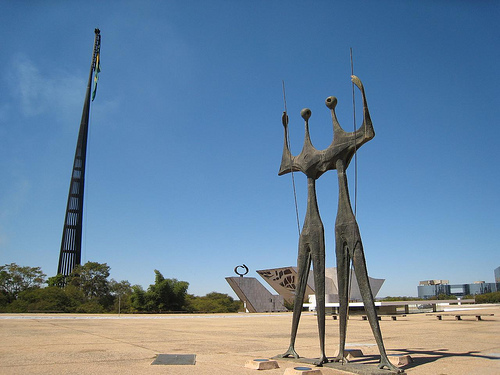
In the Plaza of the Three Powers, Bruno Giorgi’s sculpture, Os Candangos, memorialized the northeastern Brazilians who built the capital. In the national discourse of the time, these impoverished peasants were living symbols of Brazil’s colonial and agrarian past. By coming to Brasília and building the city, they were transformed into new pioneers who would settle the vast empty spaces of the country’s interior, from the dry plains of Brasília through the vast green desert of the Amazon. Unlike the North American slaves who built the White House and the U.S. Captiol buildings, the candangos were memorialized as part and parcel of Brasília’s futurist vision.
The architect must think that the world has to be a better place, that we can end poverty . . . . it is important that the architect think not only of architecture but of how architecture can solve the problems of the world . . . The architect has to always be political.
—Oscar Niemeyer, 2009
Hard Winter
Meanwhile, in London, Sylvia Plath was pregnant again. Her husband, Ted Hughes, was having an affair with another woman, and they were destined to separate soon after the birth of their son, Nicholas. In the 13 months after Nick’s birth, Plath wrote most of the poems in her second collection, Ariel, and published her autobiographical novel, The Bell Jar. Then on February 11, 1963, Plath left her children sleeping in their room, sealed the door with wet towels, and committed suicide with oven gas in the kitchen.
Among the poems she wrote in this period was Brasilia, which was not published in Ariel. Like Zweig, Plath was thinking about the past and the future and the trouble with seeing it through.
Will they occur,
These people with torso of steel
Winged elbows and eyeholes
Awaiting masses
Of cloud to give them expression,
These super-people! –
And my baby a nail
Driven, driven in.
He shrieks in his grease
Bones nosing for distance.
And I, nearly extinct,
His three teeth cutting
Themselves on my thumb –
And the star,
The old story.
In the lane I meet sheep and wagons,
Red earth, motherly blood.
O You who eat
People like light rays, leave
This one
Mirror safe, unredeemed
By the dove’s annihilation,
The glory
The power, the glory.
It was one of the coldest winters on record in England, and Sylvia Plath’s life was falling apart even as she was bringing new life on. How long she had intended to take leave of this life is not something we can know. She had attempted suicide before, and she was troubled by deep emotional struggles that went back to childhood. Her relationship with Hughes held some high points in her life, but now he had left her for another woman. What is clear, however, is that once she made her decision, she executed it with consummate intentionality. She meticulously protected her children as she took her own life.
Like Zweig, she left two works for posthumous publication, one pointing backwards, one pointing forward. The Bell Jar was on its way to publication; in this, her semi-autobiographical novel, she exposed a world she knew in the past, a world she tried to leave once before. As she died, the manuscript for Ariel and Other Poems, her masterwork, lay on the desk, each poem typed and left in the precise order she wanted for the book. The first word of the first poem, “Morning Song,” was “love.” The last word of the last poem, “Wintering,” was “spring.”
Like Zweig, Plath thought she left a book pointing to a better future, but that wasn’t to be. The Ariel that was published under Ted Hughes’s editorial guidance was not the same book. The poems were reordered, others added, and a few, like Brasilia, removed. This Ariel was darker, seeming to foreshadow Plath’s end, but whatever the critics of Hughes’s intentions, this Ariel made Plath who she is today.
Cold War
On March 31, 1964, the Brazilian military overthrew the democratically elected government. As the military took control, they created the model for the “bureaucratic authoritarian state” in the developing world. Niemeyer and Costa’s modernist visions were perverted into symbols of Latin America’s dark period, the capital’s bland functionality and order representing the kind of control that the military celebrated in its culture, the kind of functionality they wished to instill in the rest of the country.
Behind the gleaming white façades of Brasília’s futuristic vision, the Brazilian military contributed to the “dirty wars” against the left in Brazil, Argentina, Chile, and Uruguay. These regimes took the lives of tens of thousands of people who dreamed of a different kind of democracy than the region had known. Beyond those killed, many more were tortured, and hundreds of thousands were forced into exile. Niemeyer, a Communist and therefore enemy of the state, went into exile in Europe.
When the opposition movements eventually took power in the late 1980s and 1990s, the world was a very different place. Brasília was a bigger city, showing some age, surrounded by “satellite cities” and large favelas – the squatter settlements that the military tried to eradicate in Rio de Janeiro with less than efficient results. Costa’s rationally designed city had its flaws, its ups and downs, and its critics. For some, it seemed as if Brazil, and Brasília, had turned Zweig’s book into a joke: Brazil is the country of the future, and it always will be.
The future that Brasília promised, that Plath saw in her mind and in her children, didn’t work out according to the original plans. Yet life goes on. I will continue these themes in the next posting on theThe truth and Brasília, 3: Faroeste Caboclo.
Notes and Credits
The critics of Brasília’s ambitious design and lofty principles are many. I am not one of them. I am writing to explore what Brasília means, not its shortcomings, and my approach should indicate that I believe the city’s meaning far outshines any of its shortcomings.
Lauro Cavalcanti provides a beautiful guide to Brazil’s modernist architecture that places Brasília in perspective. In Brasília, the government sought to “turn the state into a spectacle,” and Brasília is indeed the enactment of a dream. If you can’t go to Brasília but can find your way to New York, go to Lincoln Center, and you can witness Neimeyer and Brasília’s influence on one of the great cultural centers of the world.
Photo of the Praça dos Três Poderes, with the statue of Os Candangos, is from the Flickr site of Shelley Bernstein, aur2899. She works at the Brooklyn Museum (according to the Flickr “about”) and has a lot of pictures from Brasília and elsewhere. Her Brooklyn Museum blog posts are here.
The candangos are publicly memorialized in Brazil, in marked contrast to the North American squelching of the slave labor employed to build our own White House. Without suggesting that Brazil is any less racist than the U.S., or that either country has a better social model for dealing with its racial legacy, I point this out as a matter of historical interest. The reader may regard these facts as he or she wishes.
Niemeyer and Costa’s designs were political statements. They expressed political beliefs in modernity, order, and democracy in the layout of the city. Niemeyer himself was a Communist, whose architeture reflected his beliefs in a world of collective and individual democracy, the triumph of working people over the old regime and the capitalist governing class.
Oscar Niemeyer is 101 years old, and he is still working. The quotation in this posting is taken from an interview he did with Santiago Fernandez-Stelley for Vice magazine online, at some point in 2009. The interview can be seen on video at VBS.TV. The video of the interview is simply inspirational.
The photo of the Sylvia Plath tattoo is from a photobucket listing from PaperCuttt. I found it first on this site for literary tattoos. You can also find material from the same person at another livejournal channel. She notes that she altered the original slightly (“As I listened to the old bray of my heart….I am. I am. I am.”) but that it contains the same spirit.
I have long been greatly motivated by the poetry and writing of Sylvia Plath. As I mentioned in the introduction to this series of posts, her Collected Poems was one of two English language books I brought to Brazil in 1992 for my year of doctoral reserach in Belém. Over my life I have read many books on her and her life. These resources include: the poems themselves. Anne Stevenson, Bitter Fame; Jacqueline Rose, The Haunting of Sylvia Plath; Linda Wagner, Critical Essays on Sylvia Plath; and Erica Wagner, Ariel’s Gift. I’ve tried to read as much as possible, and to work through the thicket of political controversy around her work and life. I also read Ted Hughes’ Birthday Letters and have some to a deeper appreciation of how Sylvia Plath affected all those around her. The tragedy of her son’s suicide last year brought me a several days of stark reflection on emotions, depression, and the struggle of human consiousness and life against itself.
This series of posts springs from three sources. First, my research for “The truth and change,” recalled the poem Brasília, by Sylvia Plath. Second, I have lived in Brazil for long periods of time and consider Belém, the “cidade das mangueiras” at the mouth of the Amazon River, as my second home town. Third, The Collected Poems of Sylvia Plath was one of two English-language books I brought with me to Belém in 1992, as I began a year-long stay for my doctoral research.
These are stories of exile, suicide and hope in a world caught just between a despair-ridden past and an open-ended, possibly bright future. They are stories of writers and writing. They are stories close to my heart and deeply tied to my own passions. The first is that of Stefan Zweig’s tragic love affair with Brazil. The exiled Austrian Jew will give his story to Sylvia Plath, the expatriate American poet of Autsrian extraction writing of a metphor sprung from a city she never visited. Like Zweig, she died by her own hand in a foreign land. Finally, Renato Russo brings us back to his Brasília, in an epic poem that marries the cinematic Western to the story of his own country.
These are stories of gifted storytellers whose lives were dealt a blow by the hubris of others. Their achievements in the face of all this are a thing of drastic beauty and desperate truth. Life is hard, a friend of mine once said, and it is. But worth every ounce of the struggle, no matter how it ends.
The truth and Brasília, 1: Land of the future
In 1942, Stefan Zweig and his wife, Lotte, commited double suicide in Petrópolis, Brazil. Ever the writer – one of the world’s best known, at the time – Zweig left a note to explain why.
Zweig stated that his decision was “of my free will and in my right mind,” and he told the world why he chose to leave this life. In the dozen years up to this point, Zweig went from being the world’s most-translated author to literary refugee, fleeing his native Vienna for Britain in 1934, then the United States, and finally Brazil in 1941. By this time he was morally and spiritually homeless, “my own language having disappeared from me and my spiritual home, Europe, having destroyed itself.”
No mention is made of Lotte in the letter, so her role, contribution, or support in the decision is only as clear as the fact that she was there on the bed with Zweig at the end of it all, free of struggle, her body like his finally free of the life within it.
Had Zweig the wherewithal to hold out a few years, so the critics say, he might have been able to reinvigorate his spirits – but such conjecture is pointless. Europe in the late 1940s was no picnic, either, and the onset of the Cold War was for many simply a continuation of Europe’s long demise.
For Zweig, the tragedy of Europe was deeply important. He was a stalwart of the pacifist movement, going back to the early years of the century, and he was a famous champion of European integration. A secular Jew from Vienna, he was of the great class of pan-European intellectuals whose history and inclinations drove them to think of a larger cultural world of ideas and human progress. To see that dream dashed so spectacularly by fascism was indeed, I imagine, a tragic, numbing blow to the soul.
Zweig wrote two books in the final years of life that spell his struggle in simple letters. In 1941, he published Brazil: Land of the Future, a love letter to his newly adopted country. On the day before he committed suicide in 1942, Zweig mailed another manuscript to his publisher: The World of Yesterday, an autobiography. Zweig’s European world was on the brink of genocidal horror, and it was killing him. In Brazil, he was trying, heroically perhaps, to follow the European tradition of celebrating all that was American as a new world, a blank slate, a place of abundance unsullied by the tragic history of European struggle, war, and religious strife. He tried, but as he says in the suicide note, he was simply too old to keep on.
. . . after one’s sixtieth year unusual powers are needed in order to make another wholly new beginning. Those that I possess have been exhausted by long years of homeless wandering. So I think it better to conclude in good time and in erect bearing a life in which intellectual labor meant the purest joy and personal freedom the highest good on earth.
Even as Zweig lived and wrote and died, young Brazilian idealists like Lúcio Costa and Oscar Niemeyer were establishing themselves as world class designers and architects. After World War II, Niemeyer’s design for the United Nations in New York placed his ideas on the world’s stage – a House of Tomorrow for the hopes and dreams that Zweig himself had given up on.
Costa and Niemeyer would go on to design Brazil’s city of the future, Brasília, its capital of the future, a gleaming, white, rational city reflecting their beliefs in a truly democratic world that would work for everyone, regardless of class or any other distinction that made life difficult in the old world they inherited. Like Zweig, they looked to a land of the future that was their own Brazil.
Notes and Credits
Cidade das mangueiras = city of mango trees. It’s the local nickname for Belém, where the avenues are lined with mango trees. Every November, when the fruit falls, children scurry into the streets, dodging busses and cars (and sometimes horses) to pick up a free snack.
There are a number of wonderful blog sites, radio interviews, and other web resources available to learn about Stefan Zweig. My source for Zweig’s suicide note is Artopia: John Perreault’s Art Diary. WNYC’s Leonard Lopate did a radio show on August 13, 2007, for which he interviewed George Prochnik, who was working on a book about Stefan and Lotte Zweig. Monica Carter of Salonicawrites of Zweig’s Amok and Other Stories,
“Three out of the four stories in this collection put us in the hearts of those suffering from unrequited love. Zweig’s style is so elegant and descriptive, the purity of this love scares and engages us. The last story draws us in to man who cannot find his way home, due to the war. This is the story I found most tragic because of its autobiographical slant. Zweig and his wife committed suicide because the home that they knew, was one they could never get to again. These stories are so worthwhile and if there is any credence to the adage ‘write what you know’ then Zweig was a man who wrote about loss and love with equal knowledge.“
Zweig’s reputation in Brazil is uneven. As journalist Carlos Haag reported in 2006, Brazilians have discounted the authenticity and sincerity of Zweig’s book, from the 1940s onwards. The book was rumoured to be a quid pro quo with the Brazilian dictator at the time, Getúlio Vargas, who allegedly granted the famous exiles, Zweig and Lotte, permanent residency in exchange for the writer’s services. Brazil was to be the land of Zweig’s future, and perhaps nothing more than that.
I first heard of Zweig’s book while living in Brazil. The book has been appropriated for an insider joke about eternal contrast between Brazil’s riches and potential for greatness with its ever-present reality of income disparity, poverty, and crime. The joke plays on Zweig’s book title and figures in the second of these postings: Brazil is the country of future, and it always will be.
The statement, “In Brazil, [Zweig] followed the grand European tradition of celebrating all that was American as a new world, a blank slate, and a place of abundance unsullied by the tragic history of European struggle,” is a standard of European history. The notion of a “new world” was the result of Columbus’s discovery of a place that no one in Europe or Asia ever knew existed. John Locke backs up his understanding of the “blank slate” of human history and his state of nature theory with unrelenting references to the Native American societies who demonstrate his point.
Jean De Lery, a French doctor and Huguenot minister who travelled to the original French Colony of Rio de Janeiro (that’s right, it was a French town at he beginning), wrote a brilliant polemic, History of a Voyage to the Land of Brazil, aimed at demonstrating that the Tupi natives were more fully civilized than French Catholics, even if the Tupi had integrated cannibalistic rituals into their warfare. As Lery wrote, the French Catholic monarchy was persecuting the Huguenots and massacring them en masse.
Finally, the Founding Fathers of the United States were themselves European intellectuals in the Enlightenment tradition, who sought to enshrine their country’s ahistorical legacy into the very structure of governance. Article I, Section 9 of the U.S. Constitution abolished nobility and privileged relationships with nobles (who could only be from Europe); and the First Amendment’s protection of freedoms to religion, speech, press, assembly, and petition is itself a rejection of the entire course of European political struggle since the Reformation began in 1517.































 truth and rocket science