Category Archives: beauty

The truth and Brasília, 2: Torsos of Steel

brasilia-trespoderes

The Dream

From 1956 to 1960, Brazilian architects, engineers and peasant laborers called candangos built a new capital, Brasília.  This was the realization of a dream first voiced in 1827, just 5 years after the country became independent, when an advisor to Emporer Pedro I suggested that he move the capital from the colonial city of Rio de Janeiro, on the coast, to a new city in the interior.

Brasília, as it eventually came to be called, was a Brazilian version of Luso-Manifest Destiny.  The new city was built on the legacy of the Bandeirantes, slave hunters and prospectors whose journeys into the South American interior in the 16th and 17th centuries extended Portuguese holdings – Brasil – at the expense of the Spanish crown.

President Juscelino Kubitschek asked Oscar Niemeyer to head up the team that would create the new capital.   A native of Rio de Janeiro, Niemeyer was already an internationally renowned architect, his design for the United Nations Head Quarters in New York an immediate icon of post-war modernism.  His designs for Brasília’s government buildings, plazas, monuments, and National Cathedral created something of a modernist theme park in Brasília, and in 1987 the city was designated a World Heritage Site by UNESCO.

For Brasília, Niemeyer collaborated with another celebrated Brazilian designer, Lucio Costa, whose plans for the city took the national dream into the air itself – from above, Brasília’s layout looks like a giant bow, loaded and aimed at the heart of the continent.  Costa’s Brasília conformed to the modernist Athens Charter of 1933 almost to the letter, creating a city of functionalism and (for many) modern alienation.  Landscaping was done by Roberto Burle Marx, another of the generation of Brazilian modernists whose work defined an era in South American history.

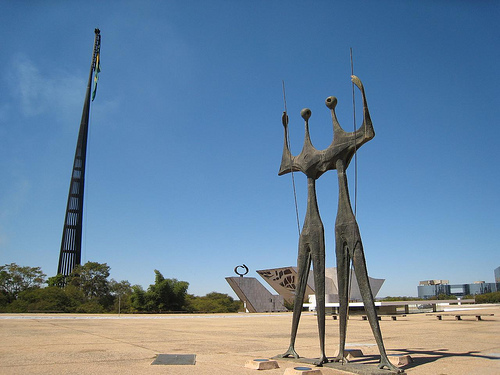
In the Plaza of the Three Powers, Bruno Giorgi’s sculpture, Os Candangos, memorialized the northeastern Brazilians who built the capital.  In the national discourse of the time, these impoverished peasants were living symbols of Brazil’s colonial and agrarian past.  By coming to Brasília and building the city, they were transformed into new pioneers who would settle the vast empty spaces of the country’s interior, from the dry plains of Brasília through the vast green desert of the Amazon.  Unlike the North American slaves who built the White House and the U.S. Captiol buildings, the candangos were memorialized as part and parcel of Brasília’s futurist vision.

The architect must think that the world has to be a better place, that we can end poverty . . . . it is important that the architect think not only of architecture but of how architecture can solve the problems of the world . . . The architect has to always be political.

—Oscar Niemeyer, 2009

Hard Winter

Meanwhile, in London, Sylvia Plath was pregnant again.  Her husband, Ted Hughes, was having an affair with another woman, and they were destined to separate soon after the birth of their son, Nicholas.  In the 13 months after Nick’s birth, Plath wrote most of the poems in her second collection, Ariel, and published her autobiographical novel, The Bell Jar.  Then on February 11, 1963, Plath left her children sleeping in their room, sealed the door with wet towels, and committed suicide with oven gas in the kitchen.

Among the poems she wrote in this period was Brasilia, which was not published in Ariel.  Like Zweig, Plath was thinking about the past and the future and the trouble with seeing it through.

Will they occur,
These people with torso of steel
Winged elbows and eyeholes

Awaiting masses
Of cloud to give them expression,
These super-people! –
And my baby a nail
Driven, driven in.
He shrieks in his grease

Bones nosing for distance.
And I, nearly extinct,
His three teeth cutting

Themselves on my thumb –
And the star,
The old story.

In the lane I meet sheep and wagons,
Red earth, motherly blood.
O You who eat

People like light rays, leave
This one
Mirror safe, unredeemed

By the dove’s annihilation,
The glory
The power, the glory.

It was one of the coldest winters on record in England, and Sylvia Plath’s life was falling apart even as she was bringing new life on.  How long she had intended to take leave of this life is not something we can know.  She had attempted suicide before, and she was troubled by deep emotional struggles that went back to childhood.  Her relationship with Hughes held some high points in her life, but now he had left her for another woman.  What is clear, however, is that once she made her decision, she executed it with consummate intentionality.  She meticulously protected her children as she took her own life.

Like Zweig, she left two works for posthumous publication, one pointing backwards, one pointing forward.  The Bell Jar was on its way to publication; in this, her semi-autobiographical novel, she exposed a world she knew in the past, a world she tried to leave once before.  As she died, the manuscript for Ariel and Other Poems, her masterwork, lay on the desk, each poem typed and left in the precise order she wanted for the book.  The first word of the first poem, “Morning Song,” was “love.”  The last word of the last poem, “Wintering,” was “spring.”

Like Zweig, Plath thought she left a book pointing to a better future, but that wasn’t to be.  The Ariel that was published under Ted Hughes’s editorial guidance was not the same book.  The poems were reordered, others added, and a few, like Brasilia, removed.  This Ariel was darker, seeming to foreshadow Plath’s end, but whatever the critics of Hughes’s intentions, this Ariel made Plath who she is today.

Cold War

On March 31, 1964, the Brazilian military overthrew the democratically elected government.  As the military took control, they created the model for the “bureaucratic authoritarian state” in the developing world.  Niemeyer and Costa’s modernist visions were perverted into symbols of Latin America’s dark period, the capital’s bland functionality and order representing the kind of control that the military celebrated in its culture, the kind of functionality they wished to instill in the rest of the country.

Behind the gleaming white façades of Brasília’s futuristic vision, the Brazilian military contributed to the “dirty wars” against the left in Brazil, Argentina, Chile, and Uruguay.  These regimes took the lives of tens of thousands of people who dreamed of a different kind of democracy than the region had known.  Beyond those killed, many more were tortured, and hundreds of thousands were forced into exile.  Niemeyer, a Communist and therefore enemy of the state, went into exile in Europe.

When the opposition movements eventually took power in the late 1980s and 1990s, the world was a very different place.  Brasília was a bigger city, showing some age, surrounded by “satellite cities” and large favelas – the squatter settlements that the military tried to eradicate in Rio de Janeiro with less than efficient results.  Costa’s rationally designed city had its flaws, its ups and downs, and its critics.  For some, it seemed as if Brazil, and Brasília, had turned Zweig’s book into a joke:  Brazil is the country of the future, and it always will be.

The future that Brasília promised, that Plath saw in her mind and in her children, didn’t work out according to the original plans.  Yet life goes on.  I will continue these themes in the next posting on the The truth and Brasília, 3:  Faroeste Caboclo.

plath-tat

Notes and Credits

The critics of Brasília’s ambitious design and lofty principles are many.  I am not one of them.  I am writing to explore what Brasília means, not its shortcomings, and my approach should indicate that I believe the city’s meaning far outshines any of its shortcomings.

Lauro Cavalcanti provides a beautiful guide to Brazil’s modernist architecture that places Brasília in perspective.  In Brasília, the government sought to “turn the state into a spectacle,” and Brasília is indeed the enactment of a dream.  If you can’t go to Brasília but can find your way to New York, go to Lincoln Center, and you can witness Neimeyer and Brasília’s influence on one of the great cultural centers of the world.

Photo of the Praça dos Três Poderes, with the statue of Os Candangos, is from the Flickr site of Shelley Bernstein, aur2899.  She works at the Brooklyn Museum (according to the Flickr “about”) and has a lot of pictures from Brasília and elsewhere.  Her Brooklyn Museum blog posts are here.

The candangos are publicly memorialized in Brazil, in marked contrast to the North American squelching of the slave labor employed to build our own White House.  Without suggesting that Brazil is any less racist than the U.S., or that either country has a better social model for dealing with its racial legacy, I point this out as a matter of historical interest.  The reader may regard these facts as he or she wishes.

Niemeyer and Costa’s designs were political statements.  They expressed political beliefs in modernity, order, and democracy in the layout of the city.  Niemeyer himself was a Communist, whose architeture reflected his beliefs in a world of collective and individual democracy, the triumph of working people over the old regime and the capitalist governing class.

Oscar Niemeyer is 101 years old, and he is still working.  The quotation in this posting is taken from an interview he did with Santiago Fernandez-Stelley for Vice magazine online, at some point in 2009.  The interview can be seen on video at VBS.TV.  The video of the interview is simply inspirational.

The photo of the Sylvia Plath tattoo is from a photobucket listing from PaperCuttt.  I found it first on this site for literary tattoos.  You can also find material from the same person at another livejournal channel.  She notes that she altered the original slightly (“As I listened to the old bray of my heart….I am. I am. I am.”) but that it contains the same spirit.

I have long been greatly motivated by the poetry and writing of Sylvia Plath.  As I mentioned in the introduction to this series of posts, her Collected Poems was one of two English language books I brought to Brazil in 1992 for my year of doctoral reserach in Belém.  Over my life I have read many books on her and her life.  These resources include:  the poems themselves. Anne Stevenson, Bitter Fame; Jacqueline Rose, The Haunting of Sylvia Plath; Linda Wagner, Critical Essays on Sylvia Plath; and Erica Wagner, Ariel’s Gift.  I’ve tried to read as much as possible, and to work through the thicket of political controversy around her work and life.  I also read Ted Hughes’ Birthday Letters and have some to a deeper appreciation of how Sylvia Plath affected all those around her.  The tragedy of her son’s suicide last year brought me a several days of stark reflection on emotions, depression, and the struggle of human consiousness and life against itself.

12 Comments

Filed under art, beauty, existentialism, failure, ideas, order

The truth and unicorns, part 2

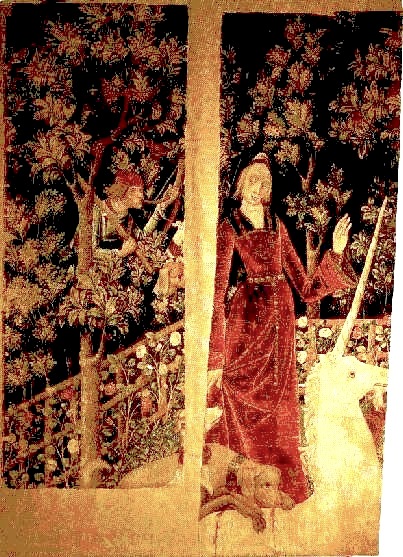
The Maiden Captures the Unicorn

The Maiden Captures the Unicorn

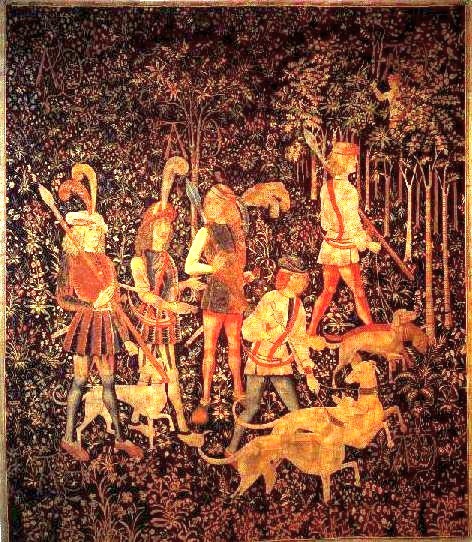
The Cloisters is the Medieval branch of the Metropolitan Museum of Art in New York City.  If you’re not in New York, drag your mouse here.  When you get there, you will find a large room, like the banquet hall of a castle, complete with a large, carved stone fireplace.  There is no table in the middle, and you will see hanging from the walls seven tapestries that date from the turn of sixteenth century (1495-1505).

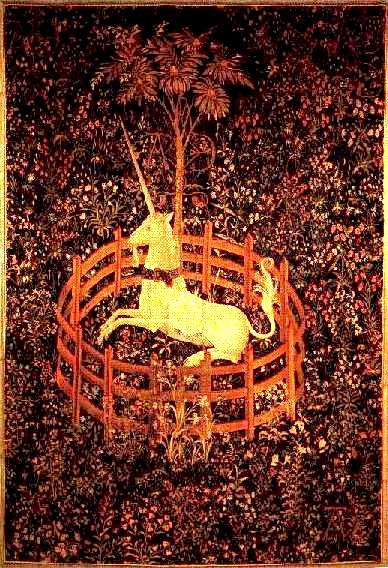
They were woven in Brussels of wool, silk, silver, and gilt wefts by deft hands. Hanging twelve feet from ceiling-to-floor, the tapestries tell the story of a unicorn hunt, a standard Medieval myth, set against mille-fleurs backgrounds that show over one hundred species of plants. A group of well-armed nobles and knights search the countryside for a unicorn, but they can capture it only with the help of a Maiden, a virgin. They stab and gore the unicorn and set their dogs on it. Custom would have the capture killed on the spot – but the unicorn lives again in the final tapestry, The Unicorn in Captivity, which shows it tied to a pomegranate tree, surrounded by a low fence.  It is an allegory of the passion of Christ, or the cruelty of mankind, the rape of nature, the fierceness of men, the innocence of virgins, sexuality itself.

If you have the chance to visit the exhibit, read aloud Rainer Maria Rilke’s sonnet to the unicorn.  The echo in the room takes you out of time and space and into the sensual experience of near-fantasy.

O this is the beast who does not exist.
They didn’t know that, and in any case
– with its stance, its arched neck and easy grace,
the light of its limpid gaze – they could not resist

but loved it though, indeed, it was not. Yet since
they always gave it room, the pure beast persisted.
And in that loving space, clear and unfenced,
reared its head freely and hardly needed

to exist. They fed it not with grain nor chaff
but fortified and nourished it solely with
the notion that it might yet come to pass,

so that, at length, it grew a single shaft
upon its brow and to a virgin came
and dwelled in her and in her silvered glass.

Or see the following video (best when set to full screen, though the quality of photos suffers a little):

Rilke follows the Medieval European unicorn myth as it lived in the space between paganism and Gothic Christianity. The unicorn was brought into being by human desire, yet represented innocence. For this reason, it could be captured only by a Maiden, and not by men, as the tapestries illustrate so beautifully. Eros and Thanatos are deeply entwined in this story.

The contradictory portrayal of sexual desire and the crushing forces of denial are all on display:  Does the unicorn’s story celebrate the feminine or banish it to a world of fantasy and lost innocence that only serve the interests of men? How far do we have to go from the Maiden and the unicorn to witches and witch-hunts?  Is this story a well-dressed window of oppression, the Maidens who become women chained to the pomegranate tree and fenced in like the unicorn of the seventh tapestry? Is the unicorn Jesus, loved by women and destroyed by the cruelty and hubris of men? Does it show the men for the hypocrites they are, able for all their weaponry and warmongering to capture the unicorn only with the aid of the Maiden?

It makes me think of my trip to the Louvre to see the Mona Lisa. To get to the room with Da Vinci’s masterpiece, you must walk through long hallways of religious paintings that depict, over and over, the Christian martyrs, the Crusades, and scenes of religious violence reminiscent more of Sam Peckinpah than St. Francis. There were at least 2 Sebastians, pierced by dozens of arrows, bleeding on the stake.  There were 3 heads of John the Baptist brought to Salome. Countless crucifixions. Nothing but destruction, over and over. Visitors weren’t lingering. They were on their way to the Mona Lisa. The ropes begin well down the hallway from her painting, to order the crowd into a manageable queue.

I had expected to be underwhelmed, but that’s not what happened. Mona Lisa’s room was packed. We were all struck, in awe of how she followed us wth her eyes, the way her smile seemed to change as we moved. It was a magical moment, unicorn-worthy and lovely.

Steve Earle, one of my great songwriting heroes, wrote a song called “The Kind,” which is on his CD Jerusalem, dedicated to themes inspired by 9/11, the War on Terror, and the build-up to the Iraq War.  In this song he sings of a soldier who “wins the prize and gets the girl,” of a “cowboy with an achin’ heart,” and finally, of a “girl with a secret smile.”

Paint me a picture of a girl with a secret smile
Lookin’ back at ya ‘cross the years through ancient eyes
You’re standin’ there like an open door
‘Cause she’s seen it all before
That’s the kind of picture I like

The kind that makes you sigh

In spite of all the art devoted to destruction and terror, we were all there just to see the painting of this girl who smiles.  In that moment, as in the story of the unicorn, truth.

Note

“The truth and unicorns, part 3” is in preparation and will round out the unicorn series for now.  After the credits I include all 7 unicorn tapestries, in order.

Credits

Unicorn Sonnet:  Rainer Maria Rilke, Sonnets To Orpheus, Pt. 2, No. 4, trans Robert Hunter. Hulogosi Communications Inc., November 1993.

“The Kind,” by Steve Earle.  Included on the CD Jerusalem, 2002.

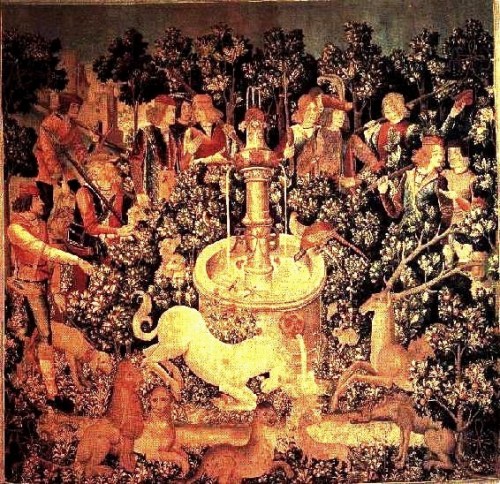
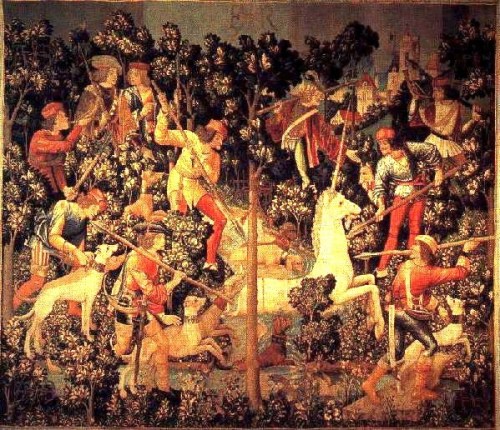
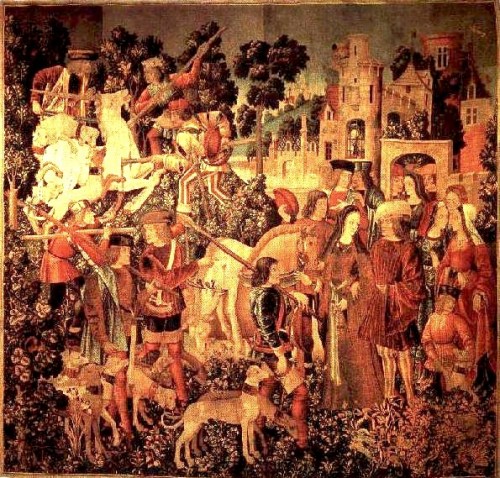
Photos of The Hunt: http://www.geocities.com/area51/corridor/5177/hunt.html.  I cannot figure out who is responsible for the site, but it lists an email address, amulet@geocities.com.  These photos are a bit darker than the tapestries; the photos on the Met’s Unicorn Tapestries site are much clearer and show the the color much better (but they cannot be dowloaded and are protected by copyright).  Here are the photos, in order.

The start of the hunt

The start of the hunt

The unicorn is found

The unicorn is found

The unicorn at bay

The unicorn at bay

The unicorn leaps from the stream

The unicorn leaps from the stream

The Maiden captures the unicorn

The Maiden captures the unicorn

The unicorn is killed and brought to the castle

The unicorn is killed and brought to the castle

The unicorn in captivity

The unicorn in captivity

3 Comments

Filed under art, beauty, danger, death, love, myth

The truth and love

htr_mrlincoln3

I love you.

We fall in love, declare love, make love, and do crazy little things for love.  We search for love in all the wrong places and find the most incredible fulfillment in even the slightest glimpse of love in our lives.  The trouble with love is that, like the truth, love creates its own parallel universes of contradictory meanings and motives.  Lovers create worlds of intoxicating beauty and lasting contentment, but lovers do things that threaten to destroy love altogether.  Why is it so much easier to reveal our secrets and anxieties to strangers, rather than just tell the one we love?  By the time we can let it out, it’s all too much.

An old pop standard put it like this,

You always hurt the one you love
The one you shouldn’t hurt at all
You always take the sweetest rose
And crush it till the petals fall

You always break the kindest heart
With a hasty word you can’t recall
So If I broke your heart last night
It’s because I love you most of all

Love is the moral equivalent of the superposition of quantum particles – this is the phenomenon in which a small particle, like an electron, seems to be doing two contradictory things at once.  Like an electron, love spins right-side up and upside down all at the same time, and any attempt to know what is going on collapses its ability to be two things at once.  And if it’s not both things at once, it’s not quite the love we desire.  Love is always and everywhere on the precipice of its own demise, the strongest trust suddenly shattered by the right amount of pressure in the right place, the right place being that fault line we’re never really aware of.

The trick with love is to know when to leave well enough alone.  None of this means that love is doomed, or that love isn’t beautiful all on its own.  It is beautiful.  Love moves us, but like Heisenberg, we find that knowing one thing about love essentially blinds us to some other quality that will catch up with us later.

Like love, the truth requires us to remember that beyond the words we say, something else is always implied, even if we can never know what it is until we’ve lost something else.  To bring truth into relationships requires us to remember that contradictions are no mere accidents.  Contradictions – in principles, thoughts, words, or actions – are the substance of the truth and par for the course in the truth of love.

Truth dares us to learn how to heal.  Love dares us to be vulnerable, to be open, and to live without knowing everything about the one we love.  Love is a dangerous beauty, as another well-known song records it,

Some say love, it is a river
that drowns the tender reed
Some say love, it is a razor
that leaves your soul to bleed

Some say love, it is a hunger
an endless aching need
I say love, it is a flower
and you its only seed

At the end of the day, love and truth challenge us to be open to the greatest rewards, in spite of any risk.

Credits:  Allan Roberts and Doris Fisher, “You Always Hurt the One You Love,” sung by many, among other Clarence Frogman Henry and Ringo Starr

Amanda McBroom, “The Rose,” made most famous by Bette Midler

http://www.flowerpictures.net , rose photo.

10 Comments

Filed under beauty, Bette Midler, Clarence Frogman Henry, danger, love, superposition

The truth and fingerprints

Inside all things, if you look hard enough, you’ll find a unique code.  It might be a genetic code.  It might be the traces of carbon-14 in tiny plant spores embedded in the rocks at the bottom of an ancient lake.  The layered patterns of sediment that tell you this could only be the Grand Canyon, for no other place on Earth has this precise pattern.  Or the tips of your own fingers.  Like zebra stripes and leopard spots, our fingerprints are indistinguishable from a distance but unique up close.  There’s something elegant and utterly beautiful in all this.

Fingerprints, of whatever kind, help us find out things that are true.  Fingerprints help us identify who committed a crime.  Fingerprints can become keys that open doors to secure places, protecting those spaces from harm or wrong-doing.  DNA fingerprints help us know who really fathered a child, or where our ancestors lived.  Fingerprints help us know things we couldn’t otherwise know.  Fingerprints are hard to erase without deformation.  Fingerprints keep us honest.

But that’s not all.  As long as we have fingerprints, we know we’re alive.  Whether DNA, carbon-14, or the tips of our fingers, fingerprints are very high-level expressions of order, and rocket scientists will tell you that order is intimately connected to life.

Here’s what they mean by order:  fingerprints carry information that can only be in one place.  This is the epitome of order.  Fingerprints tell you what to count on, so that nothing is unexpected and everything is predictable.  It’s the way mom wanted your room to be:  everything in its own place.  The opposite of order is randomness.  In a random world, there are no patterns, nothing you can recognize, and nothing you can count on.  Everything is new, everywhere you turn.  Memory ceases to be useful in a random world, and we’re all Leonard Shelby.

Stepping down from fingerprints, there are many other forms of order, which can occur in multiple places – making them a little more random than fingerprints, but somewhat orderly, nonetheless.  For example:  the behavior of electrons along copper wires or in magnets.  Wallpaper.  Or the herd-like behavior of people, who at the social level are every bit as predictable as they are “unique” at the individual level.

This is where individuality and order begin to clash, because they’re not supposed to be related to each other.  Fingerprints = individuality.  Fingerprints = order.  Therefore, individuality = order.  How can that be?  Individuality is the opposite of order, right?  Back to Leonard Shelby:  in complete randomness, everything and everyone is different but totally lifeless.  Recognition is meaningless, knowledge is impossible, and therefore individuality is impossible.  What we call “individuality” must be a symptom of order, for without order nothing could exist.  Individuality, as an experience, must be somewhere between the expression of complete uniqueness (a fingerprint seen up close) and a kind of order that says “this is a pattern” (fingerprints seen from a distance).  People are like wallpaper.

The trouble is that order is everywhere on the decline, and this has life-threatening possibilities.  Orderly things are signs that the universe hasn’t exhausted the energy that makes non-randomness (e.g. life or fingerprints) possible.  Orderly things are not always “alive” by our definition, but they make life possible if we can tap their energy.  Atoms, for example, are orderly things that contain a lot of energy.  Try splitting one (but don’t do it at home).  Order = energy.  And energy = life.  Without energy there would be no life.  Living things are, by definition, orderly and full of energy, but they get their energy by consuming it from somewhere.  The laws of rocket science tell us that this is a losing game:  energy can only ever be spent and never really recovered or recreated.  This is what the rocket scientists call entropy.

So here’s the paradox:  life stands in contrast to entropy.  Life takes and spends energy, and spending energy only increases the entropy of the world.  Life is the struggle against entropy, but no matter how you cut it, the truth about life is that living can only contribute to entropy.  To live is the act of dimming the possibility of life in the future.  It’s an awful, yet beautiful, burden to live with.

The beauty of uniqueness – of the self, of being alive, captured in the fingerprint as the epitome of order and therefore the fullest expression of living being – is itself an act of destruction.  Preserved, it is not life.  Moving and living, it only contributes to our mutual undoing, but it is all we really have.  As Keats reminded us:

Beauty is truth, truth beauty,—that is all
Ye know on earth, and all ye need to know.

1 Comment

Filed under beauty, entropy, John Keats, Leonard Shelby, order