Category Archives: ideas

Another year, and we remember

IMG_1220

This is the view from the window next to my desk.  From that window, I took the photo that was the first masthead for this blog (it’s in the page on “the blog” if you want to take a look).

This was the view last night, from the ground, at the corner of 6th Avenue and Union Street in Brooklyn.

911-sarah-alt

My downstairs neighbor, Sarah, took that photo, and I saw it on her Flickr.

For the last three years, I have engaged a small ritual on or about September 11, when I can see the beams of light from Ground Zero over downtown from this window.

I turn out the lights.  I sit for a few minutes, 10 minutes or so.  My son is asleep in the next room, or maybe he’s at his mom’s apartment, just a few blocks away in the neighborhood.  Either way, he’s safe, while I gaze at the lights.  Irony is not the word for this.

I know my fate.  One day my name will be associated with a memory of something tremendous—a crisis without equal on earth, the most profound collision of conscience, conjured up against everything that had been believed, demanded, hallowed so far … Where you see ideals, I see what is human, alas, all too human.

Nietzsche’s words stream through my mind as I look at the beams and write my friends—

The clouds have cleared now and I have turned off the lights.  I just want to look out at the beams of light streaming up to the heavens.  So strange to think of the world before that day, and the world we have now.  And it made me feel like reaching out to a few people who matter to me.  I hope you’re all well.

As it happens, I never have taken a photo of the 9.11 beams from this window.  Tonight I will try, but I fear it’s going to be cloudy.  That’s unfortunate, because over the last couple of years, the view was so spectacular, iconic – and this year, 2009, will be my last at this window.  I will be moving at the end of September, to a new apartment in “Prospect Park South” which is the trendy name for what has often been called “Kensington” or simply “Flatbush” in the local dialect.

As all things happen, however, Providence gives us what we need, and Sarah’s photo from last night is such a gift.  So:  Thank you much to Sarah for this photo.  To all those who have touched my life, or whom I have touched in any way however small, I say this,

Be well and cherish those whose love you share.  We have no way to change what was, and our attempts to shape what will be never have their intended effect.  Where we are absolute, however, is the moment at hand.  Let us live that moment well, with love, and with all the peace that the world so deeply needs.  Only then do we stand a chance against the forces of darkness.  Strange as it may seem, those are pretty good odds.

Notes and Credits

Sarah’s photo: http://www.flickr.com/photos/37558372@N03/3908398726/

The precise address of our building is 211 Sixth Avenue.  Or the Union Market, at 754 Union Street, Brooklyn.  11215.

The quote from Nietzsche was taken from the opening of the BBC documentary of him, which can be seen here.  See also this and this.

My own quoted email was what I sent in 2007, the first year I sat at this window.  I cannot find last year’s email, which was a little more focused.  My three years of having this view have been important to me, because this window was a starting-over in many ways.  I will miss the view – but mostly I will hold dear the fact that I have the chance to have this view for a little while.  I only hope that the folks who come next to this little apartment are able to appreciate it as well.

Personal Note

I moved to New York in May of 2004.  In 2001, I was in Rock Island, Illinois, teaching at Augustana College.  On that particular day, I was in my office early.  Jane, who was the secretary for the departments of History and Political Science, came running down the long hallway to my office – we might have been the only two people on the floor.  She told me that I needed to come to the television and see what happened.  Her husband had called and said that a plane crashed into the World Trade Center.  Jane and I watched the rest of it happen, in a conference room on the campus of Augustana College which from its own window had a wonderful view of the Mississippi River and America’s own “heartland” on the border of Illinois and Iowa.  We saw the second plane crash into the other tower, and we saw the buildings fall to the ground, all live.  In my office, I heard about the plane crashing into the Pentagon, live.  I was very afraid.  My wife was out of town, and she was very possibly pregnant with our child (we had this confirmed just weeks after 9.11).  My country was under attack.

I don’t know if folks in New York know what it was like to experience 9.11 outside of this city.  It was pretty dreadful.   Nothing like here, of course, but awful nonetheless.  For a little while, we had no idea where this would lead, and everyone feared bombs and flames and explosions.

A few weeks later, November 10-12, 2001, we were in New York.  My wife had some meetings and I was along for the ride and the visit.  We knew then that our child would be expected some time in May or June.  I had some good runs in the city, in Central Park, along the avenues, but not on the West Side Highway.  It was blocked, for security reasons.  As we prepared to leave on the 12th, we heard odd news suddenly:  all the bridges and tunnels were closed, and so were the airports.  A plane had crashed in Queens.

Downstairs, we spoke to the hotel personnel.  The looks on their faces and the emotions in the air are emblazoned on my mind, in a way that makes me think of my parents’ generation when they talk about what they were doing when Kennedy was assassinated.  I won’t forget that.

6 Comments

Filed under danger, death, existentialism, ideas, philosophy, politics, truth, Uncategorized, war

The truth and change, 3a: From Life on Mars to Linden

The House of Tomorrow, 200x

The House of Tomorrow, now

The third post in this series, The truth and change, is split in two, 3a and 3b.  They provide different outcomes for the multi-part essay on change and the future that I began a month ago.  It wasn’t how I planned the posts, nor are these the only two ways things can work out.  They are, instead, the unintended surprises at the end of a long chain of lateral thinking that has also suggested a set of follow-up postings down the line.  It’s always nice to pile up things to do.

From Life on Mars to Linden

Avatars are nothing new to the human species, from the caves of Lascaux to the virtual worlds of Second Life and other large web-based games.  These (brave?) new worlds carry out the same primeval urge that led people to create paintings of their daily lives 35,000 years ago.  What began in the caves has become a massive wall written on by millions of people, together, sharing a world that they have imagined out of the very world in which they live.

The House of Tomorrow, 35,000 BCE

The House of Tomorrow, 35,000 BCE

One of the interesting things about the virtual world is that it does create a “place” that didn’t exist before, uncovering new spaces in life that are hidden beneath the physical dimensions we take for granted.  In the world of Massive Multiplayer Online Role Playing Games (MMORPGs, or MMOs) such as Second Life, people leave their organic beings and create virtual selves, societies, and places in cyberspace.  These worlds are a social version of the extra-dimensional physics of string theory, “brane worlds,” and high energy model building that physicist Lisa Randall has written and spoken about.  In MMOs, we are building new worlds in very small spaces inside the world of everyday experience.

The key thing about these virtual dimensions is their connectivity to real life, which engenders much greater imaginative potential than the escape to the “silver screen” that left the sad girl in David Bowie’s song wondering if there was “Life on Mars.”  Ours is now a world of both cultural production and absolute reflexivity, in which the virtual world is like a magnifying mirror we hold to our organic lives.

In a fascinating example of this reflexivity, organic journalist Marcia Stepanek reports on Second Life journalist Draxtor Despres, who himself reports on the goings-on of the organic world for the people of Second Life.  Their dialogue is like an 8-track tape, or a Möbius Strip in which one side is organic, the other side virtual, both surfaces effortlessly sliding into each other when they are attached in just the right way.

Stepanek has also profiled the work of Douglas Gayeton, a multimedia artist who “creates immersive story experiences for virtual worlds and social networks.”  Gayeton’s documentary, “Molotov Alva and His Search for the Creator: A Second Life Odyssey,” was the first documentary produced entirely in Second Life.  For a while it was the highest rated video on YouTube.  It’s been picked up by HBO and begins to make clear how “real” the virtual world really is.

Already, the virtual economy is derived from, reflects, and ultimately contributes to the organic economy.  In July of 2009, Second Life creator Philip Linden spoke to BOSL (Best of Second Life) Blog about how Linden Labs is creating various supports for crossover services involving both businesses and educators, who will use the SL platform to provide services in real life.  Within SL, “Linden Dollars” are the basis of a vast economy of virtual goods that can be converted, ultimately, into organic dollars.

The virtual world embraces an entire crossover economy.  Hermione Watanabe is a “virtual wealth coach” whose blog provides advice and information on the SL economy and how to grow income there and in the organic world.  Perhaps the most compelling confirmation of the virtual world’s “real” existence is that the Federal Government is thinking about how to tax virtual economic activity.

The crossover continues in the amateur machinima that is becoming an art form of its own, sprawling across YouTube, Vimeo, and other video networking sites.  Aenea Nori’s SL video for Kafka Dinzeo’s remix of Lily Allen’s “Littlest Things” brilliantly takes us through the wormholes that connect virtual dimensions to the organic and back again.

LauraMW12345 created an organic-virtual mix in which “Second Life Meets Real Life,” in which the green screen existed in SL and the “real world” had to be inserted as fictional background for the avatars. The video is set over the DNA remix of “Tom’s Diner,” which was one of the early, pioneering events in remix history, on the borders of different dimensions of musical creation and imagination.

This sliding between organic and virtual lives has inevitably encompassed the most ubiquitous and equalizing of human emotions:  sex (and its correlate emotions).  Love is in the virtual air, as people in Second Life and other MMOs mix, mingle, fall for each other, become married (virtually, but quite really), pledge love, cheat, cry, break up, and try again.  For a while, people started to create real-world-like porn magazines on-line (in Second Life, Slustler was a phenomenon in 2005-07), but these have been displaced by other virtual services and games that better fit the medium, such as Red Light Center (which creates a very real organic economy for itself as well) and SL meeting places and adult parties.

Eventually, however, we come back to the connection between the virtual and organic worlds.  They cannot function without each other.  “If This is Second Life Why Is My Heart Breaking In Real Life?” is a machinima video created by Kirk Lancaster and Sandra Holyoke that explores the crossover of desire and heartache.  The relationships we create in other dimensions reverberate in the organic world and behind them all lie one, beating, very organic heart.

The future, it seems, is not out there in the world, some place distant in either time or space.  It’s in our minds, already, right now, and available for our scrutiny.  This isn’t the future I imagined as a youth, or even when I began writing these postings.  In this future, much of the world is simply brought to life from our own minds with the help of technologies that enable millions of minds to communicate in tandem, synced together to build a world that is every bit as real as the organic world even as it vanishes before us to live in our minds.

This brings me back to the Shetland Islands of the late 1940s, where Erving Goffman gathered observations and data for his book, The Presentation of Self in Everyday Life.  It was published in 1959 and became a classic of American sociology; it’s still widely read and has never been thought out-of-date.

Immersing himself in the world of the Shetland Islanders, Goffmann looked at their everyday interactions through the lens of drama – people were actors in their own plays, as well as each other’s audiences.  “All the world’s a stage,” Shakespeare famously said, and Goffmann set out to prove it.  People work hard to create settings and situations in which they can enact a specific, intentional script.  They have certain behaviors for their audience, as well as an array of backstage behaviors.

Goffman’s point of view was revolutionary at the time and cemented the foundation of a whole school of social thought.  We construct our own worlds in the same way that we construct plays and dramas.  The representational activity that started in places like Lascaux and ends up in MMOs is pretty much the same.  The attractiveness of gaming and MMOs is clear:  it’s what we already do in regular life, only in the MMO we get a greater degree of control over what we hide backstage.

This begs a question.  Is the change we experience with this technology really anything more than a change in the venue (now virtual, created) for the same old desires we’ve always had?  A vanity of vanities in which there’s nothing new under the sun except for the bottles that are filled with old wine?  Does the virtual world of love and sex and desire change any of the fundamental emotions or relationships that constitute what it means to be human?  When and where does the virtual world go beyond reflections and extrapolations of the organic?

When is the virtual world for-itself?

Notes and Credits

The opening photo is from the Flikr site of rikomatic.  The photo shows a house for sale in Second Life, where participants engage in an extensive economy that has several dimensions – purely virtual, combined virtual and organic, and mainly oriented toward organic profit.  In Second Life, people create their own houses by using virtual money (Linden dollars) to purchase land and materials in the virtual world.

Much thanks to Marcia Stepanek for introducing me to the world of machinima in her writing on Cause Global and Pop!Tech.

The photo of the Lascaux cave paintings is from Prof. Saxx and can be seen at the Wikimedia commons.

Aenea Nori’s machinima for the “Littlest Things (remix)” carries us through many layers of time and space.  I would have embedded the video in the blog for people to see, except that WordPress (the free version, anyway) isn’t communicating with Vimeo.  You should go to her site, however, and check out her video work. There is no recent activity on the Vimeo site or on her blog (the last activity is September 2008), but perhaps she’ll be back.

Lily Allen uses a lot of mixing, overdubbing, and sampling to build her songs, which are themselves an aural hypertext calling forth a multitude of associations and images.  “Littlest Things” recalls Cat Stevens’ “Wild World,” morphing time across 35 years of cultural production. Listening to Allen’s work is stimulating – and now Aenea Nori and Kafka Dinzeo transport the music and associated images into another world altogether, sliding along a “brane” between the virtual and organic worlds.

Regina Lynn has written in Wired about the growth of the virtual sex world found in MMOs all over the web, some of which are lucrative businesses. WebMD posted a balanced article on the advantages of cybersex and “teledildonics,” which include a safe place to try out new ideas (both in terms of disease and in terms of emotional control), as well as the problems – it can become addictive and affect real-life relationships.  The article quotes Regina Lynn, who brings the issue down to earth:  “Does your partner know, and does your partner consent? Lying is cheating.”  Over at True/Slant, Todd Essig writes about the cutting edge developments in the world of cyber sex – now, cyber-touch with lasers across world’s distances.

Taunt is a blog devoted to SL economics and SL sex life.  SL and other MMOs feature escort services and erotic parties to cater to every taste, including many that are all but impossible to enact in organic life.  “Second life guys can have it all, as long as they’re willing to pay,” according to Elle Kirshner, a Second Life designer and voiceover artist for Kirk Lancaster’s SL video, “Second Life Man.”

Overall, sex is actually the cutting edge of machinima and virtual reality.  Why?  Because it’s what we want so much in real life that our urges push the limits of technology so that we can pursue desire in every possible corner of existence, from dreams to waking life to virtual reality.

4 Comments

Filed under art, body, fiction, ideas, journalism, life, love, media, truth, vanity

The truth and change, 2: Technoredemption Goes Pro

house-of-tomorrow

The House of Tomorrow, 1933, Indiana version

In the first installment of The truth and change, I wrote about how the Enlightenment gave us a new kind of science and social discourse that pictured a perfectible mankind, which would be the basis of real democracy and freedom in the future.  Yet it was really a Greek tragedy.

Jefferson snubbed the ancients by declaring that there will be something new under the sun, and a hundred years later the world embarked on a century that would witness versions of apocalypse previously imaginable only in epics and divine texts.  Everything that the Enlightenment made it possible to imagine, it also made it possible to destroy.  That was the dilemma of my generation . . .

Technoredemption Goes Pro

The 1933 Chicago World’s Fair gave us the “House of Tomorrow,” which still stands in Indiana and at 78 years old combines the future and past in one space.  Like most dream houses created since the 1930s, it has a double garage, with a twist – one for an automobile and one for the airplane that “World’s Fair optimists assumed every future family would own …”

One can only imagine how this garage has played out of time – rumpus room, game room, massive mud room, cluttered workshop where grandpa used to build boats in bottles, and now the place where mom and dad surf the internet when the other isn’t looking.

The House of Tomorrow held out a vision of the future at odds with much of what was going on around it.  A few years earlier, World War I gave people a glimpse of the horror to be wrought by chemical warfare and bombs.  In 1933, faith in individual action and the capitalist economy was well under seige.  On February 27 of that year, Hitler burned the Reichstag and The Third Reich began.  World War II, with its multiple Holocausts of genocide, firebombing, and nuclear warfare would be soon upon us.

The House of Tomorrow, 1933, Berlin version

The House of Tomorrow, 1933, Berlin version

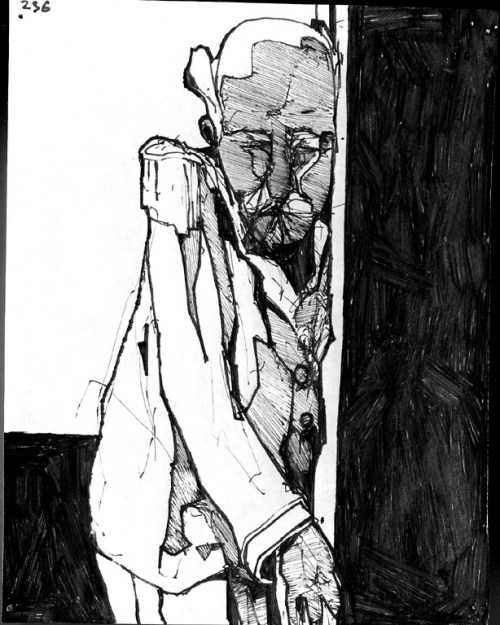
Thomas Pynchon’s Gravity’s Rainbow (published in 1973) portayed this entire destructive arc of the twentieth century.  Science fuelled a spiral of violence, which unleashed and unbound human emotions both zany and horrific.  Pynchon captured this most vividly in Brigadier Pudding’s humiliation scene, a Pavlovian experiment in the malleability/perfectibility of mankind that was a living annihilation at the border between the past and our future in which Pudding relived and relieved himself of the filth of Ypres and Passechendaele over and over again.  The ritual became the center of his being.

Brigadier Pudding on the border between past and future.

Zak Smith: Brigadier Pudding, p. 236

Still, annihilation and holocaust were not the only ideas on the table. The playfulness of Pynchon’s novel and its main character, Tyrone Slothrop, held out the competing narratives of innocence and technologial redemption, impulses ironically (and perhaps hypocritcally) present in Robert Moses’s 1964 New York World’s Fair.  This was the year of my birth and the year in which Stanley Kubrik gave us Dr. Strangelove.  At the Fair, GM’s “Tomorrow Land” provided a delightful tour of the wonders yet to be bestowed on us by reinforced concrete, steel, and plastic.  Tomorrow Land was a glimpse into the world that could be, minus the evils of nuclear war, poverty, and exploitation.

At the Fair’s Pepsi Pavilion, “Children of the World” used mechanized dolls and music to showcase a world of hope and diversity.  This became Disney’s “It’s a Small World,” leading to the installation of its relentlessly saccharine theme song in the minds of millions of people every year, some of whom must wish that Slim Pickins would ride a missile into Orlando and put an end to the little dolls and gadgets just so they could get that song out of their heads.

The world we inherited in the Reagan years was reeling between the Jetsons and Dr. Strangelove as Paul Westerberg wrote “we’ll inherit the earth, but we don’t want it.”  If we were finally, really going to do it, to blow it up, I’d at least try to spend my last years thinking of other things.

TRS80mod3

The Mighty "Trash-80"

In 1981, I bought a TRS-80, Model III.  I was 17 and had saved up the money from my job at the pizza parlor down the street.  I read Alvin Toffler’s The Third Wave and John Nesbitt’s Megatrends.  A future of progress was much more appealing future than the one forecast by the “Doomsday Clock” on the cover of the Bulletin of the Atomic Scientists.  Such was the future according to Generation X, as we stumbled between slackerism and technoredemption.

In 1989, I remember being in my kitchen, washing dishes and listening to NPR when they announced that people had climbed over the Berlin Wall and were taking it apart.  In my own mind, I replaced The Day After with Blondie and hummed “Atomic” over and over again as I felt relief wash over me.

Then in the mid-1990s, Newt Gingrich started invoking Alvin Toffler at every opportunity.  1984 and Y2K came and went with neither Orwellian nor apocalyptic futures taking hold.  The most prescient glimpse of the future provided in my entire lifetime was not Space 1999 but Prince’s 1999, which accurately forecast exactly what I, and countless others around the world, were doing in 1999.  Whatever the future would be, it would be weird, and once Tim Berners Lee put the World Wide Web up, Gen X went online and, as if following Hunter S. Thompson’s consultation to our parents, we went pro.

Technoredemption provided a kind of cure-all for anxiety about the future.  Today it feeds the relentlessly positive assessments of Twitter’s contribution to revolution and freedom around the world.  Yet the same technology can bring us back to Huxley or Orwell, and we know it.  Evgeny Morozov writes that even as “activists and NGOs are turning to crowdsourcing to analyze data, map human rights violations, scrutinize the voting records of their MPs, and even track illegal logging in the Amazon”, ” governments are also relying on crowdsourcing to identify dissenters and muzzle free speech.

Technoredemption remains as much a promise now as it was in 1776, 1933, 1964, or 1989.  Rousseau’s famous line from the opening of On the Social Contract – “Man is born free, and everywhere he is in chains” – strikes me as quite true today, in the same sense that Rousseau meant it, and with the same consequences.

Notes and Credits

The photograph of the House of Tomorrow, Indiana version, was found on Wikipedia, in the commons at http://en.wikipedia.org/wiki/File:571531cv.jpg.  The House of Tomorrow, Berlin version, is in the Wikimedia commons at http://en.wikipedia.org/wiki/File:Reichstagsbrand.jpg.

We didn’t need nuclear bombs alone to create armageddons of pain and horror.  Madhukar Shukla writes “The Firebombing of Tokyo was as devasting as the nuclear, Hidden in the history of that time, is an unnoticed footnote – the ‘Tokyo Fire-Bombing,’ which the Western press would not touch, and the Japanese survivors would not like to dwell upon [was an] event which happened months before the atom-bombs and with far more lethal consequences.”  Shukla’s blog is called “Alternative Perspective” and his homepage is here.

The illustration of Brig. Pudding is by Zak Smith, from his work Pictures Showing What Happens on Each Page of Thomas Pynchon’s Gravity’s Rainbow. Much thanks to Zak for granting me permission to use the image.  The series of illustrations was featured in the 2004 Whitney Biennial (agh, just before I arrived in New York!) and is now part of the permanent collection at the Walker in Minneapolis.  In the episode referenced above, Brig. Pudding must undergo a scatological humiliation scene with Domina Nocturna as part of his atonement for his role in Ypres and Passechendaele, a scene occupying pp. 232-36 of the book (Viking Press, 1973).  Click on the image and you will be taken to a website featuring all of the illustrations.

Among Pynchon’s themes we count the Europeans’ damning of the world to endure the repetitive future of their own racist, colonial past, which sits perversely at the heart of American innocence and condemns America (white America, especially) to this struggle between technoredemption, dystopia, and annihilation.  Like Rousseau, Pynchon sees the chains that reason has placed on mankind.  He continues to explore that theme in his writing, with impressive intensity in Mason and Dixon, in which the two famous astronomers are contracted to create an artificial boundary between two artificial entites (Pennsylvania and Maryland) that have been imposed on something like a state of nature.

Pynchon’s new novel, Inherent Vice, goes into the territory of detective fiction and film noir, two of my favorite genres.  I am giddy and cannot wait to read this book.  Expect more posts related to TP.

On August 31, 2006, Douglas Coupland posted a wonderfully ironic vision of the future as past and present on his New York Times blog.  At that point he boldly foresaw the Kindle-future, as he predicted that books will “cease to exist” and become “extinct.”  Looking at his old novels and thinking of insects, he began to think about how wasps made paper from wood, and then he used his own mouth to pulp his novels and make nests from them.  The resulting photos are quite beautiful, and the blog posting shows what Generation X looks like as a nest.

The photograph of the TRS-80 Model III comes from Stan Veit’s website, PC-History, based on his famous book, Stan Veit’s History of the Personal Computer.

I learned about Evgeny Morozov’s blog post in a Tweet from Cause Global’s Marcia Stepanek.

The ice age is coming, the sun’s zooming in
Engines stop running, the wheat is growing thin
A nuclear error, but I have no fear
Cause London is drowning and I, I live by the river

6 Comments

Filed under danger, death, freedom, ideas, politics, truth, Uncategorized, war

The truth and change, 1: From Perfection to Dystopia

The House of Tomorrow, 1776

The House of Tomorrow, 1776

For as long as I can remember, people have been trumpeting the big changes that were supposed to occur in my lifetime.  In this span of years, roughly the 1960s-forward, change was the key ingredient of the future, which amounted to three alternatives:  progress, dystopia, or annihilation.  Looking back on the future of the last 45 years, however, it turns out that these aren’t mutually exclusive alternatives.

Einstein observed that the experience of an event is subject to relational factors like who’s observing it, where, and under what conditions.  So it is with the future.  It may not be the world itself that changes, but rather how we experience it, a future that happens inside our bodies to make the world look, sound, feel, taste, and smell different.  The House of Tomorrow may well be the house of yesterday, but it won’t feel that way.

This is the first of three posts on The truth and change.  The series will look at how tangled, ironic, and weird (to invoke a favorite category of Hunter S. Thompson’s) the future will be, if it’s not that already.  The exercise in lateral thinking takes us from perfection to dystopia, annihilation, technoredemption, slacker paradise, Qoheleth, Big Pharma, and cyberchange.

From perfection to dystopia

The future, change, and progress are products of The Enlightenment.  For millennia, people were assumed to be what they were.  Thinkers in the West and the East had explored all sorts of ideas about how to create good societies, find peace, and achieve enlightenment (The Buddha’s kind) – but there was no belief in a “future” that would be different from the past.  Differences in politics, spirituality, or technology were seen as superficial, and the great wheel of history rolled along.

Vanity of vanities, says Qoheleth, vanity of vanities! All things are vanity! …
One generation passes and another comes, but the world forever stays …
What has been, that will be; what has been done, that will be done.
Nothing is new under the sun.  [Eccl. 1: 2, 4, 9]

Then in the eighteenth century the philosophes in France and other spots around Europe started to think about the life we could have on Earth through science, reason, and (in one form or another) “democracy.”  The twin notions of change and the future became tangible, captured in a repurposing of the word “progress.”  In The Invention of Air, Stephen Johnson shows how these ideas were tied together across science, politics, and religion.  Ben Franklin, Thomas Jefferson, and Joseph Priestly (the nominal subject of Johnson’s book) were scientists and radicals who imprinted the American Revolution with the Enlightenment’s vision of the future.

As Jefferson wrote to Priestly after the presidential inauguration in 1800, “We can no longer say there is nothing new under the sun.  For this whole chapter in the history of man is new.”  In another context, Jefferson famously quipped, “Every generation needs a new revolution.”  Compromised as Jefferson’s revolution was, eventually even the enslaved and formerly enslaved African Americans, written out at the beginning, would build their own revolution to insist on (some of) Jefferson’s ideals, among others.  The times, they would be a-changing, and the early Abolition movement itself was a part of the Enlightenment’s vision of change.

New industries and the “New World” conjured an image of humankind’s infinite malleability – we were blank slates on which a better world would be drawn.  People were, in a word, perfectible.  Yet perfection was a contestable quality, and disagreements over perfectibility would draw the lines of ideological battles that lasted from 1776 to 1989.  One of the central lines in the struggle over change was who would make change happen best — freely acting individuals, private corporate entities, or the state.

These conflicts underlay Adam Smith’s own writings.  He placed great faith in individuals and very little in either the state or corporations.  In Smith’s ideal world, we were a self-correcting society of individuals guided “by an invisible hand to promote an end which was no part of [their] intention.”  In other words, people following purely individual motives could create social good, almost accidentally.

Smith applied his faith in individuals to economic life, but he saw a conflict between the capacity of individual action to create a moral world and the effects of capitalism’s main motor for change, the division of labor.  Far from perfecting mankind, the nature of industrial production (and with it, the creation of wealth) would render the bulk of people ever more ignorant even as democracy expanded their ability to affect their world:

The man whose whole life is spent in performing a few simple operations, of which the effects too are, perhaps, always the same, or very nearly the same, has no occasion to exert his understanding, or to exercise his invention in finding out expedients for removing difficulties which never occur.  He naturally loses, therefore, the habit of such exertion, and generally becomes as stupid and ignorant as it is possible for a human to creature to become.  The torpor of his mind renders him, not only incapable of relishing or bearing part in any rational conversation, but of conceiving any generous, noble, or tender sentiment … Of the great and extensive interests of his country, he is altogether incapable of judging …

This would be the product of capitalism, said Smith, “unless government takes some pains to prevent it.”  Smith never resolved this conflict in his understanding of change, and his fans have ignored it and instead dwelled on the “invisible hand” alone, taking this half-premise to logical extremes.

In Atlas Shrugged, Ayn Rand made a grand dystopian plea for her version of capitalist utopia that in general (if less radical) terms is part of everyday political discourse in the United States, where faith in powerful, dynamic individuals is strong.  The fear of the state is great, and the relation to mass politics is complicated.  The masses are fickle and in general not to be trusted (even by the masses).  To wit:  In the wake of the economic collapse of 2008, “going John Galt” has become the calling card of dissident financiers holding out against the reactions of the federal government and the populist fervor aimed at them, though this fervor was short-lived and now is turned against the government and health care reform.

Over time, dystopia transcended the narrow limitations of the conflicts between capitalism and socialism, seeing in both a massification of industrial society that used technology to dampen the very urges toward freedom and expression unleashed by the forces that Jefferson and Priestly heralded with such optimism.  Yevgeny Zamyatin’s novel We combined his experiences in the Russian Revolution and in the British factories of World War I to describe a true dystopia that was the forerunner of Orwell’s 1984.  Aldous Huxley’s Brave New World concentrated our gaze on the manufacture of pleasure as a way of breeding conformity and social order from the “torpor of mind” that Smith lamented in 1776.

Yet numbing sameness wasn’t the only threat to Jefferson and Priestly’s House of Tomorrow.  The rocket scientists who stood on their shoulders (among so many others) eventually helped us create weapons of unparalleled destruction that could end all life as we know it.  Beyond dystopia, the future created by reason might actually annihilate us all.  These were our choices by the time I was growing up:  Smith, Marx, Rand, Huxley, Orwell, Dr. Strangelove, or Charlton Heston on a beach some time in the distant future.

The Apes were able to perfect themselves greatly with people out of the way.  The surviving humans, able to carry on through accidents of history and rocket science, became vermin and slaves until the moment in which Taylor and Nova became a new Adam and Eve under the ruins of the Statue of Liberty, now a fallen, man-made Tree of the Knowledge of Good and Evil.  If you look hard enough, you can see in the background the shadows of Priestly, Paine, Jefferson, Franklin, Einstein, Oppenheimer, and Teller.  Thoreau and Whitman are nowhere to be found.  They were buried by the knowledge of good and evil.

Notes and Credits

The quotation from the opening of Ecclesiastes is taken from the New American Bible, Eccl. 1: 2, 4, 9.

Jefferson’s statement setting aside Qoheleth is cited by Stephen Johnson in The Invention of Air:  A Story of Science, Faith, Revolution, and the Birth of America (New York:  Riverhead Books, 2008), p. 199.  Overall, this book is a real treat that shows a rare and impressive achievement of lateral thinking.  To extend your thinking, visit Johnson’s blog, where he is further ruminating on ecosystems, technology, and change.

My quotations from Adam Smith are taken from The Essential Adam Smith, ed. Robert L. Heilbronner (New York:  W. W. Norton, 1986), pp. 265 and 302.  Read this book, which includes abridged versions of both the Theory of the Moral Sentiments and The Wealth of Nations.  They are indispensable critiques of the world that Smith’s fans seem to adore.

1 Comment

Filed under Albert Einstein, danger, death, freedom, ideas, individuality, philosophy, politics, revolution, Uncategorized, war

The truth and Twitter, part 3: The Swarm

bees-2

Act 1:  The buzzing of keyboards

The 140 Characters Conference was held at the New World Stages in New York on June 16-17, 2009.  The New World Stages are a large complex of five stages seating different audience sizes, up to about 500 people, along with lounges, lobbies, and galleries.  Much of it is underground – one who’s never been there is quite unprepared for what he or she will find once inside the doors and down the escalator.

In the theatres, the seats rise on a steep gradient.  Everything is painted black, and the lighting makes anything on stage come out into the setting, seeming to float in space, vividly in color.

During the conference, I was distracted by a low hum in the background: the sounds of fingers on keyboards.  At least half the audience had their laptops open and were tapping away at all kinds of messages, dozens of Tweets being unleashed as each speaker spoke about the world of Twitter and Tweeting from some different point of view.

The hum was distant and faraway, sounding as though it came from some hollowed out source not quite in the room.  It was enchanting, if in an industrial kind of way, bringing to my mind in a Proustian moment an incident that was altogether different and yet fundamentally similar.

Act 2:  One dog, one man, and thousands of bees

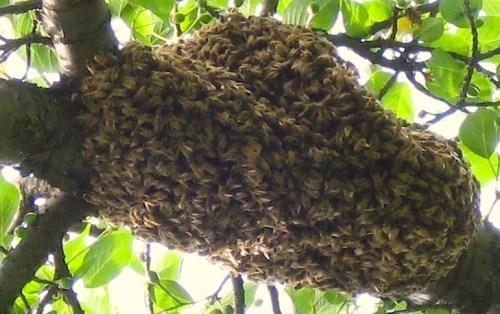
On a sunny spring day in April of 2008, I laid down with Duke under a gnarly, knotted, scrubby, runty tree.  There we rested for some time, children (including my own son) playing nearby, blue sky and warm yellow sunlight all around.

bee-tree

I noticed a bee flying just over me.  It wasn’t trying to touch me, though it came close.  As it buzzed off, I saw another coming down, slowly descending – then another, and another.  Suddenly, hundreds of bees reminded me of World War II photographs of paratroopers, but unlike paratroopers, no bees landed on us.  They came close and then flew off.

In the air above, I heard the low grade, ambient sound of buzzing.  Unlike anything I’d ever heard, it was assuredly distant, warm, and safe.  An aural blanket covering the scene, enchanting in a distinctly pre-industrial kind of way.

Act 3:  Enter the Queen

I sought a pattern in their behavior, and I soon found one.  Each bee – after buzzing around in an inert, hovering, apparently directionless state – slowly made its way to an extended branch of that knotted tree.  The swarm began packing itself on one part of the branch, growing from a small ball of bees to an enormous, undulating bulb.  A huddled, tired mass, to be sure.

Swarms like this occur when the Queen decides it’s time to move the whole the colony to a new home, or when a new Queen is born and leaves with part of the old colony – her brothers and sisters and not her offspring – in order to establish a new one.  Somewhere beneath the mass of bees above me was the Queen, who would be vulnerable until they built a new home.

Act 4:  Of the social organism

In the Queen, the insect colony becomes incarnate and we see that very magic trick that occurs again and again in nature:  the metaphysical made real.  To live or die as an individual bee makes sense only as a function of the Queen’s existence.  She alone carries the source, yet she cannot exist alone, without her offspring.  The social organism is a whole that has no physical being in itself, but is instead a thing greater than sum of its irreducible, individual parts, each of which will fight to the death to protect the Queen.

The social impulse, according to Donald Ingber, is something we can see in fractals throughout organic nature, beginning with bacteria, single-cell based colony creatures, cellular cooperation in larger organisms, insects, and possibly ourselves.

One group of Argentine ants may have broken the geographical barrier between kinship and colony.  These ants have created a kind of mega-colony that exists in North America, Europe, and Japan.  Even though they live across such vast distances, they behave like ants who live in one colony, refusing to fight each other and yet ruthlessly destroying non-kin ants they find in their way.  It is the “largest of its type ever known for any insect species, and could rival humans in the scale of its world domination.”  Interestingly, these ants were able to establish such distant colonies because people, however unwittingly, carried them there.

Human beings are the only large animal that has managed to populate the world in numbers and social structures that can be compared to the social insects – ants, bees, termites.  Our technologies – language, boats, smoke signals, printing presses, as well as the World Wide Web and Twitter – have enabled us to break the micro-social, hunter-gather barrier and form true social organisms.

Act 5:  Living in the land of ideas

Unlike ants or bees, however, we may be creating a new kind of meta-social being that relies on the very gap between the individual and social organisms.  In that gap, we remain as individuals happily, fruitfully, and contentedly human in the smallish communities that make our lives meaningful.  Exploring that gap was the whole point of the 140 Characters Conference, as it is of the plethora of commentary on Twitter and social media that one can find all over the Web, from those who damn Twitter for destroying thoughtful cultural production to those who celebrate and explain its benefits.

Further distinguishing ourselves from social insects, each Twitterer and his or her followers constitute a kind of spontaneous swarm that exists only in cyberspace.  Unlike the swarm of bees that I witnessed overhead last year, one very busy bee in Twitter can be part of many swarms, in addition to being the Queen of his or her own.  These swarms are multiple, derivative, tumescent, and utterly human.

In the buzz of Twitter, our ideas themselves become protagonists.  As Jay Rosen, one of the more thoughtful mediators of the phenomenon puts it,“Twitter keeps me in touch with people who are friends of my ideas. I know about their projects and current obsessions; they know about mine.” Todd Chaffee, a digital media expert, goes so far as to call Twitterspace “the global mind.”  One blogging group, The Hive Mind, is comprised of 5 science writers who actively swarm around topics and blog their work.

William Saletan, Slate’s prolific blogger on science and the human condition, observes a migration going on between dual and overlapping worlds of physical experience and cybercommunication, as we “shift our mental attention and our comfort zone from the physical to the digitally enhanced environment.

He notes such people are “lost in invisible worlds,” but that’s not true.  They’re living in the spaces between very real and tangible worlds, seen and unseen, building swarms and with them the ethereal sounds of buzzing keyboards humming in the background of everyday life, as audible now to the rest of us as presumably the sounds of automobiles once were to our great-grandparents’ generation.

Dénouement

I doubt we’ll ever truly understand ourselves as a social organism.  We are biologically individual creatures, and we perceive the world through individual minds, even when our perception is helped along by the grand edifice of knowledge and social consciousness that helps us understand the world.

Yet solipsism isn’t what it used to be.

We needn’t be as depressed and desperate as Sartre or Morrissey, nor as arrogant as Richard Dawkins, in order to understand how the gap between self and other makes us who we are.  That gap is the place of creation:  of all art, science, technology, storytelling, representation, and myth-making.  Einstein, unicorns, cave paintings, and Twitter all come from the same urge to touch the whole, and in these bursts of creativity we see truth and beauty and all that makes our short time in the conscious world as good, or bad, as it can be.

Notes and credits

A special thanks goes to Marcia Stepanek, a friend and colleague whose Cause Global blog chronicles how new developments in technology and communications affect the worlds of philanthropy and cause-based action.  She invited me out to the 140 Characters conference which made my observations on Twitter possible.  You can also see her blog postings at Pop!Tech and the Stanford Innovation Review.

On the micro-social, hunter-gatherer societies:  For people, these are the smallish, tribal societies that were the basic form of human social organization for most of our history, say from the time we began living on savannahs until the advent of large, social agriculture.  This covered a time period of roughly a million years or more, depending on how you want to define human beings.  In the animal world, wolves, lions, elephants, wasps, and a few other animals still use this form of social organization.  Some of the writers I’ve read on this period of our history are Jared Diamond, in The Third Chimpanzee and Guns, Germs, and Steel, his blockbuster on technology and change in the social organization.  Also quite interesting is Colin Tudge, The Time Before History, which examines human history and the impact of people on the planet for the last 5 million years.  Tudge’s book is good fodder for thinking about global warming in a very long-vue sense.

William Saletan’s posting which I quote above was not about Twitter, but rather about Blackberry and cell phone usage.  Interestingly, a search of Saletan’s blog at Slate for “Twitter” brings back no results.  Full disclosure:  his blog, “Human Nature,” has been a source of inspiration for a number of years.

Chris Weingarten’s presentation at the 140 Characters Conference was one of the more raucous and interesting.  Among his provocations was this:  “Crowd sourcing kills art,” and I reference him above as a critic of Twitter, who is also a constructive, critical user of it.  At @1000TimesYes, Weingarten is reviewing 1000 CD’s on Twitter, even while he provides a very pointed view on the negative impact of Twitter on cultural production. Weingaretn’s blog is called Poisson d’Avril.  Here you can see the Twitter reviews and appreciate the minimalist form of review on your own, such as the review of one of my favorites, Green Day, “If the world ends tonight, Green Day made the album of the year.”  Or the more esoteric pan of someone whose music I have also enjoyed, Regina Spektor, “In New York, even our twee is meta.#4.5.”  Gonna have to find the album just to figure out what he means, though I have an idea.

Counterpoint:  Solipsism isn’t what it used to be, but for Chris Weingarten and lots of others, social media like Twitter have the ironic effect of increasing solipsism by creating flocks of people telling each other “all about me.”  It’s a topic I am thinking about.

4 Comments

Filed under ideas, journalism, life, media, truth, Uncategorized

The truth and Twitter, part 2: Truth Default Swaps

newspaper

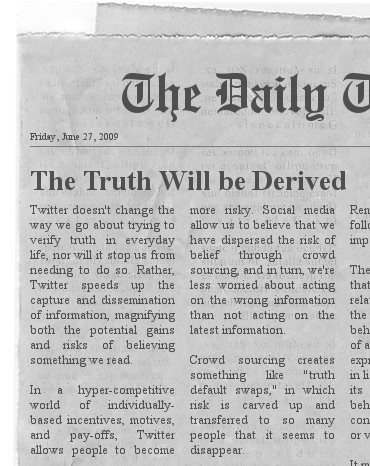
The truth will not be verified.

On January 28, 2009, a group of journalists and media professionals gathered in New York to talk about how the new social media were changing the field.  The conversation was abuzz with Twitter, which was creating fascinating new possibilities for breaking and sourcing stories.  Yet the same technology responsible for social media was killing off the newspapers by destroying their revenue base, and the rot was moving up the media’s trunk to broadcast and cable news.  No journalist’s job was safe now. The issue, said Jay Rosen, one of the panelists, was that no one knew how we were going to pay for “verified truth.”

This month, the Ann Arbor News will complete its transformation into “AnnArbor.com,” a Web-based news organization and community platform that brings together traditional journalism, digital media, and freelance bloggers.  The paper itself will be printed twice a week, on Sundays and Thursdays.  This is a first in the country for a market its size.

How AnnArbor.com intends to verify truth is not clear, but their constituents appear to have other concerns:  as of noon on June 27, 2009, the site’s “feedback forum” showed that “print the newspaper” had received 209 votes (more than any other category), while “ensure that all paid content is reviewed for accuracy” came in fifth at 80, and “investigate/analyze local issues” came in much further down the line at 21.

Perhaps some people prefer to go about verifying their own truth, on their own time, rather than trusting an institution to do so.  Social media is, after all, a DIY culture.  People who care most of about the accuracy of what they believe have always looked for news in multiple places:  papers, on-line, television, etc.  Some even read books (paper and Kindle).

At the 140 Characters Conference on June 16 and 17, Moeed Ahmad of Al-Jazeera gave a short presentation on how they used Twitter during the Gaza War of late 2008.  He discussed how they are working on a method to verify Tweets, by creating a table format for the feeds, including a column for each entry stating whether or not it was “verified.”  In the mayehm of the Iran uprising, the major news organizations in the US have started posting pieces from YouTube and reader-contributers, noting that the organization isn’t responsible for the content.  It’s the only compelling content that can be found; if you don’t post it, your competitor will.

What if reading the news became like swimming on a beach with no lifeguard?  I don’t think this is what will happen, but just consider the possibility.  Think about truth as a risk proposition:  what I believe should inform what I do, and therefore what I do is only as good as what I know.  Bad info = bad action.  This is not new – people always have worked very hard to create ways to mitigate the risk of believing things.

To deal with this risk, we create truth:  value-based, self-interested calculations about events that make sense to people and mitigate the dangers of belief and action.  Some of us construct that “sense” with a lot of external research (fact checking, asking friends, etc.).  Others rely on their internal “sense” of “The Truth” (moral codes, principle, etc.).  Still others mix these processes or switch from one to the other when it’s convenient.

Twitter doesn’t change the way we go about trying to verify truth in everyday life, nor will it stop us from needing to do so.  Rather, Twitter speeds up the capture and dissemination of information, magnifying both the potential gains and risks of believing something we read.

In a hyper-competitive world of individually-based incentives, motives, and pay-offs, Twitter allows people to become more risky.  Social media allow us to believe that we have dispersed the risk of belief through crowd sourcing, and in turn, we’re less worried about acting on the wrong information than not acting on the latest information.  Crowd sourcing creates something like “truth default swaps,” in which risk is carved up and transferred to so many people that it seems to disappear.

This works for a while, probably most of the time, but mistakes happen.  To wit:  the New York Daily News appears to have reported Farrah Fawcett’s death about a half hour before it actually happened, though it appears their reporting was accurate, if out of time.  Fortunately, the Daily News‘ slip in time did not involve the firing (alleged or real) of nuclear weapons.

On October 28, 2008, Blythe Masters, one of the young turks at J. P. Morgan who was involved in creating the mechanisms and structures of credit default swaps in the 1990s, addressed the Securities Industry and Financial Markets Association’s annual meeting.  She emphasized that “it is important to distinguish between tools and their users.  We need to remember that innovation has created tools for managing risk.”  Masters’ point was that people in the industry behaved as if they had eliminated risk, instead of recognizing that risk never truly went away.

The issue for journalists and citizens alike in the age of social media is similar.  In a world where information is flowing much more quickly than anyone’s ability to verify it, will we use the new technology to manage the risk of belief or ignore it?

Either way:  The truth will be derived.


Notes and Credits

This is the second of three posts on Twitter.  In the third and final installment, truthandrocketscience will get its own twitter account.  Also, I am a big fan of lifeguardless beaches.

The newspaper pictured at the top of the posting was generated with the Fodey.com newpaper generator, which I find especially useful when mixing up a new batch of truth.

The panel on January 28 was hosted by MediaBistro, a professional service organization for journalists.  The panel was called “Journalists and Social Media:  Sources, Skills, and the Writer,” and it featured Jay Rosen of NYU and his PressThink blog, Shirley Brady of BusinessWeek.com, Andy Carvin of NPR, and Rachel Sklar of The Daily Beast and other media endeavors.

Apart from the 300 or so people who have “voted” on the AnnArbor.com site, there are approximately 99,700 other Ann Arborites who have not yet registered their preferences (this grants that each of the votes is a unique individual, which is most likely not the case).  Perhaps they are reading the Detroit Free Press, on paper.   Or freep.com.

Further:  One might interpret the general interest in “print[ing] the newspaper” at the top of the feedback poll as a desire for all that old fashioned newspapers represented, which would automatically include “verified truth” and local investigative reporting.  But one would have to ask and explore more deeply to figure it all out.

My interest in the Ann Arbor News is partly personal.  I lived in Ann Arbor from 1988 to 1996, during which time I was a graduate student in political science.  Besides reading the News, I once appeared in the paper, in a photograph of Gulf War protestors in December of 1991.  I saved the paper that day, but somewhere along the way in moves around the upper Midwest and finally to New York, I lost it.  But every Christmas, when I unwrap the creche to put beneath my tree, I look at the the shreds of a 20-year old Ann Arbor News page and remember my days there.

The story of Blythe Masters and the group at J.P. Morgan who created the credit derivatives that figured so prominently in the financial crash of 2007-08 has been documented (and verified) by Gillian Tett of the FInancial Times, in her book, Fool’s Gold: How the Bold Dream of a Small Tribe at J.P. Morgan Was Corrupted by Wall Street Greed and Unleashed a Catastrophe (Free Press, 2009).  Tett quotes Masters’ SIFMA address on p. 250.  It’s a gripping book that also has the best explanation of all the different complex securities that were part of the story:  credit default swaps, collateralized debt obligations, asset-backed securities, etc.  Tett was interviewed about the book by Terry Gross for Fresh Air.

4 Comments

Filed under credit default swaps, ideas, journalism, media, risk, truth

The truth and Twitter, part 1: The Mix Tape

twitter-iran1

The truth will be digitized.

Last week, I went to the 140 Characters Conference here in New York.  There, hundreds of people met to explore how Twitter, new media, and micro-blogging are disrupting life these days.  People were asking important questions of all this new technology:  What do we get out of it? Is it changing anything that matters in any interesting way?  Where’s it going?  What does it mean?

The conference couldn’t have been more timely, though this was completely an accident of fate:  On the very days of the meeting, June 16 and 17, the Iranian people were using Twitter, cell phones, and other inventions to coordinate and narrate a national uprising to protest the (allegedly) fraudulent results of the recent presidential elections.  The story is available only over the internet, because Iranian control of the press and media have made it impossible for regular journalists to cover the events on the ground.  Thus we turn to Twitter and bloggers to understand what’s going onHuffington Post’s Nico Pitney is singularly inserting himself into the moment by providing the only comprehensive, live blog of the event.

These are the largest and most disruptive public demonstrations since the Iranian Revolution of 1979, when masses of Iranians overthrew the US-backed Shah of Iran.  The Iranian Revolution was one of the few documented true revolutions (to use a political science term!), in which the structure of society itself, and not merely the regime, was changed in a rapid convulsion of political will.

Something similar might be happening today.

The events of 1979 have an interesting parallel to the present, for the earlier Revolution was spurred along by the innovative application of a radical new technology that not only subverted the regime but also fit neatly into the lifestyles and habits of regular Iranians.  The new technology was accessible to everyone, regardless of education, age, gender, or geographical location.  I am referring, of course, to cassette tape recordings, which in the 1970s took the entire world on a quantum leap of do-it-yourself cultural production, re-production, and mashing-up.

In the West, this took the form of the mix tape.  We used the songs of our favorite bands to declare love or war, to apologize for insensitivity, to make a stand, break up, explain any of the preceding, or simply state the case for plain, animal lust.   The truly radical could even place Yes, The Clash, and Air Supply on the same tape, just to make a point.  The mix tape reached its all-time high with Nick Hornby’s novel, High Fidelity, in the mid-1990s, which was later immortalized on the silver screen with John Cusak at the very moment in time when the cassette tape itself was tossed into the dustbin of history by the arrival mix-CDs, MP3 playlists, and (a few years later) the iPod.

At the same time that mix tapes reshaped the possibilities for personal expression in the West, Iranians were gathering in private, often hidden, rooms to listen to cassette tapes of sermons by Ayatollah Ruhollah Khomeini, a prominent religious leader who was exiled from Iran in 1964.  Khomeini took refuge first in Iraq, which has a large (majority) population of Shiite Muslims, and later in France.  His sermons were smuggled into Iran, where they met a large audience, hungry for his words.

Khomeini’s message was both religious and social.  He married basic Islamic piety to a consciousness of poverty, economic injustice, and outrage at the atrocities of the Shah’s violently repressive state.  The Iranian Revolution of 1979 was deeply tied to Islam’s notions of charity and essential human equality (not the same as “freedom” in any Western sense), tenets of belief that the Shah’s regime violated so openly and egregiously. Cassette recordings overcame the literacy barrier and brought this message to wide audiences that might have missed him had he been restricted to paper texts and photocopies.  Cassette tapes were the samizdat of the Islamic world in the 1970s.  Anyone could listen.

Cassette tapes allowed the Iranian opposition to gather, communicate, and plan for a better day.  When that day came, in the heady rebellion of 1978-79, it seemed as if the world exploded, just like it did this week as Iran commanded center stage everywhere.  It’s no small coincidence, it might be added, that some of the chief protagonists of the present turmoil – Ayatollah MontazeriMir Hossein Mousavi, and Hashemi Rafsanhani were there in 1979, in similar roles, only as much younger people.

So Twitter brings us full circle, from cyber space and cell phones – whose ubiquitous flip-top form bears more than a passing resemblance to the original Star Trek Communicator – back to cassette tapes.  Déjà vu all over again, as Yogi Berra once noted.

Today, Twitter and cell phone videos are our cassette tapes of Iranian change, bringing us the haunting images of people shouting Allahu Akbar from the rooftops at night, just like they did in 1979.  Then, as now, regular people sang the traditional Muslim declaration, “God is great,” to indict the regime in power.

That’s the original cultural source of change in Iran.

Note

This is the first of 3 postings on “The truth and Twitter.”  More to come…

Credits

Opening photo:  www.life.com/image/ugc1002722/in-gallery/28782/eyewitness-from-tehrans-streets.  LIFE has several dramatic series of photographs from the current events; other photographs are here. Looking at these photos, I can feel, in my bones, what “history” means.

2 Comments

Filed under danger, freedom, ideas, politics, revolution

The truth and unicorns, part 3

The Narwhal, Sea-unicorn of the Arctic

The Narwhal, Sea-unicorn of the Arctic

Unicorns weren’t always mythical creatures.

The Greeks classified them among natural animals, with rhinos and other one-horned beasts.  Vikings traded Narwhal tusks to Medieval Europeans, who believed they were unicorn horns and paid dearly to possess them and their magical powers.  Marco Polo recorded his encounter with the Javan rhinoceros as the discovery of a unicorn.

No one knows exactly what the Narwhal’s tusk is for, though it is found only on males and therefore probably has a sexual function not unlike the extravagant feathers of the male peacock, or the electric guitar.  Yet while narwhal tusks and peacock feathers work as sexual aids for narwhals and peacocks, legend has it that the rhino’s tusk is coveted by humans as a sexual talisman.

This is disputed, however, and there are other medicinal applications of rhinoceros tusks in Chinese traditional medicine, for fevers and convulsions.  Either way, humankind’s uses for rhinoceros tusks are threatening the mega-mammal’s very existence, and it may soon vanish into the same ethereal space where its cousin, the unicorn, lives.  Climate change may well send the narwhal there, too, to dwell with vanishing hitchhikers, organ-jackers, and people who make phone calls that come from inside the house.

In the Charlie the Unicorn cartoons, myths and legends pile up on one another into what is among the most popular videos of all time on Youtube, collectively scoring close to 50 million views for 3 episodes.  In the first, Charlie is prodded by two smaller unicorns to come visit “Candy Mountain,” a place immortalized in the hobo fantasy song,

Where the handouts grow on bushes and you sleep out every night
Where the boxcars are all empty and the sun shines every day
On the birds and the bees and the cigarette trees

Along the way, they meet a Liopleurodon, a real-world creature of fossilized myth that is quite in dispute in contemporary America, who will help guide them to Candy Mountain.  As they move on, Charlie prods them, “Alright guys, you do know that there’s no actual candy mountain, right?”  They reply, “Shun the nonbeliever.”

When they reach the actual Candy Mountain, Charlie recognizes the error of his earlier belief, and walks into a cave in the mountainside, where he’s shut in and abandoned.  He awakens in a meadow with a large scar over his lower abdomen.  “They took my freakin’ kidney!”

In the second episode, our hero is lounging in the meadow on his nice carpet, watching a big screen TV.  Suddenly, his tormenting pals appear to him from an imaginary coral reef awash in “poisonous fugu fish” (puffer fish), which according to ethnobotanist Wade Davis are the source of the poison that produces the near-death experience resulting in zombification in Haiti.  It’s in a book Davis wrote, The Serpent and the Rainbow.  Legendary horror director Wes Craven made the book into a movie with Bill Pullman playing the real-world Indiana Jones down in the Caribbean.  Unicorns can lead you anywhere.  Maybe they’ll make Charlie into a zombie.  How many degrees can Charlie be from Kevin Bacon?

Again, they journey.  Along the way, there’s a magical amulet and a Banana King, whose temple looks like an Egyptian pyramid with an insignia of the “hammer and banana” fashioned like the “hammer and sickle” of Communist symbolism.  As Charlie is proclaimed the banana king, his friends abandon him and he falls from grace, literally.  When he reaches his original meadow clearing, he finds that his things are gone – “Aw you gotta be – great – they robbed me!”

In the third episode, his friends appear from the future with an apocalyptic message:  “The end is nigh.”  As they ride a large duck down a mythical stream in the future, Charlie’s friends taunt him with calls of “ring, ring – hello” over and over again, reminding one of the phone calls urban legend.  They confront shadowy narwhals that threaten to kill them.  Then they are on the floor of an ocean in a Greek ruins, Atlantis anyone?  Charlie’s friends abandon him and he succumbs to sleeping gas, only to awaken in a frigid landscape where he finally encounters the snowman, who has cut off Charlie’s horn and uses it as his snowman nose, and of course you know what they say about a snowman’s nose and its correlates.  There’s a large scar on the snowman’s lower abdomen.  “Aw look, it’s my kidney.”  A jolly, happy soul, as the song goes, indeed.

Note

The horse, which provides its body to the unicorn of myth, is quite closely related to rhinoceroses.  They are both perissodactyls, otherwise known as “odd-toed ungulates.” Along with narwhals, swordfish also have pointy appendages sprouting from their heads, too.

Credits

Narwahl photo: http://en.wikipedia.org/wiki/File:Narwhalsk.jpg.

Big Rock Candy Mountain, Harry McClintock, 1928.  http://www.bluegrasslyrics.com/all_song.cfm-recordID=s29253.htm

Charlie the Unicorn:  Jeff Steele, Filmcow.com.  http://www.youtube.com/user/SecretAgentBob, http://www.filmcow.com/.

For a nice collection of issues related to Darwin and debates about evolution and creationism, see this page at the the New York Times.

Bonus

7 Comments

Filed under body, fiction, ideas, myth

The truth and unicorns, part 1

unicorn-2

Unicorns are mythical creatures, but many people believe in them.  They don’t necessarily believe in the immanent possibility of seeing a unicorn on the street or in the woods any time soon.  They believe in believing in unicorns.

Myth speaks truth to reality, and the truth is that we need unicorns.  In the dialogue between myth and reality, we see the supposedly real world for what it really is:  impermanent, ever changing, mutable, a place that doesn’t have to be what it seems.  A place that isn’t really all that real, if by real you mean solid, concrete, tangible, or certain.

Without myth, the present is all we have (hello, Leonard Shelby).  Myth helps us to understand the world of now by freeing our dreams of worlds that might be, quite apart from whether or not they ever really happen.  Myth allows us the reveries of worlds lost, races won, loves cherished, sufferings endured.  Myth makes livable the stresses and oppressions of the moment.  Myth binds the present to the possible – the past that was, the past that could have been, the futures that may and may not come to pass, and the imaginary worlds that, without ever existing, will feed our passions and determine which future of the real world will, in fact, come to pass.

Myth is to our mundane world what relativity and quantum mechanics are to the world of Newtonian physics.  Newton’s laws work very well to explain the world of human-level sensory experience.  There’s a reason why an apple hits you on the head, and why every hanging apple on earth will do the same if you put a person under it at the right moment.  Newton explained the stuff we all see and helped us understand what was happening.  His laws extended our vision beyond the moment, predicting futures and explaining pasts.

Then came Einstein, whose Newtonian gaze extended much further than Newton could have dreamt, and in turn demanded a new reckoning.  With the theory of relativity, Einstein pushed our sight into the world of massive bodies – stars and galaxies – and the astronomical distances between them.  At the same time, Einstein’s discoveries also helped others (Max Plank, Neils Bohr, Erwin Schrödinger, and more) to gaze into the world of the infinitesimally small, smaller than the atom itself, and quantum mechanics was born.
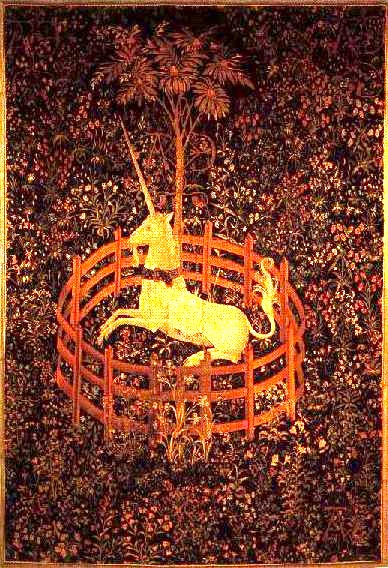
The Unicorn in Captivity

The Unicorn in Captivity

At either end of the spectrum – the massive or the tiny – Newton’s laws don’t make sense, even though they explain the world in between quite well.  In relativity, things that happen now might occur before something that happened already, depending on where you’re looking from.  At the quantum level of subatomic particles like electrons and quarks, things can be in two places at the same time.  To believe in the physics of the massive, or of the tiny, is to suspend belief in the world we can see and touch.  And we can deal with that, because our minds constantly ask for more than what’s just beyond our noses.

This is why we have relativity, the 10 or 11 dimensions of string theory, the superposition of quantum particles, positrons and anti-matter, quarks, and unicorns.

Afternote: For a real treat on the marriage of design, art, and Isaac Newton, go to The Newton Project at the Dutch Art Institute.  Click on the artists’ names and see their designs.  My favorite is the one by Meiyu Tao.

Credits

Leonard Shelby:  See the post, “The truth and tattoos” and Memento.

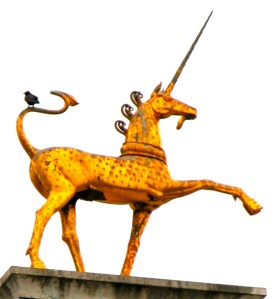
Gold unicorn:  Norman Walsh, photographer, Bristol, England,  http://norman.walsh.name/2003/10/08/bristol.

The Unicorn in Captivity, from “The Hunt Tapestries,” Metropolitan Museum of Art, The Cloisters.  Image from:  http://www.geocities.com/area51/corridor/5177/hunt.html.

9 Comments

Filed under Albert Einstein, Erwin Schrödinger, ideas, Isaac Newton, Leonard Shelby, myth, philosophy, superposition